As the latest US government shutdown ends and markets refocus on macro plumbing, Raoul Pal has sketched out a strikingly liquidity-heavy roadmap on X – one that, in his framework, has direct implications for crypto. “So now the US Gov has reopened, what’s next?” Pal asks. He immediately points to the Treasury General Account (TGA): “Expect a few days for TGA spending to begin to significantly add to liquidity and should persist for several months.Obviously, QT ends in Dec and the balance sheet will crawl higher. We should see the dollar begin to weaken again.” Mechanically, TGA drawdowns push cash back into bank reserves and money markets, reversing the reserve drain that built up while the government was partially shut. At the same time, the Federal Reserve has already confirmed that quantitative tightening (QT) will end on December 1, 2025, shifting from active balance-sheet reduction to full reinvestment of maturing Treasuries and a more “maintenance” stance. When Will Crypto Prices Rise Again? Pal’s point is that both channels tilt the system toward more dollars sloshing through funding markets, a backdrop he has long argued is constructive for risk assets, including crypto. The near-term risk, in his view, is a classic year-end funding squeeze. “The next key step is to avoid a Year End funding squeeze. Expect several ‘temporary’ measures to add liquidity. Term Funding and SRF operations are most likely.” Related Reading: SEC Chair Sets Out Plans For Crypto Taxonomy To Define Digital Asset Classification Here he is referring to term repo or funding facilities and the Standing Repo Facility (SRF), which the Fed can scale up to backstop banks’ access to cash if overnight rates spike. That reading aligns with recent Fed communication that elevated SRF usage and tighter money-market conditions were central reasons for ending QT early. Pal then escalates from tactical tools to structural regulation: “That will eventually morph into the desperately needed changes to the SLR to allow banks to absorb more issuance and re-lever their balance sheets. This is a big liquidity bazooka. Expect in Q1. SLR should lower rates as banks buy more bonds.” The Supplementary Leverage Ratio (SLR) caps large banks’ overall balance-sheet size, regardless of asset risk. Loosening it for Treasuries and reserves has been debated for years as a way to let dealers warehouse more government debt without breaching constraints. If regulators move in that direction, it would, as Pal notes, free capacity for banks to buy more bonds and could exert downward pressure on yields—again easing financial conditions. Related Reading: The 2025 Year-End Crypto Outlook: The Catalysts That Will Decide Everything For crypto, that matters indirectly: Pal’s core macro thesis is that improving liquidity and lower real yields are the primary tailwinds for digital assets. Regulation is explicitly on his radar too: “Also expect CLARITY Act for crypto to begin to get finalized.” The Digital Asset Market Clarity Act of 2025 (“CLARITY Act”) has already passed the US House and is now before the Senate. It would define digital asset categories and divide oversight between the CFTC and SEC, replacing much of the current “regulation by enforcement” model. Pal’s remark signals his expectation that the shutdown’s end clears the way for renewed legislative momentum – a key piece of the institutional puzzle for non-bitcoin crypto. He closes by broadening the lens to global and fiscal policy: “There will also be stimulus payments and the Big Beautiful Bill fiscal goosing. China will continue balance sheet expansion. Europe will add fiscal stimulus or extra spending. The debts must be rolled and the Gov wants to super heat the economy into the Mid-Terms. This is the Liquidity Flood…. the spice must flow.” Taken together, Pal is describing a synchronised regime: post-shutdown TGA spending, the end of QT, potential SLR relief, progressing US crypto legislation, and ongoing fiscal and monetary support in China and Europe. For crypto investors who share his liquidity-centric lens, the message is not subtle: the macro “spice,” in his view, is about to flow again. At press time, the total crypto market cap dropped to $3.24 trillion. Featured image created with DALL.E, chart from TradingView.comAs the latest US government shutdown ends and markets refocus on macro plumbing, Raoul Pal has sketched out a strikingly liquidity-heavy roadmap on X – one that, in his framework, has direct implications for crypto. “So now the US Gov has reopened, what’s next?” Pal asks. He immediately points to the Treasury General Account (TGA): “Expect a few days for TGA spending to begin to significantly add to liquidity and should persist for several months.Obviously, QT ends in Dec and the balance sheet will crawl higher. We should see the dollar begin to weaken again.” Mechanically, TGA drawdowns push cash back into bank reserves and money markets, reversing the reserve drain that built up while the government was partially shut. At the same time, the Federal Reserve has already confirmed that quantitative tightening (QT) will end on December 1, 2025, shifting from active balance-sheet reduction to full reinvestment of maturing Treasuries and a more “maintenance” stance. When Will Crypto Prices Rise Again? Pal’s point is that both channels tilt the system toward more dollars sloshing through funding markets, a backdrop he has long argued is constructive for risk assets, including crypto. The near-term risk, in his view, is a classic year-end funding squeeze. “The next key step is to avoid a Year End funding squeeze. Expect several ‘temporary’ measures to add liquidity. Term Funding and SRF operations are most likely.” Related Reading: SEC Chair Sets Out Plans For Crypto Taxonomy To Define Digital Asset Classification Here he is referring to term repo or funding facilities and the Standing Repo Facility (SRF), which the Fed can scale up to backstop banks’ access to cash if overnight rates spike. That reading aligns with recent Fed communication that elevated SRF usage and tighter money-market conditions were central reasons for ending QT early. Pal then escalates from tactical tools to structural regulation: “That will eventually morph into the desperately needed changes to the SLR to allow banks to absorb more issuance and re-lever their balance sheets. This is a big liquidity bazooka. Expect in Q1. SLR should lower rates as banks buy more bonds.” The Supplementary Leverage Ratio (SLR) caps large banks’ overall balance-sheet size, regardless of asset risk. Loosening it for Treasuries and reserves has been debated for years as a way to let dealers warehouse more government debt without breaching constraints. If regulators move in that direction, it would, as Pal notes, free capacity for banks to buy more bonds and could exert downward pressure on yields—again easing financial conditions. Related Reading: The 2025 Year-End Crypto Outlook: The Catalysts That Will Decide Everything For crypto, that matters indirectly: Pal’s core macro thesis is that improving liquidity and lower real yields are the primary tailwinds for digital assets. Regulation is explicitly on his radar too: “Also expect CLARITY Act for crypto to begin to get finalized.” The Digital Asset Market Clarity Act of 2025 (“CLARITY Act”) has already passed the US House and is now before the Senate. It would define digital asset categories and divide oversight between the CFTC and SEC, replacing much of the current “regulation by enforcement” model. Pal’s remark signals his expectation that the shutdown’s end clears the way for renewed legislative momentum – a key piece of the institutional puzzle for non-bitcoin crypto. He closes by broadening the lens to global and fiscal policy: “There will also be stimulus payments and the Big Beautiful Bill fiscal goosing. China will continue balance sheet expansion. Europe will add fiscal stimulus or extra spending. The debts must be rolled and the Gov wants to super heat the economy into the Mid-Terms. This is the Liquidity Flood…. the spice must flow.” Taken together, Pal is describing a synchronised regime: post-shutdown TGA spending, the end of QT, potential SLR relief, progressing US crypto legislation, and ongoing fiscal and monetary support in China and Europe. For crypto investors who share his liquidity-centric lens, the message is not subtle: the macro “spice,” in his view, is about to flow again. At press time, the total crypto market cap dropped to $3.24 trillion. Featured image created with DALL.E, chart from TradingView.com

Crypto On Alert: Raoul Pal Hints At Macro Twist Post-US Govt Shutdown

2025/11/14 22:00
4분 읽기
이 콘텐츠에 대한 의견이나 우려 사항이 있으시면 crypto.news@mexc.com으로 연락주시기 바랍니다

As the latest US government shutdown ends and markets refocus on macro plumbing, Raoul Pal has sketched out a strikingly liquidity-heavy roadmap on X – one that, in his framework, has direct implications for crypto.

“So now the US Gov has reopened, what’s next?” Pal asks. He immediately points to the Treasury General Account (TGA): “Expect a few days for TGA spending to begin to significantly add to liquidity and should persist for several months.Obviously, QT ends in Dec and the balance sheet will crawl higher. We should see the dollar begin to weaken again.”

Mechanically, TGA drawdowns push cash back into bank reserves and money markets, reversing the reserve drain that built up while the government was partially shut. At the same time, the Federal Reserve has already confirmed that quantitative tightening (QT) will end on December 1, 2025, shifting from active balance-sheet reduction to full reinvestment of maturing Treasuries and a more “maintenance” stance.

When Will Crypto Prices Rise Again?

Pal’s point is that both channels tilt the system toward more dollars sloshing through funding markets, a backdrop he has long argued is constructive for risk assets, including crypto. The near-term risk, in his view, is a classic year-end funding squeeze. “The next key step is to avoid a Year End funding squeeze. Expect several ‘temporary’ measures to add liquidity. Term Funding and SRF operations are most likely.”

Here he is referring to term repo or funding facilities and the Standing Repo Facility (SRF), which the Fed can scale up to backstop banks’ access to cash if overnight rates spike. That reading aligns with recent Fed communication that elevated SRF usage and tighter money-market conditions were central reasons for ending QT early.

Pal then escalates from tactical tools to structural regulation: “That will eventually morph into the desperately needed changes to the SLR to allow banks to absorb more issuance and re-lever their balance sheets. This is a big liquidity bazooka. Expect in Q1. SLR should lower rates as banks buy more bonds.”

The Supplementary Leverage Ratio (SLR) caps large banks’ overall balance-sheet size, regardless of asset risk. Loosening it for Treasuries and reserves has been debated for years as a way to let dealers warehouse more government debt without breaching constraints. If regulators move in that direction, it would, as Pal notes, free capacity for banks to buy more bonds and could exert downward pressure on yields—again easing financial conditions.

For crypto, that matters indirectly: Pal’s core macro thesis is that improving liquidity and lower real yields are the primary tailwinds for digital assets. Regulation is explicitly on his radar too: “Also expect CLARITY Act for crypto to begin to get finalized.”

The Digital Asset Market Clarity Act of 2025 (“CLARITY Act”) has already passed the US House and is now before the Senate. It would define digital asset categories and divide oversight between the CFTC and SEC, replacing much of the current “regulation by enforcement” model. Pal’s remark signals his expectation that the shutdown’s end clears the way for renewed legislative momentum – a key piece of the institutional puzzle for non-bitcoin crypto.

He closes by broadening the lens to global and fiscal policy: “There will also be stimulus payments and the Big Beautiful Bill fiscal goosing. China will continue balance sheet expansion. Europe will add fiscal stimulus or extra spending. The debts must be rolled and the Gov wants to super heat the economy into the Mid-Terms. This is the Liquidity Flood…. the spice must flow.”

Taken together, Pal is describing a synchronised regime: post-shutdown TGA spending, the end of QT, potential SLR relief, progressing US crypto legislation, and ongoing fiscal and monetary support in China and Europe. For crypto investors who share his liquidity-centric lens, the message is not subtle: the macro “spice,” in his view, is about to flow again.

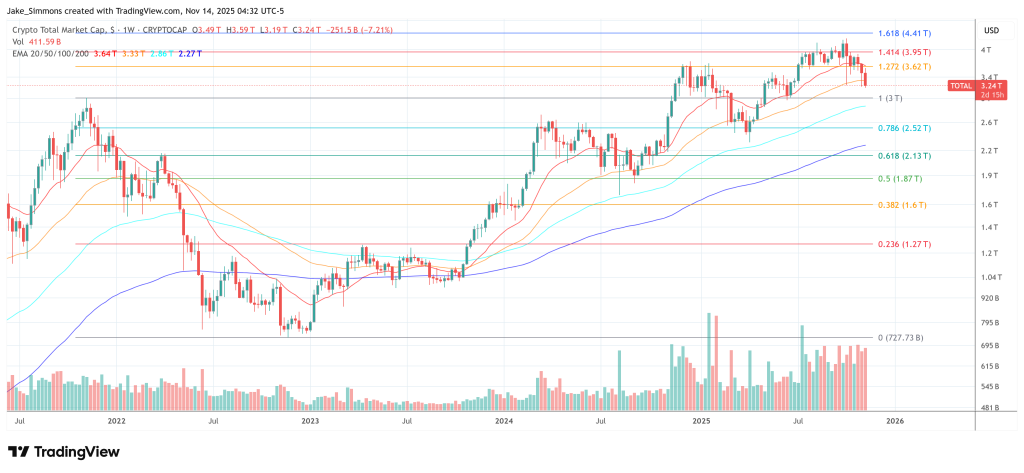
At press time, the total crypto market cap dropped to $3.24 trillion.

Total crypto market cap
시장 기회
Palio 로고
Palio 가격(PAL)
$0.001317
$0.001317$0.001317
-0.07%
USD
Palio (PAL) 실시간 가격 차트
면책 조항: 본 사이트에 재게시된 글들은 공개 플랫폼에서 가져온 것으로 정보 제공 목적으로만 제공됩니다. 이는 반드시 MEXC의 견해를 반영하는 것은 아닙니다. 모든 권리는 원저자에게 있습니다. 제3자의 권리를 침해하는 콘텐츠가 있다고 판단될 경우, crypto.news@mexc.com으로 연락하여 삭제 요청을 해주시기 바랍니다. MEXC는 콘텐츠의 정확성, 완전성 또는 시의적절성에 대해 어떠한 보증도 하지 않으며, 제공된 정보에 기반하여 취해진 어떠한 조치에 대해서도 책임을 지지 않습니다. 본 콘텐츠는 금융, 법률 또는 기타 전문적인 조언을 구성하지 않으며, MEXC의 추천이나 보증으로 간주되어서는 안 됩니다.

$30,000 in PRL + 15,000 USDT

$30,000 in PRL + 15,000 USDT$30,000 in PRL + 15,000 USDT

Deposit & trade PRL to boost your rewards!