Bitcoin exchange-traded funds (ETFs) dominated institutional flows, with a massive $407.78 million in daily net inflows on July 2, bringing cumulative inflows to $49.04 billion . In contrast, Ethereum ETFs faced modest $1.8 million outflows, according to data from SosoValue . The stark difference resulted from Bitcoin’s continued institutional appeal as BTC reached weekly highs of $109,000 on July 2, positioning it for potential breakouts toward $112,000 targets. Source: Cryptonews Fidelity’s FBTC led Bitcoin ETF inflows with $183.96 million , followed by ARK21Shares’ ARKB at $83 million and Bitwise’s BITB contributing $64.94 million . BlackRock’s IBIT, despite recording zero inflows on the day, maintains its dominant position with $76.31 billion in net assets and $52.42 billion in cumulative inflows since launch. Source: SosoValue The performance disparity between Bitcoin and Ethereum ETFs followed the broader market trend, as Bitcoin maintains psychological support above the $100,000 level defended since early May. Total Bitcoin ETF assets under management reached $136.68 billion , representing 6.30% of Bitcoin’s total market capitalization. This indicates a significant level of institutional adoption. Trading volumes also surged to $5.22 billion across Bitcoin ETFs, with IBIT alone generating $4.08 billion in daily trading activity. Institutional Momentum Drives Record Bitcoin ETF Adoption Bitcoin ETF inflows demonstrate sustained institutional conviction, despite broader market volatility, with the latest inflows representing the continuation of aggressive accumulation patterns seen so far in 2025. Particularly, Fidelity’s FBTC leadership, with $183.96 million in inflows, resulted from the growing competition among major asset managers for Bitcoin market share, following BlackRock’s early dominance. The growing competition has led to a broad-based institutional adoption, rather than concentrated buying from a single entity. Interestingly, corporate treasury strategies are increasingly embracing ETF structures over direct ownership of Bitcoin. Design giant, Figma, recently revealed in its IPO filing that it has $69.5 million in Bitcoin ETF holdings , plus $30 million earmarked for future cryptocurrency investments. 🚀 Design giant @figma goes public revealing $70M Bitcoin ETF holdings and $30M ready to buy more as corporate Bitcoin adoption explodes to 141 public companies holding $91 billion. #Figma #IPO #Bitcoin https://t.co/Q9CtjTalum — Cryptonews.com (@cryptonews) July 2, 2025 This pattern is becoming increasingly adopted, and public companies that can’t hold directly prefer regulated exposure through established financial products. Regionally, European expansion is also accelerating through structured products, such as the recent UniCredit’s Bitcoin ETF certificate , designed for Italian professional clients. The five-year instrument offers capital protection with 85% upside participation. Moreover, the regulatory landscape continues to evolve favorably with the SEC’s July 1 guidance streamlining token-based ETF approvals and enabling a 75-day review process. The new guidance establishes clearer pathways for crypto ETF approvals by implementing standardized disclosure frameworks that encompass custody practices, conflicts of interest, and creation and redemption mechanisms. Ethereum ETFs Face Headwinds Despite Previous Momentum Ethereum ETFs experienced modest $1.8 million outflows on July 2, contrasting sharply with their previous dominance, as they had recorded $240.29 million in daily inflows during June , surpassing Bitcoin ETFs’ performance at that time. The June surge represented the strongest performance of Ethereum ETFs in four months, coinciding with ETH climbing above $2,800 for the first time since February. Source: Cryptonews BlackRock’s ETHA led that momentum with $163.6 million in single-day inflows, maintaining a 23-day streak without outflows while managing over 1.55 million ETH valued at $4.23 billion. Current outflows may result from profit-taking following Ethereum’s technical breakout above multi-year descending trendlines. The asset completed an inverse head-and-shoulders pattern with projected targets around $3,300, but recent rejection from $2,834 highs suggests consolidation phases before continued advances. Ethereum staking also reached an all-time high of 34.65 million ETH locked on the Beacon Chain, representing nearly 29% of the circulating supply. Long-term holders are holding on through staking despite short-term ETF flow volatility. They’re prioritizing yield generation over immediate liquidity. Regulatory developments further support the growth of multi-asset crypto ETFs, as seen in Grayscale’s Digital Large Cap Fund conversion , which holds Bitcoin (79.9%), Ethereum (11.3%), and also XRP, Solana, and Cardano. Similarly, the REX Osprey Solana Staking ETF was launched on Wednesday as the first US-listed fund to incorporate crypto staking. This regulatory development could enable similar Ethereum staking products that combine institutional access with yield generation.Bitcoin exchange-traded funds (ETFs) dominated institutional flows, with a massive $407.78 million in daily net inflows on July 2, bringing cumulative inflows to $49.04 billion . In contrast, Ethereum ETFs faced modest $1.8 million outflows, according to data from SosoValue . The stark difference resulted from Bitcoin’s continued institutional appeal as BTC reached weekly highs of $109,000 on July 2, positioning it for potential breakouts toward $112,000 targets. Source: Cryptonews Fidelity’s FBTC led Bitcoin ETF inflows with $183.96 million , followed by ARK21Shares’ ARKB at $83 million and Bitwise’s BITB contributing $64.94 million . BlackRock’s IBIT, despite recording zero inflows on the day, maintains its dominant position with $76.31 billion in net assets and $52.42 billion in cumulative inflows since launch. Source: SosoValue The performance disparity between Bitcoin and Ethereum ETFs followed the broader market trend, as Bitcoin maintains psychological support above the $100,000 level defended since early May. Total Bitcoin ETF assets under management reached $136.68 billion , representing 6.30% of Bitcoin’s total market capitalization. This indicates a significant level of institutional adoption. Trading volumes also surged to $5.22 billion across Bitcoin ETFs, with IBIT alone generating $4.08 billion in daily trading activity. Institutional Momentum Drives Record Bitcoin ETF Adoption Bitcoin ETF inflows demonstrate sustained institutional conviction, despite broader market volatility, with the latest inflows representing the continuation of aggressive accumulation patterns seen so far in 2025. Particularly, Fidelity’s FBTC leadership, with $183.96 million in inflows, resulted from the growing competition among major asset managers for Bitcoin market share, following BlackRock’s early dominance. The growing competition has led to a broad-based institutional adoption, rather than concentrated buying from a single entity. Interestingly, corporate treasury strategies are increasingly embracing ETF structures over direct ownership of Bitcoin. Design giant, Figma, recently revealed in its IPO filing that it has $69.5 million in Bitcoin ETF holdings , plus $30 million earmarked for future cryptocurrency investments. 🚀 Design giant @figma goes public revealing $70M Bitcoin ETF holdings and $30M ready to buy more as corporate Bitcoin adoption explodes to 141 public companies holding $91 billion. #Figma #IPO #Bitcoin https://t.co/Q9CtjTalum — Cryptonews.com (@cryptonews) July 2, 2025 This pattern is becoming increasingly adopted, and public companies that can’t hold directly prefer regulated exposure through established financial products. Regionally, European expansion is also accelerating through structured products, such as the recent UniCredit’s Bitcoin ETF certificate , designed for Italian professional clients. The five-year instrument offers capital protection with 85% upside participation. Moreover, the regulatory landscape continues to evolve favorably with the SEC’s July 1 guidance streamlining token-based ETF approvals and enabling a 75-day review process. The new guidance establishes clearer pathways for crypto ETF approvals by implementing standardized disclosure frameworks that encompass custody practices, conflicts of interest, and creation and redemption mechanisms. Ethereum ETFs Face Headwinds Despite Previous Momentum Ethereum ETFs experienced modest $1.8 million outflows on July 2, contrasting sharply with their previous dominance, as they had recorded $240.29 million in daily inflows during June , surpassing Bitcoin ETFs’ performance at that time. The June surge represented the strongest performance of Ethereum ETFs in four months, coinciding with ETH climbing above $2,800 for the first time since February. Source: Cryptonews BlackRock’s ETHA led that momentum with $163.6 million in single-day inflows, maintaining a 23-day streak without outflows while managing over 1.55 million ETH valued at $4.23 billion. Current outflows may result from profit-taking following Ethereum’s technical breakout above multi-year descending trendlines. The asset completed an inverse head-and-shoulders pattern with projected targets around $3,300, but recent rejection from $2,834 highs suggests consolidation phases before continued advances. Ethereum staking also reached an all-time high of 34.65 million ETH locked on the Beacon Chain, representing nearly 29% of the circulating supply. Long-term holders are holding on through staking despite short-term ETF flow volatility. They’re prioritizing yield generation over immediate liquidity. Regulatory developments further support the growth of multi-asset crypto ETFs, as seen in Grayscale’s Digital Large Cap Fund conversion , which holds Bitcoin (79.9%), Ethereum (11.3%), and also XRP, Solana, and Cardano. Similarly, the REX Osprey Solana Staking ETF was launched on Wednesday as the first US-listed fund to incorporate crypto staking. This regulatory development could enable similar Ethereum staking products that combine institutional access with yield generation.

Bitcoin ETFs Pull $408M—Fidelity & ARK Spark the Next BTC Wave As ETH Struggles

2025/07/03 16:38
4분 읽기
이 콘텐츠에 대한 의견이나 우려 사항이 있으시면 crypto.news@mexc.com으로 연락주시기 바랍니다

Bitcoin exchange-traded funds (ETFs) dominated institutional flows, with a massive $407.78 million in daily net inflows on July 2, bringing cumulative inflows to $49.04 billion.

In contrast, Ethereum ETFs faced modest $1.8 million outflows, according to data from SosoValue.

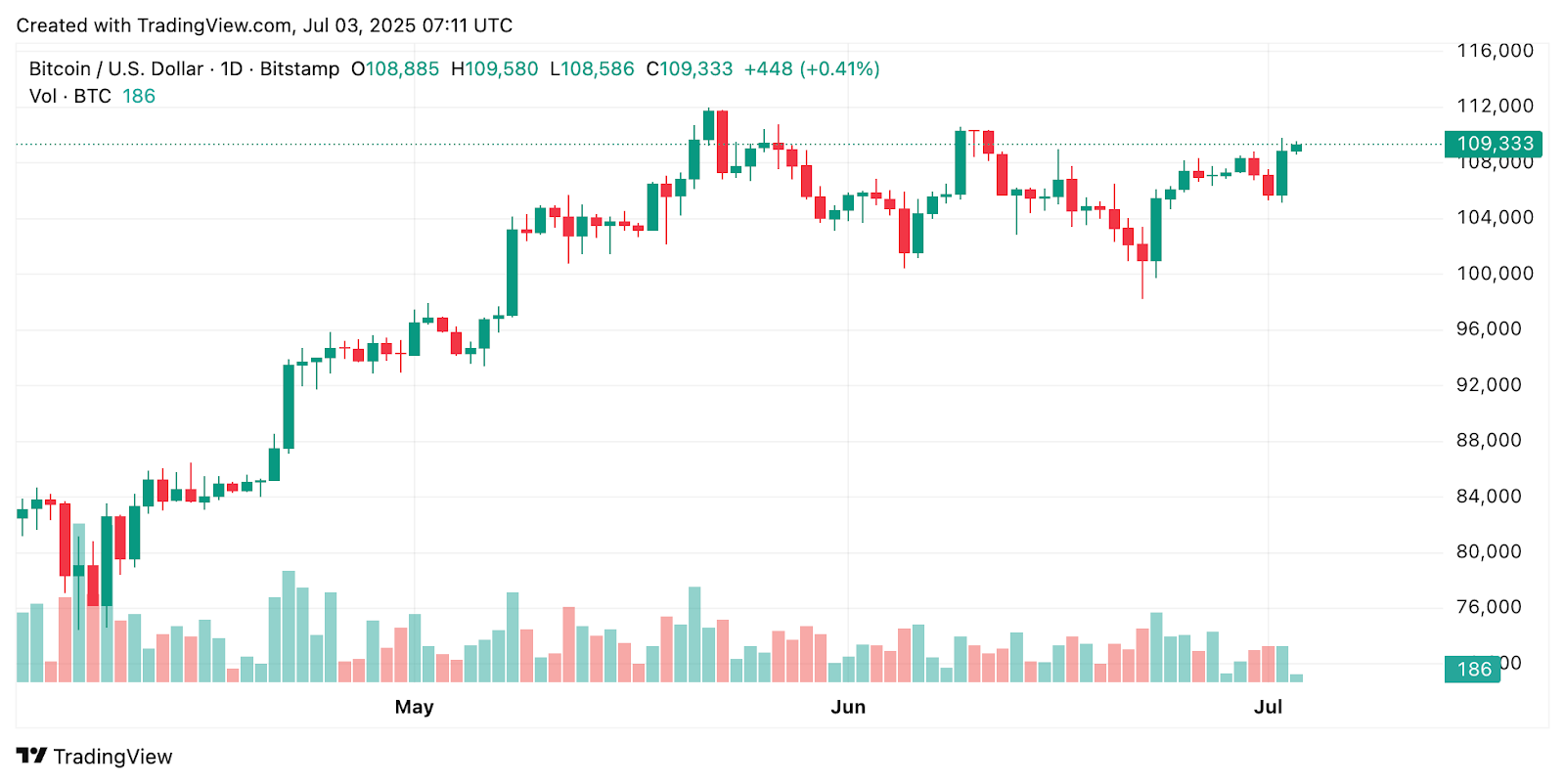
The stark difference resulted from Bitcoin’s continued institutional appeal as BTC reached weekly highs of $109,000 on July 2, positioning it for potential breakouts toward $112,000 targets.
Bitcoin ETFs Explode with $408M Inflows While Ethereum ETFs Struggle with $1.8M OutflowsSource: Cryptonews

Fidelity’s FBTC led Bitcoin ETF inflows with $183.96 million, followed by ARK21Shares’ ARKB at $83 million and Bitwise’s BITB contributing $64.94 million.

BlackRock’s IBIT, despite recording zero inflows on the day, maintains its dominant position with $76.31 billion in net assets and $52.42 billion in cumulative inflows since launch.

Bitcoin ETFs Explode with $408M Inflows While Ethereum ETFs Struggle with $1.8M OutflowsSource: SosoValue

The performance disparity between Bitcoin and Ethereum ETFs followed the broader market trend, as Bitcoin maintains psychological support above the $100,000 level defended since early May.

Total Bitcoin ETF assets under management reached $136.68 billion, representing 6.30% of Bitcoin’s total market capitalization. This indicates a significant level of institutional adoption.

Trading volumes also surged to $5.22 billion across Bitcoin ETFs, with IBIT alone generating $4.08 billion in daily trading activity.

Institutional Momentum Drives Record Bitcoin ETF Adoption

Bitcoin ETF inflows demonstrate sustained institutional conviction, despite broader market volatility, with the latest inflows representing the continuation of aggressive accumulation patterns seen so far in 2025.

Particularly, Fidelity’s FBTC leadership, with $183.96 million in inflows, resulted from the growing competition among major asset managers for Bitcoin market share, following BlackRock’s early dominance.

The growing competition has led to a broad-based institutional adoption, rather than concentrated buying from a single entity.

Interestingly, corporate treasury strategies are increasingly embracing ETF structures over direct ownership of Bitcoin.

Design giant, Figma, recently revealed in its IPO filing that it has $69.5 million in Bitcoin ETF holdings, plus $30 million earmarked for future cryptocurrency investments.

This pattern is becoming increasingly adopted, and public companies that can’t hold directly prefer regulated exposure through established financial products.

Regionally, European expansion is also accelerating through structured products, such as the recent UniCredit’s Bitcoin ETF certificate, designed for Italian professional clients. The five-year instrument offers capital protection with 85% upside participation.

Moreover, the regulatory landscape continues to evolve favorably with the SEC’s July 1 guidance streamlining token-based ETF approvals and enabling a 75-day review process.

The new guidance establishes clearer pathways for crypto ETF approvals by implementing standardized disclosure frameworks that encompass custody practices, conflicts of interest, and creation and redemption mechanisms.

Ethereum ETFs Face Headwinds Despite Previous Momentum

Ethereum ETFs experienced modest $1.8 million outflows on July 2, contrasting sharply with their previous dominance, as they had recorded $240.29 million in daily inflows during June, surpassing Bitcoin ETFs’ performance at that time.

The June surge represented the strongest performance of Ethereum ETFs in four months, coinciding with ETH climbing above $2,800 for the first time since February.

Bitcoin ETFs Explode with $408M Inflows While Ethereum ETFs Struggle with $1.8M OutflowsSource: Cryptonews

BlackRock’s ETHA led that momentum with $163.6 million in single-day inflows, maintaining a 23-day streak without outflows while managing over 1.55 million ETH valued at $4.23 billion.

Current outflows may result from profit-taking following Ethereum’s technical breakout above multi-year descending trendlines.

The asset completed an inverse head-and-shoulders pattern with projected targets around $3,300, but recent rejection from $2,834 highs suggests consolidation phases before continued advances.

Ethereum staking also reached an all-time high of 34.65 million ETH locked on the Beacon Chain, representing nearly 29% of the circulating supply.

Long-term holders are holding on through staking despite short-term ETF flow volatility. They’re prioritizing yield generation over immediate liquidity.

Regulatory developments further support the growth of multi-asset crypto ETFs, as seen in Grayscale’s Digital Large Cap Fund conversion, which holds Bitcoin (79.9%), Ethereum (11.3%), and also XRP, Solana, and Cardano.

Similarly, the REX Osprey Solana Staking ETF was launched on Wednesday as the first US-listed fund to incorporate crypto staking.

This regulatory development could enable similar Ethereum staking products that combine institutional access with yield generation.


시장 기회
스레숄드 로고
스레숄드 가격(T)
$0.006196
$0.006196$0.006196
+1.75%
USD
스레숄드 (T) 실시간 가격 차트
면책 조항: 본 사이트에 재게시된 글들은 공개 플랫폼에서 가져온 것으로 정보 제공 목적으로만 제공됩니다. 이는 반드시 MEXC의 견해를 반영하는 것은 아닙니다. 모든 권리는 원저자에게 있습니다. 제3자의 권리를 침해하는 콘텐츠가 있다고 판단될 경우, crypto.news@mexc.com으로 연락하여 삭제 요청을 해주시기 바랍니다. MEXC는 콘텐츠의 정확성, 완전성 또는 시의적절성에 대해 어떠한 보증도 하지 않으며, 제공된 정보에 기반하여 취해진 어떠한 조치에 대해서도 책임을 지지 않습니다. 본 콘텐츠는 금융, 법률 또는 기타 전문적인 조언을 구성하지 않으며, MEXC의 추천이나 보증으로 간주되어서는 안 됩니다.

$30,000 in PRL + 15,000 USDT

$30,000 in PRL + 15,000 USDT$30,000 in PRL + 15,000 USDT

Deposit & trade PRL to boost your rewards!



