Aave Labs has ignited fierce controversy by unilaterally pushing a critical governance proposal to vote without notifying its author, escalating tensions over brandAave Labs has ignited fierce controversy by unilaterally pushing a critical governance proposal to vote without notifying its author, escalating tensions over brand

Aave Labs Accused of Breaking Trust After Unilateral Vote Push

2025/12/22 23:13

Aave Labs has ignited fierce controversy by unilaterally pushing a critical governance proposal to vote without notifying its author, escalating tensions over brand ownership that threatens to redefine the relationship between the DeFi protocol’s DAO and its founding company.

The hasty move, which bypassed ongoing community discussion, has been condemned as a breach of trust by contributors and token holders who view it as an attempt to control the narrative around who truly owns Aave’s most valuable assets.

Ernesto Boado, co-founder of BGD Labs and the proposal’s author, publicly disavowed Aave Labs’ decision to submit his ownership proposal to Snapshot.

This is not, in ethos, my proposal,” Boado declared.

Aave Labs has unilaterally submitted my proposal to vote in a rush, with my name on it, and without notifying me at all.

He emphasized the action “breaks all codes of trust with the community” during what had been a productive forum discussion featuring valuable perspectives from multiple stakeholders.

Brand Control Battle Reaches Critical Point

The proposal at the center of this dispute seeks to transfer control of Aave’s brand assets, including domains such as aave.com, social media handles, GitHub organizations, and naming rights, from current stewards to the Aave DAO via a legally structured wrapper.

Boado’s specification demands that any party currently controlling these assets, explicitly naming Aave Labs and BGD Labs, transfer them to a DAO-controlled vehicle with “strong anti-capture protections” and legally enforceable recourse if misused.

The proposal emerged after mounting concerns that brand assets are “being used to enable private monetisation and to support products the DAO has no practical say on, and is not the main value-recipient.

Recent flashpoints include Aave Labs replacing Paraswap with CowSwap integration, redirecting an estimated $10 million in annual fees from the DAO treasury to private company wallets.
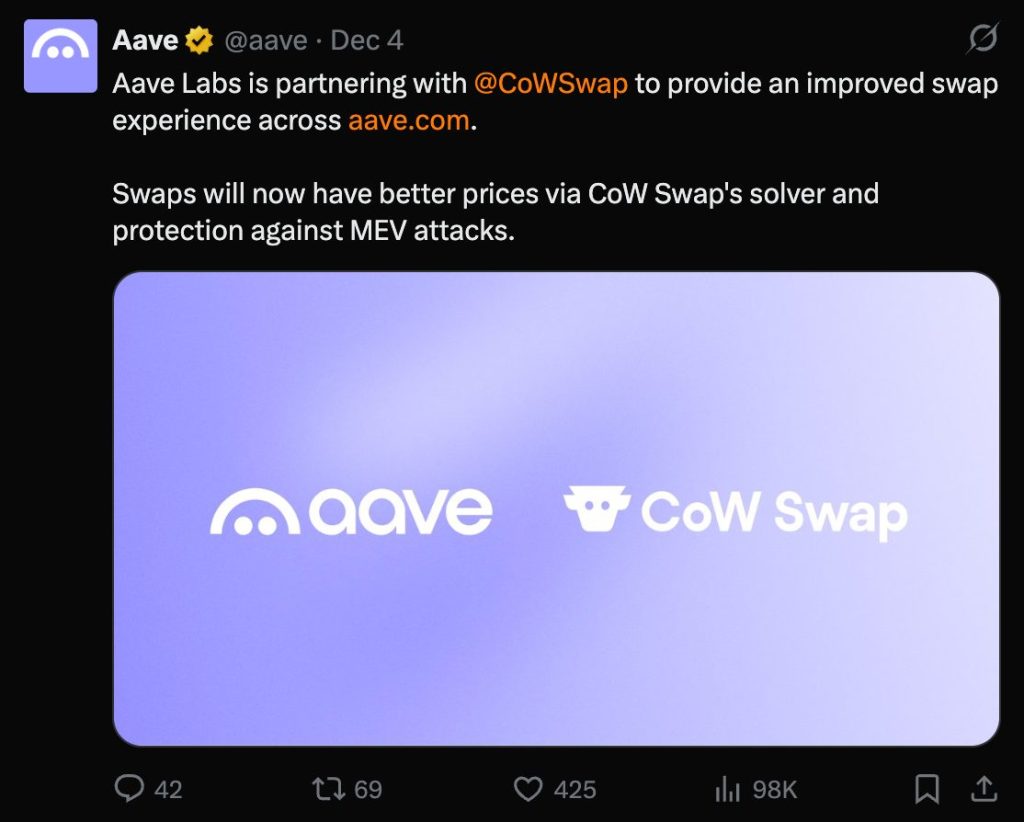
Aave Unilateral Vote Push - Tweet ScreenshotSource: X/@aave

Additionally, there’s another controversial Horizon market launch that generated approximately $100,000 in revenue while consuming $500,000 in DAO incentives.

Marc Zeller of ACI argued the DAO paid “four times” for these assets through the original LEND ICO, token dilution to the genesis team, liquidity mining programs, and generous service provider fees.

It appears to be a clear case that the DAO contributed hundreds of millions of dollars’ worth of assets, paid in cash and tokens, making these assets extremely valuable,” Zeller stated, adding that recent communication channel management under Avara’s stewardship failed to amplify the governance debate while emphasizing “one-sided attribution” of Aave’s success.

Founder Defends Legitimacy Despite Backlash

Stani Kulechov, who maintains the title “CEO of Aave” despite the DAO structure, defended the rushed vote as procedurally sound.

The discussion has been going over the past 5 days already with various of opinions and takes,” Kulechov stated, arguing the Snapshot complies with the governance framework and that “people are tired of this discussion.”

He claimed other service providers bring proposals to vote outside formal processes, creating no new precedent, while asserting that “the way to resolve this issue is simply to vote.

The defense rang hollow for many observers.

Crypto educator Duo Nine characterized Kulechov’s actions as showing he’s “not acting in good faith anymore, too much conflict of interest.”

Industry analyst Ignas also drew parallels to Uniswap Labs’ similar equity-token conflicts, which ultimately resolved in favor of token holders through the removal of front-end fees.

The clash exposes fundamental tensions in DAO governance when founding teams maintain private companies alongside supposedly decentralized protocols.

While Aave Labs draws sharp boundaries between “protocol” components governed by the DAO and “product” layers it claims ownership over, critics argue this distinction enables value extraction from the brand recognition the community collectively built.

The controversy erupts despite recent regulatory wins for Aave Labs, including securing MiCA authorization to offer regulated stablecoin ramps across Europe and the SEC dropping its four-year investigation following what the company described as a “significant” defense battle.

The lab is also preparing for Aave’s upcoming V4 launch, which is explicitly designed to move complexity into abstraction layers where UX control determines value capture.

With voting now live despite the author’s objections, the outcome will determine where the community goes from here.


시장 기회
에이브 로고
에이브 가격(AAVE)
$150.32
$150.32$150.32
-2.59%
USD
에이브 (AAVE) 실시간 가격 차트
면책 조항: 본 사이트에 재게시된 글들은 공개 플랫폼에서 가져온 것으로 정보 제공 목적으로만 제공됩니다. 이는 반드시 MEXC의 견해를 반영하는 것은 아닙니다. 모든 권리는 원저자에게 있습니다. 제3자의 권리를 침해하는 콘텐츠가 있다고 판단될 경우, service@support.mexc.com으로 연락하여 삭제 요청을 해주시기 바랍니다. MEXC는 콘텐츠의 정확성, 완전성 또는 시의적절성에 대해 어떠한 보증도 하지 않으며, 제공된 정보에 기반하여 취해진 어떠한 조치에 대해서도 책임을 지지 않습니다. 본 콘텐츠는 금융, 법률 또는 기타 전문적인 조언을 구성하지 않으며, MEXC의 추천이나 보증으로 간주되어서는 안 됩니다.

추천 콘텐츠

MFS Releases Closed-End Fund Income Distribution Sources for Certain Funds

MFS Releases Closed-End Fund Income Distribution Sources for Certain Funds

BOSTON–(BUSINESS WIRE)–MFS Investment Management® (MFS®) released today the distribution income sources for five of its closed-end funds for December 2025: MFS®
공유하기
AI Journal2025/12/23 05:45
BlackRock boosts AI and US equity exposure in $185 billion models

BlackRock boosts AI and US equity exposure in $185 billion models

The post BlackRock boosts AI and US equity exposure in $185 billion models appeared on BitcoinEthereumNews.com. BlackRock is steering $185 billion worth of model portfolios deeper into US stocks and artificial intelligence. The decision came this week as the asset manager adjusted its entire model suite, increasing its equity allocation and dumping exposure to international developed markets. The firm now sits 2% overweight on stocks, after money moved between several of its biggest exchange-traded funds. This wasn’t a slow shuffle. Billions flowed across multiple ETFs on Tuesday as BlackRock executed the realignment. The iShares S&P 100 ETF (OEF) alone brought in $3.4 billion, the largest single-day haul in its history. The iShares Core S&P 500 ETF (IVV) collected $2.3 billion, while the iShares US Equity Factor Rotation Active ETF (DYNF) added nearly $2 billion. The rebalancing triggered swift inflows and outflows that realigned investor exposure on the back of performance data and macroeconomic outlooks. BlackRock raises equities on strong US earnings The model updates come as BlackRock backs the rally in American stocks, fueled by strong earnings and optimism around rate cuts. In an investment letter obtained by Bloomberg, the firm said US companies have delivered 11% earnings growth since the third quarter of 2024. Meanwhile, earnings across other developed markets barely touched 2%. That gap helped push the decision to drop international holdings in favor of American ones. Michael Gates, lead portfolio manager for BlackRock’s Target Allocation ETF model portfolio suite, said the US market is the only one showing consistency in sales growth, profit delivery, and revisions in analyst forecasts. “The US equity market continues to stand alone in terms of earnings delivery, sales growth and sustainable trends in analyst estimates and revisions,” Michael wrote. He added that non-US developed markets lagged far behind, especially when it came to sales. This week’s changes reflect that position. The move was made ahead of the Federal…
공유하기
BitcoinEthereumNews2025/09/18 01:44
Foreigner’s Lou Gramm Revisits The Band’s Classic ‘4’ Album, Now Reissued

Foreigner’s Lou Gramm Revisits The Band’s Classic ‘4’ Album, Now Reissued

The post Foreigner’s Lou Gramm Revisits The Band’s Classic ‘4’ Album, Now Reissued appeared on BitcoinEthereumNews.com. American-based rock band Foreigner performs onstage at the Rosemont Horizon, Rosemont, Illinois, November 8, 1981. Pictured are, from left, Mick Jones, on guitar, and vocalist Lou Gramm. (Photo by Paul Natkin/Getty Images) Getty Images Singer Lou Gramm has a vivid memory of recording the ballad “Waiting for a Girl Like You” at New York City’s Electric Lady Studio for his band Foreigner more than 40 years ago. Gramm was adding his vocals for the track in the control room on the other side of the glass when he noticed a beautiful woman walking through the door. “She sits on the sofa in front of the board,” he says. “She looked at me while I was singing. And every now and then, she had a little smile on her face. I’m not sure what that was, but it was driving me crazy. “And at the end of the song, when I’m singing the ad-libs and stuff like that, she gets up,” he continues. “She gives me a little smile and walks out of the room. And when the song ended, I would look up every now and then to see where Mick [Jones] and Mutt [Lange] were, and they were pushing buttons and turning knobs. They were not aware that she was even in the room. So when the song ended, I said, ‘Guys, who was that woman who walked in? She was beautiful.’ And they looked at each other, and they went, ‘What are you talking about? We didn’t see anything.’ But you know what? I think they put her up to it. Doesn’t that sound more like them?” “Waiting for a Girl Like You” became a massive hit in 1981 for Foreigner off their album 4, which peaked at number one on the Billboard chart for 10 weeks and…
공유하기
BitcoinEthereumNews2025/09/18 01:26