A CFP breaks down how severance and salary continuance are taxed, and explains when corporations do (and don’t) make sense for tax savings. The post Can you saveA CFP breaks down how severance and salary continuance are taxed, and explains when corporations do (and don’t) make sense for tax savings. The post Can you save

Can you save tax by putting severance into a corporation?

2026/01/20 15:25

I was packaged out 6 months ago or so, got a big severance and continue to get a salary continuance for a while. My buddy said, “you should put that money in a corporation.” If I’m in the top marginal tax bracket personally, I could probably save money on investing in the corporation, couldn’t I?  
—Geoffrey

So, this is a good question and one that comes up from time to time. It is important to understand how severance and salary continuance are taxed and how a corporation saves tax on income or investing. 

How is a lump-sum severance taxed?

When you lose your job and receive severance, it may be paid as a lump sum payment. It is generally a certain number of weeks of salary that increases based on factors like length of service, age, and seniority. Other factors can play a role, though. 

When you receive a lump sum payment, the withholding tax is generally only 30%. The problem is that regardless of the withholding tax on a lump sum severance payment or any other source of income, when you file your tax return, the appropriate tax rate is determined. 

If you receive a large severance, or have a high income to begin with, the tax owing on the payment could be an additional 20% or more.

Related reading: How to avoid tax on severance pay

How is salary continuance taxed?

When you lose your job, you may continue to be paid your regular salary for a certain period of time. This is called salary continuance. 

The payroll withholding tax is the same as if you continued to be paid a salary. The result is that your tax withholding should be more or less in line with what your tax owing will be on your tax return, barring other income sources, tax deductions, or tax credits. 

How does a corporation save tax?

Corporations can help defer and save tax, Geoffrey, but it depends on the circumstances. The best tax use case for a corporation is to earn active business income. If you run a business and earn profit through a corporation that you leave in the corporation and do not withdraw, it can be subject to a low rate of tax. 

Depending on the province or territory, it can be as low as 9 to 12%. There is more tax payable when you withdraw the money and use it personally, but a corporation is definitely a great tax deferral tool.

Also read

Income Tax Guide for Canadians

Deadlines, tax tips and more

The problem with the severance is that it is employment income. If you have it paid into a corporation or you transfer the payment into a corporation, that does not magically turn T4 employment income into corporate active business income. As a result, a corporation will not help you save tax on a severance. 

Does putting money into a corporation to invest save tax? 

The tax rate on investment income earned in a corporation is similar to the top tax rate in most provinces and territories. As a result, earning investment income in a corporation tends to result in comparable or even more tax than earning it personally, Geoffrey.

So, why do people use investment holding companies? The reason is the aforementioned small business tax rate of 9 to 12%. If you earn business income and can leave it in a corporation to invest, you may be able to invest roughly 90 cents on the dollar of your corporate profit. 

Business owners often do so using a separate investment holding company, where they can transfer money out of their active business. However, putting personal savings into a corporation to invest will not generally save you tax. 

How can you save tax on a severance?

If you want to save tax on a severance, there are two easy ways, Geoffrey.

The first is to contribute to your registered retirement savings plan (RRSP). You may even have the opportunity to have your employer transfer some or all of your severance directly into your RRSP with no withholding tax. But remember, this is like getting your tax refund up front. You will not also get a tax refund when you file your tax return. 

The second opportunity is to defer the severance to a future year. Especially if it is later in the calendar year, your employer may be open to deferring the payment to January to push the incremental tax back one year. Some employers will pay a severance over multiple years, but this is less common. 

Summary

The bottom line is that a corporation can be a great tax reduction and deferral tool, but not for a severance, and not for investing personal savings.

Ask MoneySense

Have a personal finance question? Submit it here.

The post Can you save tax by putting severance into a corporation? appeared first on MoneySense.

면책 조항: 본 사이트에 재게시된 글들은 공개 플랫폼에서 가져온 것으로 정보 제공 목적으로만 제공됩니다. 이는 반드시 MEXC의 견해를 반영하는 것은 아닙니다. 모든 권리는 원저자에게 있습니다. 제3자의 권리를 침해하는 콘텐츠가 있다고 판단될 경우, service@support.mexc.com으로 연락하여 삭제 요청을 해주시기 바랍니다. MEXC는 콘텐츠의 정확성, 완전성 또는 시의적절성에 대해 어떠한 보증도 하지 않으며, 제공된 정보에 기반하여 취해진 어떠한 조치에 대해서도 책임을 지지 않습니다. 본 콘텐츠는 금융, 법률 또는 기타 전문적인 조언을 구성하지 않으며, MEXC의 추천이나 보증으로 간주되어서는 안 됩니다.

추천 콘텐츠

Seeker (SKR) will soon be listed on Bybit Spot, Alpha, and Byreal.

Seeker (SKR) will soon be listed on Bybit Spot, Alpha, and Byreal.

PANews reported on January 21 that Bybit will launch Seeker (SKR) on its spot, Alpha, and Byreal platforms. Users can quickly trade without setting up a separate
공유하기
PANews2026/01/21 08:20
Perpetual DEX in testing with cross‑chain liquidity and ADL
Perpetual DEX in testing with cross‑chain liquidity and ADL

The post Perpetual DEX in testing with cross‑chain liquidity and ADL appeared on BitcoinEthereumNews.com. Sunperp, a new perpetual DEX being tested on the Tron blockchain, promises millisecond executions, cross-chain liquidity aggregation, and an integrated auto-deleveraging (ADL) system. Justin Sun reshared the announcement on X, inviting users to try it and highlighting dedicated incentives, while numerous economic details and operational metrics remain to be confirmed. According to the data collected by on-chain analysts and industry reports, in May 2025 TRON hosted over 75 billion USDT, with the network recording over 8.3 million daily transactions and approximately 306 million active accounts, a context that justifies the interest in USDT-collateralized derivatives. Market analysts following perpetual DEX also note that the massive availability of USDT on TRON facilitates cross-chain arbitrage operations and reduces costs for market makers. What is Sunperp and what it brings differently to Tron Sunperp is a platform perp DEX that uses USDT as collateral, with profits and losses calculated in USDT. The architecture separates matching, executed off-chain to maximize speed, from settlement, recorded on-chain to ensure transparency of trading results. In this context, the debut announcement was originally reported by Jamie Redman; the team also states that, while in the testing phase, the core contracts are non-upgradable. Main Technical Features Order types: market, limit (with FOK – Fill-or-Kill, GTC – Good-Till-Cancelled, and IOC – Immediate-or-Cancel modes), post-only orders, plan orders, trailing, and TWAP (Time-Weighted Average Price). Use of multi-source oracles to determine the mark price employed in the calculation of profits and liquidations. Primary collateral: USDT, with P&L calculated in the same currency. Core contracts declared non-upgradable in an environment still in testing. Cross-chain liquidity: less slippage and tighter spreads The protocol claims to aggregate liquidity flows from various networks in order to increase market depth and improve order execution, thereby reducing slippage and spreads in large-size trades. However, the actual effect will depend…
공유하기
BitcoinEthereumNews2025/09/22 17:20
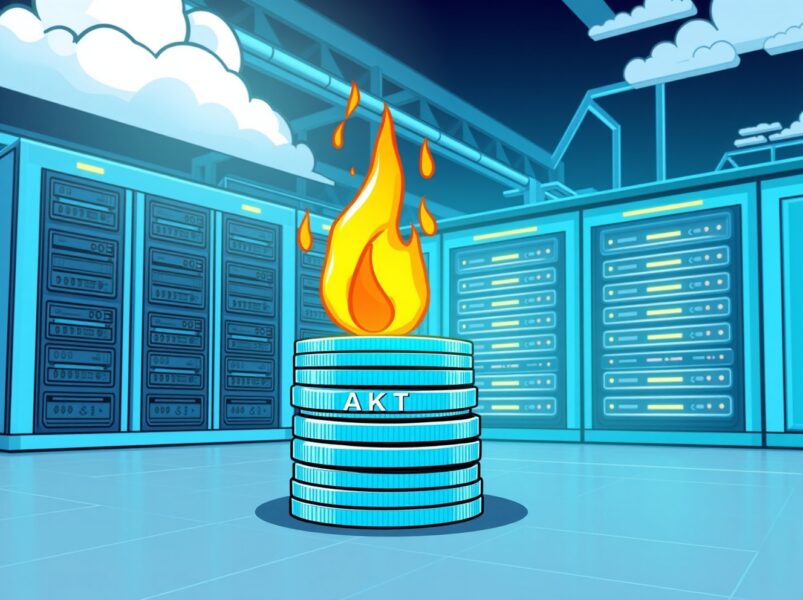
Akash Network’s Strategic Move: A Crucial Burn for AKT’s Future

Akash Network’s Strategic Move: A Crucial Burn for AKT’s Future

BitcoinWorld Akash Network’s Strategic Move: A Crucial Burn for AKT’s Future In the dynamic world of decentralized computing, exciting developments are constantly shaping the future. Today, all eyes are on Akash Network, the innovative supercloud project, as it proposes a significant change to its tokenomics. This move aims to strengthen the value of its native token, AKT, and further solidify its position in the competitive blockchain space. The community is buzzing about a newly submitted governance proposal that could introduce a game-changing Burn Mint Equilibrium (BME) model. What is the Burn Mint Equilibrium (BME) for Akash Network? The core of this proposal revolves around a concept called Burn Mint Equilibrium, or BME. Essentially, this model is designed to create a balance in the token’s circulating supply by systematically removing a portion of tokens from existence. For Akash Network, this means burning an amount of AKT that is equivalent to the U.S. dollar value of fees paid by network users. Fee Conversion: When users pay for cloud services on the Akash Network, these fees are typically collected in various cryptocurrencies or stablecoins. AKT Equivalence: The proposal suggests converting the U.S. dollar value of these collected fees into an equivalent amount of AKT. Token Burn: This calculated amount of AKT would then be permanently removed from circulation, or ‘burned’. This mechanism creates a direct link between network utility and token supply reduction. As more users utilize the decentralized supercloud, more AKT will be burned, potentially impacting the token’s scarcity and value. Why is This Proposal Crucial for AKT Holders? For anyone holding AKT, or considering investing in the Akash Network ecosystem, this proposal carries significant weight. Token burning mechanisms are often viewed as a positive development because they can lead to increased scarcity. When supply decreases while demand remains constant or grows, the price per unit tends to increase. Here are some key benefits: Increased Scarcity: Burning tokens reduces the total circulating supply of AKT. This makes each remaining token potentially more valuable over time. Demand-Supply Dynamics: The BME model directly ties the burning of AKT to network usage. Higher adoption of the Akash Network supercloud translates into more fees, and thus more AKT burned. Long-Term Value Proposition: By creating a deflationary pressure, the proposal aims to enhance AKT’s long-term value, making it a more attractive asset for investors and long-term holders. This strategic move demonstrates a commitment from the Akash Network community to optimize its tokenomics for sustainable growth and value appreciation. How Does BME Impact the Decentralized Supercloud Mission? Beyond token value, the BME proposal aligns perfectly with the broader mission of the Akash Network. As a decentralized supercloud, Akash provides a marketplace for cloud computing resources, allowing users to deploy applications faster, more efficiently, and at a lower cost than traditional providers. The BME model reinforces this utility. Consider these impacts: Network Health: A stronger AKT token can incentivize more validators and providers to secure and contribute resources to the network, improving its overall health and resilience. Ecosystem Growth: Enhanced token value can attract more developers and projects to build on the Akash Network, fostering a vibrant and diverse ecosystem. User Incentive: While users pay fees, the potential appreciation of AKT could indirectly benefit those who hold the token, creating a circular economy within the supercloud. This proposal is not just about burning tokens; it’s about building a more robust, self-sustaining, and economically sound decentralized cloud infrastructure for the future. What Are the Next Steps for the Akash Network Community? As a governance proposal, the BME model will now undergo a period of community discussion and voting. This is a crucial phase where AKT holders and network participants can voice their opinions, debate the merits, and ultimately decide on the future direction of the project. Transparency and community engagement are hallmarks of decentralized projects like Akash Network. Challenges and Considerations: Implementation Complexity: Ensuring the burning mechanism is technically sound and transparent will be vital. Community Consensus: Achieving broad agreement within the diverse Akash Network community is key for successful adoption. The outcome of this vote will significantly shape the tokenomics and economic model of the Akash Network, influencing its trajectory in the rapidly evolving decentralized cloud landscape. The proposal to introduce a Burn Mint Equilibrium model represents a bold and strategic step for Akash Network. By directly linking network usage to token scarcity, the project aims to create a more resilient and valuable AKT token, ultimately strengthening its position as a leading decentralized supercloud provider. This move underscores the project’s commitment to innovative tokenomics and sustainable growth, promising an exciting future for both users and investors in the Akash Network ecosystem. It’s a clear signal that Akash is actively working to enhance its value proposition and maintain its competitive edge in the decentralized future. Frequently Asked Questions (FAQs) 1. What is the main goal of the Burn Mint Equilibrium (BME) proposal for Akash Network? The primary goal is to adjust the circulating supply of AKT tokens by burning a portion of network fees, thereby creating deflationary pressure and potentially enhancing the token’s long-term value and scarcity. 2. How will the amount of AKT to be burned be determined? The proposal suggests burning an amount of AKT equivalent to the U.S. dollar value of fees paid by users on the Akash Network for cloud services. 3. What are the potential benefits for AKT token holders? Token holders could benefit from increased scarcity of AKT, which may lead to higher demand and appreciation in value over time, especially as network usage grows. 4. How does this proposal relate to the overall mission of Akash Network? The BME model reinforces the Akash Network‘s mission by creating a stronger, more economically robust ecosystem. A healthier token incentivizes network participants, fostering growth and stability for the decentralized supercloud. 5. What is the next step for this governance proposal? The proposal will undergo a period of community discussion and voting by AKT token holders. The community’s decision will determine if the BME model is implemented on the Akash Network. If you found this article insightful, consider sharing it with your network! Your support helps us bring more valuable insights into the world of decentralized technology. Stay informed and help spread the word about the exciting developments happening within Akash Network. To learn more about the latest crypto market trends, explore our article on key developments shaping decentralized cloud solutions price action. This post Akash Network’s Strategic Move: A Crucial Burn for AKT’s Future first appeared on BitcoinWorld.
공유하기
Coinstats2025/09/22 21:35
