The attractive headline yields and steady distributions of U.S. Master Limited Partnerships are often outweighed by tax complexities. The post Why Canadian investorsThe attractive headline yields and steady distributions of U.S. Master Limited Partnerships are often outweighed by tax complexities. The post Why Canadian investors

Why Canadian investors should avoid MLPs

2026/01/20 13:59

For better or worse, a sizable group of Canadian investors still screens prospective investments by dividend yield. When that search expands beyond Canadian stocks, it often leads into parts of the U.S. market that look attractive on the surface but are poorly understood.

Common examples include American mortgage real estate investment trusts (mREITs) and business development companies (BDCs). Both tend to be highly leveraged and structurally complex, and the headline yield rarely tells the full story. The same applies to Master Limited Partnerships, or MLPs.

What is a master limited partnership?

MLPs occupy the midstream segment of the energy sector. This part of the industry focuses on transporting, storing, and processing oil and gas rather than producing or retailing it. Canadian investors are already familiar with midstream businesses through TSX-listed companies like TC Energy and Enbridge. The difference is that these Canadian firms are conventional corporations, not partnerships.

An MLP is a U.S.-specific pass-through structure designed to generate income from energy-related assets. By operating as a partnership rather than a corporation, an MLP avoids corporate-level tax and distributes most of its cash flow directly to unitholders. That structure is the reason for the eye-catching yields. It is also why MLPs have long been popular with income-focused investors stateside.

Rankings

The best ETFs in Canada

From a distance, it is easy for Canadians to assume these investments should translate well across the border. Capital markets are similar, the businesses are familiar, and the income looks appealing. 

The sticking point is taxation. Differences between Canadian and U.S. tax rules turn MLP ownership into a complicated exercise for Canadian investors, often reducing after-tax returns and creating ongoing administrative headaches. Those frictions matter more than most investors realize.

Here is what Canadian investors need to know about U.S. MLPs, why they are usually best avoided, and which alternatives offer exposure to similar businesses without the same tax complications.

The tax headaches of MLPs for Canadian investors

For Canadian investors, the problems with U.S. master limited partnerships come down to two main issues: withholding tax and reporting requirements.

Most Canadians are already familiar with how U.S. withholding works. When you own U.S.-domiciled stocks or exchange traded funds (ETFs), 15% of dividends are typically withheld at source. That withholding can be avoided by holding those securities inside a Registered Retirement Savings Plan (RRSP), thanks to the Canada-U.S. tax treaty.

MLPs are treated very differently. They do not benefit from that treaty treatment. Distributions from MLPs are fully subject to U.S. withholding tax. Worse, the rate is not 15%. It is up to 37%. This withholding applies even inside registered accounts, including RRSPs.
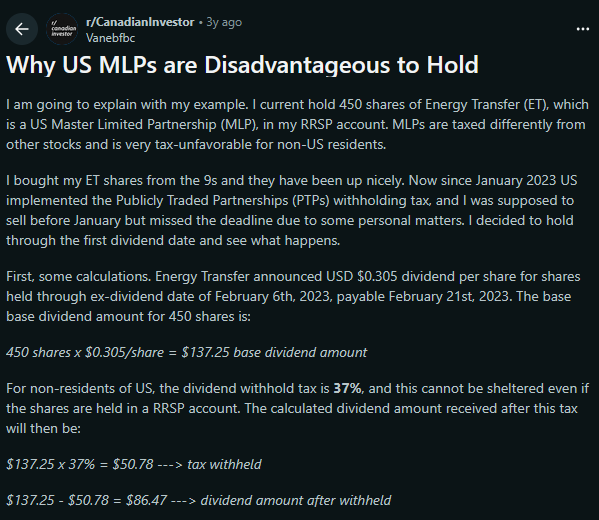
Source: r/CanadianInvestor

That means more than one third of each distribution can disappear before it ever reaches your account. This is especially damaging because most of the long-term return from MLPs comes from reinvested distributions rather than price appreciation. 

It does not stop there. When you sell an MLP, there is an additional 10% withholding tax applied to the gross proceeds by the Internal Revenue Service (IRS), because MLPs are classified as publicly traded partnerships. This is not a capital gains tax. It is withheld regardless of whether you are selling at a gain or a loss.

There are numerous real-world examples of Canadian investors discovering this the hard way. Some have bought and sold the same MLP multiple times, only to find that 10% was withheld on each transaction.
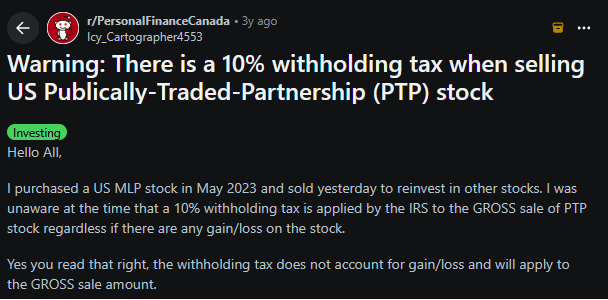
Source: r/PersonalFinanceCanada

The final complication is tax reporting requirements. When you own a typical U.S. stock, you receive a 1099-DIV form that summarizes your income. With an MLP, you are not a shareholder. You are a partner. That means you receive a Schedule K-1.

A K-1 reports your share of the partnership’s income, deductions, and credits. It is far more complex than a standard dividend slip, and it creates a U.S. tax filing obligation. In theory, you are required to file a U.S. tax return to properly report this income to the IRS.
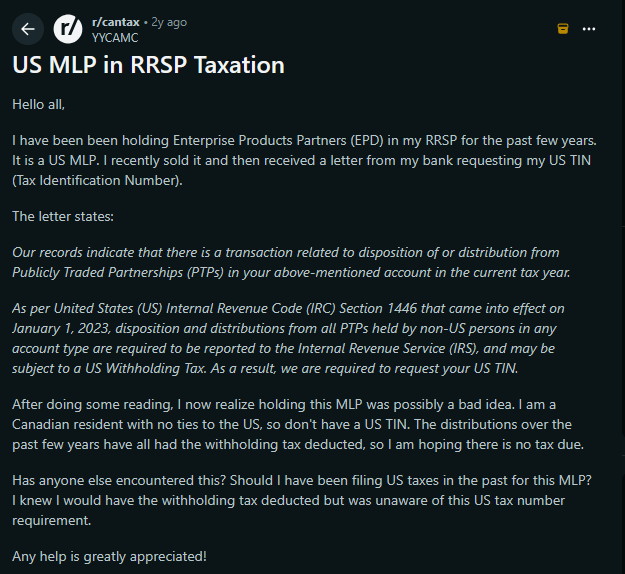
Source: r/cantax

Some investors choose to ignore this requirement, but that is a risky approach. Dealing with cross-border tax issues after the fact is rarely worth the trouble.

Taken together, these issues are hard to overlook. High withholding taxes on distributions, mandatory withholding on sales, and ongoing U.S. tax reporting obligations all apply even in registered accounts. For those reasons alone, I personally believe U.S. MLPs are generally a poor fit for Canadian investors, no matter how attractive the headline yield may look.

Also read

Canada’s best dividend stocks

MLP alternatives for Canadian investors

The simplest alternative is also the most obvious one. You can target the same part of the energy industry, the midstream segment, without using MLPs at all. That means sticking with regular corporations, and the TSX offers plenty of options. 

Companies such as Enbridge, TC Energy, and Pembina Pipeline all operate fee-based energy infrastructure with long-term contracts tied to oil and gas volumes. These businesses are similar to U.S. MLPs at the asset level. The difference is how they are taxed.

These companies pay eligible dividends, which qualify for the dividend tax credit in taxable accounts. You avoid foreign withholding issues, avoid U.S. tax filings, and still receive above-average yields from essential infrastructure assets. You can even buy a basket of them via an ETF like the Global X Equal Weight Canadian Pipelines Index ETF (PPLN).
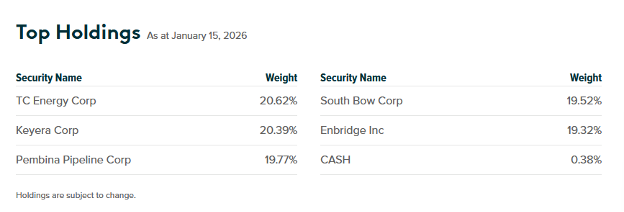
Source: Global X Canada

However, if you still want exposure to MLPs specifically, you can use a U.S.-listed ETF. There are two possibilities within this niche, each with their own trade-offs.

The first approach is a pure-play MLP ETF that is structured as a corporation. These funds own only MLPs but are taxed at the corporate level. The distributions they pay often retain MLP characteristics, including a large return of capital component, but there is an important trade-off. Because the ETF itself is a corporation, it accrues deferred income-tax liabilities. These reflect depreciation from the underlying MLPs and unrealized capital gains in the portfolio. The amount depends on the U.S. federal corporate tax rate and applicable state taxes.

This deferred tax liability can act as both a headwind and a tailwind. It may dampen gains during strong markets and soften losses during downturns. Over long periods, however, the practical effect has often been a significant tracking error.

A commonly cited example is the Alerian MLP ETF (AMLP). Over the past decade, its net asset value return has trailed its benchmark index by a wide margin. A large part of that gap comes from deferred taxes, along with its relatively high 0.85% expense ratio.
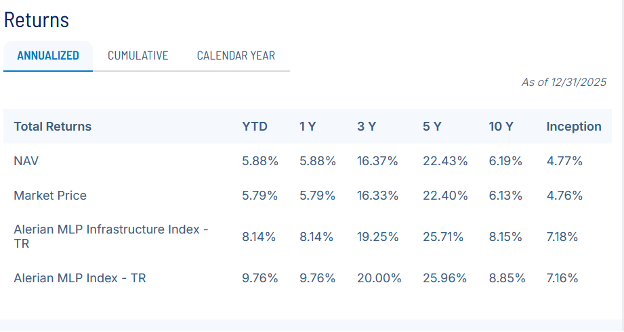
Source: ALPS Funds

Lower-cost options do exist. The Global X MLP ETF (MLPA) charges about 0.45% and pays a decent 7.94% 30-day SEC yield (a standardized calculation for funds developed by the U.S. Securities and Exchange Commission), but it still carries the same deferred tax mechanics. Global X even discloses the fund’s effective tax rate on its website, which highlights how meaningful this drag can be.
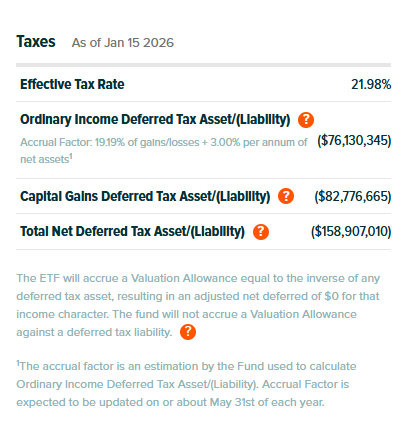
Source: Global X

There is another structure that avoids this issue, with a different compromise. U.S. ETFs that limit MLP exposure to 25% or less can be structured as registered investment companies (RICs) under the Investment Company Act of 1940. These are pass-through vehicles that do not pay corporate tax, as long as they distribute income and realized gains.

The trade-off is that you no longer get pure MLP exposure. The remaining holdings are typically incorporated midstream companies. These often include U.S.-listed shares of familiar names like ONEOK, Kinder Morgan, and Williams Companies, along with U.S. listings of Canadian firms.

An example is the Global X MLP & Energy Infrastructure ETF (MLPX). It carries the same 0.45% expense ratio as its pure-play sibling, but its yield is lower at 5.12% on a 30-day SEC basis because it is not fully invested in MLPs. The benefit is simpler taxation and no deferred tax liability dragging on returns.

Taxes are inevitable, so at least keep it simple

Whichever ETF structure you choose, there are two clear advantages compared with owning MLPs directly. Both types of ETFs issue 1099-DIV forms rather than Schedule K-1s, and they eliminate the 37% withholding on distributions and the 10% withholding on sales. You simply deal with the usual 15% foreign withholding tax on dividends, which you can avoid by putting them in a RRSP.

For Canadian investors who insist on MLP exposure, ETFs are the least painful route. For most others, Canadian and U.S. midstream corporations can offer similar economics with far fewer tax complications.

Newsletter

Get free MoneySense financial tips, news & advice in your inbox.

Read more about investing strategies:

  • The best GIC rates in Canada for 2025
  • If not bonds, then what?
  • Can you hedge against a market crash with ETFs?
  • Is Wealthsimple’s new Physical Gold Trading worth it?

The post Why Canadian investors should avoid MLPs  appeared first on MoneySense.

면책 조항: 본 사이트에 재게시된 글들은 공개 플랫폼에서 가져온 것으로 정보 제공 목적으로만 제공됩니다. 이는 반드시 MEXC의 견해를 반영하는 것은 아닙니다. 모든 권리는 원저자에게 있습니다. 제3자의 권리를 침해하는 콘텐츠가 있다고 판단될 경우, service@support.mexc.com으로 연락하여 삭제 요청을 해주시기 바랍니다. MEXC는 콘텐츠의 정확성, 완전성 또는 시의적절성에 대해 어떠한 보증도 하지 않으며, 제공된 정보에 기반하여 취해진 어떠한 조치에 대해서도 책임을 지지 않습니다. 본 콘텐츠는 금융, 법률 또는 기타 전문적인 조언을 구성하지 않으며, MEXC의 추천이나 보증으로 간주되어서는 안 됩니다.

추천 콘텐츠

Seeker (SKR) will soon be listed on Bybit Spot, Alpha, and Byreal.

Seeker (SKR) will soon be listed on Bybit Spot, Alpha, and Byreal.

PANews reported on January 21 that Bybit will launch Seeker (SKR) on its spot, Alpha, and Byreal platforms. Users can quickly trade without setting up a separate
공유하기
PANews2026/01/21 08:20
Perpetual DEX in testing with cross‑chain liquidity and ADL
Perpetual DEX in testing with cross‑chain liquidity and ADL

The post Perpetual DEX in testing with cross‑chain liquidity and ADL appeared on BitcoinEthereumNews.com. Sunperp, a new perpetual DEX being tested on the Tron blockchain, promises millisecond executions, cross-chain liquidity aggregation, and an integrated auto-deleveraging (ADL) system. Justin Sun reshared the announcement on X, inviting users to try it and highlighting dedicated incentives, while numerous economic details and operational metrics remain to be confirmed. According to the data collected by on-chain analysts and industry reports, in May 2025 TRON hosted over 75 billion USDT, with the network recording over 8.3 million daily transactions and approximately 306 million active accounts, a context that justifies the interest in USDT-collateralized derivatives. Market analysts following perpetual DEX also note that the massive availability of USDT on TRON facilitates cross-chain arbitrage operations and reduces costs for market makers. What is Sunperp and what it brings differently to Tron Sunperp is a platform perp DEX that uses USDT as collateral, with profits and losses calculated in USDT. The architecture separates matching, executed off-chain to maximize speed, from settlement, recorded on-chain to ensure transparency of trading results. In this context, the debut announcement was originally reported by Jamie Redman; the team also states that, while in the testing phase, the core contracts are non-upgradable. Main Technical Features Order types: market, limit (with FOK – Fill-or-Kill, GTC – Good-Till-Cancelled, and IOC – Immediate-or-Cancel modes), post-only orders, plan orders, trailing, and TWAP (Time-Weighted Average Price). Use of multi-source oracles to determine the mark price employed in the calculation of profits and liquidations. Primary collateral: USDT, with P&L calculated in the same currency. Core contracts declared non-upgradable in an environment still in testing. Cross-chain liquidity: less slippage and tighter spreads The protocol claims to aggregate liquidity flows from various networks in order to increase market depth and improve order execution, thereby reducing slippage and spreads in large-size trades. However, the actual effect will depend…
공유하기
BitcoinEthereumNews2025/09/22 17:20
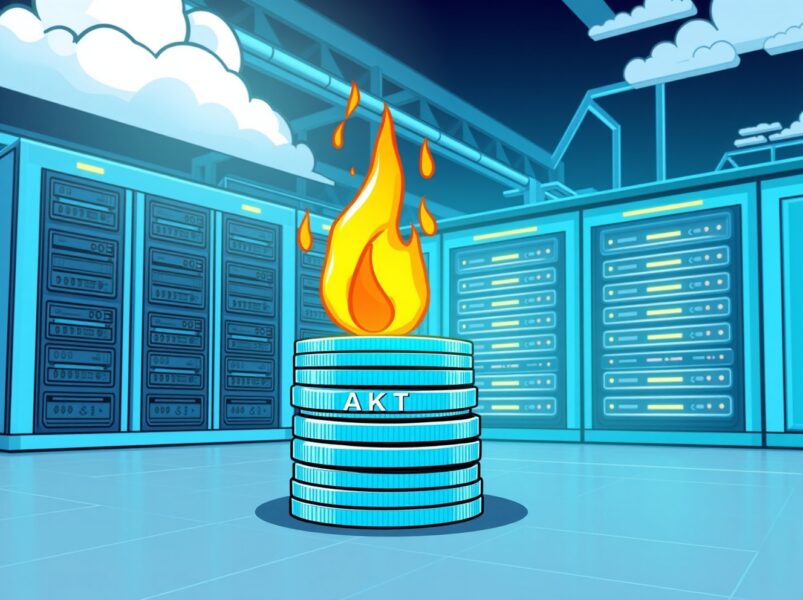
Akash Network’s Strategic Move: A Crucial Burn for AKT’s Future

Akash Network’s Strategic Move: A Crucial Burn for AKT’s Future

BitcoinWorld Akash Network’s Strategic Move: A Crucial Burn for AKT’s Future In the dynamic world of decentralized computing, exciting developments are constantly shaping the future. Today, all eyes are on Akash Network, the innovative supercloud project, as it proposes a significant change to its tokenomics. This move aims to strengthen the value of its native token, AKT, and further solidify its position in the competitive blockchain space. The community is buzzing about a newly submitted governance proposal that could introduce a game-changing Burn Mint Equilibrium (BME) model. What is the Burn Mint Equilibrium (BME) for Akash Network? The core of this proposal revolves around a concept called Burn Mint Equilibrium, or BME. Essentially, this model is designed to create a balance in the token’s circulating supply by systematically removing a portion of tokens from existence. For Akash Network, this means burning an amount of AKT that is equivalent to the U.S. dollar value of fees paid by network users. Fee Conversion: When users pay for cloud services on the Akash Network, these fees are typically collected in various cryptocurrencies or stablecoins. AKT Equivalence: The proposal suggests converting the U.S. dollar value of these collected fees into an equivalent amount of AKT. Token Burn: This calculated amount of AKT would then be permanently removed from circulation, or ‘burned’. This mechanism creates a direct link between network utility and token supply reduction. As more users utilize the decentralized supercloud, more AKT will be burned, potentially impacting the token’s scarcity and value. Why is This Proposal Crucial for AKT Holders? For anyone holding AKT, or considering investing in the Akash Network ecosystem, this proposal carries significant weight. Token burning mechanisms are often viewed as a positive development because they can lead to increased scarcity. When supply decreases while demand remains constant or grows, the price per unit tends to increase. Here are some key benefits: Increased Scarcity: Burning tokens reduces the total circulating supply of AKT. This makes each remaining token potentially more valuable over time. Demand-Supply Dynamics: The BME model directly ties the burning of AKT to network usage. Higher adoption of the Akash Network supercloud translates into more fees, and thus more AKT burned. Long-Term Value Proposition: By creating a deflationary pressure, the proposal aims to enhance AKT’s long-term value, making it a more attractive asset for investors and long-term holders. This strategic move demonstrates a commitment from the Akash Network community to optimize its tokenomics for sustainable growth and value appreciation. How Does BME Impact the Decentralized Supercloud Mission? Beyond token value, the BME proposal aligns perfectly with the broader mission of the Akash Network. As a decentralized supercloud, Akash provides a marketplace for cloud computing resources, allowing users to deploy applications faster, more efficiently, and at a lower cost than traditional providers. The BME model reinforces this utility. Consider these impacts: Network Health: A stronger AKT token can incentivize more validators and providers to secure and contribute resources to the network, improving its overall health and resilience. Ecosystem Growth: Enhanced token value can attract more developers and projects to build on the Akash Network, fostering a vibrant and diverse ecosystem. User Incentive: While users pay fees, the potential appreciation of AKT could indirectly benefit those who hold the token, creating a circular economy within the supercloud. This proposal is not just about burning tokens; it’s about building a more robust, self-sustaining, and economically sound decentralized cloud infrastructure for the future. What Are the Next Steps for the Akash Network Community? As a governance proposal, the BME model will now undergo a period of community discussion and voting. This is a crucial phase where AKT holders and network participants can voice their opinions, debate the merits, and ultimately decide on the future direction of the project. Transparency and community engagement are hallmarks of decentralized projects like Akash Network. Challenges and Considerations: Implementation Complexity: Ensuring the burning mechanism is technically sound and transparent will be vital. Community Consensus: Achieving broad agreement within the diverse Akash Network community is key for successful adoption. The outcome of this vote will significantly shape the tokenomics and economic model of the Akash Network, influencing its trajectory in the rapidly evolving decentralized cloud landscape. The proposal to introduce a Burn Mint Equilibrium model represents a bold and strategic step for Akash Network. By directly linking network usage to token scarcity, the project aims to create a more resilient and valuable AKT token, ultimately strengthening its position as a leading decentralized supercloud provider. This move underscores the project’s commitment to innovative tokenomics and sustainable growth, promising an exciting future for both users and investors in the Akash Network ecosystem. It’s a clear signal that Akash is actively working to enhance its value proposition and maintain its competitive edge in the decentralized future. Frequently Asked Questions (FAQs) 1. What is the main goal of the Burn Mint Equilibrium (BME) proposal for Akash Network? The primary goal is to adjust the circulating supply of AKT tokens by burning a portion of network fees, thereby creating deflationary pressure and potentially enhancing the token’s long-term value and scarcity. 2. How will the amount of AKT to be burned be determined? The proposal suggests burning an amount of AKT equivalent to the U.S. dollar value of fees paid by users on the Akash Network for cloud services. 3. What are the potential benefits for AKT token holders? Token holders could benefit from increased scarcity of AKT, which may lead to higher demand and appreciation in value over time, especially as network usage grows. 4. How does this proposal relate to the overall mission of Akash Network? The BME model reinforces the Akash Network‘s mission by creating a stronger, more economically robust ecosystem. A healthier token incentivizes network participants, fostering growth and stability for the decentralized supercloud. 5. What is the next step for this governance proposal? The proposal will undergo a period of community discussion and voting by AKT token holders. The community’s decision will determine if the BME model is implemented on the Akash Network. If you found this article insightful, consider sharing it with your network! Your support helps us bring more valuable insights into the world of decentralized technology. Stay informed and help spread the word about the exciting developments happening within Akash Network. To learn more about the latest crypto market trends, explore our article on key developments shaping decentralized cloud solutions price action. This post Akash Network’s Strategic Move: A Crucial Burn for AKT’s Future first appeared on BitcoinWorld.
공유하기
Coinstats2025/09/22 21:35
