

Discipline isn’t optional: Nietzsche’s line that hits hard today
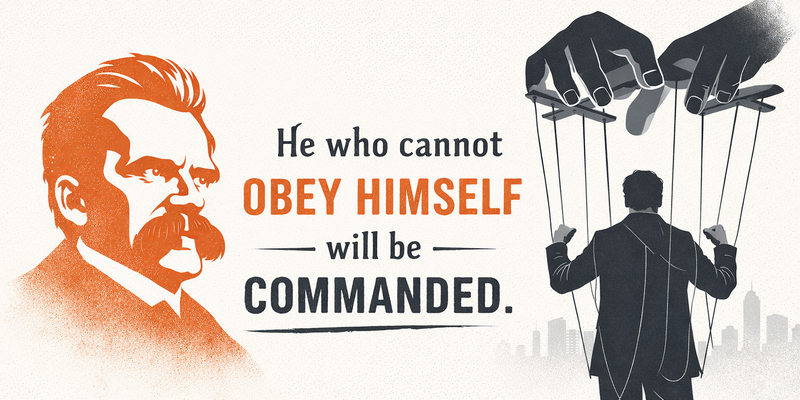
“He who cannot obey himself will be commanded.” — Friedrich Nietzsche
Nietzsche is not praising blind obedience. He is pointing to a practical truth about freedom. If you cannot follow your own principles, your own plan, your own values, you will end up following someone else’s. The “commander” may be a boss, a trend, a craving, a fear, or the loudest voice in the room. Either way, the outcome is the same. A life steered from the outside.
What does it mean to “obey yourself”?
Self-obedience is not self-punishment. It is self-governance. It means deciding what matters, then doing what that decision requires, even when motivation drops. It is the ability to act from intention rather than impulse. In modern language, Nietzsche is talking about self-discipline and personal responsibility.
This matters because the mind is not a single, unified captain. It is a crowd. One part wants long-term growth. Another wants comfort now. When the “crowd” wins, you do not become free. You become predictable. And predictable people are easy to direct, by advertising, peer pressure, workplace politics, or digital distraction.
How we get “commanded” without noticing
Most control today does not look like control. It looks like convenience. A feed decides what you see next. A notification decides when you stop thinking. A deadline decides what gets your best hours. Even your own habits can become a commander. If you reach for the phone every time you feel bored, boredom commands you. If you avoid hard conversations, discomfort commands you.
Nietzsche’s point is simple. If you do not set your own rules, you will live by default rules. And default rules are usually written by someone who benefits from your attention, your labour, or your silence.
Self-obedience in practice
You do not need grand philosophy to apply this. You need a few repeatable commitments.
- Write a small code: Pick three weekly non-negotiables, like a workout, a deep work block, and one relationship action.
- Build friction against impulses: Turn off non-essential notifications. Add a 10-minute pause before big decisions.
- Keep promises to yourself: If you say you will read two pages, read two pages. Reliability is built in inches.
- Choose your commanders on purpose: Let a calendar command your priorities, not your moods. Let a craft or mission command your effort, not random opinions.
In Nietzsche’s larger philosophy, freedom is not comfort. It is becoming capable. It is shaping your instincts, training your attention, and turning raw desire into deliberate action. That is why self-command comes first.
The leadership lesson
People who cannot govern themselves often seek governance from others. They cling to strong leaders, rigid ideologies, or constant validation. Self-mastery makes healthy leadership possible, because it reduces the urge to control others to feel stable.
Nietzsche’s warning is an invitation. Obeying yourself is how you earn autonomy. Start with one promise today, keep it, and watch how quickly the world stops pulling the steering wheel.


추천 콘텐츠

The Role of Reference Points in Achieving Equilibrium Efficiency in Fair and Socially Just Economies

CoinRabbit Reduces Crypto Lending Rates for XRP Loans and 300+ Assets




