Ethereum to Shut Down Holešky, Its Largest Testnet Ever
Key Takeaways:
- Holešky, Ethereum’s biggest testnet, will be decommissioned two weeks after the Fusaka upgrade finalizes in September 2025.
- Hoodi will fully replace Holešky as the new validator-focused testnet, designed to avoid the technical issues that plagued its predecessor.
- Ethereum now runs 3 specialized testnets: Sepolia (for dApps), Hoodi (for staking), and Ephemery (for short validator cycles).
Ethereum is officially sunsetting its most ambitious Testnet, Holešky, marking a pivotal transition in its testing infrastructure. After nearly two years of enabling critical upgrades and scaling experiments, Holešky is being phased out in favor of more modular and specialized networks.
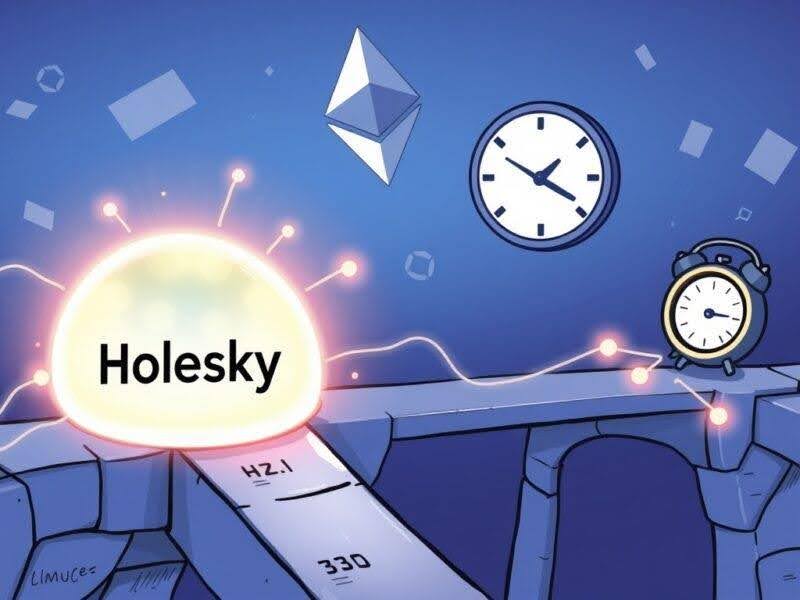
Holešky Was a Giant but Its Time Is Over
The End of a Critical Era
Launched in September 2023, Holešky was Ethereum’s largest public Testnet ever, purpose-built to simulate real-world staking conditions at massive scale. At its peak, it hosted over 1.6 million validators, dwarfing previous testnets like Goerli and Ropsten.
Holešky was particularly involved in testing upgrades including:
- Dencun: Aimed at reducing transaction costs via EIP-4844 (Proto-Danksharding)
- Pectra: Optimized validator performance and introduced partial withdrawal mechanisms
The same scale which had made Holešky so impressive turned, however, also against it.
Read More: Ethereum Rally Extends, With Solana and Emerging Projects Following

Why Holešky Had to Be Retired
Inactivity Leaks and Validator Exit Bottlenecks
In early 2025, Holešky began showing signs of stress. After the activation of the Pectra upgrade, a wave of inactivity leaks hit the network. Thousands of validators went offline, creating a massive exit queue that took weeks to process.
This resulted in:
- Slow validator churn, making it unviable to test full validator lifecycle within any practical timeline.
- Infrastructure fatigue, as developers struggled to simulate dynamic network behavior.
Even after technical recovery, the network had turned into an operating bottleneck. It was no longer able to deliver the testing agility necessary to support the fast-paced Ethereum roadmap.
Enter Hoodi: The Next-Gen Validator Testnet
Born from Holešky’s Shortcomings
Ethereum published Hoodi in March 2025 as an effort to correct the deficiencies of Holešky. It features:
- A fresh validator set, solving the legacy exit queue issue
- Built-in support for Pectra and upcoming upgrades, including the Fusaka fork
- A more resilient architecture for long-term staking simulations
Hoodi is created on a merged-from-genesis model that has a more maintainable infrastructure and fewer historical bugs.
Chainstack and Infura, and other large infra providers, already moved their tooling to use Hoodi.
Ethereum’s New Testnet Landscape
Ethereum is now running a smaller set of three testnets that are optimized to fulfill specific functions:
| Testnet | Purpose |
| Sepolia | Smart contract & dApp development |
| Hoodi | Validator & staking infrastructure testing |
| Ephemery | Lightweight, reset-every-28-days validator lifecycle testing |
This segmentation improves reliability and ensures that testnets align with developer needs, instead of trying to serve all purposes with a single network.
Fusaka Fork Sets the Final Deadline
The Fusaka upgrade, Ethereum’s next major hard fork is slated to activate on Holešky in mid-to-late September 2025. Two weeks after it finalizes, all remaining validator nodes on Holešky will be shut down.
After this, “Holešky will no longer be supported by client, testing or infrastructure teams,” said the Ethereum Foundation in a blog post.
Fusaka introduces several enhancements including:
- Improved data availability for rollups
- Distributed validator load
- Lower transaction latency and better scalability
It comprises 11 Ethereum Improvement Proposals (EIPs) and is the catalyst to the next stage of Ethereum growth.

What’s Next for Ethereum Testnets?
Holešky closure is not only a closure, but it represents the overall Ethereum strategy of evolution. In 2025 and further, it becomes clear:
- Streamlined, modular Testnets
- Faster iteration cycles
- Cleaner infrastructure
Looking forward Ethereum is targeting the Glamsterdam upgrade in 2026 which proposes to:
- Halve block time from 12s → 6s
- Separate block validation from execution
- Improve support for ZK-EVM systems
These moves are aimed squarely at improving user experience and scalability, especially for rollups – a critical component of Ethereum’s layer-2 ecosystem.
Read More: $291 Million Pulled from Bitcoin, Ethereum ETFs as Inflation Spikes Under Trump Tariffs
Ethereum Rallies Amid Infra Shakeup
At the point of writing, ETH trades at approximately $4,395 and continues its recent streak, occasioned by ETF enthusiasm and growth in institutional buying.
- Multiple publicly traded firms have added ETH to their treasuries
- The crypto community views Ethereum’s infrastructure shakeup as a maturity signal, rather than a risk
With Holešky’s chapter closing, Ethereum is entering a phase of precision engineering, replacing “big and bulky” with lean and purpose-built.
The post Ethereum to Shut Down Holešky, Its Largest Testnet Ever appeared first on CryptoNinjas.


추천 콘텐츠

Your guide to Disney Adventure’s 7 themed areas

This startup is building an ‘intelligence layer’ for Nigeria’s power grid