European Central Bank (ECB) President Christine Lagarde called for stricter regulations on non-EU stablecoin issuers to close dangerous gaps in the Markets in Crypto-Assets Regulation (MiCA) framework that could trigger liquidity crises. Speaking at the European Systemic Risk Board conference, Lagarde warned that multi-issuance schemes allow EU and non-EU entities to jointly issue fungible stablecoins while only EU operations face regulatory requirements. Euro Stablecoins Struggle as Dollar Dominates Global Markets The warning comes as euro-backed stablecoins capture merely 0.15% of the $230 billion global market, with USD-pegged tokens accounting for 99% of stablecoin capitalization.Sources: ECB ECB advisor Jürgen Schaaf had previously cautioned that widespread adoption of dollar stablecoins could weaken European monetary control and financial sovereignty. Lagarde identified critical vulnerabilities in the current MiCA implementation, where investors would naturally prefer to redeem stablecoins in jurisdictions with the strongest safeguards during crisis periods. EU-held reserves may prove insufficient to meet concentrated redemption demand, which creates systemic risks reminiscent of traditional banking liquidity mismatches. The ECB chief demanded European legislation ensure multi-issuance schemes cannot operate without robust equivalence regimes in other jurisdictions and safeguards for asset transfers between EU and non-EU entities. Her intervention follows mounting pressure to accelerate digital euro development after the United States’ comprehensive stablecoin legislation, the GENIUS Act. MiCA Loopholes Create “Path of Least Resistance” for Financial Risk Lagarde used a submarine metaphor to emphasize how financial risks seek the easiest routes through regulatory gaps, regardless of technological innovation. “Without a level global playing field, risks will always seek the path of least resistance,” she stated at the Frankfurt conference. The specific vulnerability involves multi-issuance arrangements where EU-licensed entities and offshore partners jointly issue interchangeable stablecoins. MiCA requirements apply only to European operations, resulting in asymmetric regulatory coverage within single-token systems. During market stress, investors would logically concentrate redemption requests in EU jurisdictions where MiCA prohibits redemption fees and mandates par value redemptions. However, Lagarde highlighted that reserve allocation may not match this redemption flow pattern, potentially triggering liquidity shortfalls. Banking groups already face consolidated liquidity requirements that ensure reserve availability across all operational levels through net stable funding ratios and liquidity coverage standards. Stablecoin multi-issuance schemes will replicate identical risks without equivalent regulatory oversight. The European Commission previously clarified that companies could treat tokens as fungible across jurisdictions if EU-licensed entities participate. However, the ECB warned that this approach risks undermining EU strategic autonomy by allowing non-EU redemption pressure to drain European reserves. Lagarde emphasized that regulatory principles remain constant despite technological evolution. “The categories of risk they create are not new. They are risks long familiar to supervisors and regulators,” she noted regarding stablecoin innovations. Digital Euro Acceleration Targets US Stablecoin Dominance Challenge European officials accelerated digital euro planning after Trump signed the GENIUS Act, establishing comprehensive dollar stablecoin regulations. The swift US action unsettled EU policymakers who had pursued more cautious development approaches for their central bank digital currency project. Current debates center on whether digital euros should operate on public blockchains, such as Ethereum, or private, ECB-controlled ledgers. Public blockchain advocates argue for broader circulation possibilities, while critics cite concerns about privacy and transaction exposure risks. Some policymakers believe that open blockchain digital euros could strengthen the currency’s reach beyond European borders. At the current speed of growth, dollar stablecoin integration into mainstream payment systems by Visa and Mastercard already threatens European financial control. Major US retailers, including Walmart and Amazon, are exploring stablecoin adoption for high-volume transactions, which means some payment flows may occur outside traditional banking infrastructure. Notably, Deutsche Bank, Galaxy Digital, and Flow Traders launched EURAU as Europe’s first MiCA-compliant euro stablecoin. However, its impact remains minimal given current market scale disparities. Lagarde concluded that international cooperation remains indispensable for effective regulation while maintaining that traditional risk management principles can address emerging challenges through updated application methodsEuropean Central Bank (ECB) President Christine Lagarde called for stricter regulations on non-EU stablecoin issuers to close dangerous gaps in the Markets in Crypto-Assets Regulation (MiCA) framework that could trigger liquidity crises. Speaking at the European Systemic Risk Board conference, Lagarde warned that multi-issuance schemes allow EU and non-EU entities to jointly issue fungible stablecoins while only EU operations face regulatory requirements. Euro Stablecoins Struggle as Dollar Dominates Global Markets The warning comes as euro-backed stablecoins capture merely 0.15% of the $230 billion global market, with USD-pegged tokens accounting for 99% of stablecoin capitalization.Sources: ECB ECB advisor Jürgen Schaaf had previously cautioned that widespread adoption of dollar stablecoins could weaken European monetary control and financial sovereignty. Lagarde identified critical vulnerabilities in the current MiCA implementation, where investors would naturally prefer to redeem stablecoins in jurisdictions with the strongest safeguards during crisis periods. EU-held reserves may prove insufficient to meet concentrated redemption demand, which creates systemic risks reminiscent of traditional banking liquidity mismatches. The ECB chief demanded European legislation ensure multi-issuance schemes cannot operate without robust equivalence regimes in other jurisdictions and safeguards for asset transfers between EU and non-EU entities. Her intervention follows mounting pressure to accelerate digital euro development after the United States’ comprehensive stablecoin legislation, the GENIUS Act. MiCA Loopholes Create “Path of Least Resistance” for Financial Risk Lagarde used a submarine metaphor to emphasize how financial risks seek the easiest routes through regulatory gaps, regardless of technological innovation. “Without a level global playing field, risks will always seek the path of least resistance,” she stated at the Frankfurt conference. The specific vulnerability involves multi-issuance arrangements where EU-licensed entities and offshore partners jointly issue interchangeable stablecoins. MiCA requirements apply only to European operations, resulting in asymmetric regulatory coverage within single-token systems. During market stress, investors would logically concentrate redemption requests in EU jurisdictions where MiCA prohibits redemption fees and mandates par value redemptions. However, Lagarde highlighted that reserve allocation may not match this redemption flow pattern, potentially triggering liquidity shortfalls. Banking groups already face consolidated liquidity requirements that ensure reserve availability across all operational levels through net stable funding ratios and liquidity coverage standards. Stablecoin multi-issuance schemes will replicate identical risks without equivalent regulatory oversight. The European Commission previously clarified that companies could treat tokens as fungible across jurisdictions if EU-licensed entities participate. However, the ECB warned that this approach risks undermining EU strategic autonomy by allowing non-EU redemption pressure to drain European reserves. Lagarde emphasized that regulatory principles remain constant despite technological evolution. “The categories of risk they create are not new. They are risks long familiar to supervisors and regulators,” she noted regarding stablecoin innovations. Digital Euro Acceleration Targets US Stablecoin Dominance Challenge European officials accelerated digital euro planning after Trump signed the GENIUS Act, establishing comprehensive dollar stablecoin regulations. The swift US action unsettled EU policymakers who had pursued more cautious development approaches for their central bank digital currency project. Current debates center on whether digital euros should operate on public blockchains, such as Ethereum, or private, ECB-controlled ledgers. Public blockchain advocates argue for broader circulation possibilities, while critics cite concerns about privacy and transaction exposure risks. Some policymakers believe that open blockchain digital euros could strengthen the currency’s reach beyond European borders. At the current speed of growth, dollar stablecoin integration into mainstream payment systems by Visa and Mastercard already threatens European financial control. Major US retailers, including Walmart and Amazon, are exploring stablecoin adoption for high-volume transactions, which means some payment flows may occur outside traditional banking infrastructure. Notably, Deutsche Bank, Galaxy Digital, and Flow Traders launched EURAU as Europe’s first MiCA-compliant euro stablecoin. However, its impact remains minimal given current market scale disparities. Lagarde concluded that international cooperation remains indispensable for effective regulation while maintaining that traditional risk management principles can address emerging challenges through updated application methods

ECB Chief Lagarde Calls for Stricter Rules on Non-EU Stablecoin Issuers to Close MiCA Gaps

2025/09/04 19:56
4분 읽기
이 콘텐츠에 대한 의견이나 우려 사항이 있으시면 crypto.news@mexc.com으로 연락주시기 바랍니다

European Central Bank (ECB) President Christine Lagarde called for stricter regulations on non-EU stablecoin issuers to close dangerous gaps in the Markets in Crypto-Assets Regulation (MiCA) framework that could trigger liquidity crises.

Speaking at the European Systemic Risk Board conference, Lagarde warned that multi-issuance schemes allow EU and non-EU entities to jointly issue fungible stablecoins while only EU operations face regulatory requirements.

Euro Stablecoins Struggle as Dollar Dominates Global Markets

The warning comes as euro-backed stablecoins capture merely 0.15% of the $230 billion global market, with USD-pegged tokens accounting for 99% of stablecoin capitalization.
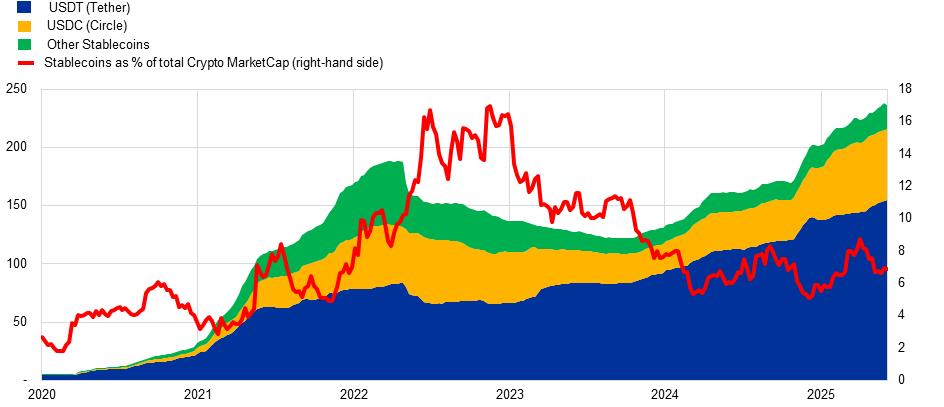
ECB Chief Lagarde Calls for Stricter Rules on Non-EU Stablecoin Issuers to Close MiCA GapsSources: ECB

ECB advisor Jürgen Schaaf had previously cautioned that widespread adoption of dollar stablecoins could weaken European monetary control and financial sovereignty.

Lagarde identified critical vulnerabilities in the current MiCA implementation, where investors would naturally prefer to redeem stablecoins in jurisdictions with the strongest safeguards during crisis periods.

EU-held reserves may prove insufficient to meet concentrated redemption demand, which creates systemic risks reminiscent of traditional banking liquidity mismatches.

The ECB chief demanded European legislation ensure multi-issuance schemes cannot operate without robust equivalence regimes in other jurisdictions and safeguards for asset transfers between EU and non-EU entities.

Her intervention follows mounting pressure to accelerate digital euro development after the United States’ comprehensive stablecoin legislation, the GENIUS Act.

MiCA Loopholes Create “Path of Least Resistance” for Financial Risk

Lagarde used a submarine metaphor to emphasize how financial risks seek the easiest routes through regulatory gaps, regardless of technological innovation.

Without a level global playing field, risks will always seek the path of least resistance,” she stated at the Frankfurt conference.

The specific vulnerability involves multi-issuance arrangements where EU-licensed entities and offshore partners jointly issue interchangeable stablecoins.

MiCA requirements apply only to European operations, resulting in asymmetric regulatory coverage within single-token systems.

During market stress, investors would logically concentrate redemption requests in EU jurisdictions where MiCA prohibits redemption fees and mandates par value redemptions.

However, Lagarde highlighted that reserve allocation may not match this redemption flow pattern, potentially triggering liquidity shortfalls.

Banking groups already face consolidated liquidity requirements that ensure reserve availability across all operational levels through net stable funding ratios and liquidity coverage standards.

Stablecoin multi-issuance schemes will replicate identical risks without equivalent regulatory oversight.

The European Commission previously clarified that companies could treat tokens as fungible across jurisdictions if EU-licensed entities participate.

However, the ECB warned that this approach risks undermining EU strategic autonomy by allowing non-EU redemption pressure to drain European reserves.

Lagarde emphasized that regulatory principles remain constant despite technological evolution.

The categories of risk they create are not new. They are risks long familiar to supervisors and regulators,” she noted regarding stablecoin innovations.

Digital Euro Acceleration Targets US Stablecoin Dominance Challenge

European officials accelerated digital euro planning after Trump signed the GENIUS Act, establishing comprehensive dollar stablecoin regulations.

The swift US action unsettled EU policymakers who had pursued more cautious development approaches for their central bank digital currency project.

Current debates center on whether digital euros should operate on public blockchains, such as Ethereum, or private, ECB-controlled ledgers.

Public blockchain advocates argue for broader circulation possibilities, while critics cite concerns about privacy and transaction exposure risks.

Some policymakers believe that open blockchain digital euros could strengthen the currency’s reach beyond European borders.

At the current speed of growth, dollar stablecoin integration into mainstream payment systems by Visa and Mastercard already threatens European financial control.

Major US retailers, including Walmart and Amazon, are exploring stablecoin adoption for high-volume transactions, which means some payment flows may occur outside traditional banking infrastructure.

Notably, Deutsche Bank, Galaxy Digital, and Flow Traders launched EURAU as Europe’s first MiCA-compliant euro stablecoin. However, its impact remains minimal given current market scale disparities.

Lagarde concluded that international cooperation remains indispensable for effective regulation while maintaining that traditional risk management principles can address emerging challenges through updated application methods.


면책 조항: 본 사이트에 재게시된 글들은 공개 플랫폼에서 가져온 것으로 정보 제공 목적으로만 제공됩니다. 이는 반드시 MEXC의 견해를 반영하는 것은 아닙니다. 모든 권리는 원저자에게 있습니다. 제3자의 권리를 침해하는 콘텐츠가 있다고 판단될 경우, crypto.news@mexc.com으로 연락하여 삭제 요청을 해주시기 바랍니다. MEXC는 콘텐츠의 정확성, 완전성 또는 시의적절성에 대해 어떠한 보증도 하지 않으며, 제공된 정보에 기반하여 취해진 어떠한 조치에 대해서도 책임을 지지 않습니다. 본 콘텐츠는 금융, 법률 또는 기타 전문적인 조언을 구성하지 않으며, MEXC의 추천이나 보증으로 간주되어서는 안 됩니다.

$30,000 in PRL + 15,000 USDT

$30,000 in PRL + 15,000 USDT$30,000 in PRL + 15,000 USDT

Deposit & trade PRL to boost your rewards!