When will the Bitcoin bear market end?
Welcome to the Canadian Crypto Observer. Financial journalist and author Aditya Nain offers perspective on market-moving headlines to help Canadian investors navigate the cryptocurrency market.
At the time of writing the previous edition of this column, the US had just removed Venezuelan leader Nicolas Maduro from that country in a special forces operation, and flown him to New York to face charges. Weeks later, as I write this column, the US and Israel have launched a military attack on Iran, ostensibly to counter Iran’s march towards the successful creation of nuclear weapons.
Suffice to say, these are not normal times in geopolitics. In a hyper-connected world, this matters to Canadian investors because these events could have far reaching consequences—especially for a globally traded, institutionally held asset such as Bitcoin (BTC). More on this later in the column.
BTC extends losses—what’s next for the crypto market?
As the chart below shows, the price of BTC has fallen about 47% from its all-time highs of October 2025 (based on a 7 day moving average). Sure, it’s not yet fallen 70% to 80% as it did in 2018, 2020 and 2022—but a drawdown of close to 50% is a stark reminder that BTC is a highly volatile asset meant only for aggressive investors with an extremely high appetite for risk.
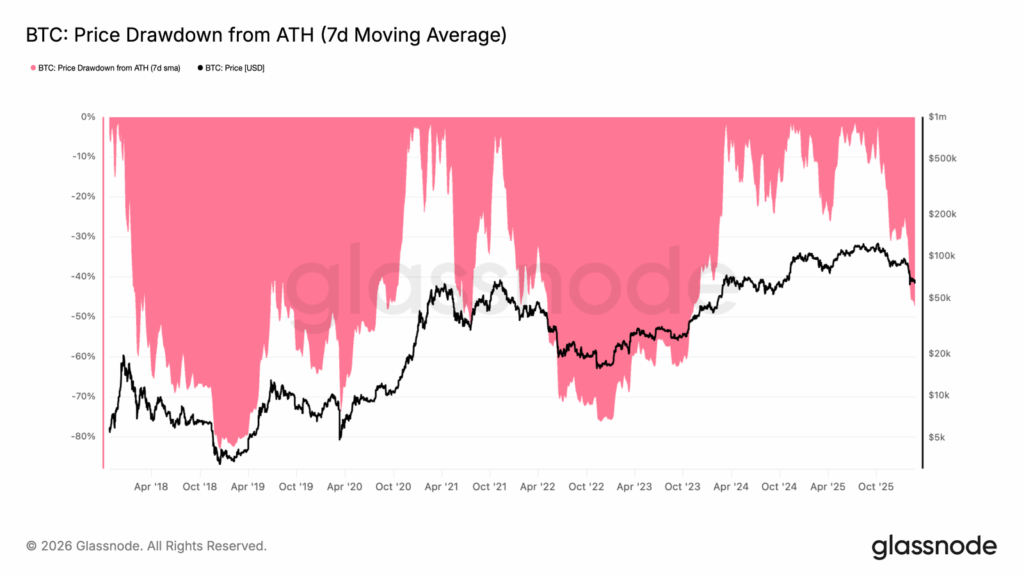
Source: Glassnode as of Feb. 25, 2026
Based on analysis by Glassnode (a research company specializing in digital asset on-chain analysis), the BTC market has yet not shown definitive signs of recovery. Based on an analysis of previous BTC market cycles, Glassnode is of the view that the longer BTC trades between $60,000 and $70,000, the higher the likelihood of a further fall in price.
The research in question suggests that the $70,000 level is an important technical marker; therefore, BTC would have to trade above that level convincingly for a period of time for confidence to re-enter the market.
When will BTC recover and start climbing again?
Let’s put this into perspective: With the benefit of hindsight, we can now say that BTC has been in a bear market since October 2025, when it touched a high of over $124,000. That means BTC has fallen close to 50% in just 5 months. To be sure, this is not new in the history of BTC, with similar capitulations seen in all cyclical bear markets of the past. Nonetheless, the dramatic fall does serve to scare away all but the most high conviction BTC investors.
The best crypto platforms and apps
We’ve ranked the best crypto exchanges in Canada.
Those who’ve held on to their BTC investments through the turmoil of the past five months may understandably be searching for some indications of when the downward trend might begin to reverse. Markets are inherently unpredictable, but history does offer some patterns to ponder. In the past two cyclical bear markets, BTC bottomed about twelve months after its all-time high, as shown in the table below.
| All-time high | Market bottom | |
|---|---|---|
| Previous two BTC market cycles | December 2017 | December 2018 |
| November 2021 | November 2022 | |
| Current BTC market cycle | October 2025 | ? |
There is no guarantee that this historical pattern will repeat itself, and it’s best to be cautious in the use of historical analogues when making investment decisions.
Between geopolitics and interest rates
As I wrote in the previous edition of this column, BTC’s fate in 2026 will likely depend on two major factors: geopolitical uncertainty and the trajectory of interest rates.
A spike in US-created geopolitical risk could push investors to consider BTC, but the extent to which this happens will be dependent on inflation and interest rates. This means that while investors may consider investing in so-called hard assets like gold and BTC to hedge against geopolitical uncertainty, their propensity to do so may be limited if liquidity conditions are anticipated to be tight.
The attacks on Iran could destabilize oil prices, leading to higher inflation expectations, leading to a hawkish stance by The Fed—and this could spook investors from risk assets (like stocks, gold, and bitcoin) to relatively risk-off assets like bonds and cash.
While it’s tempting to try to out-think other investors by attempting to predict the direction of the crypto market, it’s all but impossible to do so accurately and consistently. In such an unpredictable world, it’s probably wise to revisit one of the basics of investing: asset allocation. For most crypto investors, BTC probably accounts for 2% to 10% of their total portfolio. Instead of trying to predict where the market is headed, investors may be better served by buying or selling BTC based on the rebalancing requirements of their portfolios.
Crypto price swings are common
Cryptocurrencies including BTC, ETH, XRP, SOL, BNB, and others are speculative and highly volatile assets subject to significant price movements. Even stablecoins, which are seemingly “safe,” may be risky if not adequately backed by real-world assets.
Investing in bitcoin and other crypto coins carries significant market, technological, and regulatory risks. Invest in crypto only if it aligns with your broader investment goals, time horizon, and risk profile, and always stay vigilant about crypto scams.
Get free MoneySense financial tips, news & advice in your inbox.
Read more about crypto:
- Will bitcoin crash in 2025?
- Bitcoin tops USD$100,000 for the first time
- Price of bitcoin hits new high after Trump victory, and more crypto news
- How to protect your crypto from hacks
The post When will the Bitcoin bear market end? appeared first on MoneySense.
추천 콘텐츠

Winklevoss Twins Move $130M Bitcoin to Gemini Wallets

Crypto Firm Proposes Cutting HYPE Supply by 45%