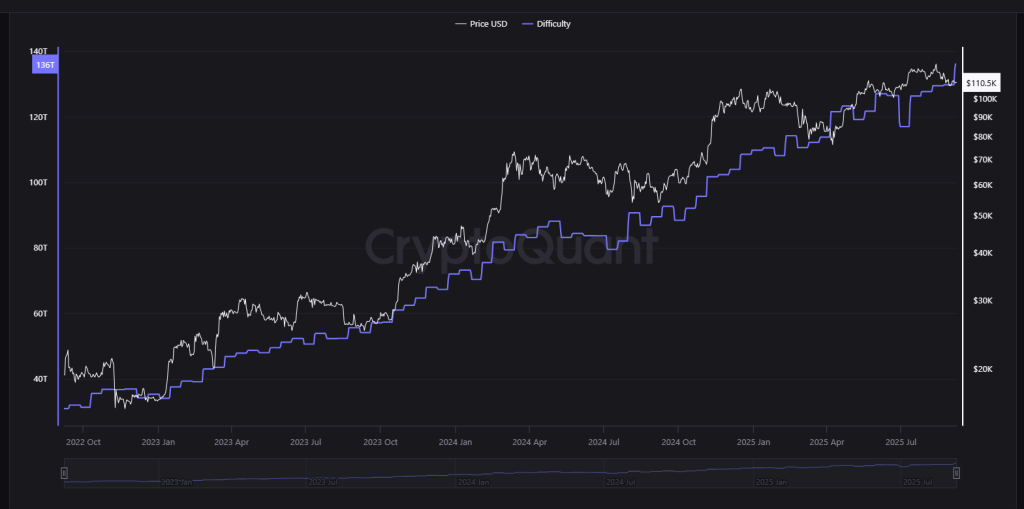
Bitcoin’s mining math hit a fresh high this week as the network’s difficulty climbed to a new all-time peak of 135 trillion. Miners now need more computing work than ever to win a block, while the overall hashpower available to the network has slipped from its summer peak. Related Reading: MemeCore Explodes 3,800% For ATH — But Is A Collapse Around The Corner? Mining Difficulty Reaches New High According to on-chain data, network hashrate fell to 967 billion hashes per second after topping 1 trillion hashes per second on August 4. That gap — rising difficulty paired with a lower hashrate — tightens margins for miners. Reports have disclosed that higher difficulty makes mining more costly, and the pressure is felt most by smaller operations that run on narrow profit margins. Big miners have room to scale. Smaller teams do not. Costs for electricity, machines and maintenance add up fast. The situation raises concern about concentration. As the cost to operate rises, larger pools and firms are better positioned to absorb the pain and keep hashing. Solo Miners Still Score Big Despite those headwinds, Three solo miners managed to land blocks in July and August, proving the system still hands out rewards to individuals now and then. Reports show the block subsidy is 3.125 BTC per block. On July three, a solo miner found block 903,883 and took home just under $350,000 in subsidy plus fees. Another solo miner added block 907,283 on July 26, claiming over $373,000 when prices at the time were used to value the reward. On August 17, block 910,440 was mined by a solo operator, yielding roughly $373,000 in subsidy and fees. Those payouts highlight two facts. First, solo success is rare but possible. Second, occasional large rewards do not erase the steady advantage of scale. Pools still smooth earnings for participants, and many miners use them to avoid long dry spells. Seasonality And Market Patterns Meanwhile, September has a poor historical record for Bitcoin, with an average return of -3.77% across 12 years beginning in 2013, researchers say. Bitcoin endured six straight losing Septembers from 2017 through 2022. The streak reversed in 2023, and 2024 closed out as the best September on record at +7.29%. Related Reading: Trump-Tied Thumzup Raises $50M, Merges Dogecoin Mining With XRP Plans What This Means Now In short, the network’s math is becoming tougher at the same time mining capacity dipped slightly. That creates tighter margins and fuels debate over centralization as scale matters more. Yet the ecosystem still shows variety: solo miners can and do win blocks, and market history gives investors a mixed picture where seasonal trends matter but do not guarantee outcomes. For now, miners and market watchers alike will be tracking difficulty, hashrate and price swings as the fall unfolds. Featured image from Unsplash, chart from TradingViewBitcoin’s mining math hit a fresh high this week as the network’s difficulty climbed to a new all-time peak of 135 trillion. Miners now need more computing work than ever to win a block, while the overall hashpower available to the network has slipped from its summer peak. Related Reading: MemeCore Explodes 3,800% For ATH — But Is A Collapse Around The Corner? Mining Difficulty Reaches New High According to on-chain data, network hashrate fell to 967 billion hashes per second after topping 1 trillion hashes per second on August 4. That gap — rising difficulty paired with a lower hashrate — tightens margins for miners. Reports have disclosed that higher difficulty makes mining more costly, and the pressure is felt most by smaller operations that run on narrow profit margins. Big miners have room to scale. Smaller teams do not. Costs for electricity, machines and maintenance add up fast. The situation raises concern about concentration. As the cost to operate rises, larger pools and firms are better positioned to absorb the pain and keep hashing. Solo Miners Still Score Big Despite those headwinds, Three solo miners managed to land blocks in July and August, proving the system still hands out rewards to individuals now and then. Reports show the block subsidy is 3.125 BTC per block. On July three, a solo miner found block 903,883 and took home just under $350,000 in subsidy plus fees. Another solo miner added block 907,283 on July 26, claiming over $373,000 when prices at the time were used to value the reward. On August 17, block 910,440 was mined by a solo operator, yielding roughly $373,000 in subsidy and fees. Those payouts highlight two facts. First, solo success is rare but possible. Second, occasional large rewards do not erase the steady advantage of scale. Pools still smooth earnings for participants, and many miners use them to avoid long dry spells. Seasonality And Market Patterns Meanwhile, September has a poor historical record for Bitcoin, with an average return of -3.77% across 12 years beginning in 2013, researchers say. Bitcoin endured six straight losing Septembers from 2017 through 2022. The streak reversed in 2023, and 2024 closed out as the best September on record at +7.29%. Related Reading: Trump-Tied Thumzup Raises $50M, Merges Dogecoin Mining With XRP Plans What This Means Now In short, the network’s math is becoming tougher at the same time mining capacity dipped slightly. That creates tighter margins and fuels debate over centralization as scale matters more. Yet the ecosystem still shows variety: solo miners can and do win blocks, and market history gives investors a mixed picture where seasonal trends matter but do not guarantee outcomes. For now, miners and market watchers alike will be tracking difficulty, hashrate and price swings as the fall unfolds. Featured image from Unsplash, chart from TradingView

New Peak: Bitcoin Mining Difficulty Soars To 135 Trillion

2025/09/07 17:00
3분 읽기
이 콘텐츠에 대한 의견이나 우려 사항이 있으시면 crypto.news@mexc.com으로 연락주시기 바랍니다

Bitcoin’s mining math hit a fresh high this week as the network’s difficulty climbed to a new all-time peak of 135 trillion. Miners now need more computing work than ever to win a block, while the overall hashpower available to the network has slipped from its summer peak.

Mining Difficulty Reaches New High

According to on-chain data, network hashrate fell to 967 billion hashes per second after topping 1 trillion hashes per second on August 4. That gap — rising difficulty paired with a lower hashrate — tightens margins for miners.

Reports have disclosed that higher difficulty makes mining more costly, and the pressure is felt most by smaller operations that run on narrow profit margins.

Big miners have room to scale. Smaller teams do not. Costs for electricity, machines and maintenance add up fast. The situation raises concern about concentration. As the cost to operate rises, larger pools and firms are better positioned to absorb the pain and keep hashing.
Solo Miners Still Score Big

Despite those headwinds, Three solo miners managed to land blocks in July and August, proving the system still hands out rewards to individuals now and then. Reports show the block subsidy is 3.125 BTC per block. On July three, a solo miner found block 903,883 and took home just under $350,000 in subsidy plus fees.

Another solo miner added block 907,283 on July 26, claiming over $373,000 when prices at the time were used to value the reward. On August 17, block 910,440 was mined by a solo operator, yielding roughly $373,000 in subsidy and fees.

Those payouts highlight two facts. First, solo success is rare but possible. Second, occasional large rewards do not erase the steady advantage of scale. Pools still smooth earnings for participants, and many miners use them to avoid long dry spells.

Seasonality And Market Patterns

Meanwhile, September has a poor historical record for Bitcoin, with an average return of -3.77% across 12 years beginning in 2013, researchers say.

Bitcoin endured six straight losing Septembers from 2017 through 2022. The streak reversed in 2023, and 2024 closed out as the best September on record at +7.29%.

What This Means Now

In short, the network’s math is becoming tougher at the same time mining capacity dipped slightly. That creates tighter margins and fuels debate over centralization as scale matters more.

Yet the ecosystem still shows variety: solo miners can and do win blocks, and market history gives investors a mixed picture where seasonal trends matter but do not guarantee outcomes.

For now, miners and market watchers alike will be tracking difficulty, hashrate and price swings as the fall unfolds.

Featured image from Unsplash, chart from TradingView

시장 기회
SIX 로고
SIX 가격(SIX)
$0.0089
$0.0089$0.0089
-1.65%
USD
SIX (SIX) 실시간 가격 차트
면책 조항: 본 사이트에 재게시된 글들은 공개 플랫폼에서 가져온 것으로 정보 제공 목적으로만 제공됩니다. 이는 반드시 MEXC의 견해를 반영하는 것은 아닙니다. 모든 권리는 원저자에게 있습니다. 제3자의 권리를 침해하는 콘텐츠가 있다고 판단될 경우, crypto.news@mexc.com으로 연락하여 삭제 요청을 해주시기 바랍니다. MEXC는 콘텐츠의 정확성, 완전성 또는 시의적절성에 대해 어떠한 보증도 하지 않으며, 제공된 정보에 기반하여 취해진 어떠한 조치에 대해서도 책임을 지지 않습니다. 본 콘텐츠는 금융, 법률 또는 기타 전문적인 조언을 구성하지 않으며, MEXC의 추천이나 보증으로 간주되어서는 안 됩니다.

USD1 Genesis: 0 Fees + 12% APR

USD1 Genesis: 0 Fees + 12% APRUSD1 Genesis: 0 Fees + 12% APR

New users: stake for up to 600% APR. Limited time!




