Massachusetts Attorney General Andrea Joy Campbell filed a civil lawsuit against prediction market platform Kalshi, alleging the company operates unlicensed sports betting disguised as “event contracts” in violation of state gambling laws. The Commonwealth seeks damages, civil penalties, and a permanent injunction to stop Kalshi from accepting sports wagers without proper licensing from the Massachusetts Gaming Commission. The lawsuit filed in Suffolk Superior Court claims Kalshi processed over $1 billion in sports wagers from 3.4 million bets between January and June 2025. Sports contracts comprised 70-75% of Kalshi’s trading volume, surpassing percentages recorded by licensed operators DraftKings and FanDuel during the same period.Source: MASS[.]GOV Kalshi Accused of Bypassing Consumer Protections Through “Event Contract” Model Massachusetts regulators allege Kalshi’s binary “yes or no” event contracts function identically to traditional sports betting while circumventing state oversight. The platform offers moneyline contracts, point spreads, over-under bets, and proposition wagers that mirror licensed operators’ offerings. The company allows users aged 18-21 to place bets despite Massachusetts requiring age 21 for sports wagering. Kalshi provides minimal responsible gambling safeguards compared to licensed operators, offering no deposit limits or cooling-off periods until March 2025. State officials note Kalshi markets extensively through television, social media, and partnerships with Robinhood. The platform previously advertised itself as “The First Nationwide Legal Sports Betting Platform” before shifting language to describe activities as “trading” after receiving cease-and-desist orders from multiple states. The Massachusetts Gaming Commission specifically requested Attorney General Campbell pursue enforcement action. Licensed operators pay $5 million for five-year licenses, plus annual fees of $1 million, while Kalshi operates without state authorization, despite processing comparable wagering volumes. Attorney General Campbell emphasized in a press release that sports wagering “comes with significant risk of addiction and financial loss and must be strictly regulated to mitigate public health consequences.” The filing requests a court order for Kalshi to cease Massachusetts operations during litigation. Federal vs State Jurisdiction Battle Intensifies Across Multiple States Kalshi argues its operations fall under Commodity Futures Trading Commission oversight rather than state gambling regulation. The company previously sued Nevada and New Jersey gaming regulators, claiming federal authority preempts state enforcement actions. Federal courts sided with Kalshi in those cases, barring state regulators from intervening while litigation continues. However, at least seven states, including Arizona, Montana, Ohio, and Illinois, have issued cease-and-desist orders targeting the platform’s sports offerings. Robinhood Derivatives filed similar lawsuits against Nevada and New Jersey in August, claiming unfair treatment compared to Kalshi’s protected status. The trading platform facilitates event contracts that settle on Kalshi’s system while seeking identical federal preemption protections. Kalshi co-founder Tarek Mansour stated the company stands “ready to defend” its technology “once again in a court of law.” The platform maintains that prediction markets represent “critical innovation” that all Americans should have access to. Meanwhile, rival prediction market Polymarket prepares U.S. re-entry after CEO Shayne Coplan claimed CFTC approval. Business Insider reports that Polymarket is seeking funding that could potentially triple its $1 billion valuation to $10 billion. Notably, for Kalshi, its rapid growth trajectory adds complexity to the regulatory challenges it faces. The platform processed $441 million in trading volume during the first four days of the 2025 NFL season, with nearly $200 million on September 7 alone, which was one of its busiest periods since the 2024 presidential election.Source: X/Kalshi The company achieved $875 million in monthly volume during August 2025, while reports suggest Kalshi is approaching a new funding round, potentially valuing it at $5 billion. This would more than double its $2 billion valuation from a June funding round led by Paradigm with participation from Sequoia and Multicoin Capital. As it stands now, Massachusetts joins growing state-level enforcement efforts targeting platforms that process billions in wagering volume without traditional sports betting licenses. CFTC acting Commissioner Caroline Pham announced in February a shift away from “regulation by enforcement” toward fraud protection. However, the agency previously probed Super Bowl contracts offered by both Kalshi and Crypto.com before concluding investigations without enforcement actionsMassachusetts Attorney General Andrea Joy Campbell filed a civil lawsuit against prediction market platform Kalshi, alleging the company operates unlicensed sports betting disguised as “event contracts” in violation of state gambling laws. The Commonwealth seeks damages, civil penalties, and a permanent injunction to stop Kalshi from accepting sports wagers without proper licensing from the Massachusetts Gaming Commission. The lawsuit filed in Suffolk Superior Court claims Kalshi processed over $1 billion in sports wagers from 3.4 million bets between January and June 2025. Sports contracts comprised 70-75% of Kalshi’s trading volume, surpassing percentages recorded by licensed operators DraftKings and FanDuel during the same period.Source: MASS[.]GOV Kalshi Accused of Bypassing Consumer Protections Through “Event Contract” Model Massachusetts regulators allege Kalshi’s binary “yes or no” event contracts function identically to traditional sports betting while circumventing state oversight. The platform offers moneyline contracts, point spreads, over-under bets, and proposition wagers that mirror licensed operators’ offerings. The company allows users aged 18-21 to place bets despite Massachusetts requiring age 21 for sports wagering. Kalshi provides minimal responsible gambling safeguards compared to licensed operators, offering no deposit limits or cooling-off periods until March 2025. State officials note Kalshi markets extensively through television, social media, and partnerships with Robinhood. The platform previously advertised itself as “The First Nationwide Legal Sports Betting Platform” before shifting language to describe activities as “trading” after receiving cease-and-desist orders from multiple states. The Massachusetts Gaming Commission specifically requested Attorney General Campbell pursue enforcement action. Licensed operators pay $5 million for five-year licenses, plus annual fees of $1 million, while Kalshi operates without state authorization, despite processing comparable wagering volumes. Attorney General Campbell emphasized in a press release that sports wagering “comes with significant risk of addiction and financial loss and must be strictly regulated to mitigate public health consequences.” The filing requests a court order for Kalshi to cease Massachusetts operations during litigation. Federal vs State Jurisdiction Battle Intensifies Across Multiple States Kalshi argues its operations fall under Commodity Futures Trading Commission oversight rather than state gambling regulation. The company previously sued Nevada and New Jersey gaming regulators, claiming federal authority preempts state enforcement actions. Federal courts sided with Kalshi in those cases, barring state regulators from intervening while litigation continues. However, at least seven states, including Arizona, Montana, Ohio, and Illinois, have issued cease-and-desist orders targeting the platform’s sports offerings. Robinhood Derivatives filed similar lawsuits against Nevada and New Jersey in August, claiming unfair treatment compared to Kalshi’s protected status. The trading platform facilitates event contracts that settle on Kalshi’s system while seeking identical federal preemption protections. Kalshi co-founder Tarek Mansour stated the company stands “ready to defend” its technology “once again in a court of law.” The platform maintains that prediction markets represent “critical innovation” that all Americans should have access to. Meanwhile, rival prediction market Polymarket prepares U.S. re-entry after CEO Shayne Coplan claimed CFTC approval. Business Insider reports that Polymarket is seeking funding that could potentially triple its $1 billion valuation to $10 billion. Notably, for Kalshi, its rapid growth trajectory adds complexity to the regulatory challenges it faces. The platform processed $441 million in trading volume during the first four days of the 2025 NFL season, with nearly $200 million on September 7 alone, which was one of its busiest periods since the 2024 presidential election.Source: X/Kalshi The company achieved $875 million in monthly volume during August 2025, while reports suggest Kalshi is approaching a new funding round, potentially valuing it at $5 billion. This would more than double its $2 billion valuation from a June funding round led by Paradigm with participation from Sequoia and Multicoin Capital. As it stands now, Massachusetts joins growing state-level enforcement efforts targeting platforms that process billions in wagering volume without traditional sports betting licenses. CFTC acting Commissioner Caroline Pham announced in February a shift away from “regulation by enforcement” toward fraud protection. However, the agency previously probed Super Bowl contracts offered by both Kalshi and Crypto.com before concluding investigations without enforcement actions

Massachusetts Sues Kalshi Over Alleged Unlicensed Sports Betting, Platform Vows to Fight

2025/09/13 17:06
4분 읽기
이 콘텐츠에 대한 의견이나 우려 사항이 있으시면 crypto.news@mexc.com으로 연락주시기 바랍니다

Massachusetts Attorney General Andrea Joy Campbell filed a civil lawsuit against prediction market platform Kalshi, alleging the company operates unlicensed sports betting disguised as “event contracts” in violation of state gambling laws.

The Commonwealth seeks damages, civil penalties, and a permanent injunction to stop Kalshi from accepting sports wagers without proper licensing from the Massachusetts Gaming Commission.

The lawsuit filed in Suffolk Superior Court claims Kalshi processed over $1 billion in sports wagers from 3.4 million bets between January and June 2025.

Sports contracts comprised 70-75% of Kalshi’s trading volume, surpassing percentages recorded by licensed operators DraftKings and FanDuel during the same period.
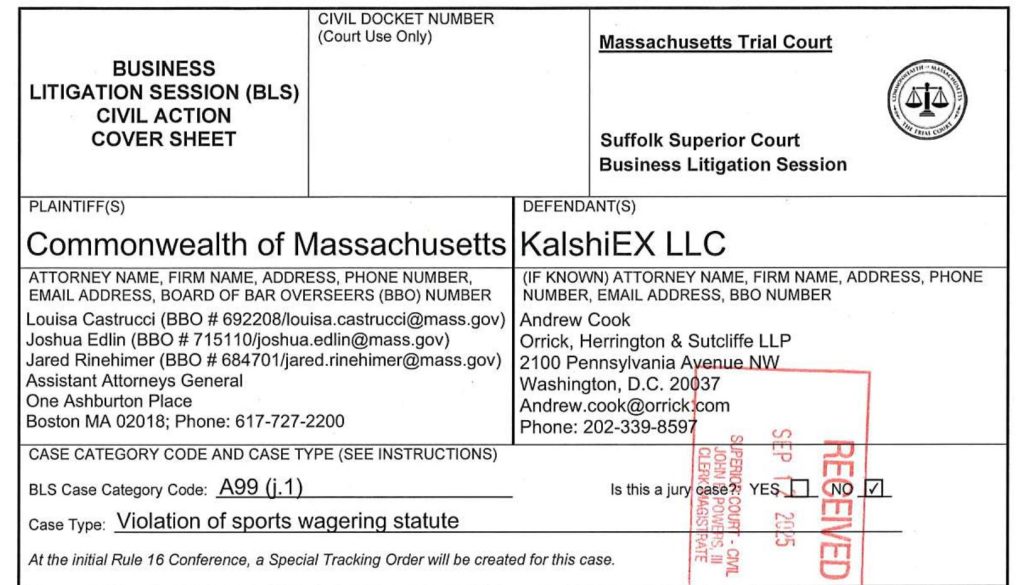
Massachusetts Sues Kalshi Over Alleged Unlicensed Sports Betting, Platform Vows to FightSource: MASS[.]GOV

Kalshi Accused of Bypassing Consumer Protections Through “Event Contract” Model

Massachusetts regulators allege Kalshi’s binary “yes or no” event contracts function identically to traditional sports betting while circumventing state oversight.

The platform offers moneyline contracts, point spreads, over-under bets, and proposition wagers that mirror licensed operators’ offerings.

The company allows users aged 18-21 to place bets despite Massachusetts requiring age 21 for sports wagering.

Kalshi provides minimal responsible gambling safeguards compared to licensed operators, offering no deposit limits or cooling-off periods until March 2025.

State officials note Kalshi markets extensively through television, social media, and partnerships with Robinhood.

The platform previously advertised itself as “The First Nationwide Legal Sports Betting Platform” before shifting language to describe activities as “trading” after receiving cease-and-desist orders from multiple states.

The Massachusetts Gaming Commission specifically requested Attorney General Campbell pursue enforcement action.

Licensed operators pay $5 million for five-year licenses, plus annual fees of $1 million, while Kalshi operates without state authorization, despite processing comparable wagering volumes.

Attorney General Campbell emphasized in a press release that sports wagering “comes with significant risk of addiction and financial loss and must be strictly regulated to mitigate public health consequences.”

The filing requests a court order for Kalshi to cease Massachusetts operations during litigation.

Federal vs State Jurisdiction Battle Intensifies Across Multiple States

Kalshi argues its operations fall under Commodity Futures Trading Commission oversight rather than state gambling regulation.

The company previously sued Nevada and New Jersey gaming regulators, claiming federal authority preempts state enforcement actions.

Federal courts sided with Kalshi in those cases, barring state regulators from intervening while litigation continues.

However, at least seven states, including Arizona, Montana, Ohio, and Illinois, have issued cease-and-desist orders targeting the platform’s sports offerings.

Robinhood Derivatives filed similar lawsuits against Nevada and New Jersey in August, claiming unfair treatment compared to Kalshi’s protected status.

The trading platform facilitates event contracts that settle on Kalshi’s system while seeking identical federal preemption protections.

Kalshi co-founder Tarek Mansour stated the company stands “ready to defend” its technology “once again in a court of law.”

The platform maintains that prediction markets represent “critical innovation” that all Americans should have access to.

Meanwhile, rival prediction market Polymarket prepares U.S. re-entry after CEO Shayne Coplan claimed CFTC approval.

Business Insider reports that Polymarket is seeking funding that could potentially triple its $1 billion valuation to $10 billion.

Notably, for Kalshi, its rapid growth trajectory adds complexity to the regulatory challenges it faces.

The platform processed $441 million in trading volume during the first four days of the 2025 NFL season, with nearly $200 million on September 7 alone, which was one of its busiest periods since the 2024 presidential election.

Massachusetts Sues Kalshi Over Alleged Unlicensed Sports Betting, Platform Vows to FightSource: X/Kalshi

The company achieved $875 million in monthly volume during August 2025, while reports suggest Kalshi is approaching a new funding round, potentially valuing it at $5 billion.

This would more than double its $2 billion valuation from a June funding round led by Paradigm with participation from Sequoia and Multicoin Capital.

As it stands now, Massachusetts joins growing state-level enforcement efforts targeting platforms that process billions in wagering volume without traditional sports betting licenses.

CFTC acting Commissioner Caroline Pham announced in February a shift away from “regulation by enforcement” toward fraud protection.

However, the agency previously probed Super Bowl contracts offered by both Kalshi and Crypto.com before concluding investigations without enforcement actions.


면책 조항: 본 사이트에 재게시된 글들은 공개 플랫폼에서 가져온 것으로 정보 제공 목적으로만 제공됩니다. 이는 반드시 MEXC의 견해를 반영하는 것은 아닙니다. 모든 권리는 원저자에게 있습니다. 제3자의 권리를 침해하는 콘텐츠가 있다고 판단될 경우, crypto.news@mexc.com으로 연락하여 삭제 요청을 해주시기 바랍니다. MEXC는 콘텐츠의 정확성, 완전성 또는 시의적절성에 대해 어떠한 보증도 하지 않으며, 제공된 정보에 기반하여 취해진 어떠한 조치에 대해서도 책임을 지지 않습니다. 본 콘텐츠는 금융, 법률 또는 기타 전문적인 조언을 구성하지 않으며, MEXC의 추천이나 보증으로 간주되어서는 안 됩니다.

USD1 Genesis: 0 Fees + 12% APR

USD1 Genesis: 0 Fees + 12% APRUSD1 Genesis: 0 Fees + 12% APR

New users: stake for up to 600% APR. Limited time!




