Ethereum could emerge as the biggest winner from the rise of digital asset treasuries (DATs), with analysts at Standard Chartered arguing that the proof-of-stake blockchain is better positioned than either Bitcoin or Solana as market pressures intensify. In a report published Monday, Geoffrey Kendrick, the bank’s global head of digital assets research, said Ethereum treasuries are set to play a larger role in driving demand for the token compared with their Bitcoin and Solana counterparts. The assessment comes as publicly listed companies that hold cryptocurrencies on their balance sheets face increasing pressure from falling market valuations. Standard Chartered Sees Consolidation Ahead in Bitcoin-Focused DATs Digital asset treasuries have been one of the defining investment trends of 2025, helping push crypto prices to fresh highs earlier in the year. These firms rely on trading at a premium to the value of their holdings, known as market NAV (mNAV), to raise funds for further purchases. But in recent weeks, mNAVs for many DATs have slipped below 1, reducing their ability to buy additional tokens and triggering concerns about sustainability.Source: Standard Chartered Research Kendrick argued that this phase would mark a shakeout in the sector, with success depending on three factors: the ability to raise cheap funding, scale that attracts liquidity, and the generation of staking yield. He noted that Ethereum and Solana treasuries have an advantage over Bitcoin in this regard, as both networks offer staking rewards. “We think ETH and SOL DATs should be assigned higher mNAVs than BTC DATs due to staking yield,” Kendrick said. The analyst also noted market saturation among Bitcoin-focused firms. Inspired by Strategy’s aggressive accumulation of BTC, nearly 90 companies have launched similar models, collectively holding more than 150,000 BTC, six times more than at the start of the year. With valuations under pressure, Standard Chartered expects consolidation in this space, suggesting that acquisitions of smaller DATs by larger players could become more common. Such moves, however, would represent coin rotation within the sector rather than new demand for Bitcoin. Ethereum treasuries, by contrast, continue to expand. Kendrick said companies holding ETH have already accumulated about 3.1% of the cryptocurrency’s circulating supply since June. BitMine Immersion Technologies, listed on the NYSE American, is currently the largest ETH-focused DAT with more than 2 million ETH, representing about 5% of supply. The firm is still only one-third of the way to its target and has continued buying despite the broader market pressure. Solana treasuries are smaller and less developed, with about 0.8% of the token’s supply held by DATs. Questions also remain over regulatory treatment, with reports suggesting Nasdaq-listed firms may need shareholder approval before allocating to crypto. Kendrick noted that this leaves Ethereum in a stronger relative position. According to Standard Chartered, DATs already hold 4% of all Bitcoin, compared with 3.1% of Ethereum and 0.8% of Solana. The bank sees Ethereum treasuries as better placed to maintain demand, thanks to staking rewards, a clearer regulatory outlook, and aggressive accumulation strategies. Ethereum is currently trading at $4,492, down 2.6% on the day but still up more than 150% since July, following institutional adoption and ETF inflows. Despite recent volatility, Kendrick concluded that DAT activity remains a more positive driver for ETH than for BTC or SOL going forward. Ethereum Treasury Firms Gain Ground as ETFs Attract Record Inflows Standard Chartered has doubled down on its view that Ethereum treasury companies may offer stronger upside than spot exchange-traded funds (ETFs). Kendrick said in August that firms buying Ether (ETH) for balance-sheet strategies are becoming increasingly attractive to investors as their net asset value (NAV) multiples normalize. According to Kendrick, the NAV ratios of treasury firms, market capitalization relative to ETH holdings, are now stabilizing near 1.0. This adjustment, he argued, makes them “very investable” for investors seeking ETH exposure, particularly as these companies provide a form of regulatory arbitrage compared with direct crypto ownership. He pointed out SharpLink Gaming, whose NAV multiple peaked at 2.5 before falling closer to parity, and BitMine Immersion Technologies, the sector leader with 2.15 million ETH ($9.7 billion) on its books. Together, Ethereum treasury companies now hold nearly 5 million ETH, or about 4.1% of the circulating supply, according to industry trackers. That figure rivals the holdings of U.S.-listed spot ETFs, which collectively manage 6.69 million ETH ($30.2 billion), equal to 5.5% of supply. BlackRock’s ETHA leads the pack with $17.25 billion in assetsEthereum could emerge as the biggest winner from the rise of digital asset treasuries (DATs), with analysts at Standard Chartered arguing that the proof-of-stake blockchain is better positioned than either Bitcoin or Solana as market pressures intensify. In a report published Monday, Geoffrey Kendrick, the bank’s global head of digital assets research, said Ethereum treasuries are set to play a larger role in driving demand for the token compared with their Bitcoin and Solana counterparts. The assessment comes as publicly listed companies that hold cryptocurrencies on their balance sheets face increasing pressure from falling market valuations. Standard Chartered Sees Consolidation Ahead in Bitcoin-Focused DATs Digital asset treasuries have been one of the defining investment trends of 2025, helping push crypto prices to fresh highs earlier in the year. These firms rely on trading at a premium to the value of their holdings, known as market NAV (mNAV), to raise funds for further purchases. But in recent weeks, mNAVs for many DATs have slipped below 1, reducing their ability to buy additional tokens and triggering concerns about sustainability.Source: Standard Chartered Research Kendrick argued that this phase would mark a shakeout in the sector, with success depending on three factors: the ability to raise cheap funding, scale that attracts liquidity, and the generation of staking yield. He noted that Ethereum and Solana treasuries have an advantage over Bitcoin in this regard, as both networks offer staking rewards. “We think ETH and SOL DATs should be assigned higher mNAVs than BTC DATs due to staking yield,” Kendrick said. The analyst also noted market saturation among Bitcoin-focused firms. Inspired by Strategy’s aggressive accumulation of BTC, nearly 90 companies have launched similar models, collectively holding more than 150,000 BTC, six times more than at the start of the year. With valuations under pressure, Standard Chartered expects consolidation in this space, suggesting that acquisitions of smaller DATs by larger players could become more common. Such moves, however, would represent coin rotation within the sector rather than new demand for Bitcoin. Ethereum treasuries, by contrast, continue to expand. Kendrick said companies holding ETH have already accumulated about 3.1% of the cryptocurrency’s circulating supply since June. BitMine Immersion Technologies, listed on the NYSE American, is currently the largest ETH-focused DAT with more than 2 million ETH, representing about 5% of supply. The firm is still only one-third of the way to its target and has continued buying despite the broader market pressure. Solana treasuries are smaller and less developed, with about 0.8% of the token’s supply held by DATs. Questions also remain over regulatory treatment, with reports suggesting Nasdaq-listed firms may need shareholder approval before allocating to crypto. Kendrick noted that this leaves Ethereum in a stronger relative position. According to Standard Chartered, DATs already hold 4% of all Bitcoin, compared with 3.1% of Ethereum and 0.8% of Solana. The bank sees Ethereum treasuries as better placed to maintain demand, thanks to staking rewards, a clearer regulatory outlook, and aggressive accumulation strategies. Ethereum is currently trading at $4,492, down 2.6% on the day but still up more than 150% since July, following institutional adoption and ETF inflows. Despite recent volatility, Kendrick concluded that DAT activity remains a more positive driver for ETH than for BTC or SOL going forward. Ethereum Treasury Firms Gain Ground as ETFs Attract Record Inflows Standard Chartered has doubled down on its view that Ethereum treasury companies may offer stronger upside than spot exchange-traded funds (ETFs). Kendrick said in August that firms buying Ether (ETH) for balance-sheet strategies are becoming increasingly attractive to investors as their net asset value (NAV) multiples normalize. According to Kendrick, the NAV ratios of treasury firms, market capitalization relative to ETH holdings, are now stabilizing near 1.0. This adjustment, he argued, makes them “very investable” for investors seeking ETH exposure, particularly as these companies provide a form of regulatory arbitrage compared with direct crypto ownership. He pointed out SharpLink Gaming, whose NAV multiple peaked at 2.5 before falling closer to parity, and BitMine Immersion Technologies, the sector leader with 2.15 million ETH ($9.7 billion) on its books. Together, Ethereum treasury companies now hold nearly 5 million ETH, or about 4.1% of the circulating supply, according to industry trackers. That figure rivals the holdings of U.S.-listed spot ETFs, which collectively manage 6.69 million ETH ($30.2 billion), equal to 5.5% of supply. BlackRock’s ETHA leads the pack with $17.25 billion in assets

Ethereum Treasuries Set to Outperform Bitcoin and Solana as DAT Shakeout Looms: Standard Chartered

2025/09/16 03:46
4분 읽기
이 콘텐츠에 대한 의견이나 우려 사항이 있으시면 crypto.news@mexc.com으로 연락주시기 바랍니다

Ethereum could emerge as the biggest winner from the rise of digital asset treasuries (DATs), with analysts at Standard Chartered arguing that the proof-of-stake blockchain is better positioned than either Bitcoin or Solana as market pressures intensify.

In a report published Monday, Geoffrey Kendrick, the bank’s global head of digital assets research, said Ethereum treasuries are set to play a larger role in driving demand for the token compared with their Bitcoin and Solana counterparts.

The assessment comes as publicly listed companies that hold cryptocurrencies on their balance sheets face increasing pressure from falling market valuations.

Standard Chartered Sees Consolidation Ahead in Bitcoin-Focused DATs

Digital asset treasuries have been one of the defining investment trends of 2025, helping push crypto prices to fresh highs earlier in the year.

These firms rely on trading at a premium to the value of their holdings, known as market NAV (mNAV), to raise funds for further purchases.

But in recent weeks, mNAVs for many DATs have slipped below 1, reducing their ability to buy additional tokens and triggering concerns about sustainability.
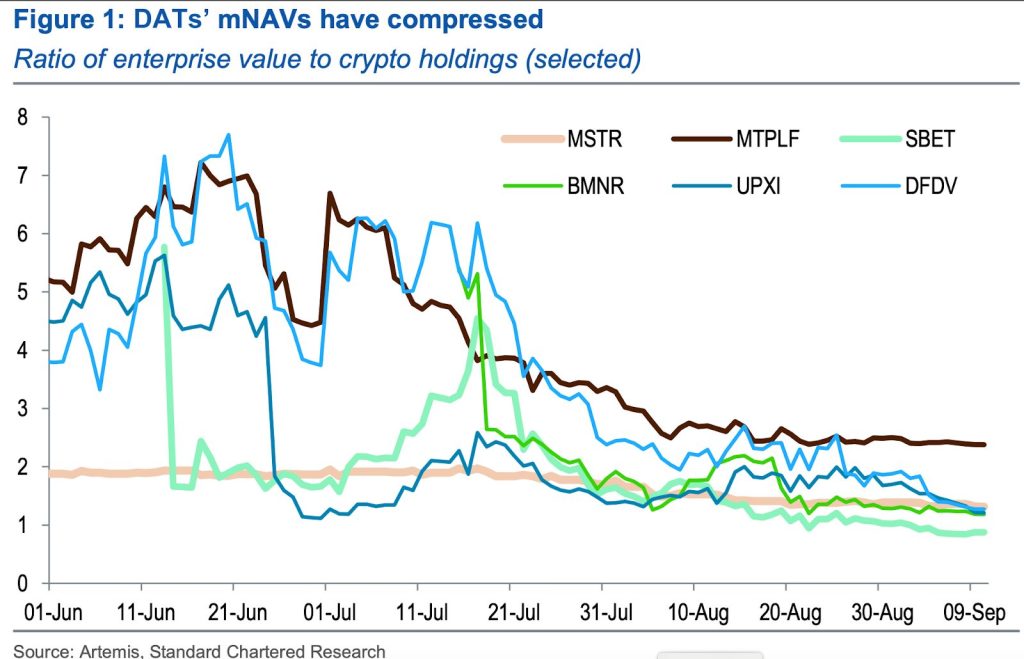
Source: Standard Chartered Research

Kendrick argued that this phase would mark a shakeout in the sector, with success depending on three factors: the ability to raise cheap funding, scale that attracts liquidity, and the generation of staking yield.

He noted that Ethereum and Solana treasuries have an advantage over Bitcoin in this regard, as both networks offer staking rewards.

“We think ETH and SOL DATs should be assigned higher mNAVs than BTC DATs due to staking yield,” Kendrick said.

The analyst also noted market saturation among Bitcoin-focused firms. Inspired by Strategy’s aggressive accumulation of BTC, nearly 90 companies have launched similar models, collectively holding more than 150,000 BTC, six times more than at the start of the year.

With valuations under pressure, Standard Chartered expects consolidation in this space, suggesting that acquisitions of smaller DATs by larger players could become more common.

Such moves, however, would represent coin rotation within the sector rather than new demand for Bitcoin.

Ethereum treasuries, by contrast, continue to expand. Kendrick said companies holding ETH have already accumulated about 3.1% of the cryptocurrency’s circulating supply since June.

BitMine Immersion Technologies, listed on the NYSE American, is currently the largest ETH-focused DAT with more than 2 million ETH, representing about 5% of supply.

The firm is still only one-third of the way to its target and has continued buying despite the broader market pressure.

Solana treasuries are smaller and less developed, with about 0.8% of the token’s supply held by DATs.

Questions also remain over regulatory treatment, with reports suggesting Nasdaq-listed firms may need shareholder approval before allocating to crypto.

Kendrick noted that this leaves Ethereum in a stronger relative position.

According to Standard Chartered, DATs already hold 4% of all Bitcoin, compared with 3.1% of Ethereum and 0.8% of Solana.

The bank sees Ethereum treasuries as better placed to maintain demand, thanks to staking rewards, a clearer regulatory outlook, and aggressive accumulation strategies.

Ethereum is currently trading at $4,492, down 2.6% on the day but still up more than 150% since July, following institutional adoption and ETF inflows.

Despite recent volatility, Kendrick concluded that DAT activity remains a more positive driver for ETH than for BTC or SOL going forward.

Ethereum Treasury Firms Gain Ground as ETFs Attract Record Inflows

Standard Chartered has doubled down on its view that Ethereum treasury companies may offer stronger upside than spot exchange-traded funds (ETFs).

Kendrick said in August that firms buying Ether (ETH) for balance-sheet strategies are becoming increasingly attractive to investors as their net asset value (NAV) multiples normalize.

According to Kendrick, the NAV ratios of treasury firms, market capitalization relative to ETH holdings, are now stabilizing near 1.0.

This adjustment, he argued, makes them “very investable” for investors seeking ETH exposure, particularly as these companies provide a form of regulatory arbitrage compared with direct crypto ownership.

He pointed out SharpLink Gaming, whose NAV multiple peaked at 2.5 before falling closer to parity, and BitMine Immersion Technologies, the sector leader with 2.15 million ETH ($9.7 billion) on its books.

Together, Ethereum treasury companies now hold nearly 5 million ETH, or about 4.1% of the circulating supply, according to industry trackers.

That figure rivals the holdings of U.S.-listed spot ETFs, which collectively manage 6.69 million ETH ($30.2 billion), equal to 5.5% of supply. BlackRock’s ETHA leads the pack with $17.25 billion in assets.


면책 조항: 본 사이트에 재게시된 글들은 공개 플랫폼에서 가져온 것으로 정보 제공 목적으로만 제공됩니다. 이는 반드시 MEXC의 견해를 반영하는 것은 아닙니다. 모든 권리는 원저자에게 있습니다. 제3자의 권리를 침해하는 콘텐츠가 있다고 판단될 경우, crypto.news@mexc.com으로 연락하여 삭제 요청을 해주시기 바랍니다. MEXC는 콘텐츠의 정확성, 완전성 또는 시의적절성에 대해 어떠한 보증도 하지 않으며, 제공된 정보에 기반하여 취해진 어떠한 조치에 대해서도 책임을 지지 않습니다. 본 콘텐츠는 금융, 법률 또는 기타 전문적인 조언을 구성하지 않으며, MEXC의 추천이나 보증으로 간주되어서는 안 됩니다.

USD1 Genesis: 0 Fees + 12% APR

USD1 Genesis: 0 Fees + 12% APRUSD1 Genesis: 0 Fees + 12% APR

New users: stake for up to 600% APR. Limited time!



