

Social Justice in Economics: A New Framework for a Free Economy with Inclusion
Table of Links
Abstract and 1. Introduction
-
A free and fair economy: definition, existence and uniqueness
2.1 A free economy
2.2 A free and fair economy
-
Equilibrium existence in a free and fair economy
3.1 A free and fair economy as a strategic form game
3.2 Existence of an equilibrium
-
Equilibrium efficiency in a free and fair economy
-
A free economy with social justice and inclusion
5.1 Equilibrium existence and efficiency in a free economy with social justice
5.2 Choosing a reference point to achieve equilibrium efficiency
-
Some applications
6.1 Teamwork: surplus distribution in a firm
6.2 Contagion and self-enforcing lockdown in a networked economy
6.3 Bias in academic publishing
6.4 Exchange economies
-
Contributions to the closely related literature
-
Conclusion and References
Appendix
5 A free economy with social justice and inclusion
Our conception of a free economy with social justice embodies both the ideals of market justice and social inclusion. Members of a society do not generally have the same abilities. Consequently, distribution schemes that are based on market justice alone will penalize individuals with less opportunities or those who are unable to develop a positive productivity to the economy.
\ One of the goals of social justice is to remedy this social disadvantage that results mainly from arbitrary factors in the sense of moral thought. Social justice requires caring for the least well-off and those who have natural limitations not allowing them to achieve as much as they would like to. This requirement goes beyond the considerations of a free and fair economy in which agents have equal access to civic rights, wealth, opportunities, and privileges. The ideal of social justice could be implemented in a fair society through specific redistribution rules, and that is the main message that we intend to provide in this section.
\ Market justice as defined in the previous sections requires that the collective outcome must be distributed based on individual marginal contributions. Thus, a citizen who is not able to contribute a positive value to the economy shouldn’t receive a positive payoff.
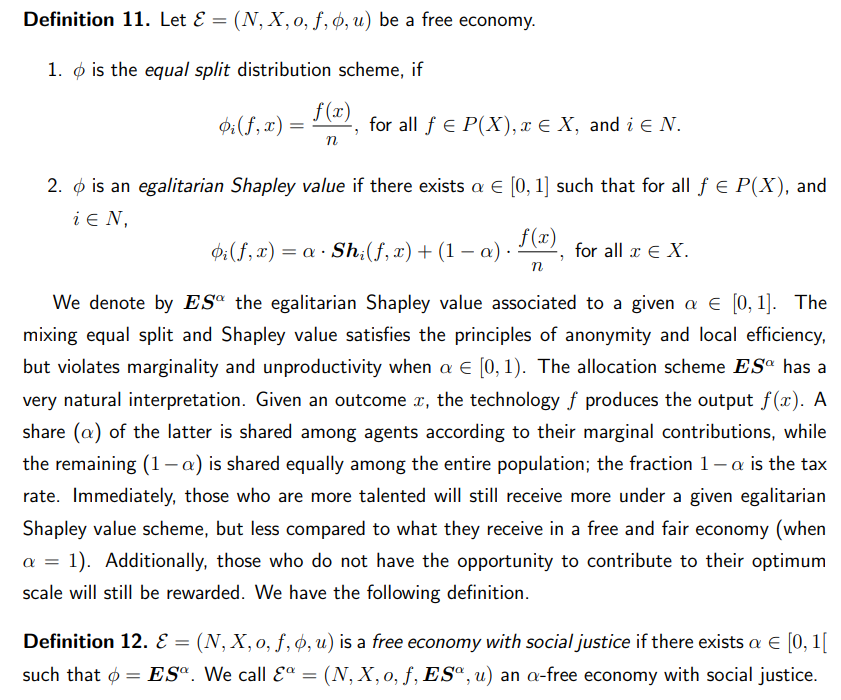
\ Social justice differs to market justice in the sense that everyone should receive a basic worth for living. This principle is consistent with the results found by De Clippel and Rozen [2013] in a recent experimental study in which neutral agents (called “Decision Makers”) are called upon to distribute collective rewards among other agents (called “Recipients”). They show that even if collective rewards depend on complementarity and substitutability between recipients, some decision markers still allocate positive rewards to those who bring nothing to the economy. Moreover, a linear convex combination of the Shapley value [Shapley, 1953] and the equal split scheme arises as a one-parameter allocation estimate of data. This convex allocation is also known as an egalitarian Shapley value [Joosten, 1996]. Intuitively, this pay scheme can be viewed as implementing a progressive redistribution policy where a positive amount of the total surplus in an economy is taxed and redistributed equally among all the agents. We use this distribution scheme to showcase our purpose. We will see that some properties of an economy that embeds the idea of social justice depends on the tax rate. Below, we define the equal-split, and an egalitarian Shapley value schemes.
\ 
\ In Section 5.1, we analyze equilibrium existence and Pareto-efficiency in free economies with social justice. Our methodology is similar to the one followed in Sections 3 and 4. In Section 5.2, we prove that an economy can always choose its reference point to induce equilibrium efficiency, even when the economy is not monotonic.
\
:::info Authors:
(1) Ghislain H. Demeze-Jouatsa, Center for Mathematical Economics, University of Bielefeld (demeze jouatsa@uni-bielefeld.de);
(2) Roland Pongou, Department of Economics, University of Ottawa (rpongou@uottawa.ca);
(3) Jean-Baptiste Tondji, Department of Economics and Finance, The University of Texas Rio Grande Valley (jeanbaptiste.tondji@utrgv.edu).
:::
:::info This paper is available on arxiv under CC BY 4.0 DEED license.
:::
\


추천 콘텐츠

South Korean Gaming Company NXC Decides to Reduce Its Crypto Holdings! Here Are the Details
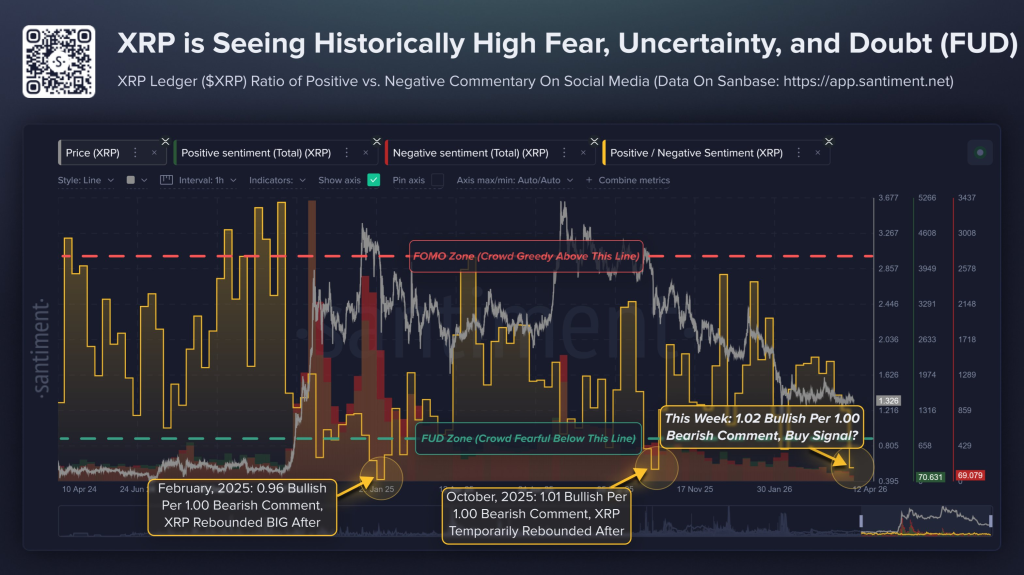
XRP Sentiment Just Flashed a Rare Contrarian Signal – Here’s What Happened the Last Two Times




