Fed Raises Rates to 3.75%–4%: Why Bitcoin and Crypto Markets Should Care
Overview
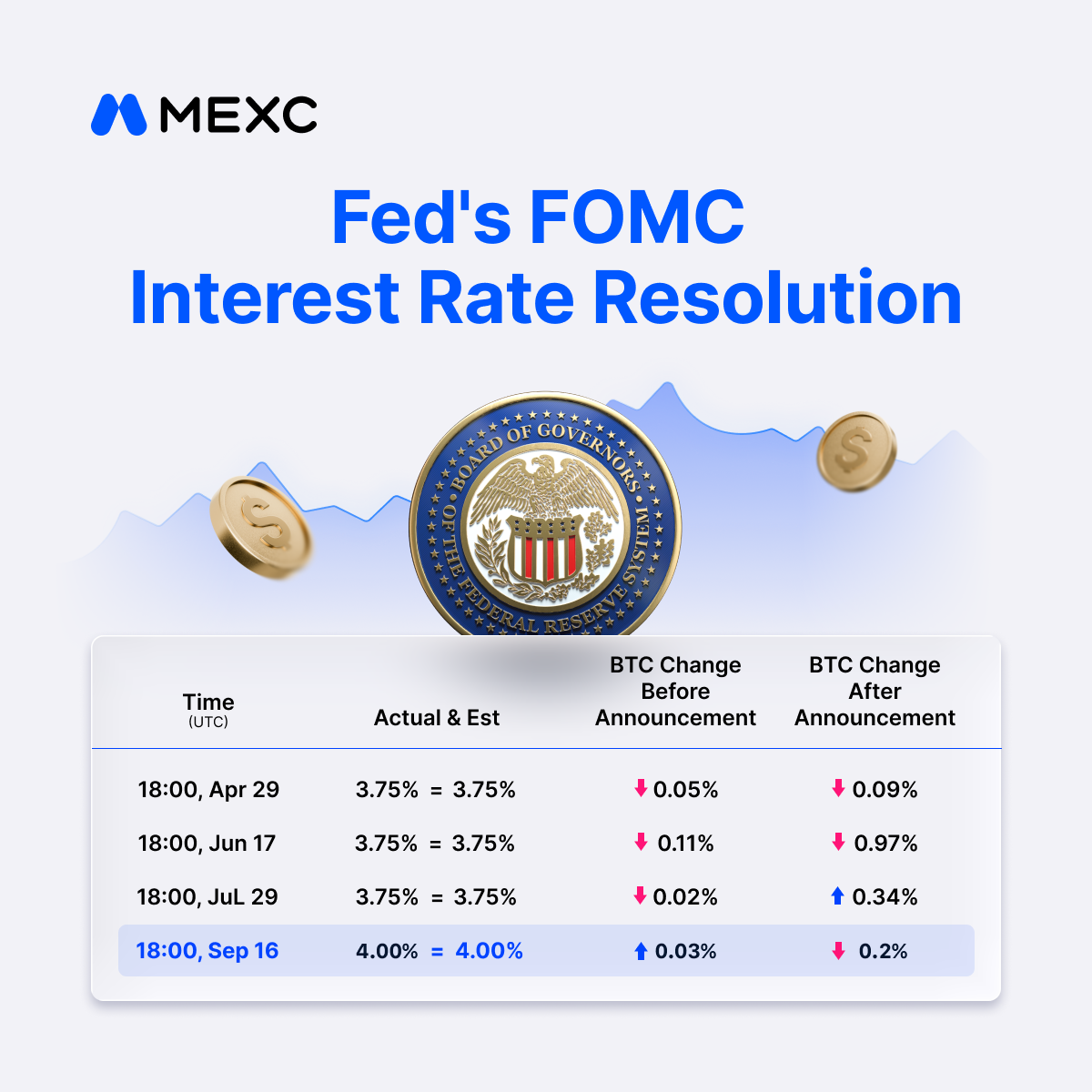
The Federal Reserve raised the federal funds target range by 25 basis points to 3.75%–4.00% on September 16, 2026, with the Federal Open Market Committee approving the decision by a unanimous 12–0 vote. The Fed said economic activity continued to expand at a solid pace, domestic spending remained resilient, productivity growth was strong, and capital investment was robust. At the same time, inflation remained elevated, leading policymakers to conclude that tighter policy was necessary to support a timelier return to the 2% target.
For Bitcoin and the broader crypto market, the importance of the Fed rate hike goes beyond the additional 25 basis points. Higher policy rates can lift the return available on cash and Treasury securities, strengthen the U.S. dollar, raise financing costs, and reduce the attractiveness of leverage. Those channels influence the liquidity environment in which BTC, altcoins, DeFi markets, and crypto equities trade.
The September projections make the decision more significant. The median FOMC projection for the federal funds rate at the end of 2026 rose to 4.1%, while 16 of 18 participants placed their year-end projection above the current 3.875% midpoint. The question for crypto is therefore no longer simply why the Fed raised rates in September, but whether the move marks the beginning of a longer tightening phase.
Key Takeaways
- The Fed raised rates by 25 basis points to 3.75%–4.00% on September 16, 2026.
- Inflation remains elevated even as U.S. economic activity continues to expand.
- Most FOMC participants project rates ending 2026 above the current target-range midpoint.
- Higher Treasury yields, a stronger dollar, and more expensive leverage can tighten liquidity for Bitcoin and crypto.
- The effect is not mechanical: ETF flows, regulation, institutional demand, and crypto-specific liquidity can still dominate short-term price action.
Why Did the Fed Raise Rates to 3.75%–4%?
Inflation Remains the Core Policy Problem
The September Fed rate hike reflects an uncomfortable combination for monetary policymakers: economic activity remains resilient while inflation has not returned to target. The Fed’s statement emphasized that domestic spending remained firm, productivity growth was strong, capital investment was robust, and unemployment had changed little. That gives the central bank more room to tighten policy than it would have in an economy already experiencing a sharp contraction.
At the same time, inflation remains the dominant constraint. The September Summary of Economic Projections put median 2026 PCE inflation at 3.7% and core PCE inflation at 3.4%, both materially above the Fed’s 2% objective. The policy logic is therefore straightforward: if demand and employment remain sufficiently resilient while inflation stays above target, policymakers can justify a higher interest-rate path even if tighter financial conditions create pressure for asset markets.
For investors, this matters because the Fed is not describing the September move as emergency tightening in response to a collapsing economy. It is instead attempting to restrain inflation while growth remains positive. That raises the possibility that restrictive financial conditions could persist longer than markets previously expected.
The September Decision Was About the Future Rate Path, Not Just One Meeting
A 25-basis-point adjustment by itself rarely determines the medium-term direction of Bitcoin. Markets generally respond more strongly to changes in expected future policy.
The September dot plot provides that forward signal. Twelve FOMC participants placed the appropriate year-end 2026 policy-rate midpoint at 4.125%, four at 4.375%, and only two at 3.875%, which corresponds to the midpoint of the new 3.75%–4.00% range. In other words, most participants currently see a higher year-end rate than the level reached after the September meeting.
That does not guarantee another hike. The projections are individual policy assessments rather than commitments, and they can change as inflation, employment, growth, energy prices, and financial conditions evolve. But for crypto markets, they raise the probability that the September move is part of a broader tightening regime rather than a one-off adjustment.
Why Does the Fed Rate Hike Matter for Bitcoin?
Higher Rates Raise the Opportunity Cost of Holding Bitcoin
Bitcoin does not provide a contractual interest payment. Its expected return comes from price appreciation, adoption, scarcity, and demand rather than a fixed coupon.
When policy rates rise, investors can earn more from Treasury bills, money-market funds, bank deposits, and other dollar-denominated instruments with substantially lower volatility. This increases the opportunity cost of allocating capital to Bitcoin and other non-yielding or highly volatile assets.
The mechanism does not mean that every Fed rate hike must cause BTC to fall. Instead, higher rates raise the return Bitcoin must effectively compete with when investors allocate capital across asset classes. If cash yields become more attractive at the same time that risk appetite weakens, marginal capital can move away from crypto even without a fundamental deterioration in Bitcoin’s network or adoption.
Institutional portfolios make this comparison especially important. A fund manager deciding between short-duration Treasuries, equities, credit, gold, and Bitcoin does not evaluate BTC in isolation. Higher risk-free rates change the relative attractiveness of the entire opportunity set.
Treasury Yields and the Dollar May Matter More Than 25 Basis Points
The transmission from Fed policy to Bitcoin often runs through Treasury yields and the U.S. dollar.
Higher policy-rate expectations can push short-dated Treasury yields higher, while persistent inflation and fiscal concerns can also keep longer-term yields elevated. When investors can earn a high nominal return from government debt, portfolio demand for speculative assets can weaken. Rising yields can also tighten financial conditions across equities, venture capital, corporate credit, and leveraged trading.
The dollar creates another channel. Higher U.S. rates can support demand for dollar-denominated assets, strengthening the currency relative to other major currencies. A stronger dollar often corresponds with tighter global financial conditions because international investors, companies, and borrowers need more local-currency resources to obtain the same amount of dollars.
Bitcoin is not permanently inversely correlated with the dollar or Treasury yields, but both remain important macro indicators. For that reason, the more useful post-FOMC question is not whether BTC rose or fell in the first hour after the decision. It is whether the 2-year Treasury yield, the 10-year yield, the dollar, and broader liquidity conditions continue moving in a restrictive direction over the following weeks.
How Could Higher Rates Affect Crypto Liquidity?
Leverage and Stablecoin Capital Face a Higher Hurdle Rate
Higher rates affect crypto partly through the cost of leverage. Hedge funds, market makers, proprietary trading firms, corporations, and other investors often rely on borrowed capital. As benchmark rates rise, the cost of financing leveraged positions generally increases.
That can reduce demand for basis trades, directional leverage, venture financing, and other strategies that depend on inexpensive capital. A lower level of leverage can reduce liquidation risk during some market periods, but it can also reduce market depth and speculative liquidity.
Stablecoin markets face a related challenge. When traditional money-market instruments offer attractive yields, crypto lenders and DeFi protocols must compete with a much higher risk-free benchmark. A 4% onchain lending return may look compelling in a near-zero-rate environment but much less attractive when government securities provide comparable yields with lower credit and smart-contract risk.
This does not make higher rates negative for every part of crypto. Tokenized Treasury products and other real-world asset markets can benefit because higher traditional yields make onchain fixed-income exposure more economically attractive. The same macro environment that pressures high-beta tokens can therefore support RWA adoption.
Bitcoin Can Still Decouple From Monetary Policy
Macro policy is only one driver of Bitcoin.
Spot ETF inflows, corporate treasury purchases, sovereign adoption, regulatory developments, derivatives positioning, exchange liquidity, and long-term holder behavior can all overwhelm the effect of interest rates over shorter periods.
This is why simple rules such as “Fed hike equals Bitcoin down” are unreliable. A restrictive rate environment can create a macro headwind while crypto-specific demand simultaneously creates a stronger tailwind.
The better framework is to view the Fed rate hike as changing the cost and availability of capital. Bitcoin’s actual market response then depends on whether crypto-specific demand is strong enough to offset that tightening.
Will the Fed Raise Rates Again in 2026?
The Dot Plot Suggests the Tightening Cycle May Not Be Over
The September projections indicate that most FOMC participants currently see additional tightening as appropriate before the end of the year. The median projected federal funds rate for 2026 is 4.1%, compared with the 3.75%–4.00% range established at the September meeting.
That makes the next rate decision more important than the September headline itself. If inflation remains elevated and economic activity continues to absorb tighter conditions, another 25-basis-point increase would be consistent with the median projection.
However, the distribution of projections also shows uncertainty. Monetary policy is not predetermined, and the Fed can change course if incoming data alter its assessment of inflation or employment risks.
For Bitcoin, this means markets are likely to become increasingly sensitive to data that could shift the expected year-end policy rate.
Inflation Data Will Determine Whether Tightening Continues
The main indicators to monitor are PCE inflation, CPI, labor-market data, wages, consumer demand, and energy prices.
If inflation continues to exceed expectations while employment and spending remain resilient, the case for additional tightening becomes stronger. In that scenario, Treasury yields and the dollar could remain elevated, extending the liquidity headwind for crypto markets.
If inflation slows faster than expected or economic conditions weaken materially, investors may reduce expectations for further increases. That would not automatically trigger a crypto rally, but it could reduce one important source of macro pressure.
The key distinction is between the current policy rate and the expected path. Markets often adjust before the Fed acts because Treasury yields, futures pricing, and portfolio positioning respond continuously to new information.
The Fed’s Policy Path Matters More for Bitcoin Than One 25-Basis-Point Hike
The September Fed rate hike matters because it changes the broader monetary-policy regime facing Bitcoin and other risk assets. The federal funds target range is now 3.75%–4.00%, inflation remains above target, and most FOMC participants currently expect rates to end 2026 above the midpoint of the new range.
For Bitcoin, the most important effects are indirect. Higher Treasury yields increase the opportunity cost of holding a volatile non-yielding asset, a stronger dollar can tighten global liquidity, and higher financing costs can reduce leverage throughout crypto markets. Stablecoin and DeFi capital must also compete with increasingly attractive traditional cash yields.
But monetary policy should not be treated as a deterministic Bitcoin trading signal. Institutional flows, ETF demand, regulation, corporate purchases, and supply dynamics can produce strong crypto-specific trends even when rates remain restrictive.
The central question is therefore whether the Fed stays tighter for longer than investors currently expect. If inflation remains persistent and rates move further above 4%, Bitcoin may require stronger structural demand to offset a more restrictive liquidity environment. If inflation moderates and the expected tightening path shortens, that macro headwind could weaken.
For crypto investors, the next phase is less about reacting to one FOMC headline and more about monitoring the interaction between inflation, Treasury yields, the dollar, liquidity, and Bitcoin-specific capital flows.
Sources
https://www.federalreserve.gov/newsevents/pressreleases/monetary20260916a.htm
https://www.federalreserve.gov/newsevents/pressreleases/monetary20260916a1.htm
https://www.federalreserve.gov/monetarypolicy/fomcprojtabl20260916.htm
https://www.federalreserve.gov/newsevents/pressreleases/monetary20260916b.htm
Risk Disclaimer: This article is for reference only and does not constitute investment advice. The cryptocurrency market is highly volatile. Please make decisions cautiously based on your individual circumstances.
Можда ће Вам се такође свидети

What Is the Aave RWA Hub? How Institutions Can Borrow Stablecoins Against Tokenized Assets on Avalanche

MUSEBOOK Coin Surges as AI Agents Find Their Own Social Network