P2P Trading Guide: How It Works and How to Trade SafelyP2P Trading Guide: How It Works and How to Trade Safely
Category List
Cancel

P2P Trading Guide: How It Works and How to Trade Safely

⚠️ Buyer Key Takeaways


Key Stage
Awareness Key Takeaway
Browse Ads
✔ Avoid prices that seem too good to be true
Order Created
✔ Keep all communication within the MEXC P2P platform
Never cancel an order after payment
✔ Always check the order time. Do not pay if it is about to expire
Confirm "I have paid" before the order expires
✔ Always verify MEXC official channels via https://www.mexc.com/official-verify
Order canceled/ Timeout
Do not make any payments after the order is canceled or has timed out
✔ Do not make any payments beyond the original order amount

⚠️ Seller Key Takeaways


Key Stage
Awareness Key Takeaway
Browse Ads
✔ Avoid prices that seem too good to be true
Order Created
✔ Keep all communication within the MEXC P2P platform
✔ Be cautious of rushed or pressured requests
Never release crypto before payment is received in your bank account or wallet
✔ Watch for chargeback risks and verify buyer identity
✔ Do not trust screenshots, SMS messages, or unverified proof
✔ Always verify MEXC official channel via https://www.mexc.com/official-verify

1. What is P2P Trading?


P2P (Peer-to-Peer) trading allows users to buy and sell cryptocurrencies directly with each other, while the platform acts as a facilitator by providing matching, asset escrow, and dispute resolution.

For more details: MEXC P2P Trading Guide

2. P2P vs. Buying Crypto on an Exchange


P2P
Exchange
Who you trade with
You trade directly with another user
You trade through the platform's trading system
How prices are set
Prices are set by individual sellers and can be compared
Prices are determined automatically by the market
Platform's role
The platform acts as a mediator and escrow provider
The platform handles order matching and settlement
In simple terms:P2P trading allows users to buy crypto at prices set by individual sellers, which may vary from seller to seller, whereas exchange trading lets users buy crypto instantly at the market price.
For more details: What is P2P Trading

3. How Does P2P Trading Work?


Basic flow
Post / Choose ads → Generate Order → Buyer transfers fiat payment → Seller verifies the payment → Seller releases the crypto
How your funds are protected
  • The seller's crypto is locked in platform escrow once the order is created and remains locked while the order is ongoing.
  • Crypto is released only after payment is confirmed
⚠️ Important
  • After sending the fiat payment, buyer please always remember to click "I have paid"on time
  • Unconfirmed payments may cause the order to time out or be canceled. The system will treat the order as unpaid and release the tokens back to the seller for withdrawal or trading.
  • Platform won't be able to provide compensation.
Simple takeaway
  • P2P trading is protected by escrow — but your actions matter.
  • Always follow the on-platform steps to ensure your funds stay protected.

4. What Are the Common Risks in P2P Trading?


Why scams happen in P2P
P2P scams are usually not caused by platform flaws, but by manipulating human behavior, such as urgency, trust, or fear.
Common pitfalls for beginners
  • Acting too quickly under pressure
  • Ignoring on-platform rules or prompts
  • Trusting off-platform messages or requests

5. Staying Alert: The Best Defense Against Scams
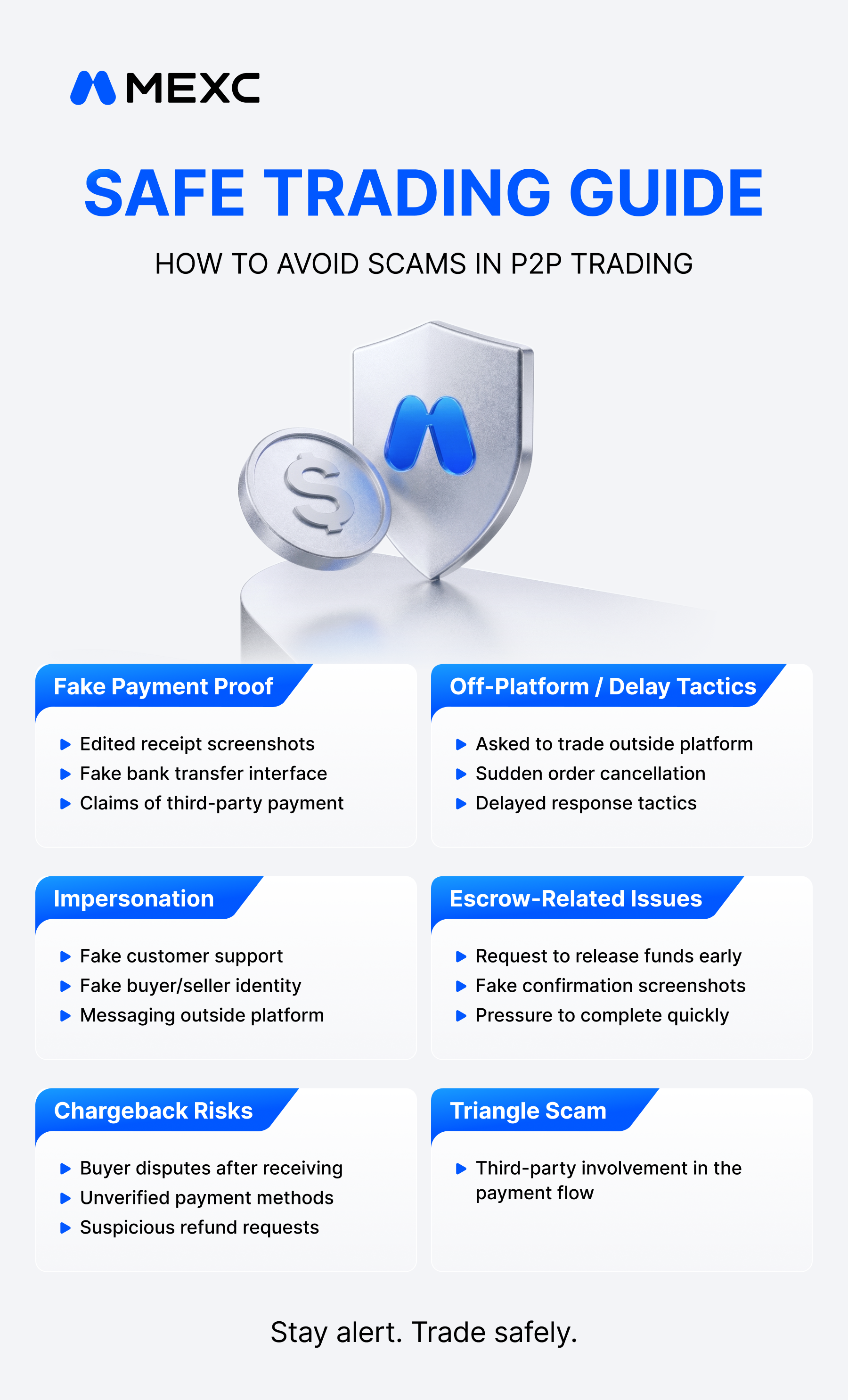


Most P2P scams follow a few repeatable patterns. Knowing them helps you spot risks early.

⚠️ Go through the scam types in the table below to avoid falling victim to scams.


Type of Scam
Summaries
For more details
Fake Payment Proof Scam
Fraudsters send fake screenshots or forged receipts to make it appear that payment has already been made. They then pressure victims to release crypto, falsely claiming that the escrow system will verify the transaction only after the crypto is released.


Offsite Order Cancellation / Timed out Scam


Scammers may move victims to external channels (e.g., Telegram, WhatsApp, Facebook) and pressure them to cancel orders after payment or release crypto before payment is confirmed. Transactions outside the platform are not protected by MEXC's escrow.

Scammers may also claim "order limits," "risk control," or "system restrictions" and demand additional fees before releasing crypto.


Impersonation Scam
Scammers pretend to be customer service and pressuring you to release your crypto immediately under the threat of account suspension or freezing.
Fake Term Escrow Scam
Scammers may use fake payment screenshots or claim a so-called "special escrow" or "third-party escrow" system, urging sellers to release crypto before payment is received. In reality, no funds are credited.
Chargeback Scam
Scammer buyers reverse fiat payments after crypto is released, leaving victim sellers with losses on both fiat and crypto.
Triangle Scam
Scammer tricks a buyer into sending payment to a different merchant's order on the platform. The payment is intentionally redirected so that the scammer can receive crypto from another completed order without paying the original seller.

P2P Trading Guide: How It Works and How to Trade Safely

⚠️ Buyer Key Takeaways


Key Stage
Awareness Key Takeaway
Browse Ads
✔ Avoid prices that seem too good to be true
Order Created
✔ Keep all communication within the MEXC P2P platform
Never cancel an order after payment
✔ Always check the order time. Do not pay if it is about to expire
Confirm "I have paid" before the order expires
✔ Always verify MEXC official channels via https://www.mexc.com/official-verify
Order canceled/ Timeout
Do not make any payments after the order is canceled or has timed out
✔ Do not make any payments beyond the original order amount

⚠️ Seller Key Takeaways


Key Stage
Awareness Key Takeaway
Browse Ads
✔ Avoid prices that seem too good to be true
Order Created
✔ Keep all communication within the MEXC P2P platform
✔ Be cautious of rushed or pressured requests
Never release crypto before payment is received in your bank account or wallet
✔ Watch for chargeback risks and verify buyer identity
✔ Do not trust screenshots, SMS messages, or unverified proof
✔ Always verify MEXC official channel via https://www.mexc.com/official-verify

1. What is P2P Trading?


P2P (Peer-to-Peer) trading allows users to buy and sell cryptocurrencies directly with each other, while the platform acts as a facilitator by providing matching, asset escrow, and dispute resolution.

For more details: MEXC P2P Trading Guide

2. P2P vs. Buying Crypto on an Exchange


P2P
Exchange
Who you trade with
You trade directly with another user
You trade through the platform's trading system
How prices are set
Prices are set by individual sellers and can be compared
Prices are determined automatically by the market
Platform's role
The platform acts as a mediator and escrow provider
The platform handles order matching and settlement
In simple terms:P2P trading allows users to buy crypto at prices set by individual sellers, which may vary from seller to seller, whereas exchange trading lets users buy crypto instantly at the market price.
For more details: What is P2P Trading

3. How Does P2P Trading Work?


Basic flow
Post / Choose ads → Generate Order → Buyer transfers fiat payment → Seller verifies the payment → Seller releases the crypto
How your funds are protected
  • The seller's crypto is locked in platform escrow once the order is created and remains locked while the order is ongoing.
  • Crypto is released only after payment is confirmed
⚠️ Important
  • After sending the fiat payment, buyer please always remember to click "I have paid"on time
  • Unconfirmed payments may cause the order to time out or be canceled. The system will treat the order as unpaid and release the tokens back to the seller for withdrawal or trading.
  • Platform won't be able to provide compensation.
Simple takeaway
  • P2P trading is protected by escrow — but your actions matter.
  • Always follow the on-platform steps to ensure your funds stay protected.

4. What Are the Common Risks in P2P Trading?


Why scams happen in P2P
P2P scams are usually not caused by platform flaws, but by manipulating human behavior, such as urgency, trust, or fear.
Common pitfalls for beginners
  • Acting too quickly under pressure
  • Ignoring on-platform rules or prompts
  • Trusting off-platform messages or requests

5. Staying Alert: The Best Defense Against Scams


Most P2P scams follow a few repeatable patterns. Knowing them helps you spot risks early.

⚠️ Go through the scam types in the table below to avoid falling victim to scams.


Type of Scam
Summaries
For more details
Fake Payment Proof Scam
Fraudsters send fake screenshots or forged receipts to make it appear that payment has already been made. They then pressure victims to release crypto, falsely claiming that the escrow system will verify the transaction only after the crypto is released.


Offsite Order Cancellation / Timed out Scam


Scammers may move victims to external channels (e.g., Telegram, WhatsApp, Facebook) and pressure them to cancel orders after payment or release crypto before payment is confirmed. Transactions outside the platform are not protected by MEXC's escrow.

Scammers may also claim "order limits," "risk control," or "system restrictions" and demand additional fees before releasing crypto.


Impersonation Scam
Scammers pretend to be customer service and pressuring you to release your crypto immediately under the threat of account suspension or freezing.
Fake Term Escrow Scam
Scammers may use fake payment screenshots or claim a so-called "special escrow" or "third-party escrow" system, urging sellers to release crypto before payment is received. In reality, no funds are credited.
Chargeback Scam
Scammer buyers reverse fiat payments after crypto is released, leaving victim sellers with losses on both fiat and crypto.
Triangle Scam
Scammer tricks a buyer into sending payment to a different merchant's order on the platform. The payment is intentionally redirected so that the scammer can receive crypto from another completed order without paying the original seller.