Bank of Korea Completes BIS Tokenized Payment Test: Can Project Agorá Reshape Cross-Border Settlement?
Overview
The Bank of Korea has participated in a live-value transaction test under Project Agorá, an international tokenized payment initiative led by the Bank for International Settlements. The experiment covered six currencies, 17 transaction scenarios, and approximately CHF 800,000 in value.
Although the amount was relatively small, the test marked an important step beyond simulated transactions. It examined whether tokenized central bank reserves and commercial bank deposits could interact through shared programmable infrastructure while preserving the existing roles of central and commercial banks.
Key Takeaways
- Project Agorá connects tokenized central bank reserves and commercial bank deposits within a shared institutional payment framework.
- The test covered six currencies and 17 transaction scenarios involving approximately CHF 800,000.
- Five major South Korean banks participated alongside the Bank of Korea.
- Tokenization could reduce reconciliation delays, settlement risk, and fragmented liquidity.
- The experiment demonstrated feasibility under controlled conditions, not readiness for commercial-scale deployment.
What Did the Project Agorá Test Cover?
Participants, Currencies, and Transactions
The latest test involved 28 central banks and financial institutions. It covered the South Korean won, U.S. dollar, euro, British pound, Swiss franc, and Japanese yen. South Korean participants included KB Kookmin Bank, NongHyup Bank, Shinhan Bank, Woori Bank, and Hana Bank.
Participants tested 17 scenarios involving different currencies, institutions, and payment relationships. These included bank-to-bank settlement, cross-currency payments, corporate transfers, and internal liquidity movements.
This wider scope matters because cross-border payments require more than the technical movement of digital tokens. Each transaction must also satisfy authorization, compliance, liquidity, accounting, and settlement requirements across several institutions.
Why Real-Value Testing Matters
Simulated transactions can show that a platform functions technically, but they do not establish whether banks can use it to settle actual financial obligations. Once real funds are involved, participants must connect transaction execution with internal approvals, balance management, reporting, and risk controls.
The approximately CHF 800,000 processed was not enough to test commercial scale. However, using real value made the experiment more meaningful than a conventional proof of concept because errors, delays, and liquidity decisions carried operational consequences.
The test should therefore be viewed as controlled validation. It showed that selected tokenized payment functions could operate with real balances, but it did not prove that Project Agorá could replace existing cross-border payment networks.
How Does Project Agorá Work?
Tokenized Reserves and Commercial Bank Deposits
Project Agorá explores whether tokenized central bank reserves and tokenized commercial bank deposits can coexist on shared programmable infrastructure.
Tokenized central bank reserves represent settlement assets available to eligible financial institutions. Tokenized deposits remain liabilities of commercial banks and represent money held by their customers or institutional counterparties. Coordinating both forms of money could allow payment instructions and final settlement to occur more closely together.
The project does not seek to eliminate commercial banks. Central banks would continue providing the final interbank settlement asset, while commercial banks would retain responsibility for customer accounts, compliance, credit intermediation, and payment services.
This preserves the two-tier banking system while attempting to improve the infrastructure connecting its participants.
A Wholesale Payment System
Project Agorá focuses on wholesale institutional transactions. It is not a retail central bank digital currency that consumers would hold in personal wallets or use directly at merchants.
Access to tokenized central bank reserves would remain restricted to eligible institutions. Commercial banks would continue managing customer relationships and regulatory obligations.
A wholesale settlement platform must therefore be evaluated according to legal finality, liquidity efficiency, institutional interoperability, regulatory compliance, and operational resilience—not consumer adoption or merchant acceptance.
How Could Tokenization Improve Cross-Border Payments?
Fewer Reconciliation Steps
A conventional international payment may pass through several correspondent banks. Each institution maintains its own ledger, performs compliance procedures, and exchanges messages with other participants. Differences in operating hours, account structures, and recordkeeping can create delays and make transaction status difficult to track.
A shared programmable platform could coordinate payment instructions, asset transfers, and settlement conditions within the same transaction environment. Once the required balances and approvals are available, the transfer could be executed without every participant separately reconciling multiple systems.
Banks would still need to identify customers, screen transactions, comply with sanctions, and meet reporting requirements. Tokenization would not remove these obligations. Its potential advantage lies in reducing duplicated processes and giving authorized institutions a consistent transaction state.
Atomic Settlement and Lower Risk
Programmable infrastructure can make different legs of a transaction conditional on one another. In a cross-currency payment, both currencies could be transferred together or neither transfer would occur.
This atomic settlement model reduces the risk that one party completes its obligation while the other does not. It can also support payment-versus-payment arrangements across multiple currencies and institutions.
The concept already exists in traditional finance, but tokenization could embed these conditions directly into more transactions. Compliance approvals, asset availability, and settlement instructions could be verified before execution rather than reconciled afterward.
Better Liquidity Management
Banks maintain balances across currencies, correspondent accounts, and payment systems to ensure transactions can be processed. These fragmented pools may leave capital idle because funds available in one part of the network cannot easily satisfy obligations elsewhere.
A synchronized platform could give institutions a clearer view of pending obligations and available balances. This may allow them to allocate liquidity more precisely and reduce excessive prefunding.
The benefit will depend on participation. If only a limited number of banks or currencies are connected, institutions may still need to maintain substantial liquidity outside the platform.
What Did the Test Prove?
The experiment demonstrated that real-value transactions involving tokenized reserves could be executed across several currencies and institutional scenarios. It also showed that central and commercial banks could coordinate different forms of regulated money within a common technical environment.
This supports the argument that tokenization does not require replacing the existing monetary structure. Central bank reserves and commercial bank deposits can retain their separate issuers and legal characteristics while interacting through shared settlement logic.
However, the test established feasibility only within a controlled environment. Its limited transaction value and volume did not reveal how the system would perform during market stress, operational outages, cyberattacks, or large liquidity movements.
Project Agorá has advanced beyond theory, but it has not yet demonstrated the resilience required for systemically important payment infrastructure.
What Challenges Remain?
Scalability and Bank Integration
Commercial deployment would require Project Agorá to process much larger transaction volumes across more currencies, banks, and jurisdictions.
Banks would also need automated connections between the platform and their core systems. These integrations would cover customer accounts, treasury operations, sanctions screening, accounting, liquidity controls, and regulatory reporting.
If institutions must transfer information manually between the tokenized platform and existing systems, the project may add complexity instead of reducing it. Its value will depend on whether it can eliminate operational duplication rather than create another settlement layer.
Legal Finality and Privacy
Cross-border transactions raise questions about which law governs a transfer, when settlement becomes final, how tokenized deposits are treated during insolvency, and which authority is responsible when an error occurs.
A transaction can be technically complete while remaining legally disputed. Participating jurisdictions will therefore need compatible rules concerning ownership, settlement finality, liability, and tokenized bank money.
Privacy and data-localization requirements present another challenge. Institutions must determine which information can be shared across borders and which participants may view it. The system must coordinate settlement without unnecessarily exposing confidential customer data.
Governance and Operational Resilience
A multinational settlement platform cannot be governed like an internal bank system. Participants must agree on access requirements, software updates, technical supervision, liability, dispute resolution, and emergency procedures.
Future tests should examine insufficient liquidity, conflicting instructions, delayed approvals, cyber incidents, system outages, and the failure of a participating institution. These conditions will show whether the system can preserve transaction integrity when individual components do not function as expected.
How Is Project Agorá Different From Stablecoins and CBDCs?
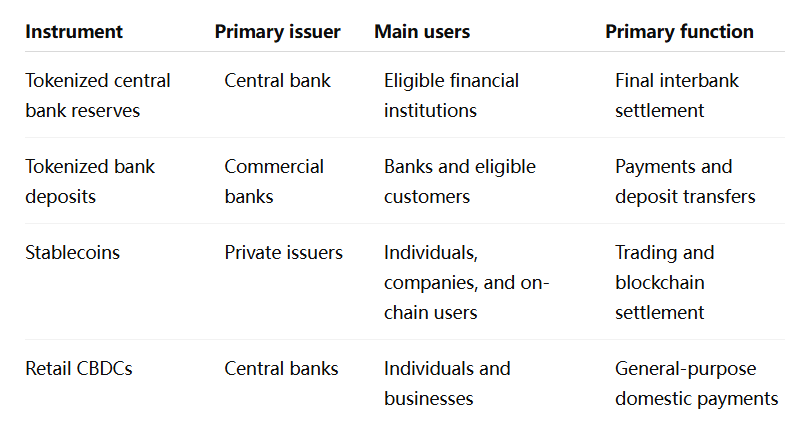
Stablecoins generally provide claims on private issuers and circulate through blockchain networks. Tokenized bank deposits remain liabilities of regulated commercial banks, while tokenized central bank reserves provide a settlement asset between eligible institutions.
Project Agorá is therefore closer to wholesale banking infrastructure than to a public stablecoin network. It may eventually interact with tokenized securities or other blockchain markets, but such connections would introduce further questions about access, redemption, compliance, and legal status.
Why South Korea’s Participation Matters
South Korea’s participation gives its central bank and commercial banks direct experience with multi-currency tokenized settlement. The involvement of five major banks is particularly important because practical adoption depends on commercial institutions.
These banks must determine how tokenized deposits would connect with customer accounts, treasury operations, compliance systems, liquidity management, and financial reporting.
Early participation also gives South Korean institutions an opportunity to influence international technical and operational standards. Without coordination, national tokenization projects could reproduce the fragmentation already found in correspondent banking.
What Comes Next?
Future testing will need to cover larger transaction volumes, additional currencies, more institutions, and adverse operating conditions. Participants must also demonstrate measurable savings in liquidity, reconciliation, processing time, and risk management.
Economic viability will be as important as technical performance. Existing payment networks may contain inefficiencies, but they already benefit from legal recognition, extensive institutional participation, and tested operational procedures. Project Agorá must deliver enough improvement to justify the cost of integration and new controls.
Conclusion
The Bank of Korea’s Project Agorá test represents meaningful progress in the institutional development of tokenized payments. Its significance lies not in the approximately CHF 800,000 processed, but in the coordinated use of real value, six currencies, tokenized reserves, commercial bank money, and multiple transaction scenarios.
The test strengthened the technical case for programmable cross-border settlement. However, large-scale adoption will depend on system integration, legal finality, privacy, governance, resilience, and clear economic benefits.
Project Agorá has moved from concept toward practical implementation, but the transition from controlled experiment to global financial infrastructure remains the greater challenge.


Ayrıca Şunları da Beğenebilirsiniz
Kulipa Collapse Disrupts Ready and Solflare Crypto Cards: What Users Should Know
Japan’s eole Makes First HYPE Purchase, Plans ¥100M Investment

STONKBROKER Briefly Hits $30M Market Cap: What Robinhood Chain Traders Should Know