SEC Innovation Exemption: How Tokenized Stocks Can Trade Onchain
Overview
The U.S. Securities and Exchange Commission introduced a five-year Innovation Exemption on September 17, 2026, creating a temporary regulatory pathway for certain tokenized U.S. stocks to trade onchain. Under the framework, qualifying Tokenized Securities Venues can facilitate trading in tokenized National Market System stocks through permissioned automated market makers and liquidity pools without being treated as registered exchanges under the usual definition, provided they comply with a detailed set of conditions. Liquidity providers participating in those pools can also receive limited conditional relief from the statutory definition of a dealer.
The policy should not be interpreted as the SEC allowing unrestricted crypto platforms to tokenize any U.S. stock. Eligible tokenized shares must provide investors with the same rights and privileges as the corresponding traditional stock, including voting and dividend rights. Synthetic tokens that merely track a stock price do not qualify. Issuers can object to third-party tokenization, smart contracts must be public and auditable, and trading must stop when the underlying stock is halted on its primary exchange.
The deeper importance of the exemption is market structure. The SEC is effectively allowing a controlled experiment in whether ownership, liquidity provision, trading, and settlement can move onto public blockchain infrastructure without abandoning core securities-law protections. The five-year limit indicates that the framework is an interim experiment intended to generate evidence for future rulemaking rather than a permanent deregulation of U.S. equity markets.
Key Takeaways
- The SEC Innovation Exemption creates a five-year conditional framework for onchain tokenized stock trading.
- Eligible tokenized shares must provide the same economic and shareholder rights as traditional NMS stock.
- Synthetic stock tokens that only replicate price exposure are outside the exemption.
- Trading can use permissioned AMMs and liquidity pools, but participation and market activity remain subject to restrictions.
- The policy is better understood as a regulated market-structure experiment than unrestricted permissionless stock trading.
What Is the SEC Innovation Exemption?
A Five-Year Experiment in Onchain Equity Trading
The Innovation Exemption provides temporary, conditional relief to a new category of market operator known as a Tokenized Securities Venue, or TSV.
A TSV can bring together buyers and sellers of tokenized NMS stocks through one or more permissioned AMM liquidity pools. Participants must satisfy the venue’s access standards, meaning the model is not equivalent to an entirely open decentralized exchange where any wallet can necessarily trade.
Under the order, qualifying TSVs receive relief from the Exchange Act definition of an exchange. Certain liquidity providers using proprietary capital to supply tokenized stock to an AMM pool can also receive conditional relief from the definition of a dealer. The anti-fraud and anti-manipulation provisions of federal securities law continue to apply.
This is an important distinction. The SEC has not suspended U.S. securities law for blockchain-based equities. Instead, it has temporarily relaxed specific regulatory classifications that could otherwise prevent new market structures from operating.
The professional way to describe the policy is therefore bounded experimentation. The SEC is permitting a limited market structure to operate while retaining investor-protection requirements and collecting evidence about how tokenized markets behave.
Why the Five-Year Limit Matters
The exemption expires five years after publication.
That timeline suggests the SEC does not view the current framework as the final architecture for tokenized equity markets. The agency has also requested public comment on possible modifications and future regulatory steps.
SEC commissioners explicitly described the exemption as an opportunity to observe how tokenized NMS stocks trade, how onchain and traditional markets interact, and which regulatory categories eventually make sense for venues and liquidity providers.
This makes the exemption as much a data-gathering exercise as a regulatory change.
If tokenized markets demonstrate efficient price discovery, robust investor protection, reliable settlement, and effective surveillance, the experience could inform more durable rules. If material problems emerge, the SEC can adjust or replace the temporary framework.
The five-year period should therefore be understood as a regulatory laboratory rather than a guarantee that the current model will become permanent.
What Kind of Tokenized Stocks Can Trade?
Investors Must Receive Real Shareholder Rights
The Innovation Exemption draws a clear line between tokenized ownership and synthetic price exposure.
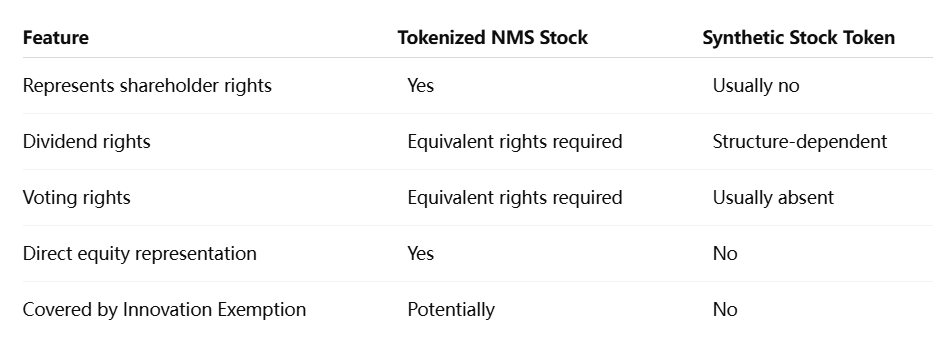
A tokenized NMS stock made available on a TSV must give holders the same rights and privileges as traditional stock of the equivalent class. That includes economic and governance rights such as dividends and voting rights.
This requirement is central to the SEC’s approach.
If a blockchain token merely tracks the price of Apple, Nvidia, Tesla, or another listed company without representing the actual rights associated with the underlying share, it does not qualify under this framework.
The legal claim therefore matters more than the token format.
A blockchain representation of a genuine equity interest can potentially fit within the exemption. A synthetic derivative that only mirrors stock-price performance remains a different type of financial product.
Issuers Can Object to Third-Party Tokenization
The exemption also gives public companies an important degree of control.
If a third party that is not affiliated with the issuer wants to tokenize a company’s stock and make it available on a TSV, the venue must provide written notice to the issuer and give the company an opportunity to object. If the issuer objects, the tokenized security cannot be made available under the exemption.
This provision materially limits the idea of permissionless stock tokenization.
A blockchain platform cannot simply create a qualifying tokenized version of any U.S.-listed stock and rely on the exemption regardless of the issuer’s view.
That reduces potential conflicts involving shareholder records, corporate actions, voting rights, dividends, and investor communications.
It also shows that the SEC is attempting to integrate blockchain infrastructure with the existing legal structure of public companies rather than create a parallel equity system detached from issuers.
Why Is the SEC Allowing AMMs for Stocks?
AMMs Introduce a Different Market Microstructure
Traditional U.S. equities primarily trade through order books where buyers and sellers submit bids and offers, supported by exchanges, broker-dealers, market makers, clearing firms, and other intermediaries.
An automated market maker works differently.
Liquidity is deposited into a pool, and smart contracts determine how trades occur according to predefined mechanisms. In crypto markets, this model has been widely used for decentralized trading. The SEC Innovation Exemption allows a permissioned version of this architecture to be tested with tokenized NMS stocks.
The significance is not simply that stocks can exist as tokens.
It is that the underlying mechanism of liquidity provision can change.
If AMM-based stock trading becomes viable, equity markets could eventually support new forms of programmable liquidity, automated settlement, and continuous ownership transfer. Market infrastructure could become more modular, with smart contracts performing functions that currently require multiple intermediaries.
However, AMMs also introduce unfamiliar risks into public equity markets.
Capital Efficiency Comes With New Risk Questions
AMM trading may offer potential benefits including more transparent pool balances, programmable settlement, reduced operational friction, and potentially longer trading windows.
But the model raises difficult questions.
Liquidity providers can face adverse selection when informed traders interact with pools whose prices adjust mechanically. Volatile assets can create inventory risk, while poorly designed pricing formulas can lead to inefficient execution. Smart contract vulnerabilities introduce a technology risk that traditional equity exchanges manage differently.
Liquidity fragmentation is another issue.
If the same stock trades simultaneously on traditional exchanges, multiple tokenized venues, and several liquidity pools, price discovery may become more complex. Arbitrage can keep prices aligned, but it also requires efficient capital movement and reliable market connectivity.
This is why the SEC imposed limits on the number of symbols and trading volume under the exemption rather than immediately opening the entire U.S. stock market to unrestricted AMM trading.
The policy allows the market structure to be tested at controlled scale before regulators decide whether it should expand.
Does the Innovation Exemption Mean U.S. Stocks Can Trade 24/7?
Not Automatically
Blockchain infrastructure is technically capable of operating continuously, but the SEC exemption does not mean every tokenized U.S. stock can immediately trade around the clock without restrictions.
One of the explicit conditions is that a TSV must stop trading a tokenized stock whenever trading in the underlying NMS stock is halted on its primary listing exchange.
This keeps the tokenized market linked to core protections in the traditional equity market.
The SEC is separately examining broader questions around 24-hour equity trading, but tokenization does not override market-wide halts, issuer-specific suspensions, or other regulatory controls.
The better interpretation is that blockchain infrastructure increases the technical possibility of extended-hours trading while the regulatory framework continues to determine when trading is permitted.
Smart Contracts Must Remain Transparent and Auditable
The SEC also requires smart contracts used by TSVs to be auditable, public, and deployed on a public, permissionless distributed ledger.
This creates an unusual hybrid model.
The blockchain infrastructure must be public and permissionless at the ledger level, but participation in the TSV itself is permissioned.
That combination allows transactions and smart-contract logic to benefit from public blockchain transparency while giving the venue control over who can access regulated securities trading.
This is materially different from fully permissionless DeFi.
It may become an important model for institutional blockchain adoption more broadly: public settlement infrastructure combined with regulated access at the application layer.
Could Tokenized Stocks Change Exchanges and Brokerages?
Market Functions Could Become More Modular
The potential disruption comes from separating functions that are currently bundled across the traditional market infrastructure.
Trading, settlement, custody, recordkeeping, liquidity provision, and ownership transfer may increasingly be handled by different technological layers.
A tokenized stock could theoretically trade through a smart-contract liquidity pool, settle onchain, and update ownership records much faster than a conventional multi-step securities transaction.
That does not mean exchanges, brokers, custodians, or transfer agents disappear. Instead, their roles may change.
Traditional institutions could operate TSVs themselves, integrate blockchain settlement, provide regulated custody, supply liquidity to AMM pools, or build interfaces that hide blockchain complexity from investors.
New entrants could also compete with established intermediaries if they satisfy the SEC’s requirements.
The likely structural impact is therefore not a simple replacement of Wall Street by DeFi. It is increased competition over which parts of securities-market infrastructure remain centralized and which functions become programmable.
Existing Investor Protections Still Constrain the Model
The exemption retains several important constraints.
Tokenized NMS stocks remain securities. Anti-fraud and anti-manipulation rules continue to apply. Issuers can object to unaffiliated tokenization. Venues must disclose information about their operations and trading activity. The number of securities and total trading volume are limited, and access is permissioned.
This substantially limits the comparison with decentralized crypto markets.
The SEC is not allowing anonymous global trading of U.S. securities through unrestricted pools. It is testing blockchain-based market infrastructure inside an existing securities-law perimeter.
That regulatory boundary will be important when assessing which crypto-native companies, brokerages, exchanges, and institutional technology providers can realistically participate.
The Innovation Exemption Is More About Market Structure Than Tokenization
The most important development in the SEC Innovation Exemption is not simply that U.S. stocks can be represented as blockchain tokens.
Tokenized securities have existed before.
What changes is that the SEC is explicitly allowing a controlled form of onchain secondary-market trading using permissioned AMMs and public blockchain infrastructure while providing targeted exemptions from the traditional definitions of exchange and dealer.
That turns tokenization from an issuance technology into a market-structure experiment.
The central questions over the next five years will therefore concern execution quality, liquidity, investor protection, surveillance, settlement efficiency, interoperability with traditional markets, and whether AMM structures can handle public equities without introducing unacceptable new risks.
The upside is potentially significant. Blockchain settlement could reduce operational friction, programmable markets could change liquidity provision, and public ledgers could improve transparency in parts of the securities lifecycle. The constraints are equally important: smart-contract risk, fragmented liquidity, issuer rights, regulatory access controls, and the need to preserve fair and orderly markets.
The SEC itself has framed the exemption as temporary and evidence-driven rather than permanent deregulation.
For investors and market infrastructure companies, the most useful conclusion is therefore not that “Wall Street has moved onchain.” The more accurate conclusion is that U.S. regulators have opened a five-year testing window in which onchain equity-market infrastructure can prove whether it deserves a permanent place alongside the traditional securities system.
Sources
https://www.sec.gov/files/rules/exorders/2026/34-106402.pdf
https://www.sec.gov/newsroom/speeches-statements/uyeda-statement-innovation-exemption-091726
Risk Disclaimer: This article is for reference only and does not constitute investment advice. The cryptocurrency market is highly volatile. Please make decisions cautiously based on your individual circumstances.
Ayrıca Şunları da Beğenebilirsiniz

What Is the Aave RWA Hub? How Institutions Can Borrow Stablecoins Against Tokenized Assets on Avalanche
MUSEBOOK Coin Surges as AI Agents Find Their Own Social Network