Original article: that1618guy , market researcher at Delphi Digital Compiled by Yuliya, PANews The market generally expects the Federal Reserve to cut interest rates for the first time this cycle in September. Historically, Bitcoin has tended to rise before easing policies are implemented, but retreat after rate cuts are implemented. However, this pattern doesn't always hold true. This article will review the performance in 2019, 2020, and 2024 to predict possible trends in September 2025. 2019: Expected rise, then a fall In 2019, Bitcoin rebounded from $3,000 at the end of 2018 to $13,000 in June. The Federal Reserve announced interest rate cuts on July 31, September 18, and October 30, respectively. Each rate cut decision signals the near exhaustion of Bitcoin's upward momentum. BTC surged before the meeting, but was subsequently sold off as the reality of weak economic growth resurfaced. This suggests the market had already priced in the positive impact of the rate cut, leaving the reality of slowing economic growth to dominate subsequent price movements. 2020: An exception to the emergency rate cut March 2020, when the Federal Reserve slashed interest rates to zero in response to the panic caused by the coronavirus pandemic, was not a typical cycle. During this liquidity crisis, BTC plummeted along with stocks, but subsequently rebounded strongly thanks to massive fiscal and monetary policy support. Therefore, this was a unique case driven by the crisis and cannot be used as a template for predicting trends in 2025. 2024: Narratives trump liquidity The trend changed in 2024. BTC did not fall back after the interest rate cut, but continued its upward momentum. The reasons are: Trump's campaign turned cryptocurrency into an election issue. Spot ETFs are attracting record inflows. MicroStrategy continues to see strong buying demand at the balance sheet level. In this context, the importance of liquidity has declined, with structural buying and political factors overriding traditional economic cycle influences. September 2025: Conditional market launch The current market backdrop is different from the runaway rallies of past cycles. Bitcoin has been consolidating since late August, ETF inflows have slowed significantly, and corporate balance sheet buying, once a persistent tailwind, has begun to wane. This makes the September rate cut a conditional market trigger rather than a direct catalyst. If Bitcoin rises sharply before the interest rate meeting, the risk of history repeating itself will increase - that is, traders "sell the fact" after the easing policy is implemented, resulting in a "rise followed by a fall" situation. But if prices remain stable or move slightly lower before the decision, much of the excess positioning may have been eliminated, making the rate cut more of a stabilizing force in the market rather than an end to the upward momentum. Core Viewpoint The current trend of Bitcoin may be affected by the Federal Reserve’s September interest rate meeting and related liquidity changes. Overall, Bitcoin may see a wave of increases before the FOMC meeting, but the increase may be difficult to break through new highs. If prices rise sharply before the meeting, then a "sell the news" pullback is likely; However, if prices consolidate or fall between early September and the meeting, there is a possibility of an unexpected rise due to interest rate adjustments. However, even if there is a rebound, the market still needs to be cautious. The next leg up may form a lower high (around $118,000 to $120,000). Assuming this lower high occurs, it could set the stage for the second half of Q4, when liquidity conditions are expected to stabilize and demand may pick up again, pushing Bitcoin to new highs. Original article: that1618guy , market researcher at Delphi Digital Compiled by Yuliya, PANews The market generally expects the Federal Reserve to cut interest rates for the first time this cycle in September. Historically, Bitcoin has tended to rise before easing policies are implemented, but retreat after rate cuts are implemented. However, this pattern doesn't always hold true. This article will review the performance in 2019, 2020, and 2024 to predict possible trends in September 2025. 2019: Expected rise, then a fall In 2019, Bitcoin rebounded from $3,000 at the end of 2018 to $13,000 in June. The Federal Reserve announced interest rate cuts on July 31, September 18, and October 30, respectively. Each rate cut decision signals the near exhaustion of Bitcoin's upward momentum. BTC surged before the meeting, but was subsequently sold off as the reality of weak economic growth resurfaced. This suggests the market had already priced in the positive impact of the rate cut, leaving the reality of slowing economic growth to dominate subsequent price movements. 2020: An exception to the emergency rate cut March 2020, when the Federal Reserve slashed interest rates to zero in response to the panic caused by the coronavirus pandemic, was not a typical cycle. During this liquidity crisis, BTC plummeted along with stocks, but subsequently rebounded strongly thanks to massive fiscal and monetary policy support. Therefore, this was a unique case driven by the crisis and cannot be used as a template for predicting trends in 2025. 2024: Narratives trump liquidity The trend changed in 2024. BTC did not fall back after the interest rate cut, but continued its upward momentum. The reasons are: Trump's campaign turned cryptocurrency into an election issue. Spot ETFs are attracting record inflows. MicroStrategy continues to see strong buying demand at the balance sheet level. In this context, the importance of liquidity has declined, with structural buying and political factors overriding traditional economic cycle influences. September 2025: Conditional market launch The current market backdrop is different from the runaway rallies of past cycles. Bitcoin has been consolidating since late August, ETF inflows have slowed significantly, and corporate balance sheet buying, once a persistent tailwind, has begun to wane. This makes the September rate cut a conditional market trigger rather than a direct catalyst. If Bitcoin rises sharply before the interest rate meeting, the risk of history repeating itself will increase - that is, traders "sell the fact" after the easing policy is implemented, resulting in a "rise followed by a fall" situation. But if prices remain stable or move slightly lower before the decision, much of the excess positioning may have been eliminated, making the rate cut more of a stabilizing force in the market rather than an end to the upward momentum. Core Viewpoint The current trend of Bitcoin may be affected by the Federal Reserve’s September interest rate meeting and related liquidity changes. Overall, Bitcoin may see a wave of increases before the FOMC meeting, but the increase may be difficult to break through new highs. If prices rise sharply before the meeting, then a "sell the news" pullback is likely; However, if prices consolidate or fall between early September and the meeting, there is a possibility of an unexpected rise due to interest rate adjustments. However, even if there is a rebound, the market still needs to be cautious. The next leg up may form a lower high (around $118,000 to $120,000). Assuming this lower high occurs, it could set the stage for the second half of Q4, when liquidity conditions are expected to stabilize and demand may pick up again, pushing Bitcoin to new highs.

Delphi Digital: How will interest rate cuts impact Bitcoin's short-term performance, based on historical data?

2025/09/02 13:45

Original article: that1618guy , market researcher at Delphi Digital

Compiled by Yuliya, PANews

The market generally expects the Federal Reserve to cut interest rates for the first time this cycle in September. Historically, Bitcoin has tended to rise before easing policies are implemented, but retreat after rate cuts are implemented. However, this pattern doesn't always hold true. This article will review the performance in 2019, 2020, and 2024 to predict possible trends in September 2025.

2019: Expected rise, then a fall
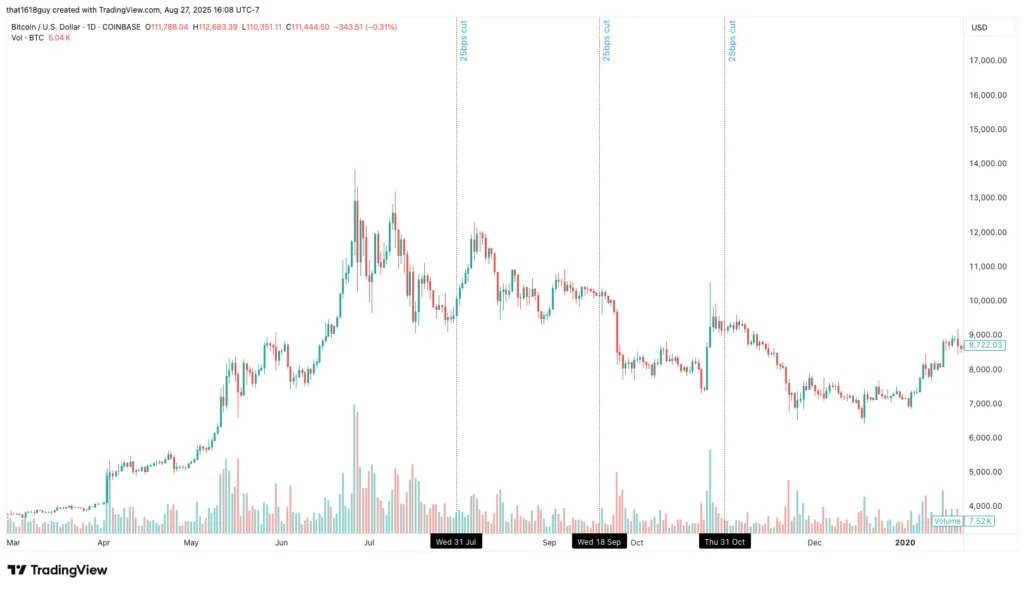
In 2019, Bitcoin rebounded from $3,000 at the end of 2018 to $13,000 in June. The Federal Reserve announced interest rate cuts on July 31, September 18, and October 30, respectively.

Each rate cut decision signals the near exhaustion of Bitcoin's upward momentum. BTC surged before the meeting, but was subsequently sold off as the reality of weak economic growth resurfaced. This suggests the market had already priced in the positive impact of the rate cut, leaving the reality of slowing economic growth to dominate subsequent price movements.

2020: An exception to the emergency rate cut
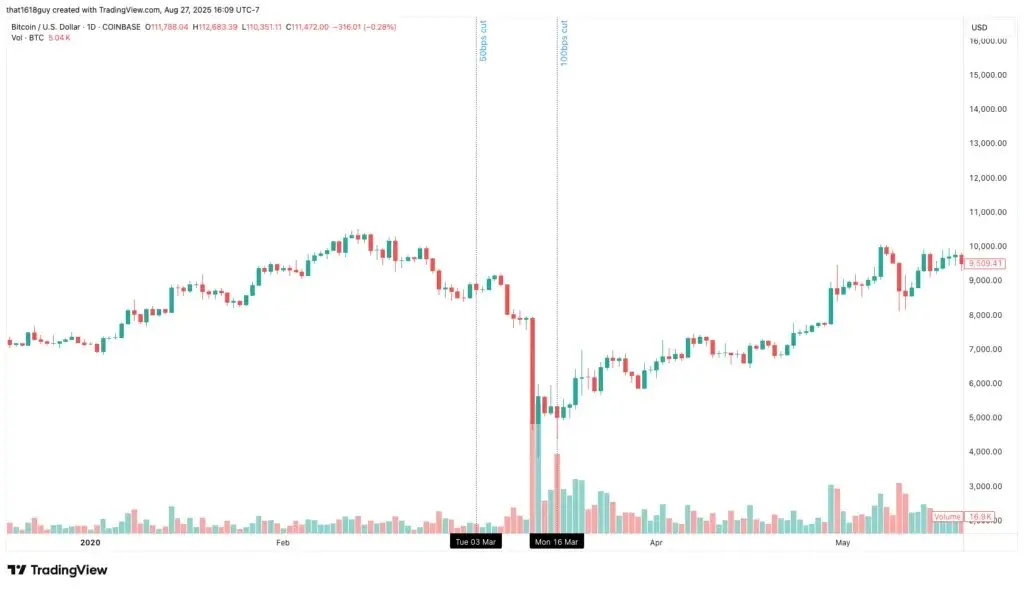
March 2020, when the Federal Reserve slashed interest rates to zero in response to the panic caused by the coronavirus pandemic, was not a typical cycle.

During this liquidity crisis, BTC plummeted along with stocks, but subsequently rebounded strongly thanks to massive fiscal and monetary policy support. Therefore, this was a unique case driven by the crisis and cannot be used as a template for predicting trends in 2025.

2024: Narratives trump liquidity
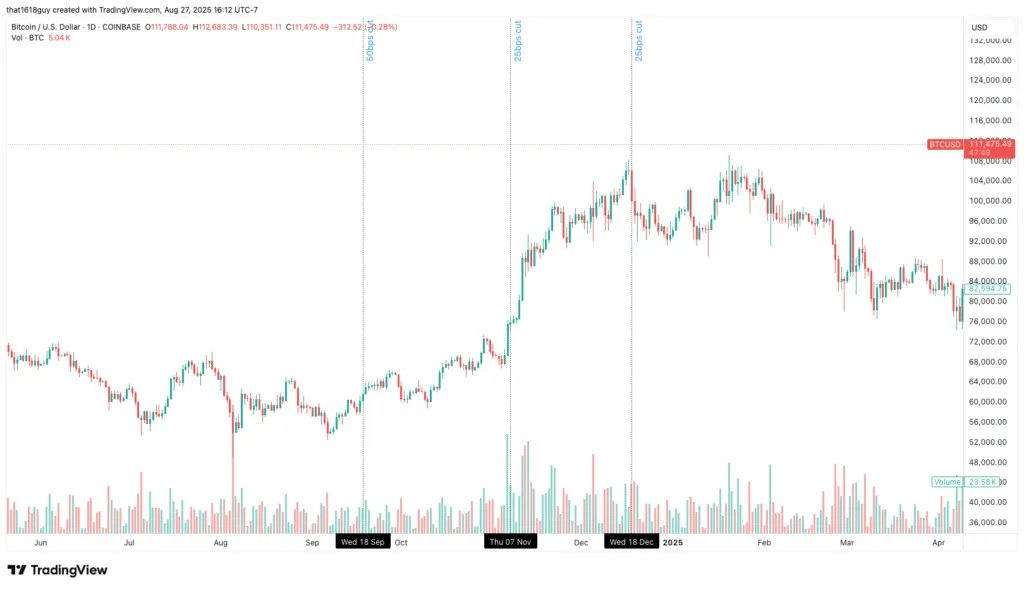
The trend changed in 2024. BTC did not fall back after the interest rate cut, but continued its upward momentum.

The reasons are:

  • Trump's campaign turned cryptocurrency into an election issue.
  • Spot ETFs are attracting record inflows.
  • MicroStrategy continues to see strong buying demand at the balance sheet level.

In this context, the importance of liquidity has declined, with structural buying and political factors overriding traditional economic cycle influences.

September 2025: Conditional market launch

The current market backdrop is different from the runaway rallies of past cycles. Bitcoin has been consolidating since late August, ETF inflows have slowed significantly, and corporate balance sheet buying, once a persistent tailwind, has begun to wane.

This makes the September rate cut a conditional market trigger rather than a direct catalyst.

  • If Bitcoin rises sharply before the interest rate meeting, the risk of history repeating itself will increase - that is, traders "sell the fact" after the easing policy is implemented, resulting in a "rise followed by a fall" situation.
  • But if prices remain stable or move slightly lower before the decision, much of the excess positioning may have been eliminated, making the rate cut more of a stabilizing force in the market rather than an end to the upward momentum.

Core Viewpoint

The current trend of Bitcoin may be affected by the Federal Reserve’s September interest rate meeting and related liquidity changes. Overall, Bitcoin may see a wave of increases before the FOMC meeting, but the increase may be difficult to break through new highs.

  • If prices rise sharply before the meeting, then a "sell the news" pullback is likely;
  • However, if prices consolidate or fall between early September and the meeting, there is a possibility of an unexpected rise due to interest rate adjustments.

However, even if there is a rebound, the market still needs to be cautious. The next leg up may form a lower high (around $118,000 to $120,000).

Assuming this lower high occurs, it could set the stage for the second half of Q4, when liquidity conditions are expected to stabilize and demand may pick up again, pushing Bitcoin to new highs.

Sorumluluk Reddi: Bu sitede yeniden yayınlanan makaleler, halka açık platformlardan alınmıştır ve yalnızca bilgilendirme amaçlıdır. MEXC'nin görüşlerini yansıtmayabilir. Tüm hakları telif sahiplerine aittir. Herhangi bir içeriğin üçüncü taraf haklarını ihlal ettiğini düşünüyorsanız, kaldırılması için lütfen service@support.mexc.com ile iletişime geçin. MEXC, içeriğin doğruluğu, eksiksizliği veya güncelliği konusunda hiçbir garanti vermez ve sağlanan bilgilere dayalı olarak alınan herhangi bir eylemden sorumlu değildir. İçerik, finansal, yasal veya diğer profesyonel tavsiye niteliğinde değildir ve MEXC tarafından bir tavsiye veya onay olarak değerlendirilmemelidir.

Ayrıca Şunları da Beğenebilirsiniz

The Channel Factories We’ve Been Waiting For

The Channel Factories We’ve Been Waiting For

The post The Channel Factories We’ve Been Waiting For appeared on BitcoinEthereumNews.com. Visions of future technology are often prescient about the broad strokes while flubbing the details. The tablets in “2001: A Space Odyssey” do indeed look like iPads, but you never see the astronauts paying for subscriptions or wasting hours on Candy Crush.  Channel factories are one vision that arose early in the history of the Lightning Network to address some challenges that Lightning has faced from the beginning. Despite having grown to become Bitcoin’s most successful layer-2 scaling solution, with instant and low-fee payments, Lightning’s scale is limited by its reliance on payment channels. Although Lightning shifts most transactions off-chain, each payment channel still requires an on-chain transaction to open and (usually) another to close. As adoption grows, pressure on the blockchain grows with it. The need for a more scalable approach to managing channels is clear. Channel factories were supposed to meet this need, but where are they? In 2025, subnetworks are emerging that revive the impetus of channel factories with some new details that vastly increase their potential. They are natively interoperable with Lightning and achieve greater scale by allowing a group of participants to open a shared multisig UTXO and create multiple bilateral channels, which reduces the number of on-chain transactions and improves capital efficiency. Achieving greater scale by reducing complexity, Ark and Spark perform the same function as traditional channel factories with new designs and additional capabilities based on shared UTXOs.  Channel Factories 101 Channel factories have been around since the inception of Lightning. A factory is a multiparty contract where multiple users (not just two, as in a Dryja-Poon channel) cooperatively lock funds in a single multisig UTXO. They can open, close and update channels off-chain without updating the blockchain for each operation. Only when participants leave or the factory dissolves is an on-chain transaction…
Paylaş
BitcoinEthereumNews2025/09/18 00:09
Wyoming-based crypto bank Custodia files rehearing petition against Fed

Wyoming-based crypto bank Custodia files rehearing petition against Fed

The post Wyoming-based crypto bank Custodia files rehearing petition against Fed appeared on BitcoinEthereumNews.com. A Wyoming-based crypto bank has filed another
Paylaş
BitcoinEthereumNews2025/12/16 22:06
US economy adds 64,000 jobs in November but unemployment rate climbs to 4.6%

US economy adds 64,000 jobs in November but unemployment rate climbs to 4.6%

The post US economy adds 64,000 jobs in November but unemployment rate climbs to 4.6% appeared on BitcoinEthereumNews.com. The economy moved in two directions at
Paylaş
BitcoinEthereumNews2025/12/16 22:18