

- Quick Buy/SellBuy & sell with cards and mobile payments
- P2PTrade with local payments at best prices
- Fiat DepositDeposit in BRL, COP, EUR, and more
- Global Bank TransferBuy and sell via local banks
- MEXC CardSpend your crypto worldwide
- SpotBuy and sell crypto with ease
- RealStocksTrade top US equities directly with crypto
- ConvertSwap hot tokens instantly with 0 fees
- Pre-MarketGet in early before official listings
- MX ZoneUnlock exclusive perks with MX
- Spot DCASteady growth through ups and downs
- Spot GridBuy low and sell high 24/7
- Meme+Discover on-chain gems early
- On-ChainYour unified hub for discovering, trading, and managing on-chain assets
- USDT-MPerpetual Futures settled in USDT
- USDC-MPerpetual Futures settled in USDC
- USD1-MPerpetual Futures settled in USD1
- Coin-MPerpetual Futures settled in other cryptos
- Futures EarnEarn up to 20% APR on your Futures funds
- AI StrategyConvert ideas into strategic action
- Grid TradingCapture volatility with automated trading
- Copy Trade × AIFollow seasoned traders or strategize with AI
- Demo TradingSimulate Futures trading risk-free
- Futures OverviewExplore Futures tools, products, and features
- Stock FuturesUp to 200x Leverage on MU, SNDK, and More, Trade with 0-fee
- GOLD Futures24/7 access to top liquidity & leveraged power
- OIL Futures24/7 access to top liquidity & leveraged trading
- SILVER FuturesTrade with 0 fees, top liquidity, and flexible leverage.
- TradFi FuturesTrade all in one place with low fees & top liquidity
- BTC FuturesMarket's lowest fees and high leverage
- ETH FuturesMarket's lowest fees and high leverage
- ZEC Futures SurgeEnjoy 0 fees, up to 150× leverage, and top position capacity at 21×+ leverage
- MEXC EarnEarn high APR on your crypto
- Hold and EarnHold assets and earn interest daily
- Futures EarnEarn on balance and unlock higher APR as you trade
- On-Chain EarnEasy staking. Real on-chain yield
- MEXC LoansBorrow instantly at competitive rates
- Rewards HubClaim up to $10K in stock & crypto rewards
- Event CenterHigher rewards, 0 fees
- Invite and EarnInvite friends and earn 140 USDT each
- Anthropic Pre-IPO HeatwaveWin ANTHROPIC(PRE), NVIDIA H200 GPU, and more
- Midterm Market RushTrade TradFi to share $500,000
- LaunchpadAccess top tokens early or at a discount
- $500K TSLA FeverWin TSLAX, TSLAON & more!
- Airdrop+Deposit and trade to claim new airdrops
- KickstarterHold MX to earn new tokens
- RealStocks PNL Rate LeaderboardTrade $100 to win up to $10,000 in stock rewards
- 0 FeesTrade hot futures, enjoy limited 0 fees
- Futures M-DayTrade Futures and claim daily rewards
- MEXC Asset Support CheckerOne screenshot to check your asset support
- Referral ProgramInvite friends and unlock commissions from 40%
- Affiliate ProgramTop-tier affiliate commissions up to 70%
- 0-Commission RealStocks APIBuild custom automated strategies
- MEXC VVIPM-Score into Wealth, 10+ Elite Benefits Upgrading
- MEXC × TradingViewConnect MEXC to trade directly on TradingView
- Crypto NewsFollow the latest crypto headlines
- AnnouncementsStay on top of every happening on MEXC
- LearnStrong crypto fundamentals for every beginner
- MEXC Event MapLight the map, live the moment
- MEXC InstitutionalTailored solutions for institutional clients
Hyperliquid HIP-3: Can Payward Bring Perps to the US?
Payward, the parent company of Kraken, is pursuing a regulated pathway for bringing onchain perpetual futures to U.S. customers through Hyperliquid's HIP-3* infrastructure. The company announced its plan on September 16, 2026, while Hyperliquid's October 26 update drew renewed attention to the proposed permissioned market architecture. Under the arrangement, Bitnomial would operate the exchange and clearing functions, NinjaTrader Clearing would maintain customer accounts, and Hyperliquid would supply the blockchain-based order book used to execute and record transactions.
The Hyperliquid HIP-3 proposal is significant because it attempts to combine shared onchain trading infrastructure with the access controls and institutional accountability required in regulated derivatives markets. Instead of granting U.S. customers unrestricted entry to existing decentralized perpetual markets, the proposed system would restrict participation to approved accounts managed through registered financial intermediaries.
The distinction between a planned deployment and an operational market remains essential. HIP-3* permissioning is still undergoing testing, and the proposed U.S. contracts remain subject to regulatory approval. The development therefore represents a test of financial market architecture rather than the completion of a new U.S. trading venue. Its longer-term importance depends on whether licensed market operators can use decentralized execution technology while maintaining effective clearing, customer protection, and market supervision.
Key Takeaways
- Payward intends to deploy regulated U.S. perpetual futures using Hyperliquid HIP-3*, subject to regulatory approval.
- Bitnomial would manage market operation and clearing, while NinjaTrader Clearing would handle customer accounts.
- HIP-3* differs from existing HIP-3 markets by introducing permissioned participant access.
- The proposed structure separates onchain execution from regulatory accountability without removing either function.
- Institutional adoption will depend on clearing reliability, liquidity, operational integration, and sustainable trading economics.
Hyperliquid HIP-3 and Payward's US Market Plan
Payward's proposed deployment follows its expansion into regulated American derivatives infrastructure. On May 1, 2026, the company completed its acquisition of Bitnomial, bringing a designated contract market, derivatives clearing organization, and futures commission merchant infrastructure into its broader business. This provides important context for the September 16 announcement. Payward is not attempting to use blockchain technology as a substitute for exchange registration. Instead, it intends to combine the regulatory capabilities of its existing subsidiaries with an external onchain execution environment. Bitnomial would create and administer the new perpetual futures markets, while NinjaTrader Clearing would provide the customer account infrastructure through which eligible U.S. participants access those contracts.
The distinction between the transaction announcement and the product's operational status is particularly important. Payward has expressed an intention to become the first registered U.S. market operator deploying HIP-3* perpetuals, but the planned contracts have not been confirmed as approved and fully operational. Hyperliquid's existing HIP-3 infrastructure supports builder-deployed perpetual markets; HIP-3* introduces additional permission controls designed for restricted participation. The regulatory registrations held by Bitnomial and NinjaTrader establish the roles these entities can perform, but they do not constitute blanket authorization for every new derivative or trading arrangement. Payward's official announcement explicitly makes the proposed product subject to regulatory approval.
How Would HIP-3* Permissioned Markets Work?
The proposed trading process would combine traditional futures account access with blockchain-based order execution. A customer would first establish an eligible futures account through NinjaTrader Clearing and satisfy the relevant onboarding requirements. Both NinjaTrader and Bitnomial would need to authorize participation before the account could trade the designated HIP-3* markets. Orders would then be executed and recorded using Hyperliquid's infrastructure, while the regulated exchange and clearing organization would remain responsible for their respective market and financial obligations.
The resulting architecture can be understood through four distinct responsibilities.
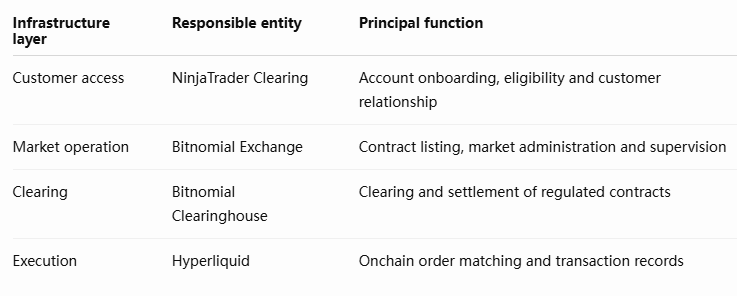
The important distinction is that execution technology and regulatory responsibility are not the same thing. Hyperliquid would support trading operations, but it would not replace the registered institutions responsible for customer access or clearing. The public blockchain could provide a shared execution environment while individual markets remain restricted to qualified participants. This architecture is neither a conventional permissionless DeFi market nor a fully proprietary centralized exchange system; it distributes technical and legal responsibilities across different components.
What Changes Between HIP-3 and HIP-3*?
HIP-3 introduced the ability for qualifying builders to create perpetual markets using Hyperliquid's shared trading infrastructure. This model allows market operators to introduce contracts referencing different underlying assets rather than relying entirely on a single centralized listing authority. HIP-3* extends the design toward markets that require participant restrictions. Such restrictions are relevant to regulated financial institutions because the ability to identify and approve customers is a central part of operating many financial products. A publicly accessible blockchain does not necessarily require every asset or financial contract on it to be freely transferable or tradable by all users.
Three differences define the proposed extension:
- Participation: HIP-3* would use allowlists to restrict trading to approved accounts rather than relying on the existing general-access model.
- Accountability: A regulated operator would administer the relevant contracts, with customer and clearing responsibilities assigned to specified institutions.
- Product status: Existing HIP-3 markets operate on mainnet, while the permissioned HIP-3* functionality discussed in Payward's plan remains in testing.
These changes could make blockchain-based derivatives infrastructure more compatible with institutions that cannot offer unrestricted access to leveraged trading products. However, permissioning alone cannot establish regulatory compliance. The exchange must still satisfy applicable product rules, market integrity requirements, recordkeeping obligations and clearing arrangements. The technical ability to restrict participants is therefore an enabling component rather than proof that the entire market structure has received regulatory approval.
Where Does Regulatory Responsibility Sit?
The central innovation in Payward's proposal is the division between market execution and market governance. Traditional derivatives exchanges commonly operate proprietary matching infrastructure while relying on established institutional arrangements for customer accounts, clearing, margin and regulatory reporting. Payward's proposed structure changes the execution component by introducing Hyperliquid's onchain order book, but it does not eliminate the remaining functions. Bitnomial would retain responsibility for administering its market and clearing contracts, while NinjaTrader Clearing would remain responsible for the customer account relationship within its registered activities.
This separation has consequences for both transparency and supervision. Blockchain transactions can provide observable execution records, but those records do not independently establish that a participant satisfies legal eligibility requirements or has sufficient collateral under the relevant clearing arrangements. Similarly, blockchain consensus may confirm that an order was executed according to protocol rules without resolving how a regulated intermediary should respond to an account deficiency, market disruption or legal dispute. Institutions need operational procedures that connect trading activity with margin obligations, customer records and the financial protections associated with regulated derivatives markets.
The proposed model therefore creates a shared technical foundation while preserving institution-specific obligations. Its success will depend on whether the various components operate coherently during normal trading and periods of market stress. A permissioned onchain market could offer some advantages in transaction transparency and execution infrastructure, yet these advantages would be limited if clearing systems, customer controls and blockchain records were not synchronized reliably.
Can Onchain Perpetuals Serve Regulated US Traders?
Perpetual futures have become an important part of international cryptocurrency derivatives trading because they allow traders to maintain leveraged exposure without a conventional fixed expiration date. Their market value depends on the underlying reference asset, margin arrangements, liquidation rules and funding mechanisms used to align contract prices with spot markets. These features create demand among sophisticated traders, but also introduce risks that require careful management. The absence of a fixed expiration date does not eliminate financing costs or ensure that positions can remain open indefinitely, particularly during periods of sharp price movements.
Payward's planned U.S. deployment must demonstrate that blockchain-based execution can function within a regulated clearing framework. Professional traders generally evaluate several features before committing significant capital: executable spreads, order-book depth, predictable liquidation procedures, margin efficiency and the reliability of trading during volatile conditions. Blockchain transparency may be useful, but it does not automatically improve market quality. Even a technically reliable exchange can struggle to attract liquidity if market makers face unfavorable collateral requirements or insufficient participation from other traders.
A regulated deployment could also face challenges that conventional permissionless markets address differently. Restricted access may improve compliance but reduce the number of potential counterparties, particularly during the early stages of market development. Liquidity could become concentrated among a small number of approved participants, affecting spreads and execution quality. The critical issue is whether Payward can combine institutional safeguards with enough market-maker participation to create a commercially useful trading environment.
What Could This Mean for HYPE and HIP-3 Liquidity?
The prospective market could broaden Hyperliquid's institutional relevance by showing that the protocol's execution infrastructure can support regulated operators. Greater participation by professional trading firms might eventually contribute additional order flow and market-making capacity. However, those benefits depend on actual deployment and trading activity rather than the announcement of an intended integration. Payward's September statement cited substantial existing Hyperliquid activity, including more than $200 billion in trading volume during the preceding 30 days, but that historical platform figure does not measure demand for the proposed U.S. market.
The potential effect on HYPE requires a separate assessment.
IndicatorWhat it would establishWhat it would not establishRegulatory approvalPermission to proceed under applicable conditionsGuaranteed institutional adoptionTrading volumeExecuted activity in the new marketEquivalent new capital inflowsOpen interestOutstanding derivatives exposureProfitability of the market operatorProtocol feesEconomic activity generated for infrastructureAutomatic token price appreciationHYPE-related deployment requirementsSpecific token utility under final rulesGuaranteed investment returns
An increase in trading activity could support Hyperliquid's infrastructure economics, but the eventual relationship with HYPE would depend on fees, deployment conditions, token-related requirements and the distribution of value between protocol infrastructure and individual market operators. It would be premature to equate CFTC-regulated participation with a specific token valuation outcome.
MEXC View: Regulated Markets May Use Shared Execution Layers
Payward's proposal illustrates how blockchain infrastructure may enter traditional financial markets without requiring those markets to abandon their regulatory structure. The competitive opportunity for Hyperliquid is not necessarily to replace licensed exchanges, but to become an execution technology that regulated operators can use. If such arrangements become viable, market operators could compete through contract design, liquidity, customer relationships and risk management while relying on shared technical infrastructure for particular trading functions.
This would represent a meaningful shift from a model in which exchanges typically develop and control most of their trading technology. It could also create new competitive pressures for blockchain protocols, which would need to demonstrate operational reliability suitable for professional financial institutions. Existing developments involving Hyperliquid's HIP-3 markets and institutional derivatives access provide relevant background, but Payward's proposal goes further by placing a registered exchange and clearing organization at the center of the intended deployment.
The long-term outcome will depend on whether the permissioned structure can provide sufficient liquidity and operational resilience while preserving the accountability of regulated institutions. Onchain execution may become another available infrastructure model for financial markets, but its adoption will be determined by practical performance rather than decentralization as an abstract objective.
Risks and Limitations
The proposed HIP-3* market remains subject to important limitations. Regulatory approval has not been confirmed for the intended contracts, and permissioning features remain under development. Future operating conditions may differ from the currently announced structure.
The most important risks fall into three areas:
- Regulatory and legal: Product authorization, participant eligibility, clearing requirements and jurisdictional restrictions may delay or limit deployment.
- Trading and liquidity: Leverage, funding costs, liquidation risk, concentrated market-making activity and insufficient depth may affect market quality.
- Technical and operational: Smart-contract vulnerabilities, blockchain disruptions, data synchronization problems and dependencies between execution and clearing systems could create additional risks.
Announced institutional participation also should not be treated as evidence of revenue, trading volume or HYPE-related financial gains before those figures can be measured.
Shared Infrastructure Does Not Remove Market Oversight
Payward's planned deployment on Hyperliquid offers a practical test of whether blockchain execution technology can be incorporated into regulated derivatives markets. The proposed structure separates customer access, exchange operation, clearing and order execution into distinct responsibilities, allowing each component to be managed by an institution or infrastructure provider suited to that function. Its potential significance lies in demonstrating that public blockchain technology and institutional market controls can coexist without requiring every participant to operate in an unrestricted environment.
The Hyperliquid HIP-3 proposal nevertheless remains a development initiative rather than a confirmed production market for U.S. customers. The next important milestones include completion of permissioning infrastructure, the necessary regulatory approvals, publication of final contract requirements and the commencement of live trading. Once operating, market depth, open interest, execution costs, clearing reliability and participant diversity will provide the strongest evidence of whether the model is economically viable.
Its broader significance could extend beyond cryptocurrency derivatives. If registered market operators can use shared blockchain infrastructure without compromising supervision or customer protections, similar arrangements may be considered for other financial products. Yet adoption would occur through specific regulatory and operational frameworks rather than a universal exemption from conventional market rules.
The structural opportunity is to make regulated financial markets less dependent on proprietary execution technology while keeping legal accountability clearly assigned. Payward's proposed HIP-3* market provides a test of that principle, but the result will depend on actual trading performance and institutional reliability—not simply on the presence of a public blockchain.
Sources
Payward — Intends to Bring Onchain Perpetual Futures to US Clients, September 16, 2026:
https://www.payward.com/press-release/payward-hyperliquid-onchain-perpetual-futures
Payward — Completes Bitnomial Acquisition, May 1, 2026:
https://www.payward.com/press-release/payward-completes-acquisition-of-bitnomial-the-first-fully-cftc-licensed-crypto-native-derivatives-stack-in-the-us
Risk Disclaimer: This article is for reference only and does not constitute investment advice. The cryptocurrency market is highly volatile. Please make decisions cautiously based on your individual circumstances.
更多相关新闻
Stay ahead of the curve with Trending News—your daily pulse on the crypto and traditional finance markets. We cut through the noise to bring you the most critical headlines, macro shifts, and market-moving events as they happen. From breaking regulatory updates to sudden price actions and institutional trends, this is where you'll find real-time insights to keep your trading strategy sharp and informed.
评论
仅可选择预设评论和表情符号