Exploring how the costs of a pandemic can lead to a self-enforcing lockdown in a networked economy, analyzing the resulting changes in network structure and the existence of stable equilibria.Exploring how the costs of a pandemic can lead to a self-enforcing lockdown in a networked economy, analyzing the resulting changes in network structure and the existence of stable equilibria.

The Economics of Self-Isolation: A Game-Theoretic Analysis of Contagion in a Free Economy

2025/09/17 23:00

Abstract and 1. Introduction

  1. A free and fair economy: definition, existence and uniqueness

    2.1 A free economy

    2.2 A free and fair economy

  2. Equilibrium existence in a free and fair economy

    3.1 A free and fair economy as a strategic form game

    3.2 Existence of an equilibrium

  3. Equilibrium efficiency in a free and fair economy

  4. A free economy with social justice and inclusion

    5.1 Equilibrium existence and efficiency in a free economy with social justice

    5.2 Choosing a reference point to achieve equilibrium efficiency

  5. Some applications

    6.1 Teamwork: surplus distribution in a firm

    6.2 Contagion and self-enforcing lockdown in a networked economy

    6.3 Bias in academic publishing

    6.4 Exchange economies

  6. Contributions to the closely related literature

  7. Conclusion and References

Appendix

6.2 Contagion and self-enforcing lockdown in a networked economy

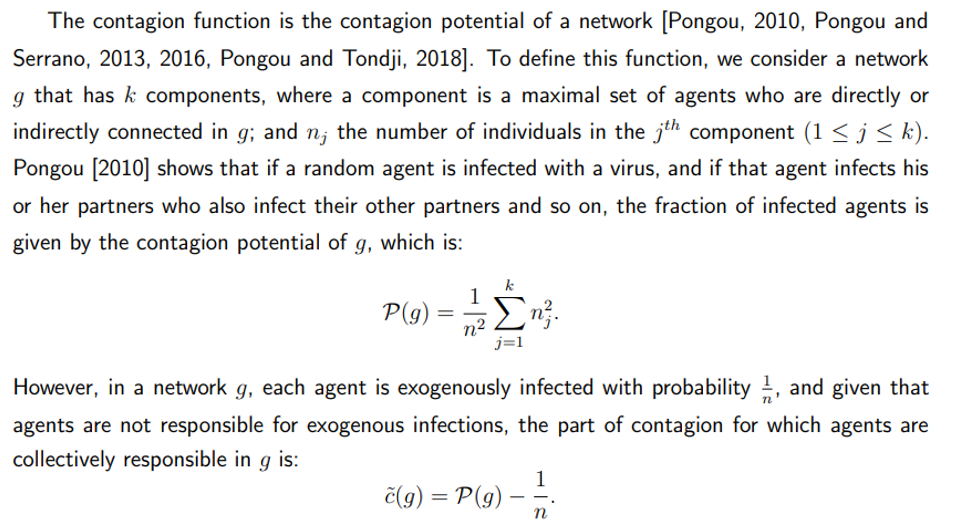
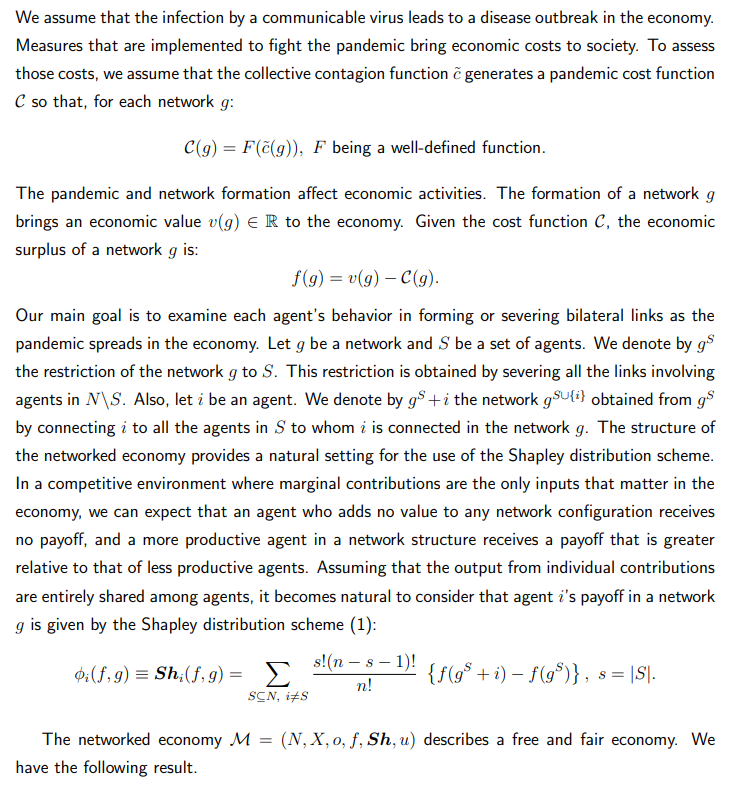
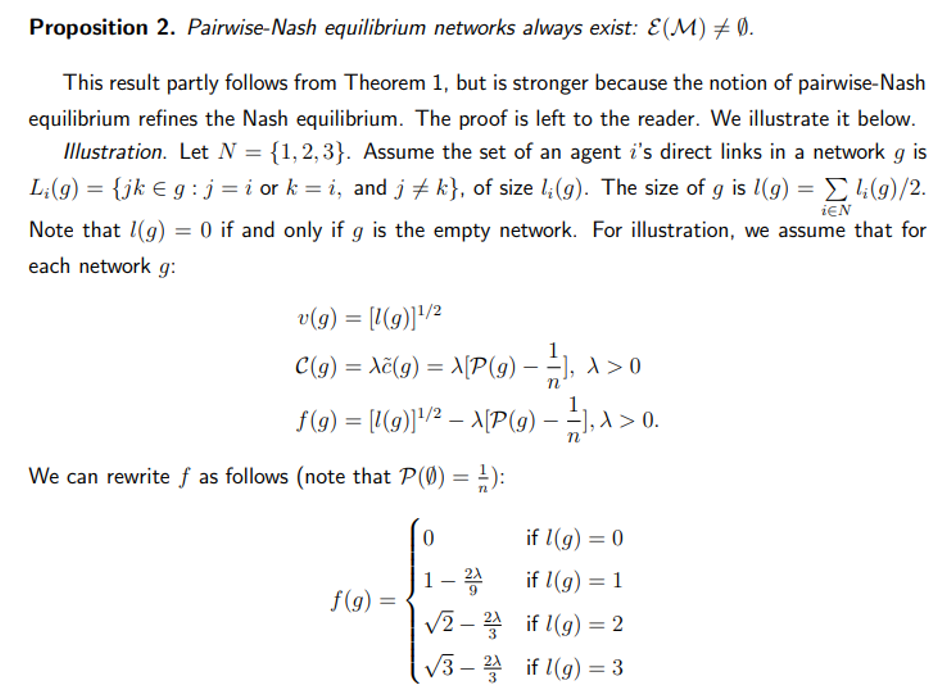
In this section, we provide an application of a free and fair economy to contagion and selfenforcing lockdown in a networked economy. We show how the costs of a pandemic from a virus outbreak can affect agents’ decisions to form and sever bilateral relationships in the economy. Specifically, we illustrate this application by using the contagion potential of a network [Pongou, 2010, Pongou and Serrano, 2013, 2016, Pongou and Tondji, 2018].

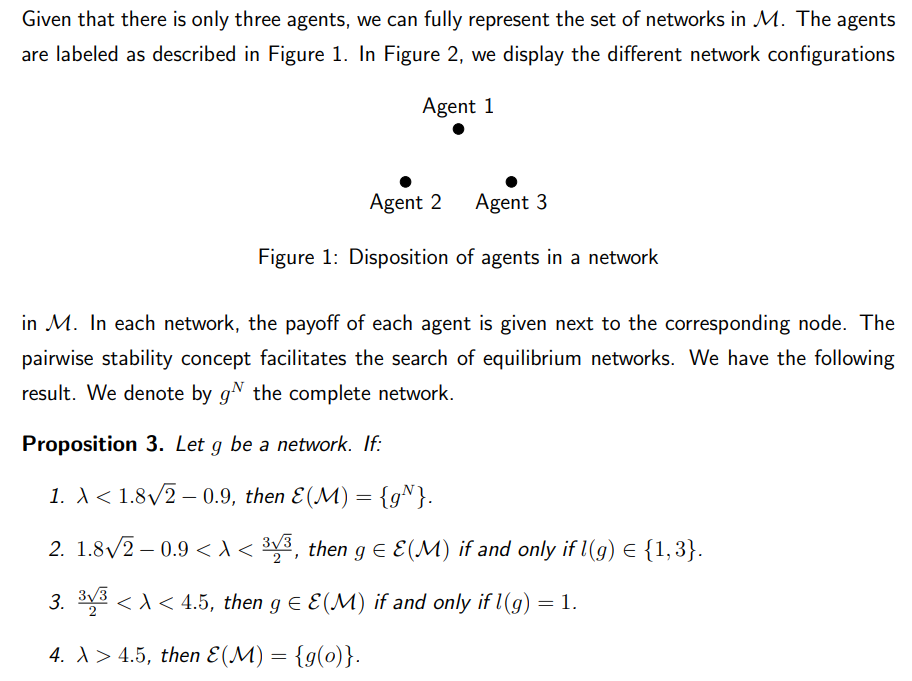
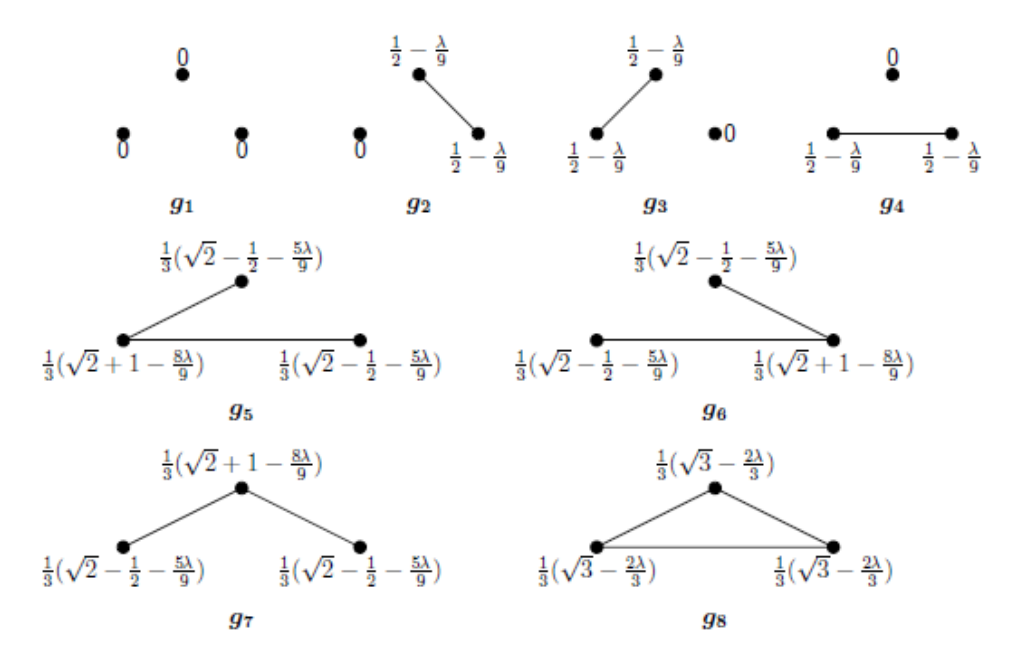
\ Consider an economy M involving agents who freely form and sever bilateral links according to their preferences. Agents’ choices lead to a network, defined as a set of bilateral links. Assume that rational behavior is captured by a certain equilibrium notion (for example, Nash equilibrium, pairwise-Nash equilibrium, etc.). Such an economy may have multiple equilibria. Denote by E(M) the set of its equilibria. Our main goal is to assess agent’s decisions in response to the spread of a random infection (for example, COVID-19) that might hit the economy. As the pandemic evolves in the economy, will some agents decide to sever existing links and self-isolate themselves? How does network structure depend on the infection cost?

\
\
\
\
\
\ Figure 2: Possible network formation in M
\

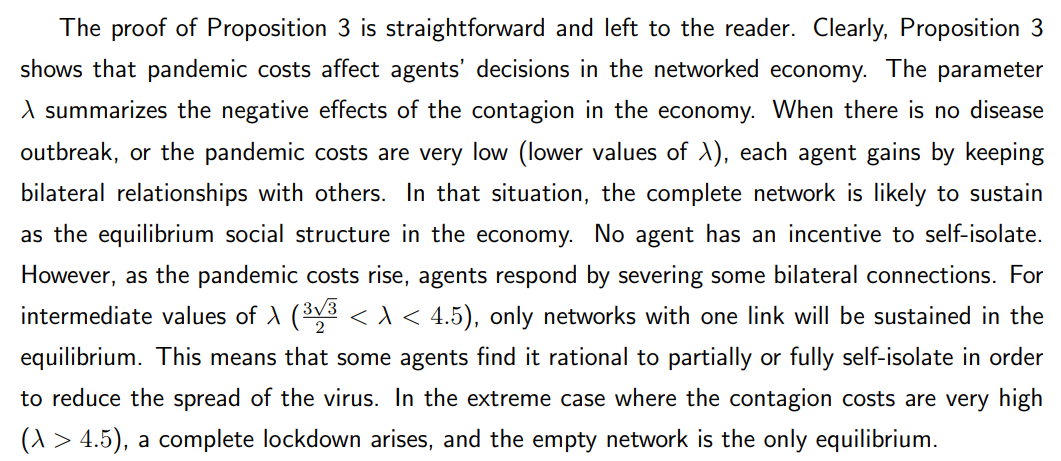
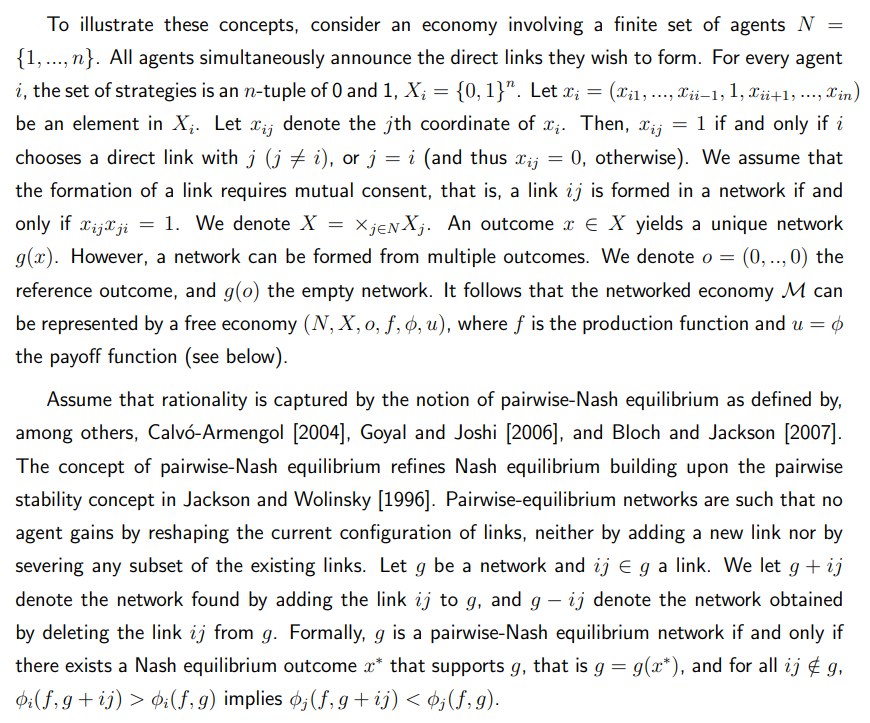
\ Interestingly, the value of λ depends on the nature of the virus. Viruses induce different severity levels. For example, COVID-19 and the flu virus have different values, inducing different network configurations in equilibrium. The different network configurations in Figure 2 can therefore be interpreted as the networks that will arise in different scenarios regarding the nature of the virus.

\

:::info Authors:

(1) Ghislain H. Demeze-Jouatsa, Center for Mathematical Economics, University of Bielefeld (demeze jouatsa@uni-bielefeld.de);

(2) Roland Pongou, Department of Economics, University of Ottawa (rpongou@uottawa.ca);

(3) Jean-Baptiste Tondji, Department of Economics and Finance, The University of Texas Rio Grande Valley (jeanbaptiste.tondji@utrgv.edu).

:::


:::info This paper is available on arxiv under CC BY 4.0 DEED license.

:::

\

Disclaimer: The articles reposted on this site are sourced from public platforms and are provided for informational purposes only. They do not necessarily reflect the views of MEXC. All rights remain with the original authors. If you believe any content infringes on third-party rights, please contact service@support.mexc.com for removal. MEXC makes no guarantees regarding the accuracy, completeness, or timeliness of the content and is not responsible for any actions taken based on the information provided. The content does not constitute financial, legal, or other professional advice, nor should it be considered a recommendation or endorsement by MEXC.

You May Also Like

Maryland Man Sentenced for Allegedly Aiding North Korea’s US Company Infiltration and Sensitive Data Access

Maryland Man Sentenced for Allegedly Aiding North Korea’s US Company Infiltration and Sensitive Data Access

The post Maryland Man Sentenced for Allegedly Aiding North Korea’s US Company Infiltration and Sensitive Data Access appeared on BitcoinEthereumNews.com. North Korea’s IT workers infiltrated US companies through a Maryland man’s scheme, earning over $970,000 while enabling access to sensitive government systems. This operation supported the regime’s cyber activities, including crypto hacks that stole $2 billion in 2025, funding nuclear programs. Minh Phuong Ngoc Vong sentenced to 15 months in prison for aiding North Korean infiltration. He used fake credentials to secure jobs at 13 US firms, passing work to overseas conspirators. North Korea stole $2 billion in crypto in 2025 via hacks, totaling over $6 billion recently, per blockchain analytics firm Elliptic. Discover how North Korea’s IT infiltration and crypto hacking schemes threaten US security. Learn the details of the Maryland case and regime’s $6B theft. Stay informed on cybersecurity risks today. What is North Korea’s IT Infiltration Scheme in US Companies? North Korea’s IT infiltration scheme involves covertly placing regime-affiliated workers into US companies using fake identities to generate revenue and access sensitive systems. In a recent Maryland case, Minh Phuong Ngoc Vong was sentenced to 15 months in prison and three years of supervised release for facilitating this for three years across 13 companies. The operation netted over $970,000, much of which funded North Korea’s weapons programs through software work performed by overseas actors, including those in China near the border. How Does North Korea Use Crypto Hacking to Fund Its Programs? North Korea employs sophisticated cyber groups to target cryptocurrency exchanges and wallets, stealing digital assets that convert to fiat for regime funding. According to blockchain analytics firm Elliptic, these groups pilfered approximately $2 billion in cryptocurrencies in 2025 alone, contributing to a total exceeding $6 billion in recent years from hacks on platforms like Bybit and Upbit. This influx directly supports nuclear and missile development, as confirmed by US intelligence assessments. Experts note the regime’s…
Share
BitcoinEthereumNews2025/12/06 09:12