Exclusive Interview with Astar Founder: Sounding the Web3 Horn in Japan, Major Update for "Sony Chain" Coming in a few months
During the "Lost Thirty Years," Japan missed the wave of internet entrepreneurship and did not see the rise of any local internet giant. The country's GDP was surpassed by Germany in 2023, making it the fourth-largest economy in the world. Acknowledging past mistakes, the Japanese government began loosening cryptocurrency regulations last year to catch up with the new wave of Web 3.0.
Due to relaxed regulatory policies and reduced uncertainty, many large Japanese companies are actively participating in the Web3 space. The influx of capital and research capabilities from these companies is expected to play a significant role in the development and popularization of Web3 technology. Astar Network, Japan's largest public blockchain, frequently appears among traditional Japanese companies entering Web3. Last September, Astar made headlines by forming a joint venture with Sony to launch the "Sony Chain," aiming to rival Base.
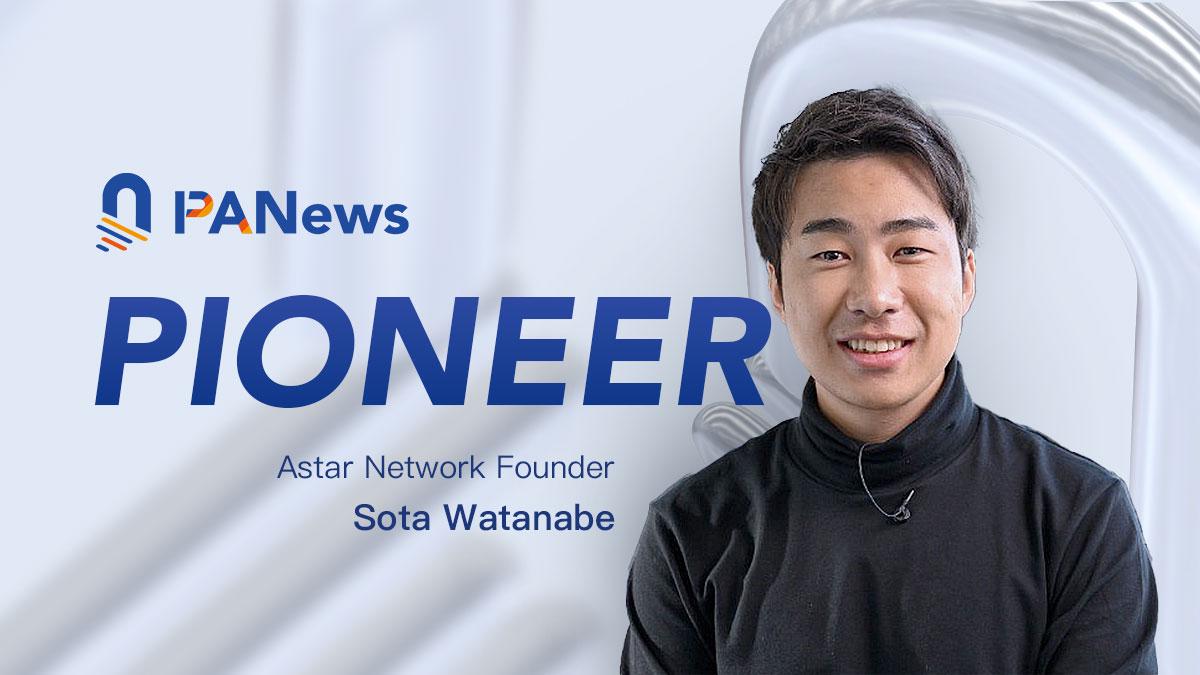
Recently, as Astar Network founder Sota Watanabe visited China, PANews met with him for an exclusive interview. Sota shared his personal experiences and the development journey of the Astar project, revealing details about the eagerly anticipated "Sony Chain."
Sota Watanabe: Entrepreneurial Journey and Global Travels
Before the COVID-19 pandemic, Sota, who had just founded Astar Network (then Plasm Network), visited China multiple times, leaving footprints in cities like Beijing, Shanghai, and Hangzhou. Years later, Sota and his Astar are no longer newcomers. Today, Astar is a leading blockchain project in both Japan and the Polkadot ecosystem, and Sota has become a renowned entrepreneur in the Web3 industry, serving as the president of the Japan Blockchain Association. On the interview day, Japan's Ministry of Economy, Trade, and Industry announced a call for companies to join a demonstration project for building digital public goods using Web3 and blockchain in 2025, with Sota as a member of the advisory committee.
"As an entrepreneur, seeing the world with your own eyes is very important. Especially for long-term strategy decisions, we need to cooperate with many people from different countries," Sota said. Before his China trip, he had just returned from Mexico and spent a few days in Japan.
During his university years, Sota traveled around the world, witnessing social issues like poverty and discrimination. After experiencing the world's inequalities, he joined a non-profit organization. "I can bring happiness to the ten people in front of me, but many more are beyond my reach. However, through internet technology, we can empower people. When I started my business, I considered choosing between AI and blockchain and ultimately chose the latter because it empowers people."
What’s Astar's Secret to Gaining Support from Sony and Samsung?
In early 2022, Astar Network launched its mainnet and entered a business expansion phase. From this period, Astar's focus shifted from within the Polkadot ecosystem to Japan's domestic market, garnering support from traditional industries and Web3 giants.
Astar signed cooperation agreements with Japanese telecom operator NTT Docomo and received sponsorship from automotive giant Toyota for its hackathon. After establishing itself in the Japanese market, Astar expanded overseas, securing investments from Samsung and UOB and launching the Astar zkEVM Layer 2 solution as the first user of Polygon's new "AggLayer" technology. This solution has attracted well-known companies and entrepreneurs, including Deloitte Japan developing a baseball-themed NFT game and new entertainment company Yoake, founded by AKB48 and Nogizaka46 creator Yasushi Akimoto, creating content and idol economies in the ecosystem.
The deepest commercial partnership with Astar Network comes from Sony, a conglomerate involved in electronics, semiconductors, entertainment, and finance. In February 2023, Sony's business division, Sony Network Communications, collaborated with Astar Network to launch a Web3 incubation program. This partnership deepened when Startale Labs, Astar’s development company, received a $3.5 million investment from Sony Network Communications.In September 2023, a joint venture subsidiary, "Sony Network Communications Labs Pte. Ltd.," was established. According to BizFile, Sony Network Communications' stake in Startale Labs has been transferred to the group company, indicating that the strategic position of the "Sony Chain" has been further elevated. This project is likely to enjoy a larger budget and greater access to Sony's resources.
During the interview, Sota shared Astar's commercial expansion secrets. "Many people focus too much on technology and then consider user experience. We believe in starting with the user experience and then developing the technology." He noted that most computer hardware and software inventions originate in the U.S., while East Asian countries like China, Japan, and South Korea excel in commercializing these technologies. "Another strategy is narrative," Sota added. Japan's prolonged economic stagnation over the past thirty years makes Web3, the next IT wave, a government-invested trend. "Japanese government officials, large companies, and entrepreneurs share this narrative, facilitating conversations."
Aspiring to Become a Global Project, Focusing on Core Strengths
Sota does not want to limit his focus to Japan. This China visit aims to discuss cooperation with well-known Chinese internet companies. "We are not satisfied yet. Japan is an important market, but we aim to become a global project, expanding across Asia and particularly into the U.S. market."
"My mission is to popularize Web3," Sota said, noting that cryptocurrency and Web3 adoption is only at 3% of the global population. "This is an incremental game, so we must bring the remaining 97% into this ecosystem. Astar will leverage Sony and other companies to bring large numbers of people into blockchain." He emphasized that while the goal is to become a global blockchain, success at home is the first priority. The Japanese government supports them, but as Japanese entrepreneurs, they need to achieve top five or ten project status to form a compelling narrative. "So it depends on us."
With Sony's Entertainment Empire, How Much Can "Sony Chain" Be Expected?
Public blockchain ecosystem competition is intense, and retaining even a small market share is challenging. Introducing "Sony Chain" at this juncture will undoubtedly face many challenges. When asked about "Sony Chain's" core competencies, Sota highlighted Sony's extensive influence in entertainment, covering movies, games, music, and more, unlike Coinbase, a cryptocurrency company, or Telegram, a social network company. "With Sony's resources and influence, we can bring millions unfamiliar with Web3 into this ecosystem, similar to how people use the internet in coffee shops without knowing TCP/IP and HTTP protocols. We aim to achieve this with blockchain and Sony."
Sony's products like cameras, audio-visual devices, game consoles, and TVs are highly recognized, with the phrase "Sony is great" widely circulated in China, reflecting a brand loyalty. However, Sony's deep investments in film, gaming, and entertainment are also significant. It acquired the Spider-Man rights early on and produced the globally popular "Demon Slayer" anime through its subsidiary Aniplex. According to financial reports, Sony's game, music, and film businesses accounted for nearly 60% of its total sales in the fiscal year 2023.
This emphasis on cultural IP is integral to Sony. Sota mentioned that one of "Sony Chain's" core strategies is to introduce a large amount of IP and explore new ways of collaborating between Web3 projects and IP on the blockchain. "The business model is not fully decided yet, but blockchain can ensure authenticity." He said that "Sony Chain" would start with Web3 project deployment and eventually introduce games, music, and more.
"We will focus on user experience, not just minting NFTs and simple transactions. User experience is crucial; users don't need to know if they're using Web3 or Web2. That's our goal for the best user experience," Sota added. While he couldn't reveal more details, he disclosed that a significant update for the project would be announced soon, with an upgrade or new milestone for Astar.
Accelerating Mass Adoption Through Mature Companies' Extensive Reach
Today's Web3 industry sees a contrast between the pursuit of mass adoption and the rampant fraud, asset risks, and speculation. Sota believes that the perception of cryptocurrency as a gambling tool by the U.S. government and some Japanese politicians is based on the current market situation. "We need to prove ourselves through practical use cases and convince political leaders and regulators that cryptocurrency is no longer just a speculative tool." He stated that industry practitioners need to provide solutions that genuinely help improve people's lives, emphasizing that cryptocurrency should benefit not just the wealthy but also the underprivileged.
Regarding mass adoption, Sota mentioned that Web3 technology wouldn't be the sole reason for Japanese companies to use it; the real benefits and user experience are more important. "We're not talking about blockchain; we're talking about solutions to improve user experience."
Sota cited the example of how early Microsoft grew with IBM and later supported OpenAI. He pointed out that achieving mass adoption requires leveraging existing assets and touchpoints, as Web3 startups alone can't reach billions of users quickly; it takes twenty years. "Web3 needs to use existing large companies and products to achieve this goal. They have unique advantages in driving blockchain into the mainstream."


You May Also Like

Bitcoin (BTC) Price Forecast: Legendary Trader Projects $250K Target While Warning of Extended Consolidation
Bitcoin (BTC) Price Prediction: Peter Brandt Points to $250K but Says the Bottom Isn’t In Yet