Apple Inc. ($AAPL) Stock: Turns Positive in 2025 After iPhone 17 Launch
TLDR
-
Apple stock plunged at $254.43on Sept. 24 down by 1.26% YTD but behind Big Tech peers.
-
UBS data shows strong wait times for iPhone 17 Base but muted demand for higher-end models.
-
ASP growth may be limited by pricing strategy favoring entry-level buyers.
-
The iPhone 17 Air’s $999 redesign and China subsidies boost near-term demand.
-
Apple still lags Microsoft and Google in AI, with major Siri updates delayed until 2026.
Apple Inc. (AAPL) shares were down 1.21% as of 12:46 PM EDT, dropping from around $254.43 to $251.36.
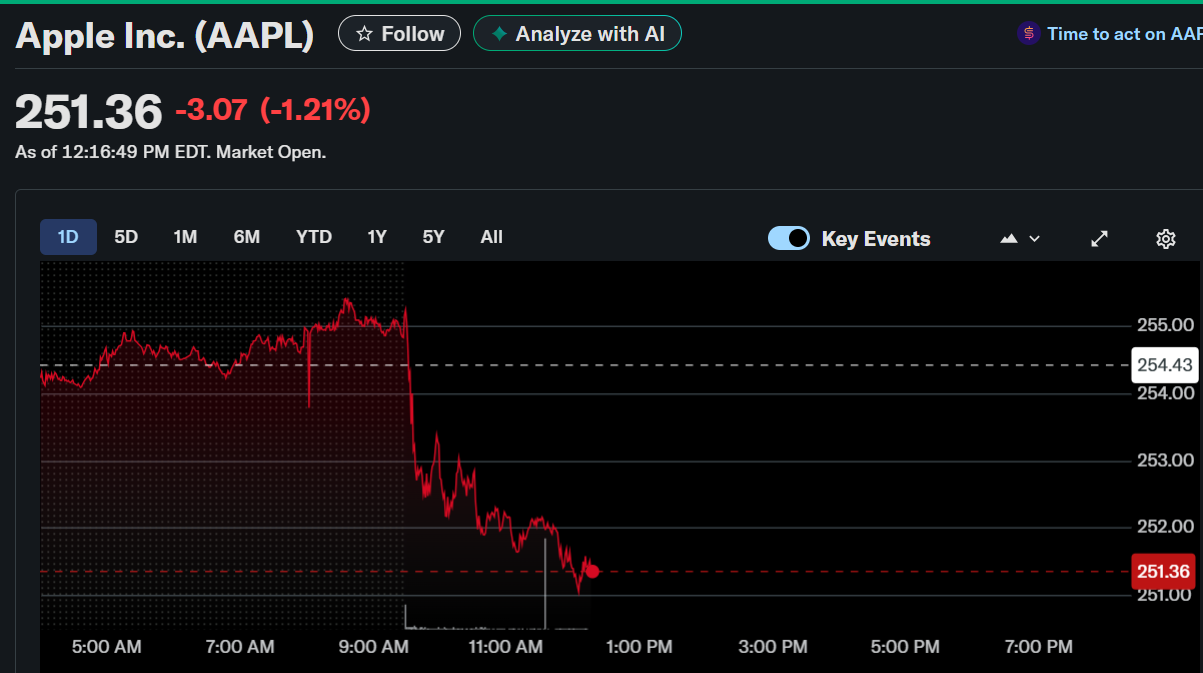
Apple Inc. (AAPL)
With these gains, Apple has erased its 2025 losses, now up 1.96% year-to-date, though still trailing the S&P 500’s 13.18% rise. The September 25 earnings report will give further clarity on Apple’s momentum.
The rally followed strong initial demand for Apple’s newly launched iPhone 17 lineup. Shares climbed 4% earlier this week as shipping times lengthened for the redesigned iPhone Air, signaling healthy interest heading into the holiday quarter.
UBS warns of ASP pressure
Despite the positive stock reaction, UBS analysts flagged potential risks for Apple’s average selling price. Evidence Lab data showed “elevated year-over-year wait times” for the iPhone 17 Base model across 30 tracked markets, while demand for higher-end models like the Pro Max looked flatter.
In the U.S., wait times for the iPhone 17 Base stretched to 18 days versus 11 days for the iPhone 16 Base. In China, wait times jumped to 25 days compared with 9 days for last year’s model, which UBS partly attributed to subsidies. However, the analysts noted that heavy mixing toward entry-level models may dampen ASP upside this quarter.
Apple’s pricing strategy
UBS pointed to Apple’s strategic pricing adjustments. The Base model now starts with 256GB storage, effectively lowering its price per gigabyte, while the Air and Pro models saw implied price increases. This mix could weigh on revenue per unit even if total shipments grow.
The $999 iPhone Air is proving a strong draw, being Apple’s first major redesign in years. Bank of America analysts reported longer delivery windows of 18 days for the Air compared with just 10 days for last year’s iPhone 16.
Broader product ecosystem and AI lag
Apple’s fall lineup also included new AirPods Pro 3 and the latest Apple Watch, which introduced AI-driven health features such as blood pressure risk alerts. Still, the company lags competitors in AI innovation. A major Siri update isn’t expected until 2026, leaving Apple behind Microsoft and Google, both of which have heavily invested in AI this year.
Performance overview
Looking beyond 2025, Apple remains a long-term outperformer. The company has returned 12.87% over the past year and 144.18% over five years, compared with the S&P 500’s 16.41% and 105.66% gains, respectively. Yet the near-term focus rests squarely on the iPhone 17’s holiday season performance and whether Apple can sustain momentum despite ASP concerns and AI challenges.
The post Apple Inc. ($AAPL) Stock: Turns Positive in 2025 After iPhone 17 Launch appeared first on CoinCentral.
You May Also Like

US Prosecutors Seek 12-Year Prison for Do Kwon Over Terra Collapse
Highlights: US prosecutors requested a 12-year prison sentence for Do Kwon after the Terra collapse. Terraform’s $40 billion downfall caused huge losses and sparked a long downturn in crypto markets. Do Kwon will face sentencing on December 11 and must give up $19 million in earnings. US prosecutors have asked a judge to give Do Kwon, Terraform Labs co-founder, a 12-year prison sentence for his role in the remarkable $40 billion collapse of the Terra and Luna tokens. The request also seeks to finalize taking away Kwon’s criminal earnings. The court filing came in New York’s Southern District on Thursday. This is about four months after Kwon admitted guilt on two charges: wire fraud and conspiracy to defraud. Prosecutors said Kwon caused more losses than Samuel Bankman-Fried, Alexander Mashinsky, and Karl Sebastian Greenwood combined. U.S. prosecutors have asked a New York federal judge to sentence Terraform Labs co-founder Do Kwon to 12 years in prison, calling his role in the 2022 TerraUSD collapse a “colossal” fraud that triggered broader crypto-market failures, including the downfall of FTX. Sentencing is… — Wu Blockchain (@WuBlockchain) December 5, 2025 Terraform Collapse Shakes Crypto Market Authorities explained that Terraform’s collapse affected the entire crypto market. They said it helped trigger what is now called the ‘Crypto Winter.’ The filing stressed that Kwon’s conduct harmed many investors and the broader crypto world. On Thursday, prosecutors said Kwon must give up just over $19 million. They added that they will not ask for any additional restitution. They said: “The cost and time associated with calculating each investor-victim’s loss, determining whether the victim has already been compensated through the pending bankruptcy, and then paying out a percentage of the victim’s losses, will delay payment and diminish the amount of money ultimately paid to victims.” Authorities will sentence Do Kwon on December 11. They charged him in March 2023 with multiple crimes, including securities fraud, market manipulation, money laundering, and wire fraud. All connections are tied to his role at Terraform. After Terra fell in 2022, authorities lost track of Kwon until they arrested him in Montenegro on unrelated charges and sent him to the U.S. Do Kwon’s Legal Case and Sentencing In April last year, a jury ruled that both Terraform and Kwon committed civil fraud. They found the company and its co-founder misled investors about how the business operated and its finances. Jay Clayton, U.S. Attorney for the Southern District of New York, submitted the sentencing request in November. TERRA STATEMENT: “We are very disappointed with the verdict, which we do not believe is supported by the evidence. We continue to maintain that the SEC does not have the legal authority to bring this case at all, and we are carefully weighing our options and next steps.” — Zack Guzmán (@zGuz) April 5, 2024 The news of Kwon’s sentencing caused Terraform’s token, LUNA, to jump over 40% in one day, from $0.07 to $0.10. Still, this rise remains small compared to its all-time high of more than $19, which the ecosystem reached before collapsing in May 2022. In a November court filing, Do Kwon’s lawyers asked for a maximum five-year sentence. They argued for a shorter term partly because he could face up to 40 years in prison in South Korea, where prosecutors are also pursuing a case against him. The legal team added that even if Kwon serves time in the U.S., he would not be released freely. He would be moved from prison to an immigration detention center and then sent to Seoul to face pretrial detention for his South Korea charges. eToro Platform Best Crypto Exchange Over 90 top cryptos to trade Regulated by top-tier entities User-friendly trading app 30+ million users 9.9 Visit eToro eToro is a multi-asset investment platform. The value of your investments may go up or down. Your capital is at risk. Don’t invest unless you’re prepared to lose all the money you invest. This is a high-risk investment, and you should not expect to be protected if something goes wrong.

Tether CEO Delivers Rare Bitcoin Price Comment