The cost model leverages SMT‑based solving (Z3) to achieve optimal decoding speed under CPU, I/O, and memory constraints.The cost model leverages SMT‑based solving (Z3) to achieve optimal decoding speed under CPU, I/O, and memory constraints.

How PowerInfer‑2 Turns Your Smartphone Into an AI Workstation

2025/11/04 03:56

Abstract and 1. Introduction

  1. Background and Motivation
  2. PowerInfer-2 Overview
  3. Neuron-Aware Runtime Inference
  4. Execution Plan Generation
  5. Implementation
  6. Evaluation
  7. Related Work
  8. Conclusion and References

5 Execution Plan Generation

Today’s smartphones are equipped with a variety of hardware specifications, such as differing CPU capabilities, I/O throughput, and DRAM sizes. Users deploying LLMs on these devices also have diverse objectives. Some may prioritize a balance between generation speed and memory usage, while others aim to maximize hardware utilization for increased speed. Additionally, the models themselves vary in weight numbers, structures, and sparsity levels. To manage this complexity, PowerInfer-2 includes an offline planner specifically designed to develop execution plans that optimally meet these varied requirements.

\

5.1 Execution Plan

\

5.2 Input Parameters

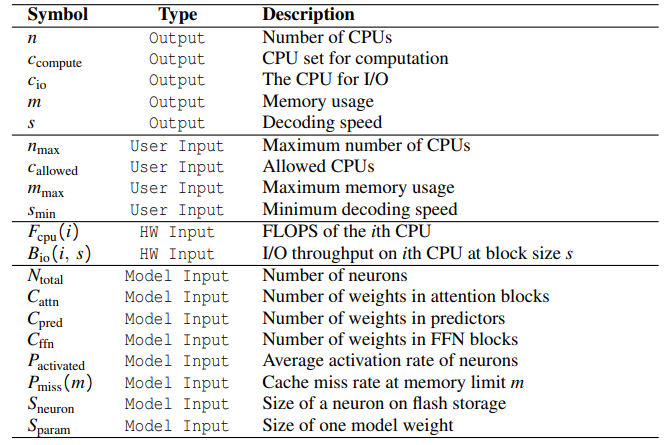
Table 2 also lists three categories of input parameters:

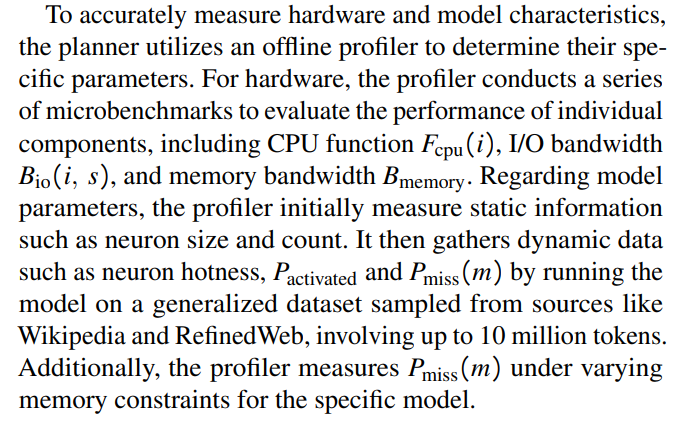
\ • Hardware: Parameters profiled from the hardware, such as CPU FLOPS, I/O throughput, and memory bandwidth.

\ • User: Parameters specified by the user, such as CPU constraints, memory limit, and lower bound of decoding speed.

\ • Model: Parameters about the model collected by an offline profiler, such as the size of the model, sparsity levels and caching characteristics, etc.

\
\

5.3 Cost Model

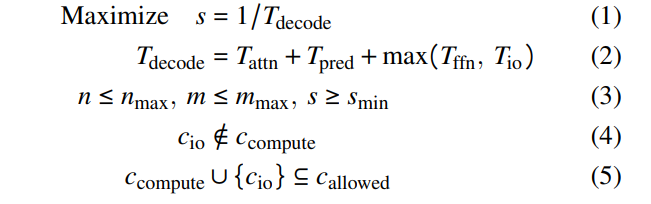
After collecting the input parameters, the planner uses a cost model to generate the execution plan. The goal is to maximize the generation speed s (as defined by Equation 1) while adhering to user-specified constraints (Formulas 3-5). The decoding speed s is inversely proportional to the time taken to decode one token (Equation 1), which is determined by the computation times for that token (Equation 2), as we efficiently overlap the computation and I/O operations. As we have defined the objective function and the constraints, the constructed model can be solved by mature SMT solvers. In our implementation, we utilize the Z3 solver [11] to solve the cost model.

\
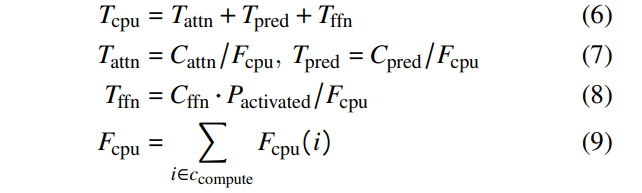
\ To compute the decoding time, we first model the times for computation. As we observed that memory opeartion is not a significant factor compared to the computation, we do not consider it in the computation time. Computation time (Equation 6) is primarily influenced by the attention blocks, predictors, and FFN blocks. The calculation involves dividing the computational workload of these components by the CPU flops (defined in Equation 7- 8). The flops of the selected CPU cores are specified in Equations 9.

\
\ Table 2: Symbols used in execution planning.
\ As FFN block computation overlaps with neuron loading, the planner must also account for I/O transmission time. This is calculated by dividing the volume of neurons transferred from flash storage (Equation 10) by the I/O bandwidth. This transferred volume depends on both the activation rate and the cache miss rate.

\

\ Finally, the planner calculates the time to load neurons from memory, which relates to the weight sizes of attention blocks, predictors, and neurons activated at runtime. The memory time is determined by dividing the total weight of activated neurons for one token by the memory bandwidth (Equation 11).

\

6 Implementation

PowerInfer-2 is developed on top of PowerInfer [30], a stateof-the-art serving framework designed for sparsely-activated LLMs, by integrating an additional 12K lines of C++ code into PowerInfer [30]. These enhancements encompass several key areas, including the polymorphic neuron engine, neuron cache, flexible neuron loading, and neuron-cluster-level I/O pipeline.

\ Since PowerInfer-2 depends on privileged system APIs (e.g., mlock that locks pages in memory) that needs the root permission, we built it on the Android [5] platform. Even though there is no need to alter the system kernel, a rooted Android system still provides us with considerable flexibility in developing and debugging our system. Furthermore, PowerInfer-2 is inherently designed with no modifications to the kernel, making it easily portable to other operating systems, including iOS [14] platform.

\ The current implementation of PowerInfer-2 supports a diverse array of LLMs with varying model sizes, including Llama-2 family [27] (7B, 13B), TurboSparse-Mistral [31] (7B), and TurboSparse-Mixtral [31] (47B).

\ Table 3: Hardware specifications of smartphones we used in the evaluation. “DRAM” is the physical memory size. “Available” is the maximum memory size that can be occupied by an application.

\

:::info Authors:

(1) Zhenliang Xue, Co-first author from Institute of Parallel and Distributed Systems (IPADS), Shanghai Jiao Tong University;

(2) Yixin Song, Co-first author from Institute of Parallel and Distributed Systems (IPADS), Shanghai Jiao Tong University;

(3) Zeyu Mi, Institute of Parallel and Distributed Systems (IPADS), Shanghai Jiao Tong University (yzmizeyu@sjtu.edu.cn);

(4) Le Chen, Institute of Parallel and Distributed Systems (IPADS), Shanghai Jiao Tong University;

(5) Yubin Xia, Institute of Parallel and Distributed Systems (IPADS), Shanghai Jiao Tong University;

(6) Haibo Chen, Institute of Parallel and Distributed Systems (IPADS), Shanghai Jiao Tong University.

:::


:::info This paper is available on arxiv under CC BY 4.0 license.

:::

\

Disclaimer: The articles reposted on this site are sourced from public platforms and are provided for informational purposes only. They do not necessarily reflect the views of MEXC. All rights remain with the original authors. If you believe any content infringes on third-party rights, please contact service@support.mexc.com for removal. MEXC makes no guarantees regarding the accuracy, completeness, or timeliness of the content and is not responsible for any actions taken based on the information provided. The content does not constitute financial, legal, or other professional advice, nor should it be considered a recommendation or endorsement by MEXC.

You May Also Like

Shocking OpenVPP Partnership Claim Draws Urgent Scrutiny

Shocking OpenVPP Partnership Claim Draws Urgent Scrutiny

The post Shocking OpenVPP Partnership Claim Draws Urgent Scrutiny appeared on BitcoinEthereumNews.com. The cryptocurrency world is buzzing with a recent controversy surrounding a bold OpenVPP partnership claim. This week, OpenVPP (OVPP) announced what it presented as a significant collaboration with the U.S. government in the innovative field of energy tokenization. However, this claim quickly drew the sharp eye of on-chain analyst ZachXBT, who highlighted a swift and official rebuttal that has sent ripples through the digital asset community. What Sparked the OpenVPP Partnership Claim Controversy? The core of the issue revolves around OpenVPP’s assertion of a U.S. government partnership. This kind of collaboration would typically be a monumental endorsement for any private cryptocurrency project, especially given the current regulatory climate. Such a partnership could signify a new era of mainstream adoption and legitimacy for energy tokenization initiatives. OpenVPP initially claimed cooperation with the U.S. government. This alleged partnership was said to be in the domain of energy tokenization. The announcement generated considerable interest and discussion online. ZachXBT, known for his diligent on-chain investigations, was quick to flag the development. He brought attention to the fact that U.S. Securities and Exchange Commission (SEC) Commissioner Hester Peirce had directly addressed the OpenVPP partnership claim. Her response, delivered within hours, was unequivocal and starkly contradicted OpenVPP’s narrative. How Did Regulatory Authorities Respond to the OpenVPP Partnership Claim? Commissioner Hester Peirce’s statement was a crucial turning point in this unfolding story. She clearly stated that the SEC, as an agency, does not engage in partnerships with private cryptocurrency projects. This response effectively dismantled the credibility of OpenVPP’s initial announcement regarding their supposed government collaboration. Peirce’s swift clarification underscores a fundamental principle of regulatory bodies: maintaining impartiality and avoiding endorsements of private entities. Her statement serves as a vital reminder to the crypto community about the official stance of government agencies concerning private ventures. Moreover, ZachXBT’s analysis…
Share
BitcoinEthereumNews2025/09/18 02:13
Metaplanet 50M Bitcoin Loan and BTC Relief Rally

Metaplanet 50M Bitcoin Loan and BTC Relief Rally

The post Metaplanet 50M Bitcoin Loan and BTC Relief Rally appeared on BitcoinEthereumNews.com. Metaplanet has secured a 50 million dollar loan using its Bitcoin holdings as collateral to fund new BTC purchases and income products. At the same time, chartist Titan of Crypto says Bitcoin’s price action continues to track a earlier relief rally fractal on the two day chart. Metaplanet secured a 50 million dollar loan backed by its existing Bitcoin holdings, according to a new disclosure shared today. The company said the funds will support additional Bitcoin purchases and expand its Bitcoin-based income operations as part of its ongoing treasury strategy. The filing shows that Metaplanet pledged part of its current holdings to obtain the loan instead of issuing new equity or bonds. This structure allows the firm to raise capital while keeping its Bitcoin position intact. It also signals that the company continues to lean heavily on Bitcoin as both a reserve asset and a financing tool. The move follows a series of Bitcoin-focused initiatives from Metaplanet, including earlier bond issuances and ongoing accumulation programs. Today’s loan marks the latest step in that strategy as the company increases leverage to expand its holdings. Analyst Sees Bitcoin Still Following Earlier Cycle Fractal Meanwhile, Crypto chartist Titan of Crypto says Bitcoin’s latest pullback still fits the “relief rally” fractal he has been tracking on the two-day chart. In a new update, he compares the current structure to the 2021–2022 cycle, highlighting a similar sequence of a local peak, a sharp drop into a demand zone, and then a rebound. Bitcoin Relief Rally Fractal Roadmap. Source: Titan of Crypto and TradingView In the chart, Bitcoin’s price action forms a pattern that mirrors the earlier cycle, with a shaded support area marking the zone where the last major relief rally started. An accompanying momentum oscillator also shows a repeat of lower highs on price…
Share
BitcoinEthereumNews2025/12/06 01:14