An engineer compares an LLM’s fabricated claims about printheads with real-world data, revealing why statistical models fail at physical reasoning—and why technical decisions should never rely on AI alone.An engineer compares an LLM’s fabricated claims about printheads with real-world data, revealing why statistical models fail at physical reasoning—and why technical decisions should never rely on AI alone.

A Simple Hardware Question Exposes the Limits of Today’s LLMs

2025/12/05 18:29

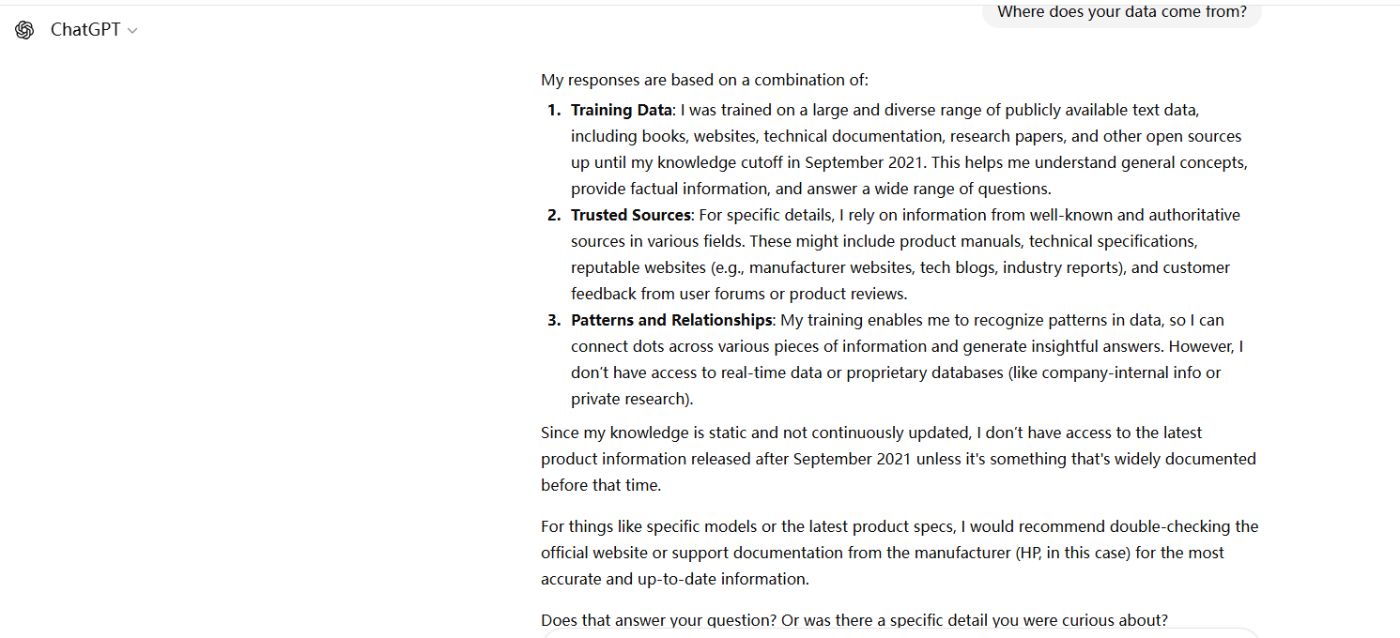
\ As engineers and builders, we're trained to trust data and specifications. So, when I decided to stress-test a popular Large Language Model (LLM) on a piece of hardware I know intimately—printheads—the results weren't just wrong; they were a masterclass in confident fabrication.

My query was straightforward: "Compare the HP 841 industrial printhead with a standard HP A3 office printhead." The LLM responded with a detailed, articulate argument that was, technically speaking, precisely backward. It touted the office-grade component as superior. This isn't a simple mistake; it's a fundamental failure of how LLMs "understand" the physical world.

\
\

The LLM's Architectural Flaw: It's a Statistician, Not an Engineer

Let's be clear: an LLM is not a reasoning engine. It's a stochastic parroting engine. Its core function is to predict the next most statistically plausible token (word fragment) based on its training corpus. It has no sensor for truth, no grounding in physics, and no concept of mechanical wear.

When asked about a technical subject, it doesn't retrieve facts from a verified database. Instead, it assembles an answer based on patterns it has seen in its training data.

The problem is, the internet is filled with:

  • Volume-skewed data: There are far more discussions, reviews, and queries about common office A3 printers than niche industrial printheads.
  • Ambiguous language: The term "A3" is often used as a proxy for "large format" or "high-quality" in casual writing, muddying the technical waters.
  • Outdated and incorrect forum posts.

The LLM absorbed this messy, imbalanced corpus and produced a response that sounded authoritative but was built on a foundation of statistical noise. It's the equivalent of asking a million people on the street about quantum mechanics and basing your thesis on the most common phrases they utter.

A Technical Reality Check: The HP 841 vs. A3 Printhead

My goal here isn't just to say the AI is wrong; it's to provide the ground truth that the LLM lacks. The difference between these components isn't a matter of opinion; it's a matter of engineering intent.

The following comparison isn't AI-generated; it's sourced from datasheets, tear-downs, and real-world deployment.

| Feature | HP 841 (Industrial PageWide) | Standard HP A3 Office Printhead | |----|----|----| | Target Application | High-throughput commercial printing, central reprographic departments | Low-to-medium volume office/desktop printing | | Core Architecture | Page-wide, fixed-array, single-pass | Scanning carriage, shuttle-based, multi-pass | | Throughput (A4) | 70-80 PPM | 15-30 PPM | | Duty Cycle | Hundreds of thousands of pages/month | Tens of thousands of pages/month | | Design Lifespan | Years (or millions of pages) | 1-2 years (or hundreds of thousands of pages) | | Cost Model | Extremely low cost-per-page | Higher cost-per-page |

The Engineering Deep Dive: Where the LLM Misses the Point

The specs above tell a clear story, but the real differentiators are in the physical design, which an LLM can never comprehend.

  1. Electrical & Contact Design:
  • HP 841: Uses a wide, dual-sided contact cable. This is for superior current delivery, lower resistance, and resilience against oxidation—a critical feature for 24/7 operation. It's built like a server power supply.

  • A3 Printhead: Typically uses a simpler, single-sided flex cable. It's sufficient for intermittent use but a single point of failure under constant load. It's a consumer-grade component.

    \

  1. Fluid Systems & Reliability:
  • HP 841: Features a sophisticated ink system with a short, tall ink sac to maintain optimal pressure and flow. Its internal architecture is designed with anti-airlock mechanisms to prevent the number one cause of printhead failure: air bubbles clogging the micro-channels.
  • A3 Printhead: Often has a longer, more passive ink path prone to starvation and air ingestion. It's the primary reason for print quality degradation and premature death.

My Perspective: Why This Matters Beyond Printers

This isn't just about printheads. It's a cautionary tale for any technical decision-maker. LLMs are phenomenal for brainstorming, boilerplate code, and summarizing well-trodden topics. 

But when your question requires:

  • Specialized, up-to-date technical knowledge
  • An understanding of physical properties and engineering constraints
  • The ability to discern between marketing fluff and technical reality

…you must treat the LLM's output as unverified, potentially hazardous draft material. It is a tool for acceleration, not a source of truth.

The final authority must always be official documentation, empirical testing, and domain expertise. In the case of the HP 841, its design is a masterpiece of industrial engineering, optimized for a single metric: total cost of ownership at scale. To claim an office-grade component is superior is to fundamentally misunderstand the problem it was built to solve.

Let's use AI for what it's good at, but never outsource our technical judgment to a model that has never held a printhead in its hand, nor seen one fail under production load.

\

Disclaimer: The articles reposted on this site are sourced from public platforms and are provided for informational purposes only. They do not necessarily reflect the views of MEXC. All rights remain with the original authors. If you believe any content infringes on third-party rights, please contact service@support.mexc.com for removal. MEXC makes no guarantees regarding the accuracy, completeness, or timeliness of the content and is not responsible for any actions taken based on the information provided. The content does not constitute financial, legal, or other professional advice, nor should it be considered a recommendation or endorsement by MEXC.

You May Also Like

Shocking OpenVPP Partnership Claim Draws Urgent Scrutiny

Shocking OpenVPP Partnership Claim Draws Urgent Scrutiny

The post Shocking OpenVPP Partnership Claim Draws Urgent Scrutiny appeared on BitcoinEthereumNews.com. The cryptocurrency world is buzzing with a recent controversy surrounding a bold OpenVPP partnership claim. This week, OpenVPP (OVPP) announced what it presented as a significant collaboration with the U.S. government in the innovative field of energy tokenization. However, this claim quickly drew the sharp eye of on-chain analyst ZachXBT, who highlighted a swift and official rebuttal that has sent ripples through the digital asset community. What Sparked the OpenVPP Partnership Claim Controversy? The core of the issue revolves around OpenVPP’s assertion of a U.S. government partnership. This kind of collaboration would typically be a monumental endorsement for any private cryptocurrency project, especially given the current regulatory climate. Such a partnership could signify a new era of mainstream adoption and legitimacy for energy tokenization initiatives. OpenVPP initially claimed cooperation with the U.S. government. This alleged partnership was said to be in the domain of energy tokenization. The announcement generated considerable interest and discussion online. ZachXBT, known for his diligent on-chain investigations, was quick to flag the development. He brought attention to the fact that U.S. Securities and Exchange Commission (SEC) Commissioner Hester Peirce had directly addressed the OpenVPP partnership claim. Her response, delivered within hours, was unequivocal and starkly contradicted OpenVPP’s narrative. How Did Regulatory Authorities Respond to the OpenVPP Partnership Claim? Commissioner Hester Peirce’s statement was a crucial turning point in this unfolding story. She clearly stated that the SEC, as an agency, does not engage in partnerships with private cryptocurrency projects. This response effectively dismantled the credibility of OpenVPP’s initial announcement regarding their supposed government collaboration. Peirce’s swift clarification underscores a fundamental principle of regulatory bodies: maintaining impartiality and avoiding endorsements of private entities. Her statement serves as a vital reminder to the crypto community about the official stance of government agencies concerning private ventures. Moreover, ZachXBT’s analysis…
Share
BitcoinEthereumNews2025/09/18 02:13
Metaplanet 50M Bitcoin Loan and BTC Relief Rally

Metaplanet 50M Bitcoin Loan and BTC Relief Rally

The post Metaplanet 50M Bitcoin Loan and BTC Relief Rally appeared on BitcoinEthereumNews.com. Metaplanet has secured a 50 million dollar loan using its Bitcoin holdings as collateral to fund new BTC purchases and income products. At the same time, chartist Titan of Crypto says Bitcoin’s price action continues to track a earlier relief rally fractal on the two day chart. Metaplanet secured a 50 million dollar loan backed by its existing Bitcoin holdings, according to a new disclosure shared today. The company said the funds will support additional Bitcoin purchases and expand its Bitcoin-based income operations as part of its ongoing treasury strategy. The filing shows that Metaplanet pledged part of its current holdings to obtain the loan instead of issuing new equity or bonds. This structure allows the firm to raise capital while keeping its Bitcoin position intact. It also signals that the company continues to lean heavily on Bitcoin as both a reserve asset and a financing tool. The move follows a series of Bitcoin-focused initiatives from Metaplanet, including earlier bond issuances and ongoing accumulation programs. Today’s loan marks the latest step in that strategy as the company increases leverage to expand its holdings. Analyst Sees Bitcoin Still Following Earlier Cycle Fractal Meanwhile, Crypto chartist Titan of Crypto says Bitcoin’s latest pullback still fits the “relief rally” fractal he has been tracking on the two-day chart. In a new update, he compares the current structure to the 2021–2022 cycle, highlighting a similar sequence of a local peak, a sharp drop into a demand zone, and then a rebound. Bitcoin Relief Rally Fractal Roadmap. Source: Titan of Crypto and TradingView In the chart, Bitcoin’s price action forms a pattern that mirrors the earlier cycle, with a shaded support area marking the zone where the last major relief rally started. An accompanying momentum oscillator also shows a repeat of lower highs on price…
Share
BitcoinEthereumNews2025/12/06 01:14
