Recently the crypto chart of Pepecoin (PEPE) has indicated a sudden drop of approximately 16 percent and some investors are now seeking other more advantageous Recently the crypto chart of Pepecoin (PEPE) has indicated a sudden drop of approximately 16 percent and some investors are now seeking other more advantageous

Pepecoin (PEPE) Drops 16% as Investors Reallocate to This New Cheap Cryptocurrency

Recently the crypto chart of Pepecoin (PEPE) has indicated a sudden drop of approximately 16 percent and some investors are now seeking other more advantageous risk-reward curves. As the crypto prices decline, traders tend to divert capital to projects with more defined utility or more fundamentals. 

That change is currently becoming reflected in interest in Mutuum Finance (MUTM), a new cheap cryptocurrency with protocol launch catalysts. Market pundits are wondering whether this is a change in terms of what crypto to buy now.

Pepecoin (PEPE)

One of the higher-ranking meme tokens in the crypto world is pepecoin (PEPE). It is trading at around $0.000006 and it has a market cap of about $2.5B. PEPE has emerged due to community interest and viral attention like many other meme coins. These can rest on the prices without much hesitation but they may not be a good long term price support.

Considering the crypto charts, PEPE has resistance at major levels. A zone traders resistance is observed to be in the range, around $0.000008 and this is where the previous rallies have leveled and profit squeegee has been used. 

The stronger resistance band seems to have been nearer to $0.000010 as this is the nearest mark to both the psychological and technical barrier. When PEPE ruptures on these levels with volume, the sentiment may be enhanced. However, with no obvious drivers of growth, it may be difficult to emerge out of these zones.

Mutuum Finance (MUTM)

Mutuum Finance (MUTM) is an upcoming cheap crypto pegged to a decentralized lending protocol which is anticipated to launch its V1 protocol on the Sepolia testnet in early 2026. The system is developed to enable the lending and borrowing of assets by pooled contracts as opposed to matching individually. When the protocol is operational, suppliers will get mtTokens which will reflect their percentage of a pool and their interest in this pool.

The presale of MUTM started with an opening price of $0.01 in early 2025 and has risen in stages until it reaches $0.04 which is approximately 300% higher than its initial stages. It is estimated that at the time of launch, prices will be $0.06, and therefore early presale holders will be at a 500% upside opportunity at the time of launch, provided the markets and adoption work. Mutuum Finance has collected a total of $19.8M to date, and over 18,800 of the holders have been sold and 830M of the tokens have sold.

PEPE vs MUTM Price Predictions

The market commentators tracking meme coins will tend to warn that PEPE has a finite ceiling because of its design. In the absence of a roadmap that is connected with actual utilization, analysts believe PEPE could continue to trade within sideways movements or within the regions that are already known to have resistance without any real breakouts. 

There are predictions that even in a robust bull cycle, PEPE may not break out of the $0.000010 level without another outburst of viral hype or a massive burn of a large number of tokens. Such a move is but a short-term payoff to risk when it comes to the investors posing questions on what they can buy as long-term returns on crypto.

In contrast, the price prospectus of Mutuum Finance indicates the design of its protocol. Since the token will be pegged to a lending market which is likely to be launched, analysts expect the crypto to perform better than most of the meme coins once it starts being used. In a bullish case, certain predictions indicate that MUTM could be trading more than $0.20 in 12-18 months after launch in case the revenue begins to flow and exchanges list the token. 

Whale Allocations and Security

One reason that Mutuum Finance appears in some lists of cheap crypto to buy now is because of its security and community incentives. The protocol passed an independent audit by Halborn and received 90/100 in a CertiK scan of the token. It also has a code bug bounty program with a reward of $50,000 to find code vulnerabilities before release of the mainnet.

There is increased investor activity. Whale allocations have been rising in the presale stages, a fact that some market commentators view as confidence. Another feature of the project is a 24 hour leaderboard where the best contributor is rewarded with $500 of MUTM which could be used as a form of gamification and therefore increase participation.

With the volatile crypto prices and the changing stories, a comparison of the developed meme coins such as PEPE to the ones currently being developed in protocols will show the line of thought of the investors. 

Traders seeking crypto to purchase at the moment can put emphasis on not just the charts and resistance zones but also fundamentals and protocol execution. The presale and future V1 launch of Mutuum Finance may have a varying risk-reward curve in comparison to a token using community sentiment as a primary driver.

For more information about Mutuum Finance (MUTM) visit the links below:

Website: https://www.mutuum.com

Linktree: https://linktr.ee/mutuumfinance

Market Opportunity
PepeCoin Logo
PepeCoin Price(PEPECOIN)
$0.1241
$0.1241$0.1241
-4.09%
USD
PepeCoin (PEPECOIN) Live Price Chart
Disclaimer: The articles reposted on this site are sourced from public platforms and are provided for informational purposes only. They do not necessarily reflect the views of MEXC. All rights remain with the original authors. If you believe any content infringes on third-party rights, please contact service@support.mexc.com for removal. MEXC makes no guarantees regarding the accuracy, completeness, or timeliness of the content and is not responsible for any actions taken based on the information provided. The content does not constitute financial, legal, or other professional advice, nor should it be considered a recommendation or endorsement by MEXC.

You May Also Like

Seeker (SKR) will soon be listed on Bybit Spot, Alpha, and Byreal.

Seeker (SKR) will soon be listed on Bybit Spot, Alpha, and Byreal.

PANews reported on January 21 that Bybit will launch Seeker (SKR) on its spot, Alpha, and Byreal platforms. Users can quickly trade without setting up a separate
Share
PANews2026/01/21 08:20
Perpetual DEX in testing with cross‑chain liquidity and ADL
Perpetual DEX in testing with cross‑chain liquidity and ADL

The post Perpetual DEX in testing with cross‑chain liquidity and ADL appeared on BitcoinEthereumNews.com. Sunperp, a new perpetual DEX being tested on the Tron blockchain, promises millisecond executions, cross-chain liquidity aggregation, and an integrated auto-deleveraging (ADL) system. Justin Sun reshared the announcement on X, inviting users to try it and highlighting dedicated incentives, while numerous economic details and operational metrics remain to be confirmed. According to the data collected by on-chain analysts and industry reports, in May 2025 TRON hosted over 75 billion USDT, with the network recording over 8.3 million daily transactions and approximately 306 million active accounts, a context that justifies the interest in USDT-collateralized derivatives. Market analysts following perpetual DEX also note that the massive availability of USDT on TRON facilitates cross-chain arbitrage operations and reduces costs for market makers. What is Sunperp and what it brings differently to Tron Sunperp is a platform perp DEX that uses USDT as collateral, with profits and losses calculated in USDT. The architecture separates matching, executed off-chain to maximize speed, from settlement, recorded on-chain to ensure transparency of trading results. In this context, the debut announcement was originally reported by Jamie Redman; the team also states that, while in the testing phase, the core contracts are non-upgradable. Main Technical Features Order types: market, limit (with FOK – Fill-or-Kill, GTC – Good-Till-Cancelled, and IOC – Immediate-or-Cancel modes), post-only orders, plan orders, trailing, and TWAP (Time-Weighted Average Price). Use of multi-source oracles to determine the mark price employed in the calculation of profits and liquidations. Primary collateral: USDT, with P&L calculated in the same currency. Core contracts declared non-upgradable in an environment still in testing. Cross-chain liquidity: less slippage and tighter spreads The protocol claims to aggregate liquidity flows from various networks in order to increase market depth and improve order execution, thereby reducing slippage and spreads in large-size trades. However, the actual effect will depend…
Share
BitcoinEthereumNews2025/09/22 17:20
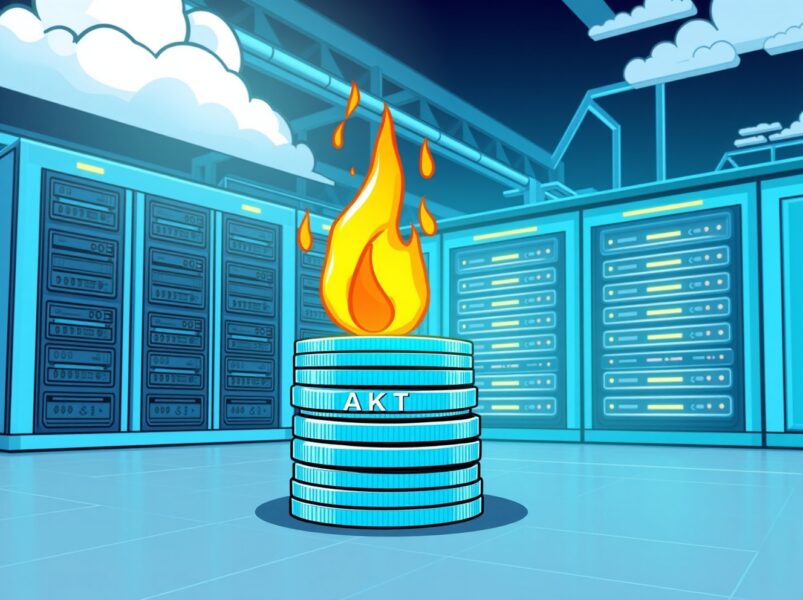
Akash Network’s Strategic Move: A Crucial Burn for AKT’s Future

Akash Network’s Strategic Move: A Crucial Burn for AKT’s Future

BitcoinWorld Akash Network’s Strategic Move: A Crucial Burn for AKT’s Future In the dynamic world of decentralized computing, exciting developments are constantly shaping the future. Today, all eyes are on Akash Network, the innovative supercloud project, as it proposes a significant change to its tokenomics. This move aims to strengthen the value of its native token, AKT, and further solidify its position in the competitive blockchain space. The community is buzzing about a newly submitted governance proposal that could introduce a game-changing Burn Mint Equilibrium (BME) model. What is the Burn Mint Equilibrium (BME) for Akash Network? The core of this proposal revolves around a concept called Burn Mint Equilibrium, or BME. Essentially, this model is designed to create a balance in the token’s circulating supply by systematically removing a portion of tokens from existence. For Akash Network, this means burning an amount of AKT that is equivalent to the U.S. dollar value of fees paid by network users. Fee Conversion: When users pay for cloud services on the Akash Network, these fees are typically collected in various cryptocurrencies or stablecoins. AKT Equivalence: The proposal suggests converting the U.S. dollar value of these collected fees into an equivalent amount of AKT. Token Burn: This calculated amount of AKT would then be permanently removed from circulation, or ‘burned’. This mechanism creates a direct link between network utility and token supply reduction. As more users utilize the decentralized supercloud, more AKT will be burned, potentially impacting the token’s scarcity and value. Why is This Proposal Crucial for AKT Holders? For anyone holding AKT, or considering investing in the Akash Network ecosystem, this proposal carries significant weight. Token burning mechanisms are often viewed as a positive development because they can lead to increased scarcity. When supply decreases while demand remains constant or grows, the price per unit tends to increase. Here are some key benefits: Increased Scarcity: Burning tokens reduces the total circulating supply of AKT. This makes each remaining token potentially more valuable over time. Demand-Supply Dynamics: The BME model directly ties the burning of AKT to network usage. Higher adoption of the Akash Network supercloud translates into more fees, and thus more AKT burned. Long-Term Value Proposition: By creating a deflationary pressure, the proposal aims to enhance AKT’s long-term value, making it a more attractive asset for investors and long-term holders. This strategic move demonstrates a commitment from the Akash Network community to optimize its tokenomics for sustainable growth and value appreciation. How Does BME Impact the Decentralized Supercloud Mission? Beyond token value, the BME proposal aligns perfectly with the broader mission of the Akash Network. As a decentralized supercloud, Akash provides a marketplace for cloud computing resources, allowing users to deploy applications faster, more efficiently, and at a lower cost than traditional providers. The BME model reinforces this utility. Consider these impacts: Network Health: A stronger AKT token can incentivize more validators and providers to secure and contribute resources to the network, improving its overall health and resilience. Ecosystem Growth: Enhanced token value can attract more developers and projects to build on the Akash Network, fostering a vibrant and diverse ecosystem. User Incentive: While users pay fees, the potential appreciation of AKT could indirectly benefit those who hold the token, creating a circular economy within the supercloud. This proposal is not just about burning tokens; it’s about building a more robust, self-sustaining, and economically sound decentralized cloud infrastructure for the future. What Are the Next Steps for the Akash Network Community? As a governance proposal, the BME model will now undergo a period of community discussion and voting. This is a crucial phase where AKT holders and network participants can voice their opinions, debate the merits, and ultimately decide on the future direction of the project. Transparency and community engagement are hallmarks of decentralized projects like Akash Network. Challenges and Considerations: Implementation Complexity: Ensuring the burning mechanism is technically sound and transparent will be vital. Community Consensus: Achieving broad agreement within the diverse Akash Network community is key for successful adoption. The outcome of this vote will significantly shape the tokenomics and economic model of the Akash Network, influencing its trajectory in the rapidly evolving decentralized cloud landscape. The proposal to introduce a Burn Mint Equilibrium model represents a bold and strategic step for Akash Network. By directly linking network usage to token scarcity, the project aims to create a more resilient and valuable AKT token, ultimately strengthening its position as a leading decentralized supercloud provider. This move underscores the project’s commitment to innovative tokenomics and sustainable growth, promising an exciting future for both users and investors in the Akash Network ecosystem. It’s a clear signal that Akash is actively working to enhance its value proposition and maintain its competitive edge in the decentralized future. Frequently Asked Questions (FAQs) 1. What is the main goal of the Burn Mint Equilibrium (BME) proposal for Akash Network? The primary goal is to adjust the circulating supply of AKT tokens by burning a portion of network fees, thereby creating deflationary pressure and potentially enhancing the token’s long-term value and scarcity. 2. How will the amount of AKT to be burned be determined? The proposal suggests burning an amount of AKT equivalent to the U.S. dollar value of fees paid by users on the Akash Network for cloud services. 3. What are the potential benefits for AKT token holders? Token holders could benefit from increased scarcity of AKT, which may lead to higher demand and appreciation in value over time, especially as network usage grows. 4. How does this proposal relate to the overall mission of Akash Network? The BME model reinforces the Akash Network‘s mission by creating a stronger, more economically robust ecosystem. A healthier token incentivizes network participants, fostering growth and stability for the decentralized supercloud. 5. What is the next step for this governance proposal? The proposal will undergo a period of community discussion and voting by AKT token holders. The community’s decision will determine if the BME model is implemented on the Akash Network. If you found this article insightful, consider sharing it with your network! Your support helps us bring more valuable insights into the world of decentralized technology. Stay informed and help spread the word about the exciting developments happening within Akash Network. To learn more about the latest crypto market trends, explore our article on key developments shaping decentralized cloud solutions price action. This post Akash Network’s Strategic Move: A Crucial Burn for AKT’s Future first appeared on BitcoinWorld.
Share
Coinstats2025/09/22 21:35
