A federal judge appeared less than credulous on Thursday that the Trump administration has the authority to build his massive new ballroom on the footprint of theA federal judge appeared less than credulous on Thursday that the Trump administration has the authority to build his massive new ballroom on the footprint of the

Trump's White House ballroom may hit brick wall as judge finds plan dubious: 'Be serious!'

A federal judge appeared less than credulous on Thursday that the Trump administration has the authority to build his massive new ballroom on the footprint of the demolished East Wing.

According to CBS News, "U.S. District Judge Richard Leon heard arguments Thursday on a motion brought by the National Trust for Historic Preservation to block the ongoing construction of the East Wing until the Trump administration goes through the appropriate approval processes, which it alleges the Trump administration has ignored."

During the hearing, Leon said "there's been an end-run around this oversight from Congress" in the process, and barked "Come on, be serious!" when the Justice Department lawyer argued that the project was legally equivalent to when former President Gerald Ford built a swimming pool at the White House in 1975.

Trump has promised that the ballroom, which will be around twice the size of the central White House building, is to be financed exclusively through private donations, without any taxpayer money. However, the price tag continues to go up and up over time, and experts are fearful that the massive corporate donations for the project could lead to conflicts of interest and favor-trading.

Leon raised this point as well, per the report, as he "repeatedly called the financing arrangement a 'Rube Goldberg,' referring to the cartoonist and inventor who made complex contraptions to perform simple tasks."

The ballroom project is one of many that the president has proposed or enacted to try to leave his mark on Washington, D.C., in his second term. Another controversial change, approved by a board of Trump's hand-picked allies, was to add Trump's name to the Kennedy Center for the Performing Arts, which has prompted a lawsuit.

Disclaimer: The articles reposted on this site are sourced from public platforms and are provided for informational purposes only. They do not necessarily reflect the views of MEXC. All rights remain with the original authors. If you believe any content infringes on third-party rights, please contact service@support.mexc.com for removal. MEXC makes no guarantees regarding the accuracy, completeness, or timeliness of the content and is not responsible for any actions taken based on the information provided. The content does not constitute financial, legal, or other professional advice, nor should it be considered a recommendation or endorsement by MEXC.

You May Also Like

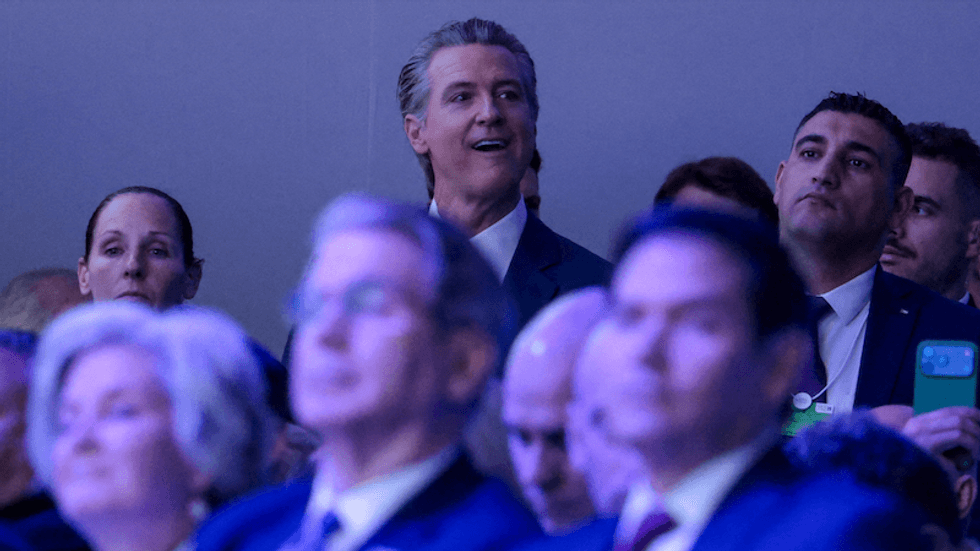
Trump and Newsom seen engaging in 'friendly banter' backstage: 'Gavin, we're good'

Trump and Newsom seen engaging in 'friendly banter' backstage: 'Gavin, we're good'

President Donald Trump and California Gov. Gavin Newsom engaged in a public war of words this week in Davos, Switzerland, but a Washington, D.C., insider revealed
Share
Rawstory2026/01/23 19:55
Visa Direct Enhances Mercuryo’s Real-Time Crypto-to-Fiat Conversions

Visa Direct Enhances Mercuryo’s Real-Time Crypto-to-Fiat Conversions

TLDR Mercuryo has partnered with Visa to offer near real-time crypto-to-fiat conversions through Visa Direct. The integration enables users to off-ramp cryptocurrency
Share
Coincentral2026/01/23 20:10
Vitalik Buterin lays out new Ethereum roadmap at EDCON

Vitalik Buterin lays out new Ethereum roadmap at EDCON

The post Vitalik Buterin lays out new Ethereum roadmap at EDCON appeared on BitcoinEthereumNews.com. At EDCON 2025 in Osaka, Ethereum co-founder Vitalik Buterin delivered fresh details of Ethereum’s technical roadmap, delineating both short-term scaling goals and longer-term protocol transformations. The immediate priority, according to slides from the presentation, is scaling at the L1 level by raising the gas limit while maintaining decentralization. Tools such as block-level access lists, ZK-EVMs, gas repricing, and slot optimization were highlighted as means to improve throughput and efficiency. A central theme of the presentation was privacy, divided into protections for on-chain “writes” (transactions, voting, DeFi operations) and “reads” (retrieving blockchain state). Write privacy could be achieved through client-side zero-knowledge proofs, encrypted voting, and mixnet-based transaction relays. Read privacy efforts include trusted execution environments, private information retrieval techniques, dummy queries to obscure access patterns, and partial state nodes that reveal only necessary data. These measures aim to reduce information leakage across both ends of user interaction. In the medium term, Ethereum’s focus shifts to cross-Layer-2 interoperability. Vitalik described trustless L2 asset transfers, proof aggregation, and faster settlement mechanisms as key milestones toward a seamless rollup ecosystem. Faster slots and stronger finality, supported by techniques like erasure coding and three-stage finalization (3SF), are also in scope to enhance responsiveness and security. The roadmap also includes Stage 2 rollup advancements to strengthen verification efficiency, alongside a call for broader community participation to help build and maintain these improvements. The long-term “Lean Ethereum” blueprint emphasizes security, simplicity and optimization, with ambitions for quantum-resistant cryptography, formal verification of the protocol, and adoption of ideal primitives for hashing, signatures, and zero-knowledge proofs. Buterin stressed that these improvements are not just for scalability but to make Ethereum a stable, trustworthy foundation for the broader decentralized ecosystem. This is a developing story. This article was generated with the assistance of AI and reviewed by editor Jeffrey Albus before publication.…
Share
BitcoinEthereumNews2025/09/18 03:22