A decline in ERC-20 stablecoin supply is often interpreted as liquidity exiting the cryptocurrency market. However, on-chain data from CryptoQuant shows a differentA decline in ERC-20 stablecoin supply is often interpreted as liquidity exiting the cryptocurrency market. However, on-chain data from CryptoQuant shows a different

Stablecoin Liquidity Is Shifting Networks, Not Leaving Crypto

2026/01/29 07:23

A decline in ERC-20 stablecoin supply is often interpreted as liquidity exiting the cryptocurrency market.

However, on-chain data from CryptoQuant shows a different dynamic unfolding in January 2026. Rather than leaving the system, stablecoin liquidity appears to be rotating across blockchain networks.

Stablecoin Supply Moves: January 19–20, 2026

On January 19 and 20, a clear divergence emerged between Ethereum and Tron stablecoin supplies.
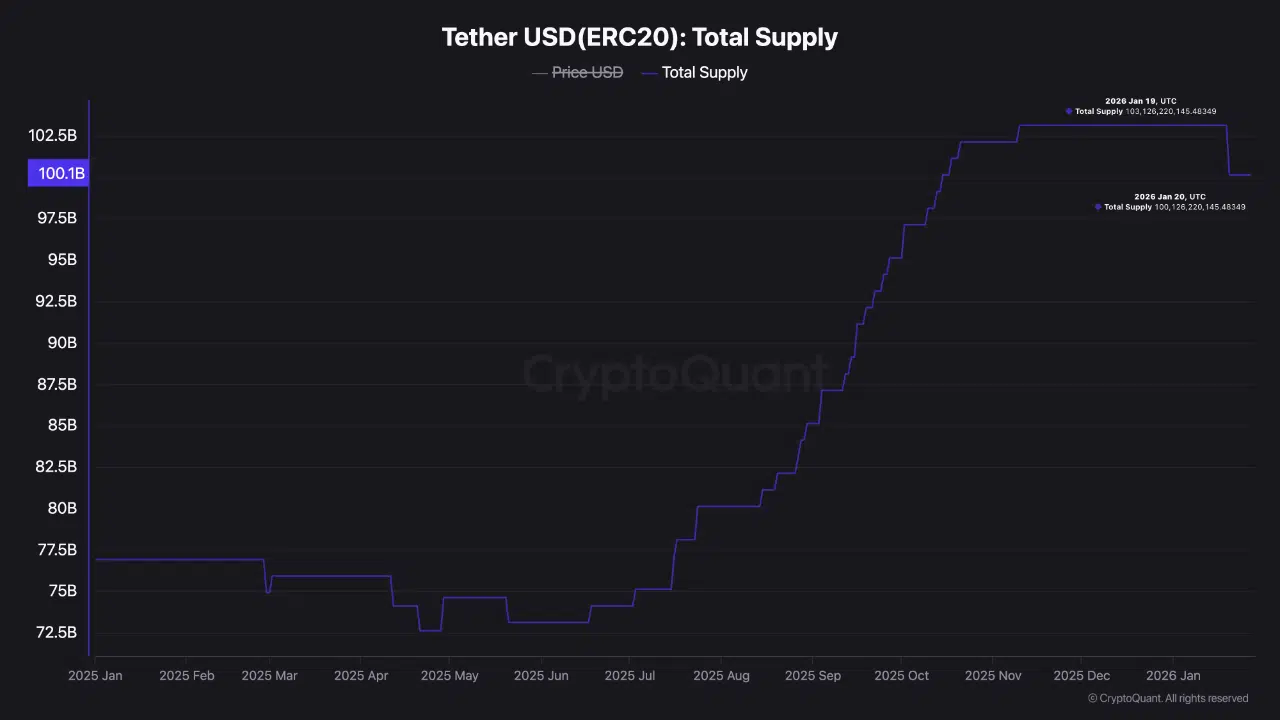
On the Tron network, USDT supply increased sharply. Total TRC-20 USDT rose from 82,434,679,540 on January 19 to 83,434,679,540 on January 20, marking a net increase of $1 billion in a single day. This expansion was driven by a direct mint on Tron.

At the same time, Ethereum experienced a notable contraction in stablecoin balances. ERC-20 USDT supply declined by approximately $3.0 billion, while ERC-20 USDC fell by around $3.55 billion. Combined, this represents roughly $6.5 billion in stablecoins removed from Ethereum-based circulation.

The timing is critical. The increase in TRC-20 USDT followed immediately after the contraction on Ethereum, suggesting a coordinated liquidity shift rather than an isolated redemption event.

What the Flow Data Indicates

This pattern does not resemble a broad exit from crypto into fiat. Instead, it reflects a redistribution of liquidity across networks and use cases.

USDT is primarily used for derivatives trading, OTC settlement, and short-term tactical positioning. Because of this role, it frequently migrates to lower-cost networks where transaction efficiency is higher. Tron has increasingly served as a preferred rail for these functions.

USDC, by contrast, is more closely tied to spot market activity and on-chain settlement. As a result, changes in ERC-20 USDC supply tend to act as a clearer signal for spot demand conditions, particularly on Ethereum.

When both USDT and USDC decline on Ethereum while USDT simultaneously expands on Tron, the most straightforward interpretation is that liquidity is changing rails, not disappearing.

OKX Launches Stablecoin Card in Europe as MiCA Takes Effect

Market Implications

The data suggests that liquidity remains inside the crypto ecosystem, but its positioning has become more defensive. Demand for Ethereum-based settlement appears to be softening, while capital preference shifts toward derivatives-oriented and parked liquidity environments.

From a market perspective, falling ERC-20 stablecoin supply carries specific implications. It is bearish for Ethereum on-chain activity, neutral to bearish for spot-driven risk appetite, and not evidence of capital exiting crypto entirely.

Rather than signaling capitulation, the stablecoin flows point to structural reallocation, a rotation within crypto infrastructure driven by cost efficiency and evolving use cases.

The post Stablecoin Liquidity Is Shifting Networks, Not Leaving Crypto appeared first on ETHNews.

Disclaimer: The articles reposted on this site are sourced from public platforms and are provided for informational purposes only. They do not necessarily reflect the views of MEXC. All rights remain with the original authors. If you believe any content infringes on third-party rights, please contact service@support.mexc.com for removal. MEXC makes no guarantees regarding the accuracy, completeness, or timeliness of the content and is not responsible for any actions taken based on the information provided. The content does not constitute financial, legal, or other professional advice, nor should it be considered a recommendation or endorsement by MEXC.

You May Also Like

Husky Inu (HINU) Completes Move To $0.00020688

Husky Inu (HINU) Completes Move To $0.00020688

Husky Inu (HINU) has completed its latest price jump, rising from $0.00020628 to $0.00020688. The price jump is part of the project’s pre-launch phase, which began on April 1, 2025.
Share
Cryptodaily2025/09/18 01:10
BDACS Launches KRW1, South Korean Won-Backed Stablecoin, Marking Key Digital Asset Milestone

BDACS Launches KRW1, South Korean Won-Backed Stablecoin, Marking Key Digital Asset Milestone

BDACS launches KRW1, a won-backed stablecoin with strong institutional backing. Avalanche blockchain powers KRW1, ensuring high performance and security. KRW1 aims for diverse use cases in payments and remittances. BDACS has officially launched KRW1, a stablecoin fully backed by the South Korean won, after completing a proof of concept (PoC) that validated its technical infrastructure. This launch is a big move towards BDACS the company has incorporated fiat deposits and issuing of stablecoins as well as blockchain verification into an ever functioning and operational ecosystem. KRW1 will become an important participant in the market of digital assets, where the priority will be compliance with the regulation, openness, and scalability. The stablecoin is fully backed by South Korean won kept in escrow at the Woori Bank, which is the key participant in this project. It also allows for the verification of reserves in real time by means of an integrated banking API, which supports the stability and reliability of KRW1. This is what makes BDACS a unique solution to the problem of breaking the barrier between the old financial system and the digital economy due to its integration of conventional banking and blockchain technology. Also Read: Bitcoin’s Next Move Depends on $115,440: Here’s What Happens Next! Leveraging Avalanche Blockchain for Enhanced Security and Scalability For its blockchain infrastructure, BDACS has chosen the Avalanche network, which is known for its high-performance capabilities and security. Avalanche’s speed and reliability make it an ideal choice for supporting KRW1’s stablecoin operations, ensuring that they can scale effectively while maintaining the highest levels of security. The collaboration between BDACS and Avalanche underscores the company’s belief in utilizing cutting-edge blockchain technology to provide a safe and scalable solution to the digital asset exchange. Looking ahead, BDACS envisions KRW1 as a versatile stablecoin that can be used for various purposes, including remittances, payments, investments, and deposits. The company also intends to incorporate the use case of KRW1 into the public sector, as the company will be able to provide low-cost payment options in emergency relief disbursements and other basic services. This growth will assist in decreasing transaction charges and increasing accessibility to digital financial solutions. BDACS aims to make KRW1 a key component of South Korea’s burgeoning digital economy by making strategic commitments with Woori Bank and using the latest blockchain technology. The company is determined to play a pivotal role in shaping the future of stablecoins in the region. Also Read: Top Investor Issues Advance Warning to XRP Holders – Beware of this Risk The post BDACS Launches KRW1, South Korean Won-Backed Stablecoin, Marking Key Digital Asset Milestone appeared first on 36Crypto.
Share
Coinstats2025/09/18 21:39
Michael Saylor Pushes Digital Capital Narrative At Bitcoin Treasuries Unconference

Michael Saylor Pushes Digital Capital Narrative At Bitcoin Treasuries Unconference

The post Michael Saylor Pushes Digital Capital Narrative At Bitcoin Treasuries Unconference appeared on BitcoinEthereumNews.com. The suitcoiners are in town.  From a low-key, circular podium in the middle of a lavish New York City event hall, Strategy executive chairman Michael Saylor took the mic and opened the Bitcoin Treasuries Unconference event. He joked awkwardly about the orange ties, dresses, caps and other merch to the (mostly male) audience of who’s-who in the bitcoin treasury company world.  Once he got onto the regular beat, it was much of the same: calm and relaxed, speaking freely and with confidence, his keynote was heavy on the metaphors and larger historical stories. Treasury companies are like Rockefeller’s Standard Oil in its early years, Michael Saylor said: We’ve just discovered crude oil and now we’re making sense of the myriad ways in which we can use it — the automobile revolution and jet fuel is still well ahead of us.  Established, trillion-dollar companies not using AI because of “security concerns” make them slow and stupid — just like companies and individuals rejecting digital assets now make them poor and weak.  “I’d like to think that we understood our business five years ago; we didn’t.”  We went from a defensive investment into bitcoin, Saylor said, to opportunistic, to strategic, and finally transformational; “only then did we realize that we were different.” Michael Saylor: You Come Into My Financial History House?! Jokes aside, Michael Saylor is very welcome to the warm waters of our financial past. He acquitted himself honorably by invoking the British Consol — though mispronouncing it, and misdating it to the 1780s; Pelham’s consolidation of debts happened in the 1750s and perpetual government debt existed well before then — and comparing it to the gold standard and the future of bitcoin. He’s right that Strategy’s STRC product in many ways imitates the consols; irredeemable, perpetual debt, issued at par, with…
Share
BitcoinEthereumNews2025/09/18 02:12