President Trump pledged that the U.S. would be a "crypto capital" — today, it's anything but. And the Winklevoss super-PAC is feeling the sting.President Trump pledged that the U.S. would be a "crypto capital" — today, it's anything but. And the Winklevoss super-PAC is feeling the sting.

Bitcoin volatility costs Winklevoss-backed Super-PAC millions

A super-PAC backed by crypto billionaires Cameron and Tyler Winklevoss is learning the hard way that political fundraising in Bitcoin can be a risky bet.

A large cryptocurrency donation made during last year’s bull market has since lost millions in value, Bloomberg reported. The plummet underscores how volatility can complicate both campaign finance strategies and promises. After all, President Trump pledged that the U.S. would be a “crypto capital” — today, it’s anything but.

Summary
  • Winklevoss-backed super-PAC, Digital Freedom Fund, raised over $22 million in late 2025, including a major Bitcoin donation.
  • Holding 188.4547 Bitcoin instead of converting it to cash caused a $5 million loss as the cryptocurrency fell from ~$114,000 to under $88,000.
  • The super-PAC continues to hold crypto while also receiving $1 million in cash from Kraken, highlighting the risks and challenges of using digital assets in political fundraising.

The Digital Freedom Fund, a political fundraising group launched by the Winklevoss twins, raised more than $22 million in the final five months of 2025, according to federal filings. A significant portion of that came in the form of Bitcoin (BTC), which the super-PAC chose to hold rather than immediately convert to cash—a decision that proved costly as prices fell sharply.

In August, the twins, who run the crypto exchange Gemini, transferred 188.4547 Bitcoin to the Digital Freedom Fund, filings with the Federal Election Commission show. At the time, Bitcoin was trading at roughly $114,000. By the end of the year, however, the price had dropped to under $88,000, reducing the value of the contribution by nearly $5 million. As of Dec. 31, the super-PAC was still holding the digital asset.

Holding onto Bitcoin may have seemed prudent when the donation was made, as the cryptocurrency was riding a strong bull run. In a lengthy post on X at the time, Tyler Winklevoss said the contribution was aimed at influencing midterm elections, backing Trump, and helping make the U.S. “the crypto capital of the world.”

But Bitcoin’s momentum reversed after peaking near $125,000 in early October. As of Friday’s last check, it was trading below $82,000.
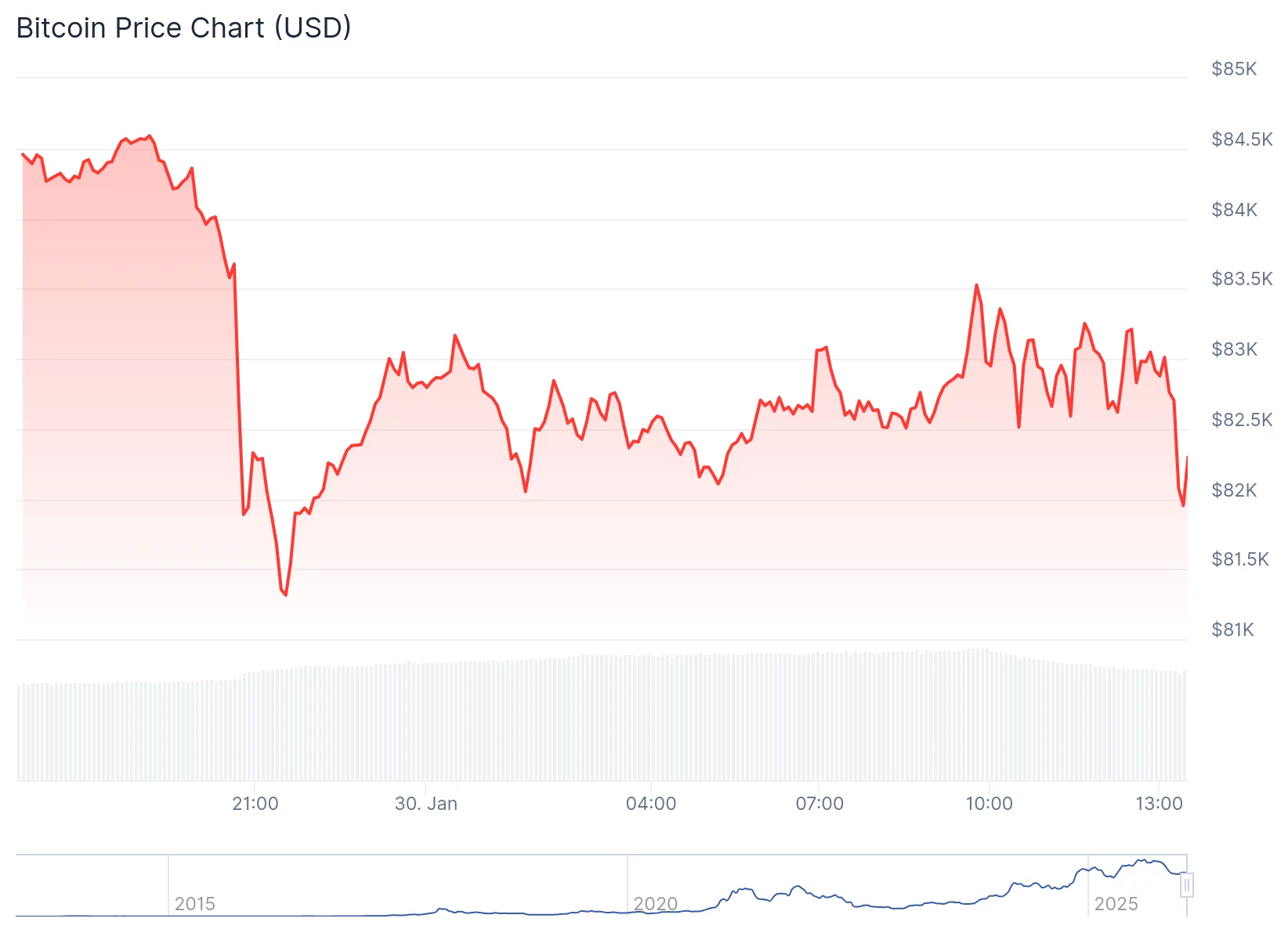
Bitcoin technicals

Federal rules do not require super-PACs to immediately liquidate cryptocurrency donations, though most convert them to cash relatively quickly. In addition to crypto, Digital Freedom Fund also received $1 million in cash from Payward Inc., operator of the Kraken exchange, and reported just over $723,000 in cash on hand at year’s end.

The fund is one of several crypto-backed super-PACs active in U.S. politics, as the industry continues to test how digital assets fit into traditional campaign finance.

Meanwhile, Trump’s approval rating dropped to 37% in the latest Pew poll, and a growing number of Republicans are reportedly fed up with his administration.

Disclaimer: The articles reposted on this site are sourced from public platforms and are provided for informational purposes only. They do not necessarily reflect the views of MEXC. All rights remain with the original authors. If you believe any content infringes on third-party rights, please contact service@support.mexc.com for removal. MEXC makes no guarantees regarding the accuracy, completeness, or timeliness of the content and is not responsible for any actions taken based on the information provided. The content does not constitute financial, legal, or other professional advice, nor should it be considered a recommendation or endorsement by MEXC.

You May Also Like

[Time Trowel] Zamboanga City and ‘Chief of War’

[Time Trowel] Zamboanga City and ‘Chief of War’

Zamboanga's importance never came from being a center that pulled everything inward, but from being a place where connections met and continued.
Share
Rappler2026/02/01 10:00
SUI At The Smart Money Zone: Big Moves Brewing Above $2

SUI At The Smart Money Zone: Big Moves Brewing Above $2

The post SUI At The Smart Money Zone: Big Moves Brewing Above $2 appeared on BitcoinEthereumNews.com. SUI is approaching a critical smart money zone, with price
Share
BitcoinEthereumNews2026/02/01 10:00
Headwind Helps Best Wallet Token

Headwind Helps Best Wallet Token

The post Headwind Helps Best Wallet Token appeared on BitcoinEthereumNews.com. Google has announced the launch of a new open-source protocol called Agent Payments Protocol (AP2) in partnership with Coinbase, the Ethereum Foundation, and 60 other organizations. This allows AI agents to make payments on behalf of users using various methods such as real-time bank transfers, credit and debit cards, and, most importantly, stablecoins. Let’s explore in detail what this could mean for the broader cryptocurrency markets, and also highlight a presale crypto (Best Wallet Token) that could explode as a result of this development. Google’s Push for Stablecoins Agent Payments Protocol (AP2) uses digital contracts known as ‘Intent Mandates’ and ‘Verifiable Credentials’ to ensure that AI agents undertake only those payments authorized by the user. Mandates, by the way, are cryptographically signed, tamper-proof digital contracts that act as verifiable proof of a user’s instruction. For example, let’s say you instruct an AI agent to never spend more than $200 in a single transaction. This instruction is written into an Intent Mandate, which serves as a digital contract. Now, whenever the AI agent tries to make a payment, it must present this mandate as proof of authorization, which will then be verified via the AP2 protocol. Alongside this, Google has also launched the A2A x402 extension to accelerate support for the Web3 ecosystem. This production-ready solution enables agent-based crypto payments and will help reshape the growth of cryptocurrency integration within the AP2 protocol. Google’s inclusion of stablecoins in AP2 is a massive vote of confidence in dollar-pegged cryptocurrencies and a huge step toward making them a mainstream payment option. This widens stablecoin usage beyond trading and speculation, positioning them at the center of the consumption economy. The recent enactment of the GENIUS Act in the U.S. gives stablecoins more structure and legal support. Imagine paying for things like data crawls, per-task…
Share
BitcoinEthereumNews2025/09/18 01:27