Payy has launched a new privacy-focused Layer-2 network built on Ethereum, which makes the everyday crypto transfers invisible to the public by default while stillPayy has launched a new privacy-focused Layer-2 network built on Ethereum, which makes the everyday crypto transfers invisible to the public by default while still

Payy Debuts Privacy-Enabled Ethereum Layer 2, Supporting MetaMask Wallets

2 min read
  • Payy hides Ethereum transactions by default, even when using MetaMask.
  • Users get privacy without changing wallets or apps.

Payy has launched a new privacy-focused Layer-2 network built on Ethereum, which makes the everyday crypto transfers invisible to the public by default while still running on popular wallets like MetaMask. 

On the public blockchains wallets transactions and balances are visible, and this can be tracked, which leads to the exploit and front running. Payy says that this level of transparency has slowed the adoption of the institutions, Fintech companies, and everyday stablecoin users. So the New layer 2 network makes the transactions private automatically. 

How Payy’s Layer 2 Network Works

Payy network works on Ethereum by adding a privacy layer without changing it. When users send the token, the transactions are routed through private ERC 20 pools, which makes it harder to trace the funds, and users can continue using the existing wallet. ERC20 transfers are private by default, and when interacting with the DeFi platform, funds are sent to newly created addresses, which prevents activity linked to the user. These private transactions are stored in the privacy vaults, and the users can choose how much privacy they want, depending on the rules of the apps they interact with. 
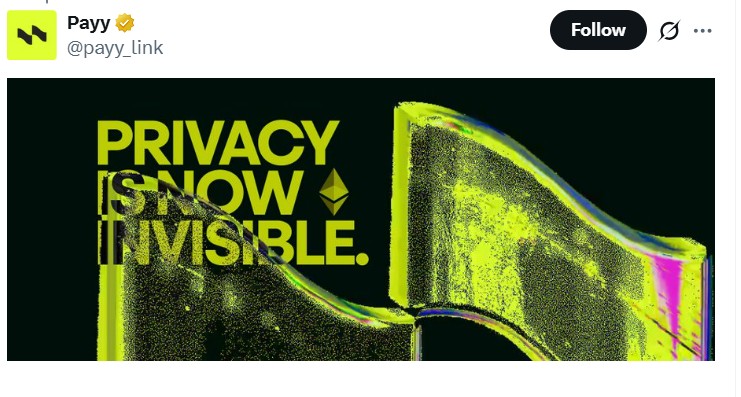
Image source: https://x.com/payy_link/status/2019113530293907526

Payy says that this is designed for the two main groups, such as Institutions and crypto users who value privacy. For the institutions that want to move payments without exposing financial data on-chain and for the users who want privacy and want to avoid managing multiple wallets, Payy says that their system allows privacy-focused transactions, which prevent competitive risks and keeps user experience simple.

Payy already operates a privacy-focused crypto wallet and Visa powered crypto card. This new Ethereum layer  2 network is being launched with an initial base of 100,000 existing users and support from major stablecoin players. Sid Gandhi, CEO of Payy, said that privacy is the final hurdle stopping crypto from going mainstream and argues that global payments cannot move on-chain if every transaction becomes public data. 

Highlighted Crypto News:

ETH Price Analysis: Downtrend Persists, Support Seen at $2,100–$2,000     

Disclaimer: The articles reposted on this site are sourced from public platforms and are provided for informational purposes only. They do not necessarily reflect the views of MEXC. All rights remain with the original authors. If you believe any content infringes on third-party rights, please contact service@support.mexc.com for removal. MEXC makes no guarantees regarding the accuracy, completeness, or timeliness of the content and is not responsible for any actions taken based on the information provided. The content does not constitute financial, legal, or other professional advice, nor should it be considered a recommendation or endorsement by MEXC.

You May Also Like

Wormhole launches reserve tying protocol revenue to token

Wormhole launches reserve tying protocol revenue to token

The post Wormhole launches reserve tying protocol revenue to token appeared on BitcoinEthereumNews.com. Wormhole is changing how its W token works by creating a new reserve designed to hold value for the long term. Announced on Wednesday, the Wormhole Reserve will collect onchain and offchain revenues and other value generated across the protocol and its applications (including Portal) and accumulate them into W, locking the tokens within the reserve. The reserve is part of a broader update called W 2.0. Other changes include a 4% targeted base yield for tokenholders who stake and take part in governance. While staking rewards will vary, Wormhole said active users of ecosystem apps can earn boosted yields through features like Portal Earn. The team stressed that no new tokens are being minted; rewards come from existing supply and protocol revenues, keeping the cap fixed at 10 billion. Wormhole is also overhauling its token release schedule. Instead of releasing large amounts of W at once under the old “cliff” model, the network will shift to steady, bi-weekly unlocks starting October 3, 2025. The aim is to avoid sharp periods of selling pressure and create a more predictable environment for investors. Lockups for some groups, including validators and investors, will extend an additional six months, until October 2028. Core contributor tokens remain under longer contractual time locks. Wormhole launched in 2020 as a cross-chain bridge and now connects more than 40 blockchains. The W token powers governance and staking, with a capped supply of 10 billion. By redirecting fees and revenues into the new reserve, Wormhole is betting that its token can maintain value as demand for moving assets and data between chains grows. This is a developing story. This article was generated with the assistance of AI and reviewed by editor Jeffrey Albus before publication. Get the news in your inbox. Explore Blockworks newsletters: Source: https://blockworks.co/news/wormhole-launches-reserve
Share
BitcoinEthereumNews2025/09/18 01:55
Kalshi debuts ecosystem hub with Solana and Base

Kalshi debuts ecosystem hub with Solana and Base

The post Kalshi debuts ecosystem hub with Solana and Base appeared on BitcoinEthereumNews.com. Kalshi, the US-regulated prediction market exchange, rolled out a new program on Wednesday called KalshiEco Hub. The initiative, developed in partnership with Solana and Coinbase-backed Base, is designed to attract builders, traders, and content creators to a growing ecosystem around prediction markets. By combining its regulatory footing with crypto-native infrastructure, Kalshi said it is aiming to become a bridge between traditional finance and onchain innovation. The hub offers grants, technical assistance, and marketing support to selected projects. Kalshi also announced that it will support native deposits of Solana’s SOL token and USDC stablecoin, making it easier for users already active in crypto to participate directly. Early collaborators include Kalshinomics, a dashboard for market analytics, and Verso, which is building professional-grade tools for market discovery and execution. Other partners, such as Caddy, are exploring ways to expand retail-facing trading experiences. Kalshi’s move to embrace blockchain partnerships comes at a time when prediction markets are drawing fresh attention for their ability to capture sentiment around elections, economic policy, and cultural events. Competitor Polymarket recently acquired QCEX — a derivatives exchange with a CFTC license — to pave its way back into US operations under regulatory compliance. At the same time, platforms like PredictIt continue to push for a clearer regulatory footing. The legal terrain remains complex, with some states issuing cease-and-desist orders over whether these event contracts count as gambling, not finance. This is a developing story. This article was generated with the assistance of AI and reviewed by editor Jeffrey Albus before publication. Get the news in your inbox. Explore Blockworks newsletters: Source: https://blockworks.co/news/kalshi-ecosystem-hub-solana-base
Share
BitcoinEthereumNews2025/09/18 04:40
Optimizely Named a Leader in the 2026 Gartner® Magic Quadrant™ for Personalization Engines

Optimizely Named a Leader in the 2026 Gartner® Magic Quadrant™ for Personalization Engines

Company recognized as a Leader for the second consecutive year NEW YORK, Feb. 5, 2026 /PRNewswire/ — Optimizely, the leading digital experience platform (DXP) provider
Share
AI Journal2026/02/06 00:47