

Stellar Price Slips as XLM Enters a Make-or-Break Zone: Can Sellers Push It Lower?

The post Stellar Price Slips as XLM Enters a Make-or-Break Zone: Can Sellers Push It Lower? appeared first on Coinpedia Fintech News
Stellar (XLM) remains under pressure as the broader crypto market struggles to regain traction, keeping buyers on the defensive. Stellar price has continued to face bearishness and price action has weakened steadily over recent sessions, pulling XLM back toward a key demand zone that previously acted as a base for rebounds. The token is no longer pricing optimism, yet it has not entered capitulation either. XLM’s next move around current levels will determine whether the move lower evolves into a deeper breakdown or stabilizes into another consolidation phase.
Exchange Netflows Point to Supply Dominance
Recent exchange flow data paints a cautious picture for XLM. After a period of relatively balanced flows, net inflows have turned positive, with millions of XLM tokens moving onto centralized exchanges over a short window. This shift typically reflects increased sell-side readiness rather than accumulation, especially when it coincides with weakening price structure.
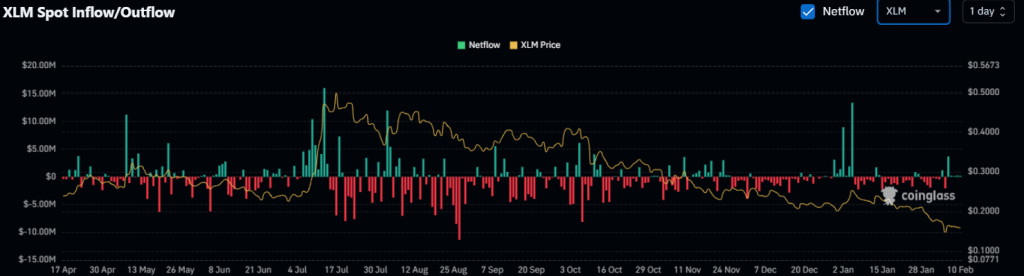
Historically, similar inflow patterns in XLM have preceded periods of downside continuation rather than immediate reversals. The logic is simple: when supply migrates to exchanges during declining momentum, sellers are positioning ahead of potential volatility rather than stepping aside. At the same time, there is little evidence of aggressive exchange outflows that would signal strong dip-buying behavior. Without that counterbalance, price remains exposed to further pressure if market sentiment deteriorates again.
Stellar Price Structure Remains Bearish: Can Bulls Defend $0.1500?
Amidst the broader market headwinds, Stellar price has continued to underperform and slipped below its prior support zone of $0.2000. XLM has traded below its short-term moving averages and displayed lower lows, with each rebound capped below previous resistance levels. As XLM price traded below its short-term moving averages, the momentum tilted to the downside.
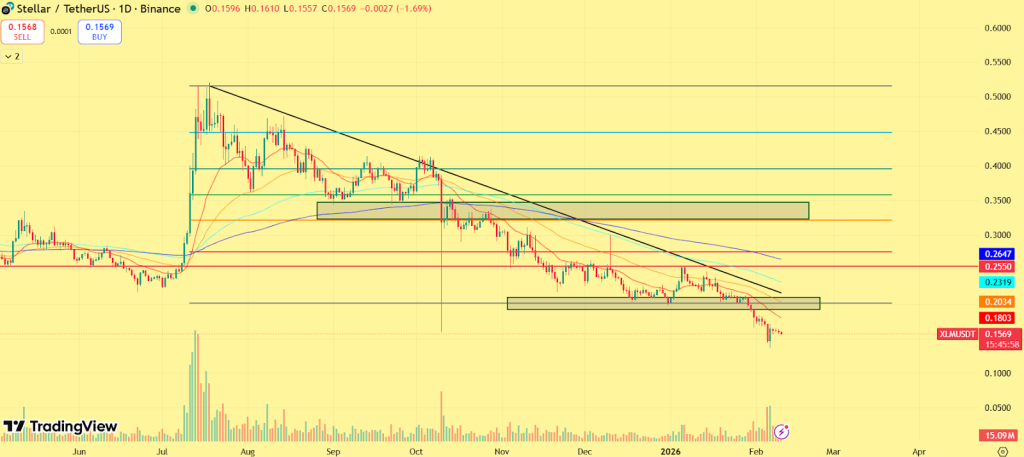
The most notable shift occurred when XLM price flipped its former demand zone into overhead supply. Moreover, momentum indicators also align with this structure, the RSI and MACD indicators display negative crossover, underlying the bearish outlook. The current setup suggests that XLM is not yet in a basing phase. Instead, price appears to be compressing beneath resistance, a condition that often resolves lower if demand does not return decisively. Until XLM price does not reclaim the $0.2000 mark, the downtrend remains intact.
Final Thoughts
Despite slowing downside momentum, Stellar’s market structure does not yet support a bullish thesis. Exchange flows continue to reflect available supply, volume favors sellers, and price remains trapped beneath key hurdles. For now, XLM appears to be consolidating under bearish control, not forming a base. Until on-chain data shifts toward accumulation and price reclaims broken levels with authority, rallies are likely to face selling pressure rather than spark trend reversal.
You May Also Like

Crypto execs met with US lawmakers to discuss Bitcoin reserve, market structure bills
Lawmakers in the US House of Representatives and Senate met with cryptocurrency industry leaders in three separate roundtable events this week. Members of the US Congress met with key figures in the cryptocurrency industry to discuss issues and potential laws related to the establishment of a strategic Bitcoin reserve and a market structure.On Tuesday, a group of lawmakers that included Alaska Representative Nick Begich and Ohio Senator Bernie Moreno met with Strategy co-founder Michael Saylor and others in a roundtable event regarding the BITCOIN Act, a bill to establish a strategic Bitcoin (BTC) reserve. The discussion was hosted by the advocacy organization Digital Chamber and its affiliates, the Digital Power Network and Bitcoin Treasury Council.“Legislators and the executives at yesterday’s roundtable agree, there is a need [for] a Strategic Bitcoin Reserve law to ensure its longevity for America’s financial future,” Hailey Miller, director of government affairs and public policy at Digital Power Network, told Cointelegraph. “Most attendees are looking for next steps, which may mean including the SBR within the broader policy frameworks already advancing.“Read more

Messari and Warden Protocol have partnered to launch an AI research assistant to aid in real-time crypto market analysis.
