

Major Pi Network Update: Will This Be the Turning Point for PI?
The developments surrounding the controversial crypto project Pi Network are quite frequent, and in the following lines, we will focus on the latest one.
We will also examine the price performance of the native token PI and assess its potential for a short-term resurgence.
‘Turn Your PI Into Power’
PiBridge, a project related to Pi Network that specializes in offering exclusive services to the community, such as an exchange platform, recently unveiled P2P lending. This means that people can now use their PI holdings as collateral, borrow stablecoins, or lend to earn yields.
The team revealed that this initiative marks the next step toward the launch of the PiBridge Neobank.
Another recent development surrounding Pi Network is the upgrade of the AI-powered platform Pi App Studio. In mid-October, the team launched new updates “to make app creation more accessible and customizable, and integrated within the ecosystem.”
Pi App Studio saw the light of day on June 28, a date known across the PI community as Pi2Day, with the primary goal of enabling users to create decentralized applications (dApps) without any programming skills.
Meanwhile, in August, the team unveiled the Pi Hackathon 2025: an event that encourages developers to build real-world applications that expand the utility of the PI coin. While it was supposed to run until October 14, Pi Network has not yet given details about its end.
PI Price Outlook
Several hours ago, the price of Pi Network’s native cryptocurrency plummeted to $0.19, but shortly after, it followed the resurgence of the entire crypto market and is now trading above $0.20.
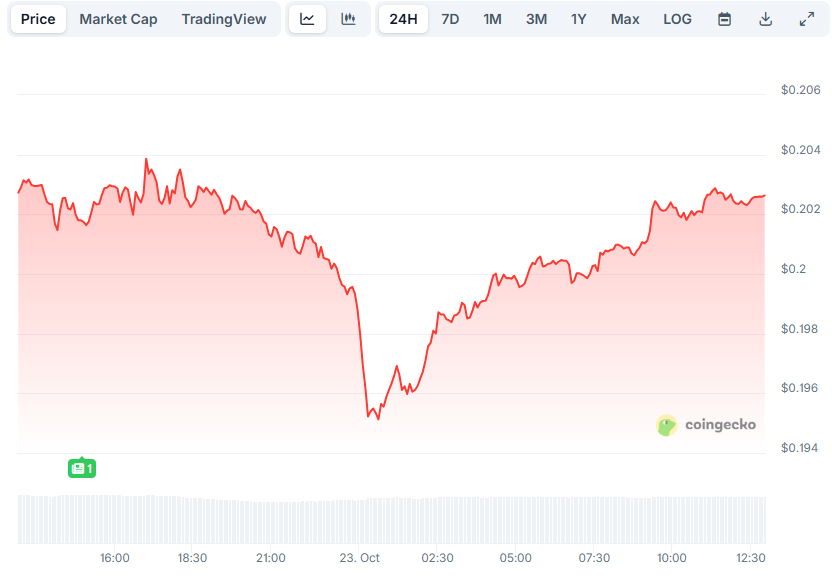 PI Price, Source: CoinGecko
However, this level remains quite disappointing for the bulls since it represents a 26% decline on a monthly scale and a staggering 93% crash since the all-time high of $3 witnessed at the start of the year.
Two essential factors signal that PI’s valuation may experience a more substantial rebound in the near future. First, the amount of tokens stored on crypto exchanges has decreased significantly: over one million coins have left centralized platforms in the past 24 hours alone, suggesting investors have shifted towards self-custody methods, thus reducing selling pressure.
Second, PI’s Relative Strength Index (RSI), which continues hovering around 30. The technical analysis tool measures the speed and magnitude of recent price changes to give traders a possible idea of reversal points. Ratios below 30 indicate the asset is oversold and due for a potential rally, while anything above 70 is interpreted as a bearish signal.
 PI RSI, Source: TradingView
The post Major Pi Network Update: Will This Be the Turning Point for PI? appeared first on CryptoPotato.
You May Also Like

The Channel Factories We’ve Been Waiting For


Waarom BTC niet stijgt: OG holders verkopen massaal call opties
