The first prediction markets exchange to be regulated by the CFTC, Kalshi, has launched the KalshiEco Hub in partnership with Solana and Coinbase-backed Base. The new program aims to bring builders, traders, and content creators onto an expanding ecosystem of blockchain-based prediction markets. The launch of the KalshiEco Hub signals a step toward linking traditional […]The first prediction markets exchange to be regulated by the CFTC, Kalshi, has launched the KalshiEco Hub in partnership with Solana and Coinbase-backed Base. The new program aims to bring builders, traders, and content creators onto an expanding ecosystem of blockchain-based prediction markets. The launch of the KalshiEco Hub signals a step toward linking traditional […]

Kalshi Partners with Solana & Base to Launch KalshiEco Hub for Onchain Prediction Markets

2025/09/18 16:30
4 min read
Kalshi
  • Kalshi launches KalshiEco Hub with Solana and Base to expand regulated prediction markets.
  • Kalshi strengthens blockchain prediction markets with grants, partnerships, and Solana support.
  • SOL price trades near $240, signaling a potential breakout as the prediction market’s partnership expands.

The first prediction markets exchange to be regulated by the CFTC, Kalshi, has launched the KalshiEco Hub in partnership with Solana and Coinbase-backed Base. The new program aims to bring builders, traders, and content creators onto an expanding ecosystem of blockchain-based prediction markets.

The launch of the KalshiEco Hub signals a step toward linking traditional finance with crypto-native innovation. Kalshi stated on X, “We’re backing offchain and onchain innovation, with dedicated grants partnering with Solana and Base.”

The collaboration merges the prediction platform’s regulated status with the scalability of Solana infrastructure and Base’s Ethereum layer-2 technology. The prediction platform also affirmed that it will enable direct deposits of Solana’s SOL token and USDC stablecoin.

KalshiEco hub to expand blockchain prediction markets

KalshiEco is designed to make digital assets accessible to users already engaged in digital assets. The program also offers grants, technical support, and marketing assistance to selected projects. By providing developers with resources and grants, the Prediction platform also aims to accelerate the creation of new products in the prediction market. 

The initiative creates a community flywheel where builders launch their products, creators highlight their products, and traders drive more visibility and growth.

The CFTC-regulated exchange also has collaborators like Kalshinomics, an analytics dashboard for market analytics, and Verso, which is building professional-grade tools for market discovery. Other partners, like Caddy, are targeting retail-based trading solutions.

Kalshi faces competition amid a shifting regulatory landscape

The development of prediction markets has gained renewed momentum. Through prediction markets, users can trade contracts based on real-life events, including political elections and economic policy outcomes. 

Notably, on the day of the KalshiEco launch, Kalshi’s prediction market on the Federal Reserve interest rate decision surpassed $85 million in trading volume.
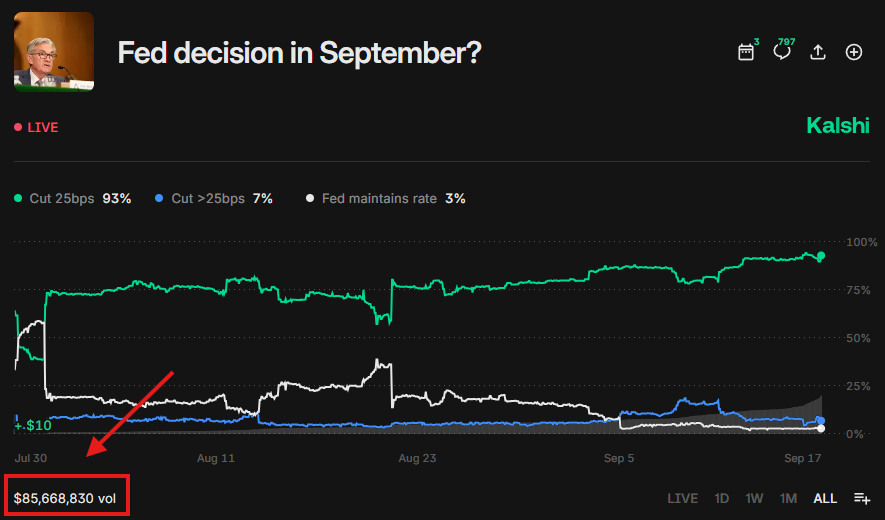
Source: X

Nevertheless, prediction markets are still subject to legal scrutiny in the United States. Although the exchange operates its business with the CFTC’s approval, some states doubt that these kinds of contracts can be considered gambling. 

Furthermore, Polymarket, a prediction markets platform, recently acquired QCEX, a licensed derivatives exchange, in anticipation of U.S. operations subject to regulatory supervision. Meanwhile, PredictIt is still seeking clarity on its legal status.

The introduction of KalshiEco indicates how licensed exchanges are applying blockchain integration to stay competitive. The regulated exchange is providing developers and traders with an ecosystem that is flexible for on-chain innovation with Solana and Base.

Also Read: Polymarket Acquires CFTC-Licensed QCEX for $112 Million to Relaunch U.S. Prediction Market

SOL price consolidates at $240 ahead of key breakout

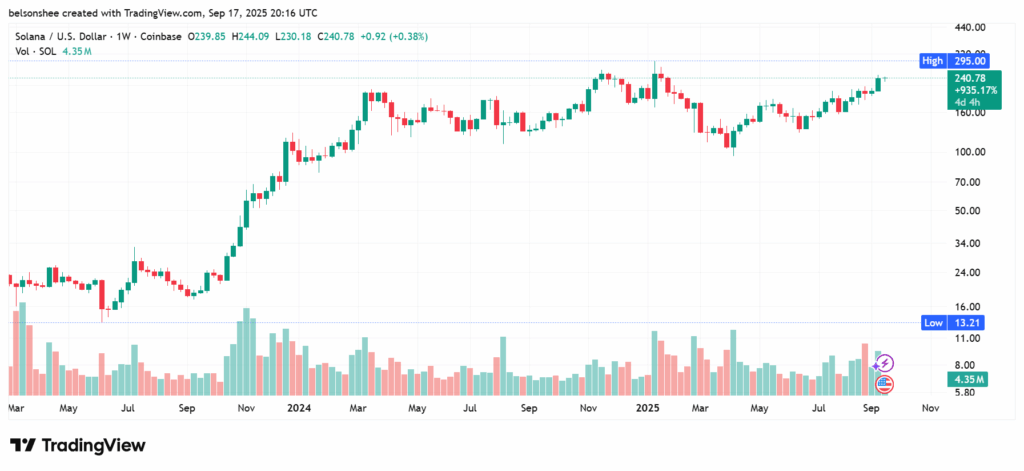
Recent price action in Solana (SOL) supports the timing of Kalshi’s collaboration with the network. As of September 17, SOL is trading around $240, which is up 8.5% in the last week. The token has been in the range of $175.99 to $249.12 over the past 30 days. 

On the weekly chart, the price action is steadily at higher lows, with resistance being created in the $245-$250 range. If the trading volume continues to increase, this could suggest a potential breakout.
Source: TradingView

Moreover, the chart pattern shows that a key breakout above $250 may open the door to the $260-$265 area and possibly retest the all-time high around $295. 

On the downside, a break of the $230 support is likely to lead to a pullback towards $221, potentially leading to a deeper correction towards the $176-180 level if selling pressure is strong enough. These market dynamics may affect liquidity, adoption, and overall integration of blockchain-based prediction markets for builders and traders.

Also Read:  Solana Poised to Retest $249.60 as Institutional Support Strengthens

Disclaimer: The articles reposted on this site are sourced from public platforms and are provided for informational purposes only. They do not necessarily reflect the views of MEXC. All rights remain with the original authors. If you believe any content infringes on third-party rights, please contact service@support.mexc.com for removal. MEXC makes no guarantees regarding the accuracy, completeness, or timeliness of the content and is not responsible for any actions taken based on the information provided. The content does not constitute financial, legal, or other professional advice, nor should it be considered a recommendation or endorsement by MEXC.

You May Also Like

UK and US Seal $42 Billion Tech Pact Driving AI and Energy Future

UK and US Seal $42 Billion Tech Pact Driving AI and Energy Future

The post UK and US Seal $42 Billion Tech Pact Driving AI and Energy Future appeared on BitcoinEthereumNews.com. Key Highlights Microsoft and Google pledge billions as part of UK US tech partnership Nvidia to deploy 120,000 GPUs with British firm Nscale in Project Stargate Deal positions UK as an innovation hub rivaling global tech powers UK and US Seal $42 Billion Tech Pact Driving AI and Energy Future The UK and the US have signed a “Technological Prosperity Agreement” that paves the way for joint projects in artificial intelligence, quantum computing, and nuclear energy, according to Reuters. Donald Trump and King Charles review the guard of honour at Windsor Castle, 17 September 2025. Image: Kirsty Wigglesworth/Reuters The agreement was unveiled ahead of U.S. President Donald Trump’s second state visit to the UK, marking a historic moment in transatlantic technology cooperation. Billions Flow Into the UK Tech Sector As part of the deal, major American corporations pledged to invest $42 billion in the UK. Microsoft leads with a $30 billion investment to expand cloud and AI infrastructure, including the construction of a new supercomputer in Loughton. Nvidia will deploy 120,000 GPUs, including up to 60,000 Grace Blackwell Ultra chips—in partnership with the British company Nscale as part of Project Stargate. Google is contributing $6.8 billion to build a data center in Waltham Cross and expand DeepMind research. Other companies are joining as well. CoreWeave announced a $3.4 billion investment in data centers, while Salesforce, Scale AI, BlackRock, Oracle, and AWS confirmed additional investments ranging from hundreds of millions to several billion dollars. UK Positions Itself as a Global Innovation Hub British Prime Minister Keir Starmer said the deal could impact millions of lives across the Atlantic. He stressed that the UK aims to position itself as an investment hub with lighter regulations than the European Union. Nvidia spokesman David Hogan noted the significance of the agreement, saying it would…
Share
BitcoinEthereumNews2025/09/18 02:22
Trump caves on his own snubs as retaliation ploy against Dem governors backfires

Trump caves on his own snubs as retaliation ploy against Dem governors backfires

President Donald Trump on Wednesday walked back a snub he gave to two Democratic Governors. Last week, Trump notably did not invite Democratic governors Wes Moore
Share
Rawstory2026/02/12 10:29
Bitcoin devs cheer block reconstruction stats, ignore security budget concerns

Bitcoin devs cheer block reconstruction stats, ignore security budget concerns

The post Bitcoin devs cheer block reconstruction stats, ignore security budget concerns appeared on BitcoinEthereumNews.com. This morning, Bitcoin Core developers celebrated improved block reconstruction statistics for node operators while conveniently ignoring the reason for these statistics — the downward trend in fees for Bitcoin’s security budget. Reacting with heart emojis and thumbs up to a green chart showing over 80% “successful compact block reconstructions without any requested transactions,” they conveniently omitted red trend lines of the fees that Bitcoin users pay for mining security which powered those green statistics. Block reconstructions occur when a node requests additional information about transactions within a compact block. Although compact blocks allow nodes to quickly relay valid bundles of transactions across the internet, the more frequently that nodes can reconstruct without extra, cumbersome transaction requests from their peers is a positive trend. Because so many nodes switched over in August to relay transactions bidding 0.1 sat/vB across their mempools, nodes now have to request less transaction data to reconstruct blocks containing sub-1 sat/vB transactions. After nodes switched over in August to accept and relay pending transactions bidding less than 1 sat/vB, disparate mempools became harmonized as most nodes had a better view of which transactions would likely join upcoming blocks. As a result, block reconstruction times improved, as nodes needed less information about these sub-1 sat/vB transactions. In July, several miners admitted that user demand for Bitcoin blockspace had persisted at such a low that they were willing to accept transaction fees of just 0.1 satoshi per virtual byte — 90% lower than their prior 1 sat/vB minimum. With so many blocks partially empty, they succumbed to the temptation to accept at least something — even 1 billionth of one bitcoin (BTC) — rather than $0 to fill up some of the excess blockspace. Read more: Bitcoin’s transaction fees have fallen to a multi-year low Green stats for block reconstruction after transaction fees crash After…
Share
BitcoinEthereumNews2025/09/18 04:07


