Jimmy Song, a notable Bitcoin developer and industry advocate, has criticized the decision by Bitcoin Core developers to remove the OP_Return data size limit in the upcoming Bitcoin Core 30 upgrade. He denounces this move as reflective of a “fiat” mentality, implying a departure from Bitcoin’s core principles of decentralization and security. Song pointed out [...]Jimmy Song, a notable Bitcoin developer and industry advocate, has criticized the decision by Bitcoin Core developers to remove the OP_Return data size limit in the upcoming Bitcoin Core 30 upgrade. He denounces this move as reflective of a “fiat” mentality, implying a departure from Bitcoin’s core principles of decentralization and security. Song pointed out [...]

Jimmy Song: Why Fiat Arguments About OP_RETURN Must End


For feedback or concerns regarding this content, please contact us at crypto.news@mexc.com
Jimmy Song: Why Fiat Arguments About Op_return Must End

Jimmy Song, a notable Bitcoin developer and industry advocate, has criticized the decision by Bitcoin Core developers to remove the OP_Return data size limit in the upcoming Bitcoin Core 30 upgrade. He denounces this move as reflective of a “fiat” mentality, implying a departure from Bitcoin’s core principles of decentralization and security.

Song pointed out that the Core team’s decision to eliminate the current 80-byte cap on OP_Return—used for embedding non-monetary data—ignores significant resistance from the Bitcoin community and node operators. He emphasized that the debate is rooted in definitional issues around what constitutes spam on the network, suggesting that non-monetary data embedded in Bitcoin now falls into a gray area.

He further argued that the claim of ambiguity around spam is a stalling tactic aimed at avoiding a discussion on the long-term implications of removing these limits. The debate over OP_Return’s unrestricted data size has been ongoing for nearly six months and echoes the historical Bitcoin block size wars of 2015-2017, which led to the creation of Bitcoin Cash (BCH). Some community members fear that this decision could spark a similar split in the network.

Node Runners Respond with Exodus to Bitcoin Knots

The unilateral removal of the OP_Return data limit has caused a notable shift among node operators. An increasing number are migrating to Bitcoin Knots, an alternative implementation of Bitcoin node software that enforces stricter data limits to support decentralization. This migration reflects growing concern over network centralization and data bloat.
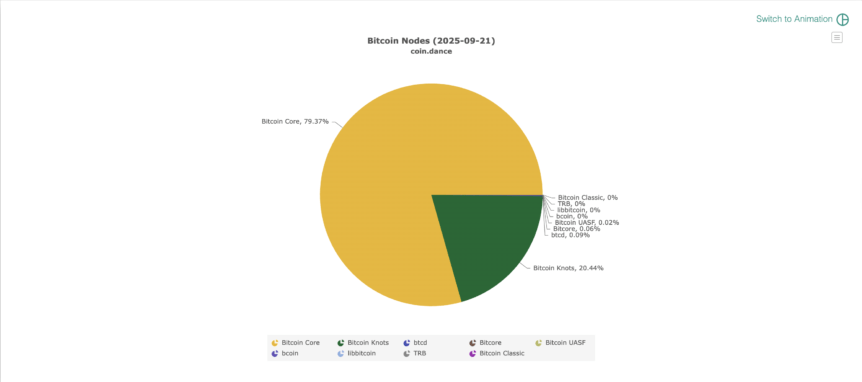
Bitcoin Core, Decentralization, Bitcoin Block Size, Nodes, Bitcoin Cash, Bitcoin OrdinalsA breakdown of different node software implementations on the Bitcoin network. Source: Coin Dance

Since February 2024, Bitcoin Knots nodes have surged from roughly 1% to approximately 20% of all active nodes—a tenfold increase in less than a year. Advocates argue that maintaining data size constraints is vital for preserving Bitcoin’s decentralization and allowing anyone to operate a node with affordable hardware.

Compared to other blockchain platforms that generate much larger data volumes—often requiring costly specialized hardware—Bitcoin’s lean design keeps running a full node accessible to retail users, thus promoting a more decentralized network. This setup minimizes the risk of centralization, where a small group of entities could influence or compromise consensus rules.

Related: Long-term security and the sustainability of Bitcoin’s economic model remain pivotal issues as debates around protocol upgrades unfold, shaping the future of cryptocurrency and blockchain regulation.

This article was originally published as Jimmy Song: Why Fiat Arguments About OP_RETURN Must End on Crypto Breaking News – your trusted source for crypto news, Bitcoin news, and blockchain updates.

Disclaimer: The articles reposted on this site are sourced from public platforms and are provided for informational purposes only. They do not necessarily reflect the views of MEXC. All rights remain with the original authors. If you believe any content infringes on third-party rights, please contact crypto.news@mexc.com for removal. MEXC makes no guarantees regarding the accuracy, completeness, or timeliness of the content and is not responsible for any actions taken based on the information provided. The content does not constitute financial, legal, or other professional advice, nor should it be considered a recommendation or endorsement by MEXC.

You May Also Like

The Channel Factories We’ve Been Waiting For

The Channel Factories We’ve Been Waiting For

The post The Channel Factories We’ve Been Waiting For appeared on BitcoinEthereumNews.com. Visions of future technology are often prescient about the broad strokes while flubbing the details. The tablets in “2001: A Space Odyssey” do indeed look like iPads, but you never see the astronauts paying for subscriptions or wasting hours on Candy Crush.  Channel factories are one vision that arose early in the history of the Lightning Network to address some challenges that Lightning has faced from the beginning. Despite having grown to become Bitcoin’s most successful layer-2 scaling solution, with instant and low-fee payments, Lightning’s scale is limited by its reliance on payment channels. Although Lightning shifts most transactions off-chain, each payment channel still requires an on-chain transaction to open and (usually) another to close. As adoption grows, pressure on the blockchain grows with it. The need for a more scalable approach to managing channels is clear. Channel factories were supposed to meet this need, but where are they? In 2025, subnetworks are emerging that revive the impetus of channel factories with some new details that vastly increase their potential. They are natively interoperable with Lightning and achieve greater scale by allowing a group of participants to open a shared multisig UTXO and create multiple bilateral channels, which reduces the number of on-chain transactions and improves capital efficiency. Achieving greater scale by reducing complexity, Ark and Spark perform the same function as traditional channel factories with new designs and additional capabilities based on shared UTXOs.  Channel Factories 101 Channel factories have been around since the inception of Lightning. A factory is a multiparty contract where multiple users (not just two, as in a Dryja-Poon channel) cooperatively lock funds in a single multisig UTXO. They can open, close and update channels off-chain without updating the blockchain for each operation. Only when participants leave or the factory dissolves is an on-chain transaction…
Share
BitcoinEthereumNews2025/09/18 00:09
The Federal Reserve cut interest rates by 25 basis points, and Powell said this was a risk management cut


The Federal Reserve cut interest rates by 25 basis points, and Powell said this was a risk management cut

PANews reported on September 18th, according to the Securities Times, that at 2:00 AM Beijing time on September 18th, the Federal Reserve announced a 25 basis point interest rate cut, lowering the federal funds rate from 4.25%-4.50% to 4.00%-4.25%, in line with market expectations. The Fed's interest rate announcement triggered a sharp market reaction, with the three major US stock indices rising briefly before quickly plunging. The US dollar index plummeted, briefly hitting a new low since 2025, before rebounding sharply, turning a decline into an upward trend. The sharp market volatility was closely tied to the subsequent monetary policy press conference held by Federal Reserve Chairman Powell. He stated that the 50 basis point rate cut lacked broad support and that there was no need for a swift adjustment. Today's move could be viewed as a risk-management cut, suggesting the Fed will not enter a sustained cycle of rate cuts. Powell reiterated the Fed's unwavering commitment to maintaining its independence. Market participants are currently unaware of the risks to the Fed's independence. The latest published interest rate dot plot shows that the median expectation of Fed officials is to cut interest rates twice more this year (by 25 basis points each), one more than predicted in June this year. At the same time, Fed officials expect that after three rate cuts this year, there will be another 25 basis point cut in 2026 and 2027.
Share
PANews2025/09/18 06:54
Solana Sees $10M Capital Rotation, Eyes $100 Breakout

Solana Sees $10M Capital Rotation, Eyes $100 Breakout

The post Solana Sees $10M Capital Rotation, Eyes $100 Breakout appeared on BitcoinEthereumNews.com. Capital rotation into Solana accelerated this week as traders
Share
BitcoinEthereumNews2026/03/18 00:18