China has tightened export controls on rare earth magnets, escalating tensions with Washington and triggering widespread turbulence across global markets, including a $7 billion sell-off in cryptocurrencies. The move, seen as direct retaliation against President Donald Trump’s newly announced 100% tariffs on Chinese goods, has reignited fears of a full-scale trade war between the world’s two largest economies. Following the announcement, over 1.66 million traders were wiped out in 24 hours, resulting in $19.33 billion in liquidated positions. Bitcoin and Ethereum alone accounted for nearly $10 billion of those losses, making it one of the year’s most severe deleveraging events. Additionally, the Crypto Fear & Greed Index plunged from a “Greed” level of 64 on Friday to 27 (“Fear”) on Saturday, its lowest in six months. Rare Earth Exports Fall 31% as Beijing Tightens Controls The latest measures expand Beijing’s existing restrictions to five additional rare earth elements, including holmium and erbium, requiring export approval for any product containing more than 0.1% of Chinese-sourced rare earths. These materials are essential to industries ranging from electric vehicles and wind turbines to advanced defense systems. With China controlling more than 90% of global rare earth processing capacity, the new policy has raised concerns over potential supply chain disruptions and mounting production costs worldwide. Sources familiar with the matter said Chinese magnet manufacturers have been facing tighter scrutiny on export license applications since September. Approval processes have lengthened, with applications increasingly returned for additional documentation. Though still within the Commerce Ministry’s 45-day window, the review process now resembles that of April, when export delays caused magnet shortages and temporary shutdowns at several automotive plants. Data released Monday showed China’s rare earth exports plunged 31% in September, suggesting that the slowdown had already begun before the latest round of restrictions. Beijing’s Ministry of Commerce has defended the controls, calling them “legitimate actions” intended to refine China’s export management system. “China has consistently and resolutely safeguarded its own national security,” a spokesperson said, adding that the measures align with international standards. President Trump, however, responded on Friday with a social media post promising a 100% tariff on all Chinese imports, accusing Beijing of “extraordinarily aggressive” export tactics. He also warned of possible U.S. export bans on critical software beginning November 1. The exchange rattled markets and cast doubt on a potential meeting between Trump and Chinese President Xi Jinping later this month. China fired back on Tuesday, vowing to “fight to the end” if the U.S. escalates. “The United States cannot simultaneously seek dialogue while threatening new restrictive measures,” China’s commerce ministry said in a statement. Trump appeared to soften his stance on Sunday, posting that “it will all be fine,” calling Xi “highly respected,” and saying the U.S. wanted to “help, not hurt” China. Crypto Market Sinks $7B as China Tightens Rare Earth Controls The timing of Beijing’s move has also raised concerns within the crypto mining sector. Rare earths are vital for GPU and ASIC chip manufacturing, meaning tighter Chinese export reviews could increase hardware costs and potentially impact mining difficulty and network hash rates in the short term. The Federal Reserve’s next moves could further sway sentiment. Fed Chair Jerome Powell is set to speak Tuesday at the NABE Annual Meeting in Philadelphia, where investors expect clarity on rate-cut prospects. Analysts say any hawkish tone could deepen the market downturn, while signs of policy easing may stabilize risk assets Despite the brief conciliatory tone, markets remained volatile. Wall Street suffered losses, with U.S. tech stocks falling over 2%, while global commodities rallied as investors shifted to safe havens. Gold surged to a record $4,200 per ounce, and silver climbed to $51.70. The crypto market bore the sharpest impact. Over $500M in leveraged positions were liquidated within hours of China’s announcement, as traders rushed to de-risk amid the mounting geopolitical uncertainty.Source: Coinglass Bitcoin plunged 3.1% to around $113,600 before briefly dipping below $111,700. Ethereum fell 5.1%, trading below $4,000 for the first time in weeks. XRP and Dogecoin each crashed by more than 30%, marking one of the steepest single-day declines this year. The broader crypto market capitalization dropped 3.2% to $3.8 trillionChina has tightened export controls on rare earth magnets, escalating tensions with Washington and triggering widespread turbulence across global markets, including a $7 billion sell-off in cryptocurrencies. The move, seen as direct retaliation against President Donald Trump’s newly announced 100% tariffs on Chinese goods, has reignited fears of a full-scale trade war between the world’s two largest economies. Following the announcement, over 1.66 million traders were wiped out in 24 hours, resulting in $19.33 billion in liquidated positions. Bitcoin and Ethereum alone accounted for nearly $10 billion of those losses, making it one of the year’s most severe deleveraging events. Additionally, the Crypto Fear & Greed Index plunged from a “Greed” level of 64 on Friday to 27 (“Fear”) on Saturday, its lowest in six months. Rare Earth Exports Fall 31% as Beijing Tightens Controls The latest measures expand Beijing’s existing restrictions to five additional rare earth elements, including holmium and erbium, requiring export approval for any product containing more than 0.1% of Chinese-sourced rare earths. These materials are essential to industries ranging from electric vehicles and wind turbines to advanced defense systems. With China controlling more than 90% of global rare earth processing capacity, the new policy has raised concerns over potential supply chain disruptions and mounting production costs worldwide. Sources familiar with the matter said Chinese magnet manufacturers have been facing tighter scrutiny on export license applications since September. Approval processes have lengthened, with applications increasingly returned for additional documentation. Though still within the Commerce Ministry’s 45-day window, the review process now resembles that of April, when export delays caused magnet shortages and temporary shutdowns at several automotive plants. Data released Monday showed China’s rare earth exports plunged 31% in September, suggesting that the slowdown had already begun before the latest round of restrictions. Beijing’s Ministry of Commerce has defended the controls, calling them “legitimate actions” intended to refine China’s export management system. “China has consistently and resolutely safeguarded its own national security,” a spokesperson said, adding that the measures align with international standards. President Trump, however, responded on Friday with a social media post promising a 100% tariff on all Chinese imports, accusing Beijing of “extraordinarily aggressive” export tactics. He also warned of possible U.S. export bans on critical software beginning November 1. The exchange rattled markets and cast doubt on a potential meeting between Trump and Chinese President Xi Jinping later this month. China fired back on Tuesday, vowing to “fight to the end” if the U.S. escalates. “The United States cannot simultaneously seek dialogue while threatening new restrictive measures,” China’s commerce ministry said in a statement. Trump appeared to soften his stance on Sunday, posting that “it will all be fine,” calling Xi “highly respected,” and saying the U.S. wanted to “help, not hurt” China. Crypto Market Sinks $7B as China Tightens Rare Earth Controls The timing of Beijing’s move has also raised concerns within the crypto mining sector. Rare earths are vital for GPU and ASIC chip manufacturing, meaning tighter Chinese export reviews could increase hardware costs and potentially impact mining difficulty and network hash rates in the short term. The Federal Reserve’s next moves could further sway sentiment. Fed Chair Jerome Powell is set to speak Tuesday at the NABE Annual Meeting in Philadelphia, where investors expect clarity on rate-cut prospects. Analysts say any hawkish tone could deepen the market downturn, while signs of policy easing may stabilize risk assets Despite the brief conciliatory tone, markets remained volatile. Wall Street suffered losses, with U.S. tech stocks falling over 2%, while global commodities rallied as investors shifted to safe havens. Gold surged to a record $4,200 per ounce, and silver climbed to $51.70. The crypto market bore the sharpest impact. Over $500M in leveraged positions were liquidated within hours of China’s announcement, as traders rushed to de-risk amid the mounting geopolitical uncertainty.Source: Coinglass Bitcoin plunged 3.1% to around $113,600 before briefly dipping below $111,700. Ethereum fell 5.1%, trading below $4,000 for the first time in weeks. XRP and Dogecoin each crashed by more than 30%, marking one of the steepest single-day declines this year. The broader crypto market capitalization dropped 3.2% to $3.8 trillion

China Hits Back at Trump’s Tariffs with Rare Earth Restrictions — Wipes Over $500M from Crypto Market

China has tightened export controls on rare earth magnets, escalating tensions with Washington and triggering widespread turbulence across global markets, including a $7 billion sell-off in cryptocurrencies.

The move, seen as direct retaliation against President Donald Trump’s newly announced 100% tariffs on Chinese goods, has reignited fears of a full-scale trade war between the world’s two largest economies.

Following the announcement, over 1.66 million traders were wiped out in 24 hours, resulting in $19.33 billion in liquidated positions. Bitcoin and Ethereum alone accounted for nearly $10 billion of those losses, making it one of the year’s most severe deleveraging events.

Additionally, the Crypto Fear & Greed Index plunged from a “Greed” level of 64 on Friday to 27 (“Fear”) on Saturday, its lowest in six months.

Rare Earth Exports Fall 31% as Beijing Tightens Controls

The latest measures expand Beijing’s existing restrictions to five additional rare earth elements, including holmium and erbium, requiring export approval for any product containing more than 0.1% of Chinese-sourced rare earths.

These materials are essential to industries ranging from electric vehicles and wind turbines to advanced defense systems.

With China controlling more than 90% of global rare earth processing capacity, the new policy has raised concerns over potential supply chain disruptions and mounting production costs worldwide.

Sources familiar with the matter said Chinese magnet manufacturers have been facing tighter scrutiny on export license applications since September. Approval processes have lengthened, with applications increasingly returned for additional documentation.

Though still within the Commerce Ministry’s 45-day window, the review process now resembles that of April, when export delays caused magnet shortages and temporary shutdowns at several automotive plants.

Data released Monday showed China’s rare earth exports plunged 31% in September, suggesting that the slowdown had already begun before the latest round of restrictions.

Beijing’s Ministry of Commerce has defended the controls, calling them “legitimate actions” intended to refine China’s export management system.

“China has consistently and resolutely safeguarded its own national security,” a spokesperson said, adding that the measures align with international standards.

President Trump, however, responded on Friday with a social media post promising a 100% tariff on all Chinese imports, accusing Beijing of “extraordinarily aggressive” export tactics. He also warned of possible U.S. export bans on critical software beginning November 1.

The exchange rattled markets and cast doubt on a potential meeting between Trump and Chinese President Xi Jinping later this month.

China fired back on Tuesday, vowing to “fight to the end” if the U.S. escalates. “The United States cannot simultaneously seek dialogue while threatening new restrictive measures,” China’s commerce ministry said in a statement.

Trump appeared to soften his stance on Sunday, posting that “it will all be fine,” calling Xi “highly respected,” and saying the U.S. wanted to “help, not hurt” China.

Crypto Market Sinks $7B as China Tightens Rare Earth Controls

The timing of Beijing’s move has also raised concerns within the crypto mining sector. Rare earths are vital for GPU and ASIC chip manufacturing, meaning tighter Chinese export reviews could increase hardware costs and potentially impact mining difficulty and network hash rates in the short term.

The Federal Reserve’s next moves could further sway sentiment. Fed Chair Jerome Powell is set to speak Tuesday at the NABE Annual Meeting in Philadelphia, where investors expect clarity on rate-cut prospects.

Analysts say any hawkish tone could deepen the market downturn, while signs of policy easing may stabilize risk assets

Despite the brief conciliatory tone, markets remained volatile. Wall Street suffered losses, with U.S. tech stocks falling over 2%, while global commodities rallied as investors shifted to safe havens. Gold surged to a record $4,200 per ounce, and silver climbed to $51.70.

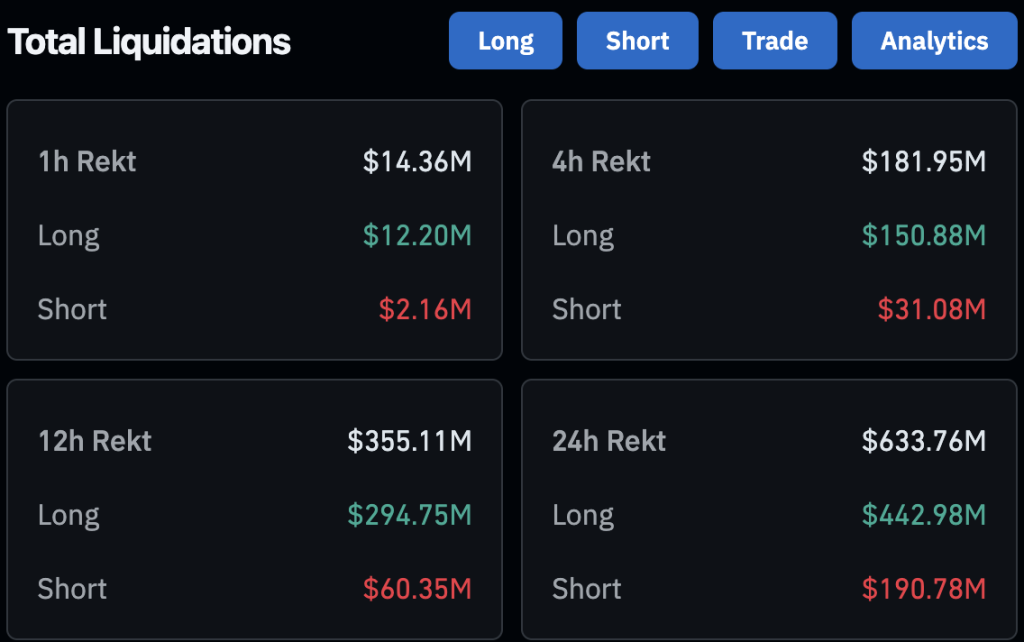
The crypto market bore the sharpest impact. Over $500M in leveraged positions were liquidated within hours of China’s announcement, as traders rushed to de-risk amid the mounting geopolitical uncertainty.
Source: Coinglass

Bitcoin plunged 3.1% to around $113,600 before briefly dipping below $111,700. Ethereum fell 5.1%, trading below $4,000 for the first time in weeks.

XRP and Dogecoin each crashed by more than 30%, marking one of the steepest single-day declines this year.

The broader crypto market capitalization dropped 3.2% to $3.8 trillion.

Market Opportunity
OFFICIAL TRUMP Logo
OFFICIAL TRUMP Price(TRUMP)
$4.844
$4.844$4.844
-0.30%
USD
OFFICIAL TRUMP (TRUMP) Live Price Chart
Disclaimer: The articles reposted on this site are sourced from public platforms and are provided for informational purposes only. They do not necessarily reflect the views of MEXC. All rights remain with the original authors. If you believe any content infringes on third-party rights, please contact service@support.mexc.com for removal. MEXC makes no guarantees regarding the accuracy, completeness, or timeliness of the content and is not responsible for any actions taken based on the information provided. The content does not constitute financial, legal, or other professional advice, nor should it be considered a recommendation or endorsement by MEXC.

You May Also Like

X3 Acquisition Corp. Ltd. Announces Closing of $200,000,000 Initial Public Offering

X3 Acquisition Corp. Ltd. Announces Closing of $200,000,000 Initial Public Offering

MINNEAPOLIS–(BUSINESS WIRE)–X3 Acquisition Corp. Ltd. (Nasdaq: XCBEU) (the “Company”), a newly organized special purpose acquisition company formed as a Cayman
Share
AI Journal2026/01/23 05:46
North America’s Largest RV Dealers Still Failing Google Core Web Vitals–Overfuel Reports Nearly 79% Failure Rate for Second Year

North America’s Largest RV Dealers Still Failing Google Core Web Vitals–Overfuel Reports Nearly 79% Failure Rate for Second Year

INDIANAPOLIS, Jan. 22, 2026 /PRNewswire/ — Overfuel, a website solutions provider for automotive, powersports and RV dealers, today announced the findings of its
Share
AI Journal2026/01/23 05:15
3 Paradoxes of Altcoin Season in September

3 Paradoxes of Altcoin Season in September

The post 3 Paradoxes of Altcoin Season in September appeared on BitcoinEthereumNews.com. Analyses and data indicate that the crypto market is experiencing its most active altcoin season since early 2025, with many altcoins outperforming Bitcoin. However, behind this excitement lies a paradox. Most retail investors remain uneasy as their portfolios show little to no profit. This article outlines the main reasons behind this situation. Altcoin Market Cap Rises but Dominance Shrinks Sponsored TradingView data shows that the TOTAL3 market cap (excluding BTC and ETH) reached a new high of over $1.1 trillion in September. Yet the share of OTHERS (excluding the top 10) has declined since 2022, now standing at just 8%. OTHERS Dominance And TOTAL3 Capitalization. Source: TradingView. In past cycles, such as 2017 and 2021, TOTAL3 and OTHERS.D rose together. That trend reflected capital flowing not only into large-cap altcoins but also into mid-cap and low-cap ones. The current divergence shows that capital is concentrated in stablecoins and a handful of top-10 altcoins such as SOL, XRP, BNB, DOG, HYPE, and LINK. Smaller altcoins receive far less liquidity, making it hard for their prices to return to levels where investors previously bought. This creates a situation where only a few win while most face losses. Retail investors also tend to diversify across many coins instead of adding size to top altcoins. That explains why many portfolios remain stagnant despite a broader market rally. Sponsored “Position sizing is everything. Many people hold 25–30 tokens at once. A 100x on a token that makes up only 1% of your portfolio won’t meaningfully change your life. It’s better to make a few high-conviction bets than to overdiversify,” analyst The DeFi Investor said. Altcoin Index Surges but Investor Sentiment Remains Cautious The Altcoin Season Index from Blockchain Center now stands at 80 points. This indicates that over 80% of the top 50 altcoins outperformed…
Share
BitcoinEthereumNews2025/09/18 01:43