At a conference in London this week, Nigel Farage, leader of the UK Reform Party, positioned himself as a "supporter" of the digital asset sector and put forward a series of policy proposals. Specifically, it includes: imposing a uniform capital gains tax of 10% on cryptocurrencies; using seized cryptocurrencies to establish a national Bitcoin reserve of approximately 5 billion pounds; halting the Bank of England's digital pound project; and allowing taxes to be paid in the form of cryptocurrencies (not mandatory). This policy proposal bears similarities to three policies proposed by Donald Trump during his cryptocurrency campaign. For example, opposition to central bank digital currencies, open partnerships with cryptocurrency mining companies and industries, and the White House sending signals in its digital asset strategy that leadership in fintech is a priority at the federal level. However, the policy transmission path in the United States is very clear - policy statements have been repeatedly reflected in the capital flows of spot Bitcoin ETFs, and such capital flows have largely driven market demand. The pace of policy advancement in the UK is completely different. The Bank of England’s latest progress report shows that the Bank of England and the UK Treasury are still in the design and exploration phase of a potential digital pound and have not yet decided whether to move forward with the project. According to the Consultation Paper No. 25/14 (CP25/14) issued by the UK Financial Conduct Authority (FCA), the focus of market attention in the short term is on the scope of regulated stablecoins and the custody rules that are in the consultation stage. Meanwhile, the UK is preparing to allow the issuance of tokenized investment funds, a move that would provide banks and asset managers with an easy channel for market access that is independent of election policy proposals. Factors such as power distribution, policy process and time nodes determine that the reform party’s policy propositions are difficult to translate into actual policies. After the 2024 UK general election, the Reform Party only held 5 seats in the 650-seat British Parliament, while the Labour Party came to power with an absolute majority. In the UK, tax rate adjustments require approval through the Finance Bill. The government is responsible for setting the reserve framework, with the Bank of England assisting in its implementation. Both primary and secondary legislation must be reviewed and approved by the House of Commons and the House of Lords. According to the Dissolution and Convocation of Parliament Act, the next UK general election will not be held until August 2029 at the earliest. In this parliament, smaller parties are unable to influence the Bank of England or the Treasury's policies, and backbench bills rarely become law. Even if some of Farage's policy proposals gain support, they would need to be implemented by the current government. If any of its policy proposals are incorporated into mainstream policy, the data behind the core proposals will determine the potential impact. Bitcoin-related data in the UK Based on the exchange rate of 1.328 pounds to the US dollar, the 5 billion pounds Bitcoin allocation is equivalent to approximately 6.64 billion US dollars. If calculated at a price of $112,000 per Bitcoin, this means that the UK needs to purchase or hold approximately 59,000 to 60,000 Bitcoins, accounting for about 0.30% of the current total Bitcoin circulation. The UK already holds a significant amount of seized Bitcoin, with law enforcement reports indicating that 61,000 Bitcoins were seized in connection with a 2016 hack. Theoretically, with this reserve, the plan of "retaining seized assets to establish reserves" is feasible. However, under the UK's Proceeds of Crime Act, seized assets are usually liquidated first and used for compensation, which means that if the government wants to hold seized assets as reserves, it needs clear legal authorization. At the tax level, cryptocurrencies are currently subject to capital gains tax. While a flat 10% rate will reduce the effective tax burden for high-tax taxpayers and potentially change the market entry, loss-taking strategies, and holding periods for cryptocurrencies in the UK, this tax rate adjustment still requires the government to submit and approve the Finance Bill before implementation. For market participants who focus on policy transmission paths rather than campaign rhetoric, the underlying mechanisms influencing capital flows are already underway. The improvement of stablecoin issuance and custody rules, coupled with a clear development path for tokenized funds, will jointly build an institutional-level market infrastructure. This infrastructure will not only expand the liquidity of the British pound in the cryptocurrency field, but also reduce the operational friction costs of market neutral strategies and basis strategies. Although there are differences between the UK's policy path and the US's ETF model, as the regulated infrastructure continues to improve, the market impacts of the two may gradually accumulate. For this reason, campaign policy proposals will only be meaningful if they are adopted by the governing party or if they intersect with processes already underway at the Financial Conduct Authority or the Bank of England. Comparison with US Bitcoin Policy By comparing transatlantic policies, we can better understand Farage's choice of words. Trump has expressed opposition to the Federal Reserve's launch of digital currency, publicly sought support from mining companies, and sent signals at the federal level to emphasize the leading position in the digital asset field. These measures have provided a clear development direction for the cryptocurrency industry. Subsequently, the policy transmission is reflected through the subscription and redemption of spot Bitcoin ETFs, and the relevant data will be reflected in the weekly fund flow report. At present, the UK has not yet formed a local spot Bitcoin ETF channel comparable in scale to that of the United States, which means that the key factors affecting the activity of the UK cryptocurrency market in the short term are more regulated custody services, connectivity between banks and cryptocurrency markets, and tokenized fund vehicles, rather than sovereign-level demand. If the UK allocates sovereign Bitcoin on the scale proposed by Farage, this action will be clearly visible in the global ledger of country-linked Bitcoin holdings. Data from on-chain analysts shows that the US government controls a large amount of seized Bitcoin; El Salvador also holds thousands of Bitcoins on its balance sheet. The UK currently holds 61,245 Bitcoins, making it one of the largest Bitcoin holders in the world (based on measurable scale). Although this signal is very clear, the impact at the monetary policy level is still limited by the overall size of the UK's foreign exchange reserves and the Bank of England's inflation target. Therefore, we need to focus on the relevant legal basis, implementation process and institutional objectives. If the Reform Party were to win an absolute majority in the next UK general election and come to power, it would be an unprecedented electoral reversal in modern British political history. The party only won five seats in the 2024 general election. To increase from five seats to an absolute majority in Parliament (it would need to occupy at least 326 of the 650 seats), its seat increase would exceed the record of seat growth achieved by any single party in a general election in British history. Previous notable seat gains in UK history include: Labor's 2024 seat surge: 211 more seats than in 2019. The largest number of seat changes in British general election history occurred in 2024, with a total of 303 seats changing hands; the previous highs were 289 seats in 1931 and 279 seats in 1945. Market background and policy feasibility If a policy causes approximately 60,000 bitcoins to be withdrawn from circulation, or if the same amount of bitcoins is continuously purchased over a period of time, it will marginally change the overall trend of market capital flows. The implementation path of the policy is crucial, and the legal basis for deciding to retain seized assets rather than auction them is equally critical. These decisions need to be made by the government and the Bank of England within the existing framework, not by small opposition parties. Here's a quick overview for readers interested in the data surrounding Farage's policy proposals: Looking ahead, the policy direction can be judged by the following three key signals: First, the Bank of England stated that the time plan of the Bank of England and the Treasury on the digital pound and the modernization of the payment system will determine whether the scope of the relevant design work will be adjusted and the pace will change. Second, the progress of the UK Financial Conduct Authority in formulating stablecoin and custody rules will determine the speed of infrastructure construction for the British pound in the cryptocurrency field. According to the UK Financial Conduct Authority's plan, the implementation of the final rules and subsequent supervision will bring cryptocurrency-related activities into a more standardized regulatory scope. Third, if the major political parties decide to adopt some of Farage’s policy proposals, the relevant trends will first be reflected in the party manifestos and the draft text of the Finance Bill, and may only be reflected in the sovereign reserve data later. Currently, the Labour Party holds a majority of seats in Parliament, the legislative process proceeds as usual, and existing regulatory work continues. These factors together determine that the UK's cryptocurrency policy will continue to move along the direction set by the UK Financial Conduct Authority and the Bank of England, rather than the policy path proposed by the Reform Party.At a conference in London this week, Nigel Farage, leader of the UK Reform Party, positioned himself as a "supporter" of the digital asset sector and put forward a series of policy proposals. Specifically, it includes: imposing a uniform capital gains tax of 10% on cryptocurrencies; using seized cryptocurrencies to establish a national Bitcoin reserve of approximately 5 billion pounds; halting the Bank of England's digital pound project; and allowing taxes to be paid in the form of cryptocurrencies (not mandatory). This policy proposal bears similarities to three policies proposed by Donald Trump during his cryptocurrency campaign. For example, opposition to central bank digital currencies, open partnerships with cryptocurrency mining companies and industries, and the White House sending signals in its digital asset strategy that leadership in fintech is a priority at the federal level. However, the policy transmission path in the United States is very clear - policy statements have been repeatedly reflected in the capital flows of spot Bitcoin ETFs, and such capital flows have largely driven market demand. The pace of policy advancement in the UK is completely different. The Bank of England’s latest progress report shows that the Bank of England and the UK Treasury are still in the design and exploration phase of a potential digital pound and have not yet decided whether to move forward with the project. According to the Consultation Paper No. 25/14 (CP25/14) issued by the UK Financial Conduct Authority (FCA), the focus of market attention in the short term is on the scope of regulated stablecoins and the custody rules that are in the consultation stage. Meanwhile, the UK is preparing to allow the issuance of tokenized investment funds, a move that would provide banks and asset managers with an easy channel for market access that is independent of election policy proposals. Factors such as power distribution, policy process and time nodes determine that the reform party’s policy propositions are difficult to translate into actual policies. After the 2024 UK general election, the Reform Party only held 5 seats in the 650-seat British Parliament, while the Labour Party came to power with an absolute majority. In the UK, tax rate adjustments require approval through the Finance Bill. The government is responsible for setting the reserve framework, with the Bank of England assisting in its implementation. Both primary and secondary legislation must be reviewed and approved by the House of Commons and the House of Lords. According to the Dissolution and Convocation of Parliament Act, the next UK general election will not be held until August 2029 at the earliest. In this parliament, smaller parties are unable to influence the Bank of England or the Treasury's policies, and backbench bills rarely become law. Even if some of Farage's policy proposals gain support, they would need to be implemented by the current government. If any of its policy proposals are incorporated into mainstream policy, the data behind the core proposals will determine the potential impact. Bitcoin-related data in the UK Based on the exchange rate of 1.328 pounds to the US dollar, the 5 billion pounds Bitcoin allocation is equivalent to approximately 6.64 billion US dollars. If calculated at a price of $112,000 per Bitcoin, this means that the UK needs to purchase or hold approximately 59,000 to 60,000 Bitcoins, accounting for about 0.30% of the current total Bitcoin circulation. The UK already holds a significant amount of seized Bitcoin, with law enforcement reports indicating that 61,000 Bitcoins were seized in connection with a 2016 hack. Theoretically, with this reserve, the plan of "retaining seized assets to establish reserves" is feasible. However, under the UK's Proceeds of Crime Act, seized assets are usually liquidated first and used for compensation, which means that if the government wants to hold seized assets as reserves, it needs clear legal authorization. At the tax level, cryptocurrencies are currently subject to capital gains tax. While a flat 10% rate will reduce the effective tax burden for high-tax taxpayers and potentially change the market entry, loss-taking strategies, and holding periods for cryptocurrencies in the UK, this tax rate adjustment still requires the government to submit and approve the Finance Bill before implementation. For market participants who focus on policy transmission paths rather than campaign rhetoric, the underlying mechanisms influencing capital flows are already underway. The improvement of stablecoin issuance and custody rules, coupled with a clear development path for tokenized funds, will jointly build an institutional-level market infrastructure. This infrastructure will not only expand the liquidity of the British pound in the cryptocurrency field, but also reduce the operational friction costs of market neutral strategies and basis strategies. Although there are differences between the UK's policy path and the US's ETF model, as the regulated infrastructure continues to improve, the market impacts of the two may gradually accumulate. For this reason, campaign policy proposals will only be meaningful if they are adopted by the governing party or if they intersect with processes already underway at the Financial Conduct Authority or the Bank of England. Comparison with US Bitcoin Policy By comparing transatlantic policies, we can better understand Farage's choice of words. Trump has expressed opposition to the Federal Reserve's launch of digital currency, publicly sought support from mining companies, and sent signals at the federal level to emphasize the leading position in the digital asset field. These measures have provided a clear development direction for the cryptocurrency industry. Subsequently, the policy transmission is reflected through the subscription and redemption of spot Bitcoin ETFs, and the relevant data will be reflected in the weekly fund flow report. At present, the UK has not yet formed a local spot Bitcoin ETF channel comparable in scale to that of the United States, which means that the key factors affecting the activity of the UK cryptocurrency market in the short term are more regulated custody services, connectivity between banks and cryptocurrency markets, and tokenized fund vehicles, rather than sovereign-level demand. If the UK allocates sovereign Bitcoin on the scale proposed by Farage, this action will be clearly visible in the global ledger of country-linked Bitcoin holdings. Data from on-chain analysts shows that the US government controls a large amount of seized Bitcoin; El Salvador also holds thousands of Bitcoins on its balance sheet. The UK currently holds 61,245 Bitcoins, making it one of the largest Bitcoin holders in the world (based on measurable scale). Although this signal is very clear, the impact at the monetary policy level is still limited by the overall size of the UK's foreign exchange reserves and the Bank of England's inflation target. Therefore, we need to focus on the relevant legal basis, implementation process and institutional objectives. If the Reform Party were to win an absolute majority in the next UK general election and come to power, it would be an unprecedented electoral reversal in modern British political history. The party only won five seats in the 2024 general election. To increase from five seats to an absolute majority in Parliament (it would need to occupy at least 326 of the 650 seats), its seat increase would exceed the record of seat growth achieved by any single party in a general election in British history. Previous notable seat gains in UK history include: Labor's 2024 seat surge: 211 more seats than in 2019. The largest number of seat changes in British general election history occurred in 2024, with a total of 303 seats changing hands; the previous highs were 289 seats in 1931 and 279 seats in 1945. Market background and policy feasibility If a policy causes approximately 60,000 bitcoins to be withdrawn from circulation, or if the same amount of bitcoins is continuously purchased over a period of time, it will marginally change the overall trend of market capital flows. The implementation path of the policy is crucial, and the legal basis for deciding to retain seized assets rather than auction them is equally critical. These decisions need to be made by the government and the Bank of England within the existing framework, not by small opposition parties. Here's a quick overview for readers interested in the data surrounding Farage's policy proposals: Looking ahead, the policy direction can be judged by the following three key signals: First, the Bank of England stated that the time plan of the Bank of England and the Treasury on the digital pound and the modernization of the payment system will determine whether the scope of the relevant design work will be adjusted and the pace will change. Second, the progress of the UK Financial Conduct Authority in formulating stablecoin and custody rules will determine the speed of infrastructure construction for the British pound in the cryptocurrency field. According to the UK Financial Conduct Authority's plan, the implementation of the final rules and subsequent supervision will bring cryptocurrency-related activities into a more standardized regulatory scope. Third, if the major political parties decide to adopt some of Farage’s policy proposals, the relevant trends will first be reflected in the party manifestos and the draft text of the Finance Bill, and may only be reflected in the sovereign reserve data later. Currently, the Labour Party holds a majority of seats in Parliament, the legislative process proceeds as usual, and existing regulatory work continues. These factors together determine that the UK's cryptocurrency policy will continue to move along the direction set by the UK Financial Conduct Authority and the Bank of England, rather than the policy path proposed by the Reform Party.

Taking a cue from Trump? UK seeks to build £5 billion worth of Bitcoin reserves

2025/10/15 12:00
8 min read
For feedback or concerns regarding this content, please contact us at crypto.news@mexc.com

At a conference in London this week, Nigel Farage, leader of the UK Reform Party, positioned himself as a "supporter" of the digital asset sector and put forward a series of policy proposals.

Specifically, it includes: imposing a uniform capital gains tax of 10% on cryptocurrencies; using seized cryptocurrencies to establish a national Bitcoin reserve of approximately 5 billion pounds; halting the Bank of England's digital pound project; and allowing taxes to be paid in the form of cryptocurrencies (not mandatory).

This policy proposal bears similarities to three policies proposed by Donald Trump during his cryptocurrency campaign.

For example, opposition to central bank digital currencies, open partnerships with cryptocurrency mining companies and industries, and the White House sending signals in its digital asset strategy that leadership in fintech is a priority at the federal level.

However, the policy transmission path in the United States is very clear - policy statements have been repeatedly reflected in the capital flows of spot Bitcoin ETFs, and such capital flows have largely driven market demand.

The pace of policy advancement in the UK is completely different. The Bank of England’s latest progress report shows that the Bank of England and the UK Treasury are still in the design and exploration phase of a potential digital pound and have not yet decided whether to move forward with the project.

According to the Consultation Paper No. 25/14 (CP25/14) issued by the UK Financial Conduct Authority (FCA), the focus of market attention in the short term is on the scope of regulated stablecoins and the custody rules that are in the consultation stage.

Meanwhile, the UK is preparing to allow the issuance of tokenized investment funds, a move that would provide banks and asset managers with an easy channel for market access that is independent of election policy proposals.

Factors such as power distribution, policy process and time nodes determine that the reform party’s policy propositions are difficult to translate into actual policies.

After the 2024 UK general election, the Reform Party only held 5 seats in the 650-seat British Parliament, while the Labour Party came to power with an absolute majority.

In the UK, tax rate adjustments require approval through the Finance Bill. The government is responsible for setting the reserve framework, with the Bank of England assisting in its implementation. Both primary and secondary legislation must be reviewed and approved by the House of Commons and the House of Lords.

According to the Dissolution and Convocation of Parliament Act, the next UK general election will not be held until August 2029 at the earliest.

In this parliament, smaller parties are unable to influence the Bank of England or the Treasury's policies, and backbench bills rarely become law. Even if some of Farage's policy proposals gain support, they would need to be implemented by the current government.

If any of its policy proposals are incorporated into mainstream policy, the data behind the core proposals will determine the potential impact.

Bitcoin-related data in the UK

Based on the exchange rate of 1.328 pounds to the US dollar, the 5 billion pounds Bitcoin allocation is equivalent to approximately 6.64 billion US dollars.

If calculated at a price of $112,000 per Bitcoin, this means that the UK needs to purchase or hold approximately 59,000 to 60,000 Bitcoins, accounting for about 0.30% of the current total Bitcoin circulation.

The UK already holds a significant amount of seized Bitcoin, with law enforcement reports indicating that 61,000 Bitcoins were seized in connection with a 2016 hack.
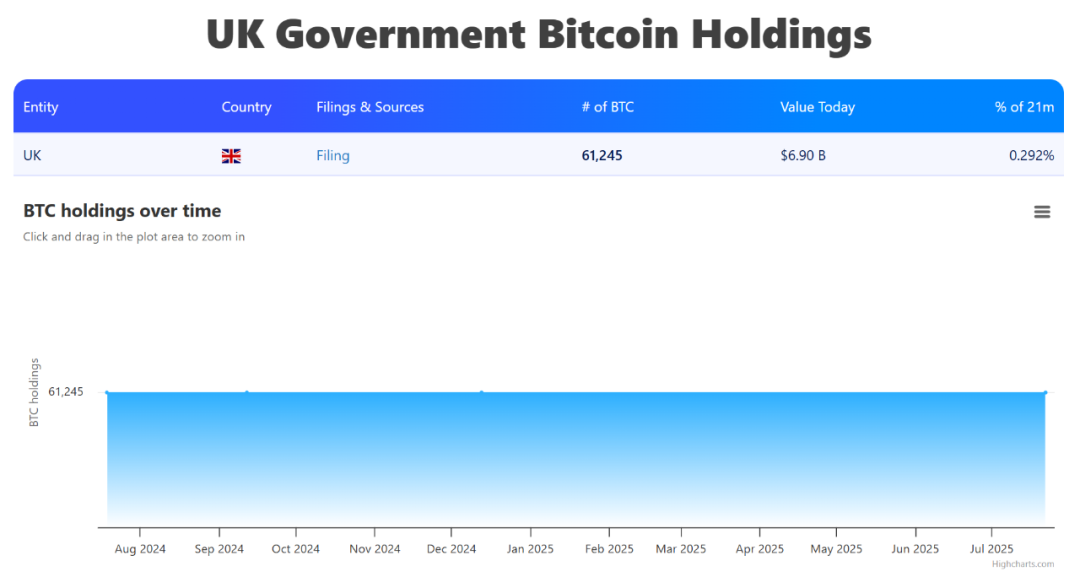
Theoretically, with this reserve, the plan of "retaining seized assets to establish reserves" is feasible.

However, under the UK's Proceeds of Crime Act, seized assets are usually liquidated first and used for compensation, which means that if the government wants to hold seized assets as reserves, it needs clear legal authorization.

At the tax level, cryptocurrencies are currently subject to capital gains tax. While a flat 10% rate will reduce the effective tax burden for high-tax taxpayers and potentially change the market entry, loss-taking strategies, and holding periods for cryptocurrencies in the UK, this tax rate adjustment still requires the government to submit and approve the Finance Bill before implementation.

For market participants who focus on policy transmission paths rather than campaign rhetoric, the underlying mechanisms influencing capital flows are already underway.

The improvement of stablecoin issuance and custody rules, coupled with a clear development path for tokenized funds, will jointly build an institutional-level market infrastructure.

This infrastructure will not only expand the liquidity of the British pound in the cryptocurrency field, but also reduce the operational friction costs of market neutral strategies and basis strategies.

Although there are differences between the UK's policy path and the US's ETF model, as the regulated infrastructure continues to improve, the market impacts of the two may gradually accumulate.

For this reason, campaign policy proposals will only be meaningful if they are adopted by the governing party or if they intersect with processes already underway at the Financial Conduct Authority or the Bank of England.

Comparison with US Bitcoin Policy

By comparing transatlantic policies, we can better understand Farage's choice of words.

Trump has expressed opposition to the Federal Reserve's launch of digital currency, publicly sought support from mining companies, and sent signals at the federal level to emphasize the leading position in the digital asset field. These measures have provided a clear development direction for the cryptocurrency industry.

Subsequently, the policy transmission is reflected through the subscription and redemption of spot Bitcoin ETFs, and the relevant data will be reflected in the weekly fund flow report.

At present, the UK has not yet formed a local spot Bitcoin ETF channel comparable in scale to that of the United States, which means that the key factors affecting the activity of the UK cryptocurrency market in the short term are more regulated custody services, connectivity between banks and cryptocurrency markets, and tokenized fund vehicles, rather than sovereign-level demand.

If the UK allocates sovereign Bitcoin on the scale proposed by Farage, this action will be clearly visible in the global ledger of country-linked Bitcoin holdings.

Data from on-chain analysts shows that the US government controls a large amount of seized Bitcoin; El Salvador also holds thousands of Bitcoins on its balance sheet. The UK currently holds 61,245 Bitcoins, making it one of the largest Bitcoin holders in the world (based on measurable scale).

Although this signal is very clear, the impact at the monetary policy level is still limited by the overall size of the UK's foreign exchange reserves and the Bank of England's inflation target. Therefore, we need to focus on the relevant legal basis, implementation process and institutional objectives.

If the Reform Party were to win an absolute majority in the next UK general election and come to power, it would be an unprecedented electoral reversal in modern British political history.

The party only won five seats in the 2024 general election. To increase from five seats to an absolute majority in Parliament (it would need to occupy at least 326 of the 650 seats), its seat increase would exceed the record of seat growth achieved by any single party in a general election in British history.

Previous notable seat gains in UK history include:

  • Labor's 2024 seat surge: 211 more seats than in 2019.
  • The largest number of seat changes in British general election history occurred in 2024, with a total of 303 seats changing hands; the previous highs were 289 seats in 1931 and 279 seats in 1945.

Market background and policy feasibility

If a policy causes approximately 60,000 bitcoins to be withdrawn from circulation, or if the same amount of bitcoins is continuously purchased over a period of time, it will marginally change the overall trend of market capital flows.

The implementation path of the policy is crucial, and the legal basis for deciding to retain seized assets rather than auction them is equally critical.

These decisions need to be made by the government and the Bank of England within the existing framework, not by small opposition parties.

Here's a quick overview for readers interested in the data surrounding Farage's policy proposals:

Looking ahead, the policy direction can be judged by the following three key signals:

First, the Bank of England stated that the time plan of the Bank of England and the Treasury on the digital pound and the modernization of the payment system will determine whether the scope of the relevant design work will be adjusted and the pace will change.

Second, the progress of the UK Financial Conduct Authority in formulating stablecoin and custody rules will determine the speed of infrastructure construction for the British pound in the cryptocurrency field.

According to the UK Financial Conduct Authority's plan, the implementation of the final rules and subsequent supervision will bring cryptocurrency-related activities into a more standardized regulatory scope.

Third, if the major political parties decide to adopt some of Farage’s policy proposals, the relevant trends will first be reflected in the party manifestos and the draft text of the Finance Bill, and may only be reflected in the sovereign reserve data later.

Currently, the Labour Party holds a majority of seats in Parliament, the legislative process proceeds as usual, and existing regulatory work continues.

These factors together determine that the UK's cryptocurrency policy will continue to move along the direction set by the UK Financial Conduct Authority and the Bank of England, rather than the policy path proposed by the Reform Party.

Market Opportunity
OFFICIAL TRUMP Logo
OFFICIAL TRUMP Price(TRUMP)
$2.905
$2.905$2.905
-1.79%
USD
OFFICIAL TRUMP (TRUMP) Live Price Chart
Disclaimer: The articles reposted on this site are sourced from public platforms and are provided for informational purposes only. They do not necessarily reflect the views of MEXC. All rights remain with the original authors. If you believe any content infringes on third-party rights, please contact crypto.news@mexc.com for removal. MEXC makes no guarantees regarding the accuracy, completeness, or timeliness of the content and is not responsible for any actions taken based on the information provided. The content does not constitute financial, legal, or other professional advice, nor should it be considered a recommendation or endorsement by MEXC.

You May Also Like

Winklevoss Twins Move $130M Bitcoin to Gemini Wallets

Winklevoss Twins Move $130M Bitcoin to Gemini Wallets

Crypto investors are watching the latest moves from twins Cameron Winklevoss and Tyler Winklevoss. According to blockchain tracking data, wallets linked to the
Share
Coinfomania2026/03/10 20:12
Facts Vs. Hype: Analyst Examines XRP Supply Shock Theory

Facts Vs. Hype: Analyst Examines XRP Supply Shock Theory

Prominent analyst Cheeky Crypto (203,000 followers on YouTube) set out to verify a fast-spreading claim that XRP’s circulating supply could “vanish overnight,” and his conclusion is more nuanced than the headline suggests: nothing in the ledger disappears, but the amount of XRP that is truly liquid could be far smaller than most dashboards imply—small enough, in his view, to set the stage for an abrupt liquidity squeeze if demand spikes. XRP Supply Shock? The video opens with the host acknowledging his own skepticism—“I woke up to a rumor that XRP supply could vanish overnight. Sounds crazy, right?”—before committing to test the thesis rather than dismiss it. He frames the exercise as an attempt to reconcile a long-standing critique (“XRP’s supply is too large for high prices”) with a rival view taking hold among prominent community voices: that much of the supply counted as “circulating” is effectively unavailable to trade. His first step is a straightforward data check. Pulling public figures, he finds CoinMarketCap showing roughly 59.6 billion XRP as circulating, while XRPScan reports about 64.7 billion. The divergence prompts what becomes the video’s key methodological point: different sources count “circulating” differently. Related Reading: Analyst Sounds Major XRP Warning: Last Chance To Get In As Accumulation Balloons As he explains it, the higher on-ledger number likely includes balances that aggregators exclude or treat as restricted, most notably Ripple’s programmatic escrow. He highlights that Ripple still “holds a chunk of XRP in escrow, about 35.3 billion XRP locked up across multiple wallets, with a nominal schedule of up to 1 billion released per month and unused portions commonly re-escrowed. Those coins exist and are accounted for on-ledger, but “they aren’t actually sitting on exchanges” and are not immediately available to buyers. In his words, “for all intents and purposes, that escrow stash is effectively off of the market.” From there, the analysis moves from headline “circulating supply” to the subtler concept of effective float. Beyond escrow, he argues that large strategic holders—banks, fintechs, or other whales—may sit on material balances without supplying order books. When you strip out escrow and these non-selling stashes, he says, “the effective circulating supply… is actually way smaller than the 59 or even 64 billion figure.” He cites community estimates in the “20 or 30 billion” range for what might be truly liquid at any given moment, while emphasizing that nobody has a precise number. That effective-float framing underpins the crux of his thesis: a potential supply shock if demand accelerates faster than fresh sell-side supply appears. “Price is a dance between supply and demand,” he says; if institutional or sovereign-scale users suddenly need XRP and “the market finds that there isn’t enough XRP readily available,” order books could thin out and prices could “shoot on up, sometimes violently.” His phrase “circulating supply could collapse overnight” is presented not as a claim that tokens are destroyed or removed from the ledger, but as a market-structure scenario in which available inventory to sell dries up quickly because holders won’t part with it. How Could The XRP Supply Shock Happen? On the demand side, he anchors the hypothetical to tokenization. He points to the “very early stages of something huge in finance”—on-chain tokenization of debt, stablecoins, CBDCs and even gold—and argues the XRP Ledger aims to be “the settlement layer” for those assets.He references Ripple CTO David Schwartz’s earlier comments about an XRPL pivot toward tokenized assets and notes that an institutional research shop (Bitwise) has framed XRP as a way to play the tokenization theme. In his construction, if “trillions of dollars in value” begin settling across XRPL rails, working inventories of XRP for bridging, liquidity and settlement could rise sharply, tightening effective float. Related Reading: XRP Bearish Signal: Whales Offload $486 Million In Asset To illustrate, he offers two analogies. First, the “concert tickets” model: you think there are 100,000 tickets (100B supply), but 50,000 are held by the promoter (escrow) and 30,000 by corporate buyers (whales), leaving only 20,000 for the public; if a million people want in, prices explode. Second, a comparison to Bitcoin’s halving: while XRP has no programmatic halving, he proposes that a sudden adoption wave could function like a de facto halving of available supply—“XRP’s version of a halving could actually be the adoption event.” He also updates the narrative context that long dogged XRP. Once derided for “too much supply,” he argues the script has “totally flipped.” He cites the current cycle’s optics—“XRP is sitting above $3 with a market cap north of around $180 billion”—as evidence that raw supply counts did not cap price as tightly as critics claimed, and as a backdrop for why a scarcity narrative is gaining traction. Still, he declines to publish targets or timelines, repeatedly stressing uncertainty and risk. “I’m not a financial adviser… cryptocurrencies are highly volatile,” he reminds viewers, adding that tokenization could take off “on some other platform,” unfold more slowly than enthusiasts expect, or fail to get to “sudden shock” scale. The verdict he offers is deliberately bound. The theory that “XRP supply could vanish overnight” is imprecise on its face; the ledger will not erase coins. But after examining dashboard methodologies, escrow mechanics and the behavior of large holders, he concludes that the effective float could be meaningfully smaller than headline supply figures, and that a fast-developing tokenization use case could, under the right conditions, stress that float. “Overnight is a dramatic way to put it,” he concedes. “The change could actually be very sudden when it comes.” At press time, XRP traded at $3.0198. Featured image created with DALL.E, chart from TradingView.com
Share
NewsBTC2025/09/18 11:00
What to Expect in Laptop Rental Services: A Cost Breakdown

What to Expect in Laptop Rental Services: A Cost Breakdown

Laptop rental services are emerging as a popular choice. This is true, especially among businesses that require temporary equipment. Renting a laptop can be an
Share
Techbullion2026/03/10 20:05