OpenSea, once the face of the NFT boom, has undergone a dramatic transformation as the sector sees trading volumes collapse by more than 90% from their 2021 highs. The NFT marketplace has rebranded itself as a multi-chain crypto trading aggregator, expanding beyond digital collectibles into the wider world of token trading. Under CEO Devin Finzer, OpenSea has pivoted toward becoming a “trade-any-crypto” platform that now supports 22 blockchains. The shift follows one of the sharpest declines in the NFT sector’s history, a market that once reached a $20 billion capitalization in early 2022 before plunging to roughly $4.87 billion by October 2025, according to CoinGecko.Source: CoinGecko Finzer said the shift toward crypto aggregation is both a survival strategy and a bet on where the industry is headed. “You can’t fight the macro trend,” he said. “People want to trade everything—not just digital art.” The new business model aggregates buy and sell orders from decentralized exchanges such as Uniswap and Meteora, generating around $16 million in revenue over the same period through a 0.9% transaction fee. According to him, OpenSea does not perform know-your-customer checks, arguing that they are incompatible with its non-custodial model, though it uses blockchain analytics to flag suspicious transactions. The platform’s evolution into a multi-asset aggregator reflects a wider trend among former NFT-focused firms adapting to the changing crypto economy. Earlier this year, Solana-based marketplace Magic Eden acquired trading platform Slingshot to expand beyond NFTs. OpenSea’s Trading Volume Hits 3-Year High as Platform Reinvents Itself At the height of the NFT frenzy in January 2022, OpenSea generated $125 million in monthly revenue and was valued at $13.3 billion, making it one of the most valuable startups in crypto. But by late 2023, as interest in digital collectibles evaporated, its monthly revenue had fallen to just $3 million. The company was forced to lay off more than half of its staff, shrinking from about 175 employees to around 60 today. The downturn was accelerated by competition from rival marketplace Blur, which captured traders with zero fees and no royalties for creators. OpenSea’s response, loosening its own royalty structure, backfired, sparking backlash from artists and collectors who accused the company of abandoning its roots. Facing dwindling market share and financial strain, Finzer initiated a major reset. The company has since relocated its headquarters to Miami, with most staff working remotely. Additionally, in the first two weeks of October 2025, the company handled $1.6 billion in crypto trades and $230 million in NFT transactions, its biggest month in more than three years. Also, in an X post, Finzer noted that OpenSea saw massive demand with about $2.6 billion in trading volume this month, with over 90% from token trading. OpenSea Prepares Token Launch, Eyes Recovery After NFT Market Collapse OpenSea’s resurgence comes amid shifting investor appetite across the digital asset space. While Bitcoin and other cryptocurrencies have rallied, NFT trading remains a fraction of what it once was. Blue-chip collections such as Bored Ape Yacht Club have seen floor prices tumble from around $400,000 at their peak to about $32,000.Source: CoinGecko Blur, the platform that once dethroned OpenSea, has also seen its activity collapse, from over $1 billion in monthly volume in early 2023 to just $92 million last month, according to DappRadar. Despite the slump, the NFT market has shown intermittent signs of recovery in 2025. DappRadar reported that July saw NFT market capitalization rise 94% to $6.6 billion, driven by renewed interest in blue-chip assets like CryptoPunks and Pudgy Penguins. CryptoPunks alone saw a 53% floor price increase, while Pudgy Penguins overtook Bored Ape Yacht Club by market cap. Even so, trading volumes remain volatile. After a resurgence in mid-2025, NFT sales have slowed again, with daily volumes hovering around $8 million, according to CoinGecko.Source: NFTpulse Base, Coinbase’s Layer-2 network, now dominates NFT activity, accounting for more than half of total transactions across blockchains, followed by Ethereum, Polygon, and Solana. OpenSea’s “2.0” vision includes plans for a mobile app and an independent foundation that will issue an OpenSea token. Finzer says the goal is to make trading as intuitive as Robinhood but fully self-custodial, allowing users to maintain control of their assets across chainsOpenSea, once the face of the NFT boom, has undergone a dramatic transformation as the sector sees trading volumes collapse by more than 90% from their 2021 highs. The NFT marketplace has rebranded itself as a multi-chain crypto trading aggregator, expanding beyond digital collectibles into the wider world of token trading. Under CEO Devin Finzer, OpenSea has pivoted toward becoming a “trade-any-crypto” platform that now supports 22 blockchains. The shift follows one of the sharpest declines in the NFT sector’s history, a market that once reached a $20 billion capitalization in early 2022 before plunging to roughly $4.87 billion by October 2025, according to CoinGecko.Source: CoinGecko Finzer said the shift toward crypto aggregation is both a survival strategy and a bet on where the industry is headed. “You can’t fight the macro trend,” he said. “People want to trade everything—not just digital art.” The new business model aggregates buy and sell orders from decentralized exchanges such as Uniswap and Meteora, generating around $16 million in revenue over the same period through a 0.9% transaction fee. According to him, OpenSea does not perform know-your-customer checks, arguing that they are incompatible with its non-custodial model, though it uses blockchain analytics to flag suspicious transactions. The platform’s evolution into a multi-asset aggregator reflects a wider trend among former NFT-focused firms adapting to the changing crypto economy. Earlier this year, Solana-based marketplace Magic Eden acquired trading platform Slingshot to expand beyond NFTs. OpenSea’s Trading Volume Hits 3-Year High as Platform Reinvents Itself At the height of the NFT frenzy in January 2022, OpenSea generated $125 million in monthly revenue and was valued at $13.3 billion, making it one of the most valuable startups in crypto. But by late 2023, as interest in digital collectibles evaporated, its monthly revenue had fallen to just $3 million. The company was forced to lay off more than half of its staff, shrinking from about 175 employees to around 60 today. The downturn was accelerated by competition from rival marketplace Blur, which captured traders with zero fees and no royalties for creators. OpenSea’s response, loosening its own royalty structure, backfired, sparking backlash from artists and collectors who accused the company of abandoning its roots. Facing dwindling market share and financial strain, Finzer initiated a major reset. The company has since relocated its headquarters to Miami, with most staff working remotely. Additionally, in the first two weeks of October 2025, the company handled $1.6 billion in crypto trades and $230 million in NFT transactions, its biggest month in more than three years. Also, in an X post, Finzer noted that OpenSea saw massive demand with about $2.6 billion in trading volume this month, with over 90% from token trading. OpenSea Prepares Token Launch, Eyes Recovery After NFT Market Collapse OpenSea’s resurgence comes amid shifting investor appetite across the digital asset space. While Bitcoin and other cryptocurrencies have rallied, NFT trading remains a fraction of what it once was. Blue-chip collections such as Bored Ape Yacht Club have seen floor prices tumble from around $400,000 at their peak to about $32,000.Source: CoinGecko Blur, the platform that once dethroned OpenSea, has also seen its activity collapse, from over $1 billion in monthly volume in early 2023 to just $92 million last month, according to DappRadar. Despite the slump, the NFT market has shown intermittent signs of recovery in 2025. DappRadar reported that July saw NFT market capitalization rise 94% to $6.6 billion, driven by renewed interest in blue-chip assets like CryptoPunks and Pudgy Penguins. CryptoPunks alone saw a 53% floor price increase, while Pudgy Penguins overtook Bored Ape Yacht Club by market cap. Even so, trading volumes remain volatile. After a resurgence in mid-2025, NFT sales have slowed again, with daily volumes hovering around $8 million, according to CoinGecko.Source: NFTpulse Base, Coinbase’s Layer-2 network, now dominates NFT activity, accounting for more than half of total transactions across blockchains, followed by Ethereum, Polygon, and Solana. OpenSea’s “2.0” vision includes plans for a mobile app and an independent foundation that will issue an OpenSea token. Finzer says the goal is to make trading as intuitive as Robinhood but fully self-custodial, allowing users to maintain control of their assets across chains

OpenSea Reinvents Itself as Crypto Aggregator Amid 90% NFT Volume Crash

OpenSea, once the face of the NFT boom, has undergone a dramatic transformation as the sector sees trading volumes collapse by more than 90% from their 2021 highs.

The NFT marketplace has rebranded itself as a multi-chain crypto trading aggregator, expanding beyond digital collectibles into the wider world of token trading.

Under CEO Devin Finzer, OpenSea has pivoted toward becoming a “trade-any-crypto” platform that now supports 22 blockchains.

The shift follows one of the sharpest declines in the NFT sector’s history, a market that once reached a $20 billion capitalization in early 2022 before plunging to roughly $4.87 billion by October 2025, according to CoinGecko.
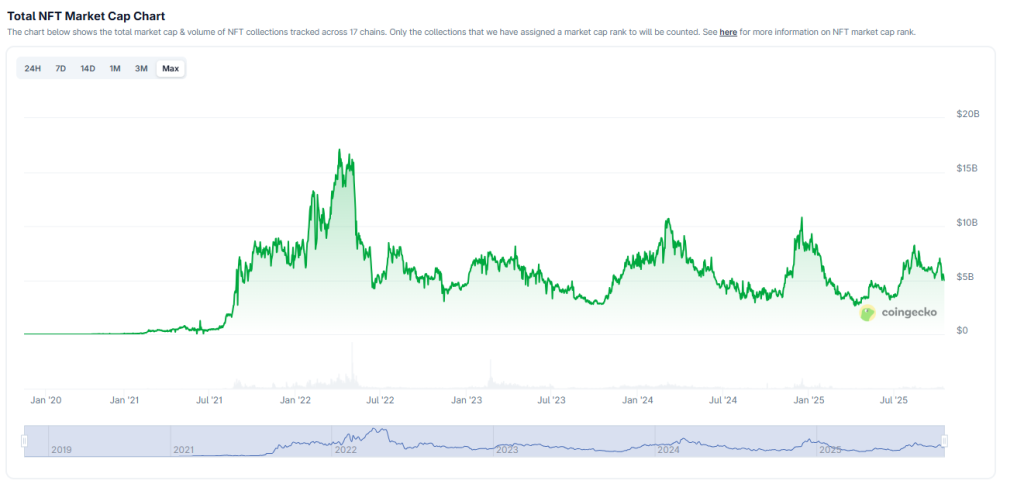
Source: CoinGecko

Finzer said the shift toward crypto aggregation is both a survival strategy and a bet on where the industry is headed. “You can’t fight the macro trend,” he said. “People want to trade everything—not just digital art.”

The new business model aggregates buy and sell orders from decentralized exchanges such as Uniswap and Meteora, generating around $16 million in revenue over the same period through a 0.9% transaction fee.

According to him, OpenSea does not perform know-your-customer checks, arguing that they are incompatible with its non-custodial model, though it uses blockchain analytics to flag suspicious transactions.

The platform’s evolution into a multi-asset aggregator reflects a wider trend among former NFT-focused firms adapting to the changing crypto economy.

Earlier this year, Solana-based marketplace Magic Eden acquired trading platform Slingshot to expand beyond NFTs.

OpenSea’s Trading Volume Hits 3-Year High as Platform Reinvents Itself

At the height of the NFT frenzy in January 2022, OpenSea generated $125 million in monthly revenue and was valued at $13.3 billion, making it one of the most valuable startups in crypto.

But by late 2023, as interest in digital collectibles evaporated, its monthly revenue had fallen to just $3 million. The company was forced to lay off more than half of its staff, shrinking from about 175 employees to around 60 today.

The downturn was accelerated by competition from rival marketplace Blur, which captured traders with zero fees and no royalties for creators.

OpenSea’s response, loosening its own royalty structure, backfired, sparking backlash from artists and collectors who accused the company of abandoning its roots.

Facing dwindling market share and financial strain, Finzer initiated a major reset. The company has since relocated its headquarters to Miami, with most staff working remotely.

Additionally, in the first two weeks of October 2025, the company handled $1.6 billion in crypto trades and $230 million in NFT transactions, its biggest month in more than three years.

Also, in an X post, Finzer noted that OpenSea saw massive demand with about $2.6 billion in trading volume this month, with over 90% from token trading.

OpenSea Prepares Token Launch, Eyes Recovery After NFT Market Collapse

OpenSea’s resurgence comes amid shifting investor appetite across the digital asset space. While Bitcoin and other cryptocurrencies have rallied, NFT trading remains a fraction of what it once was.

Blue-chip collections such as Bored Ape Yacht Club have seen floor prices tumble from around $400,000 at their peak to about $32,000.

Source: CoinGecko

Blur, the platform that once dethroned OpenSea, has also seen its activity collapse, from over $1 billion in monthly volume in early 2023 to just $92 million last month, according to DappRadar.

Despite the slump, the NFT market has shown intermittent signs of recovery in 2025.

DappRadar reported that July saw NFT market capitalization rise 94% to $6.6 billion, driven by renewed interest in blue-chip assets like CryptoPunks and Pudgy Penguins.

CryptoPunks alone saw a 53% floor price increase, while Pudgy Penguins overtook Bored Ape Yacht Club by market cap.

Even so, trading volumes remain volatile. After a resurgence in mid-2025, NFT sales have slowed again, with daily volumes hovering around $8 million, according to CoinGecko.

Source: NFTpulse

Base, Coinbase’s Layer-2 network, now dominates NFT activity, accounting for more than half of total transactions across blockchains, followed by Ethereum, Polygon, and Solana.

OpenSea’s “2.0” vision includes plans for a mobile app and an independent foundation that will issue an OpenSea token.

Finzer says the goal is to make trading as intuitive as Robinhood but fully self-custodial, allowing users to maintain control of their assets across chains.


Market Opportunity
AINFT Logo
AINFT Price(NFT)
$0,0000003445
$0,0000003445$0,0000003445
-0,60%
USD
AINFT (NFT) Live Price Chart
Disclaimer: The articles reposted on this site are sourced from public platforms and are provided for informational purposes only. They do not necessarily reflect the views of MEXC. All rights remain with the original authors. If you believe any content infringes on third-party rights, please contact service@support.mexc.com for removal. MEXC makes no guarantees regarding the accuracy, completeness, or timeliness of the content and is not responsible for any actions taken based on the information provided. The content does not constitute financial, legal, or other professional advice, nor should it be considered a recommendation or endorsement by MEXC.

You May Also Like

MAXI DOGE Holders Diversify into $GGs for Fast-Growth 2025 Crypto Presale Opportunities

MAXI DOGE Holders Diversify into $GGs for Fast-Growth 2025 Crypto Presale Opportunities

Presale crypto tokens have become some of the most active areas in Web3, offering early access to projects that blend culture, finance, and technology. Investors are constantly searching for the best crypto presale to buy right now, comparing new token presales across different niches. MAXI DOGE has gained attention for its meme-driven energy, but early [...] The post MAXI DOGE Holders Diversify into $GGs for Fast-Growth 2025 Crypto Presale Opportunities appeared first on Blockonomi.
Share
Blockonomi2025/09/18 00:00
Edges higher ahead of BoC-Fed policy outcome

Edges higher ahead of BoC-Fed policy outcome

The post Edges higher ahead of BoC-Fed policy outcome appeared on BitcoinEthereumNews.com. USD/CAD gains marginally to near 1.3760 ahead of monetary policy announcements by the Fed and the BoC. Both the Fed and the BoC are expected to lower interest rates. USD/CAD forms a Head and Shoulder chart pattern. The USD/CAD pair ticks up to near 1.3760 during the late European session on Wednesday. The Loonie pair gains marginally ahead of monetary policy outcomes by the Bank of Canada (BoC) and the Federal Reserve (Fed) during New York trading hours. Both the BoC and the Fed are expected to cut interest rates amid mounting labor market conditions in their respective economies. Inflationary pressures in the Canadian economy have cooled down, emerging as another reason behind the BoC’s dovish expectations. However, the Fed is expected to start the monetary-easing campaign despite the United States (US) inflation remaining higher. Investors will closely monitor press conferences from both Fed Chair Jerome Powell and BoC Governor Tiff Macklem to get cues about whether there will be more interest rate cuts in the remainder of the year. According to analysts from Barclays, the Fed’s latest median projections for interest rates are likely to call for three interest rate cuts by 2025. Ahead of the Fed’s monetary policy, the US Dollar Index (DXY), which tracks the Greenback’s value against six major currencies, holds onto Tuesday’s losses near 96.60. USD/CAD forms a Head and Shoulder chart pattern, which indicates a bearish reversal. The neckline of the above-mentioned chart pattern is plotted near 1.3715. The near-term trend of the pair remains bearish as it stays below the 20-day Exponential Moving Average (EMA), which trades around 1.3800. The 14-day Relative Strength Index (RSI) slides to near 40.00. A fresh bearish momentum would emerge if the RSI falls below that level. Going forward, the asset could slide towards the round level of…
Share
BitcoinEthereumNews2025/09/18 01:23
The Contrarian Truth: Why Bitcoin and Ethereum Prices Defy Social Media Sentiment

The Contrarian Truth: Why Bitcoin and Ethereum Prices Defy Social Media Sentiment

BitcoinWorld The Contrarian Truth: Why Bitcoin and Ethereum Prices Defy Social Media Sentiment Have you ever noticed that when everyone on social media is screaming
Share
bitcoinworld2025/12/20 07:45



