Bitcoin’s momentum has weakened sharply this week, breaking below a key support zone that historically marked the transition from bull markets to bear phases. After months of consolidation above the six-figure threshold, Bitcoin slipped under $100,000, raising fears that a deeper correction could unfold if price recovery fails to materialize soon. According to CryptoQuant’s Bull Score Index, market sentiment has turned extremely bearish, dropping to zero for the first time since June 2022—a reading that previously coincided with the onset of the last major bear market. As macro conditions tighten and on-chain indicators soften, traders are watching key support levels closely to determine whether this pullback is a temporary correction or the beginning of a prolonged downtrend. Bitcoin Falls Below the 365-Day Moving Average The most alarming technical development is Bitcoin’s fall below its 365-day moving average (MA), currently around $102,000. This long-term indicator has served as a key line of defense throughout the current cycle, acting as both technical and psychological support. Historically, when Bitcoin broke decisively below its 365-day MA—most notably in December 2021 to January 2022—it indicated the formal start of a bear market. Unless Bitcoin reclaims this level quickly, analysts warn of a potential acceleration in selling pressure, with momentum traders and algorithms likely to amplify downside volatility. On-chain Data Points to Possible Drop Toward $72K The Traders’ On-chain Realized Price Bands also point to an elevated risk of further downside. These bands, which track average acquisition prices for short-term holders, indicate a lower band near $100K and a minimum band around $72K. If Bitcoin remains below the $100K threshold for long, traders realizing losses could push prices toward that $72K support, marking a 28% drawdown from current levels. So far this cycle, the lower band has acted as a dynamic support, cushioning retracements as weaker hands capitulate. A breakdown below this range would mark a structural shift in trader behavior, mirroring patterns last seen in 2022. Network Valuation Support Near $91K Under the network valuation model based on Metcalfe’s law—which states a network’s value grows proportionally to the square of its user base—Bitcoin’s next key support lies around $91,000, corresponding to the 2x Metcalfe-Value band. Bitcoin traded near this valuation from November 2024 through May 2025, and a retest could stabilize the market temporarily if investor participation remains steady. With fundamentals weakening and confidence slipping, Bitcoin is again testing that “red thin line” between a deep correction and a renewed rally—echoing the precarious dynamics that defined the 2022 bear marketBitcoin’s momentum has weakened sharply this week, breaking below a key support zone that historically marked the transition from bull markets to bear phases. After months of consolidation above the six-figure threshold, Bitcoin slipped under $100,000, raising fears that a deeper correction could unfold if price recovery fails to materialize soon. According to CryptoQuant’s Bull Score Index, market sentiment has turned extremely bearish, dropping to zero for the first time since June 2022—a reading that previously coincided with the onset of the last major bear market. As macro conditions tighten and on-chain indicators soften, traders are watching key support levels closely to determine whether this pullback is a temporary correction or the beginning of a prolonged downtrend. Bitcoin Falls Below the 365-Day Moving Average The most alarming technical development is Bitcoin’s fall below its 365-day moving average (MA), currently around $102,000. This long-term indicator has served as a key line of defense throughout the current cycle, acting as both technical and psychological support. Historically, when Bitcoin broke decisively below its 365-day MA—most notably in December 2021 to January 2022—it indicated the formal start of a bear market. Unless Bitcoin reclaims this level quickly, analysts warn of a potential acceleration in selling pressure, with momentum traders and algorithms likely to amplify downside volatility. On-chain Data Points to Possible Drop Toward $72K The Traders’ On-chain Realized Price Bands also point to an elevated risk of further downside. These bands, which track average acquisition prices for short-term holders, indicate a lower band near $100K and a minimum band around $72K. If Bitcoin remains below the $100K threshold for long, traders realizing losses could push prices toward that $72K support, marking a 28% drawdown from current levels. So far this cycle, the lower band has acted as a dynamic support, cushioning retracements as weaker hands capitulate. A breakdown below this range would mark a structural shift in trader behavior, mirroring patterns last seen in 2022. Network Valuation Support Near $91K Under the network valuation model based on Metcalfe’s law—which states a network’s value grows proportionally to the square of its user base—Bitcoin’s next key support lies around $91,000, corresponding to the 2x Metcalfe-Value band. Bitcoin traded near this valuation from November 2024 through May 2025, and a retest could stabilize the market temporarily if investor participation remains steady. With fundamentals weakening and confidence slipping, Bitcoin is again testing that “red thin line” between a deep correction and a renewed rally—echoing the precarious dynamics that defined the 2022 bear market

Bitcoin Breaks Key Support Level That Confirmed the 2022 Bear Market: CryptoQuant

Bitcoin’s momentum has weakened sharply this week, breaking below a key support zone that historically marked the transition from bull markets to bear phases.

After months of consolidation above the six-figure threshold, Bitcoin slipped under $100,000, raising fears that a deeper correction could unfold if price recovery fails to materialize soon.

According to CryptoQuant’s Bull Score Index, market sentiment has turned extremely bearish, dropping to zero for the first time since June 2022—a reading that previously coincided with the onset of the last major bear market.

As macro conditions tighten and on-chain indicators soften, traders are watching key support levels closely to determine whether this pullback is a temporary correction or the beginning of a prolonged downtrend.

Bitcoin Falls Below the 365-Day Moving Average

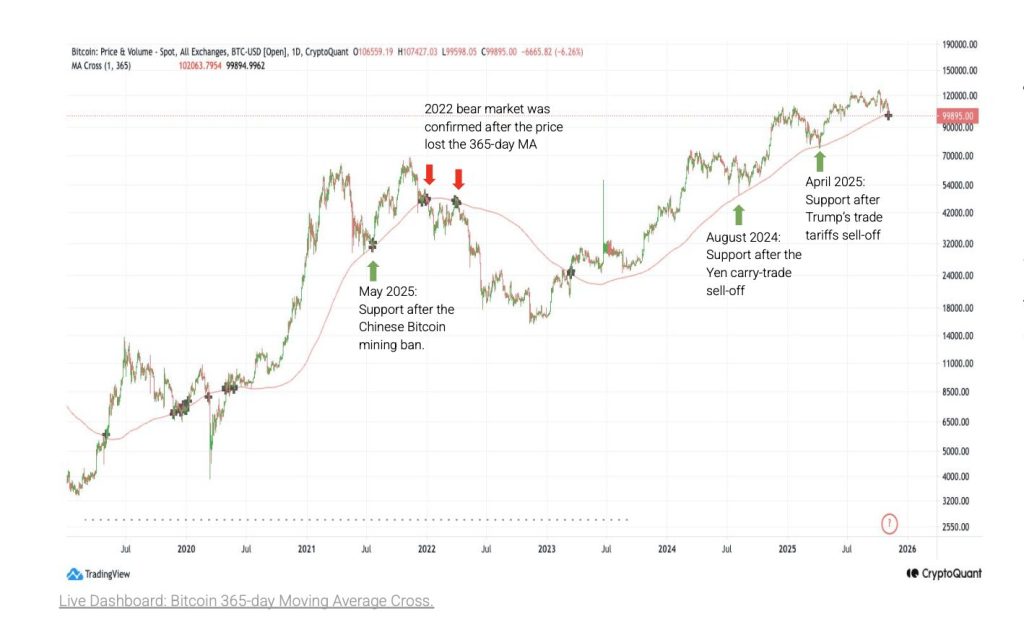
The most alarming technical development is Bitcoin’s fall below its 365-day moving average (MA), currently around $102,000. This long-term indicator has served as a key line of defense throughout the current cycle, acting as both technical and psychological support.

Historically, when Bitcoin broke decisively below its 365-day MA—most notably in December 2021 to January 2022—it indicated the formal start of a bear market.
Unless Bitcoin reclaims this level quickly, analysts warn of a potential acceleration in selling pressure, with momentum traders and algorithms likely to amplify downside volatility.

On-chain Data Points to Possible Drop Toward $72K

The Traders’ On-chain Realized Price Bands also point to an elevated risk of further downside. These bands, which track average acquisition prices for short-term holders, indicate a lower band near $100K and a minimum band around $72K.

If Bitcoin remains below the $100K threshold for long, traders realizing losses could push prices toward that $72K support, marking a 28% drawdown from current levels.

So far this cycle, the lower band has acted as a dynamic support, cushioning retracements as weaker hands capitulate. A breakdown below this range would mark a structural shift in trader behavior, mirroring patterns last seen in 2022.

Network Valuation Support Near $91K

Under the network valuation model based on Metcalfe’s law—which states a network’s value grows proportionally to the square of its user base—Bitcoin’s next key support lies around $91,000, corresponding to the 2x Metcalfe-Value band.

Bitcoin traded near this valuation from November 2024 through May 2025, and a retest could stabilize the market temporarily if investor participation remains steady.

With fundamentals weakening and confidence slipping, Bitcoin is again testing that “red thin line” between a deep correction and a renewed rally—echoing the precarious dynamics that defined the 2022 bear market.


Disclaimer: The articles reposted on this site are sourced from public platforms and are provided for informational purposes only. They do not necessarily reflect the views of MEXC. All rights remain with the original authors. If you believe any content infringes on third-party rights, please contact service@support.mexc.com for removal. MEXC makes no guarantees regarding the accuracy, completeness, or timeliness of the content and is not responsible for any actions taken based on the information provided. The content does not constitute financial, legal, or other professional advice, nor should it be considered a recommendation or endorsement by MEXC.

You May Also Like

The Channel Factories We’ve Been Waiting For

The Channel Factories We’ve Been Waiting For

The post The Channel Factories We’ve Been Waiting For appeared on BitcoinEthereumNews.com. Visions of future technology are often prescient about the broad strokes while flubbing the details. The tablets in “2001: A Space Odyssey” do indeed look like iPads, but you never see the astronauts paying for subscriptions or wasting hours on Candy Crush.  Channel factories are one vision that arose early in the history of the Lightning Network to address some challenges that Lightning has faced from the beginning. Despite having grown to become Bitcoin’s most successful layer-2 scaling solution, with instant and low-fee payments, Lightning’s scale is limited by its reliance on payment channels. Although Lightning shifts most transactions off-chain, each payment channel still requires an on-chain transaction to open and (usually) another to close. As adoption grows, pressure on the blockchain grows with it. The need for a more scalable approach to managing channels is clear. Channel factories were supposed to meet this need, but where are they? In 2025, subnetworks are emerging that revive the impetus of channel factories with some new details that vastly increase their potential. They are natively interoperable with Lightning and achieve greater scale by allowing a group of participants to open a shared multisig UTXO and create multiple bilateral channels, which reduces the number of on-chain transactions and improves capital efficiency. Achieving greater scale by reducing complexity, Ark and Spark perform the same function as traditional channel factories with new designs and additional capabilities based on shared UTXOs.  Channel Factories 101 Channel factories have been around since the inception of Lightning. A factory is a multiparty contract where multiple users (not just two, as in a Dryja-Poon channel) cooperatively lock funds in a single multisig UTXO. They can open, close and update channels off-chain without updating the blockchain for each operation. Only when participants leave or the factory dissolves is an on-chain transaction…
Share
BitcoinEthereumNews2025/09/18 00:09
Market data: ICP rose 4.54% intraday, while GLM fell 5.44% intraday.

Market data: ICP rose 4.54% intraday, while GLM fell 5.44% intraday.

PANews reported on January 16th that, according to OKX market data, the top gainers of the day are: ICP at $4.494, up 4.54%; CHZ at $0.0579, up 4.19%; CRV at $0
Share
PANews2026/01/16 10:00
Iran Crypto Volume Hits $7.78B as IRGC Controls Half of Market

Iran Crypto Volume Hits $7.78B as IRGC Controls Half of Market

The post Iran Crypto Volume Hits $7.78B as IRGC Controls Half of Market appeared on BitcoinEthereumNews.com. Darius Baruo Jan 15, 2026 15:54 Chainalysis data
Share
BitcoinEthereumNews2026/01/16 10:16