This article presents an ablation study showing that the proposed IIL method performs well with larger networksThis article presents an ablation study showing that the proposed IIL method performs well with larger networks

Network Size and Task Number: Ablation Study on IIL Performance and Stability

2025/11/12 23:30

Abstract and 1 Introduction

  1. Related works

  2. Problem setting

  3. Methodology

    4.1. Decision boundary-aware distillation

    4.2. Knowledge consolidation

  4. Experimental results and 5.1. Experiment Setup

    5.2. Comparison with SOTA methods

    5.3. Ablation study

  5. Conclusion and future work and References

    \

Supplementary Material

  1. Details of the theoretical analysis on KCEMA mechanism in IIL
  2. Algorithm overview
  3. Dataset details
  4. Implementation details
  5. Visualization of dusted input images
  6. More experimental results

12. More experimental results

12.1. Ablation study on network size

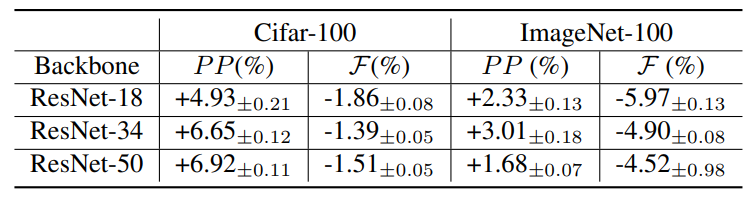
\ To investigate the impact of network size on the proposed method, we compare the performance of ResNet-18, ResNet-34 and ResNet-50 on the ImageNet-100. As shown in Tab. 5, the proposed method performs well with bigger

\ Table 5. Impact of the network size on the proposed method.
\ Table 6. Performance of the proposed method with different IIL task numbers.

\ network size. When the network size is larger, more parameters can be utilized for new knowledge learning with the proposed decision boundary-aware distillation. Hence, consolidating knowledge from student to teacher causes less forgetting.

\ 12.2. Ablation study on the task number

\ As mentioned in Sec. 7, our method accumulates the error along with the consecutive IIL tasks. However, such a kind of error accumulates slowly and mainly affects the performance on old tasks, i.e. forgetting rate. We further study the impact of task length on the performance of the proposed method by splitting the incremental data into different number of subsets. As shown in Tab. 6, with the incremental of task number, the performance promotion changes less but the forgetting rate increased slightly. Minor variation of performance promotion reveals that the proposed method is stable in learning new knowledge, irrespective of the number of tasks. The acquisition of new knowledge primarily hinges on the volume of new data involved. Although we increase the task number in the experiments, the total number of new data utilized in IIL phase is the same. While increasing the task number will increase the EMA steps, which causes more forgetting on the old data. Experimental results in Tab. 6 well validate our analysis in Sec. 7.

\ Compared to the performance promotion, forgetting on the old data is negligible. Noteworthy, when the task number is relatively small, such as 5 in Tab. 6, the proposed method slightly boosts the model’s performance on the base data. This behavior is similar with full-data model, which demonstrates the capability of our method in accumulating knowledge from new data.

\ 12.3. Detailed comparison between the KC-EMA and vanilla EMA

\ The performance of vanilla EMA and the proposed KCEMA during training is shown in Fig. 11. As can be seen, the student model’s accuracy initially plummets due to the introduction of new data. However, around the 10th epoch,

\ Figure 11. Comparison between the proposed KC-EMA and vanilla EMA during training in the first IIL task, where t denotes the teacher model and s denotes the student model. Result is achieved on Cifar-100.
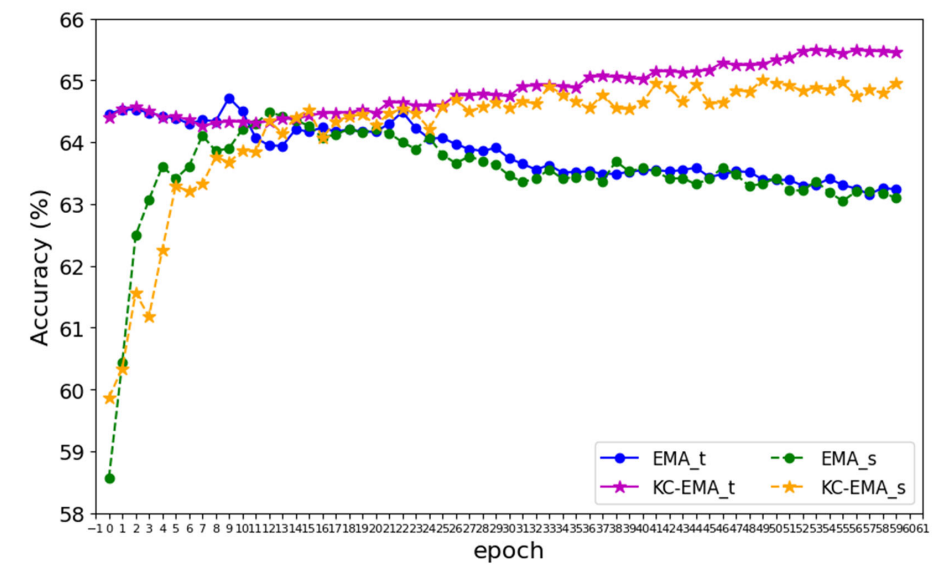
\ there’s a resurgence in accuracy for both the KC-EMA and vanilla EMA models. Therefore, we empirically set a freezing epoch of 10 in the proposed method.

\ When EMA is applied post the 10th epoch, the teacher model in the vanilla EMA is rapidly drawn towards the student model. This homogenization, however, doesn’t enhance either model. Instead, it leads to a decline in test accuracy due to overfitting to the new data. In contrast, with KC-EMA, both the teacher and student models exhibit gradual growth,, which indicates a knowledge accumulation in these two models. On one hand, consolidating new knowledge to the teacher model improves its test performance. On the other hand, a teacher model equipped with new knowledge liberates the student model to learn new data. That is, constraints from the teacher in distillation is alleviated.

\

:::info Authors:

(1) Qiang Nie, Hong Kong University of Science and Technology (Guangzhou);

(2) Weifu Fu, Tencent Youtu Lab;

(3) Yuhuan Lin, Tencent Youtu Lab;

(4) Jialin Li, Tencent Youtu Lab;

(5) Yifeng Zhou, Tencent Youtu Lab;

(6) Yong Liu, Tencent Youtu Lab;

(7) Qiang Nie, Hong Kong University of Science and Technology (Guangzhou);

(8) Chengjie Wang, Tencent Youtu Lab.

:::


:::info This paper is available on arxiv under CC BY-NC-ND 4.0 Deed (Attribution-Noncommercial-Noderivs 4.0 International) license.

:::

\

Disclaimer: The articles reposted on this site are sourced from public platforms and are provided for informational purposes only. They do not necessarily reflect the views of MEXC. All rights remain with the original authors. If you believe any content infringes on third-party rights, please contact service@support.mexc.com for removal. MEXC makes no guarantees regarding the accuracy, completeness, or timeliness of the content and is not responsible for any actions taken based on the information provided. The content does not constitute financial, legal, or other professional advice, nor should it be considered a recommendation or endorsement by MEXC.

You May Also Like

CME Group to launch options on XRP and SOL futures

CME Group to launch options on XRP and SOL futures

The post CME Group to launch options on XRP and SOL futures appeared on BitcoinEthereumNews.com. CME Group will offer options based on the derivative markets on Solana (SOL) and XRP. The new markets will open on October 13, after regulatory approval.  CME Group will expand its crypto products with options on the futures markets of Solana (SOL) and XRP. The futures market will start on October 13, after regulatory review and approval.  The options will allow the trading of MicroSol, XRP, and MicroXRP futures, with expiry dates available every business day, monthly, and quarterly. The new products will be added to the existing BTC and ETH options markets. ‘The launch of these options contracts builds on the significant growth and increasing liquidity we have seen across our suite of Solana and XRP futures,’ said Giovanni Vicioso, CME Group Global Head of Cryptocurrency Products. The options contracts will have two main sizes, tracking the futures contracts. The new market will be suitable for sophisticated institutional traders, as well as active individual traders. The addition of options markets singles out XRP and SOL as liquid enough to offer the potential to bet on a market direction.  The options on futures arrive a few months after the launch of SOL futures. Both SOL and XRP had peak volumes in August, though XRP activity has slowed down in September. XRP and SOL options to tap both institutions and active traders Crypto options are one of the indicators of market attitudes, with XRP and SOL receiving a new way to gauge sentiment. The contracts will be supported by the Cumberland team.  ‘As one of the biggest liquidity providers in the ecosystem, the Cumberland team is excited to support CME Group’s continued expansion of crypto offerings,’ said Roman Makarov, Head of Cumberland Options Trading at DRW. ‘The launch of options on Solana and XRP futures is the latest example of the…
Share
BitcoinEthereumNews2025/09/18 00:56
SEC Approves Decision Concerning Bitcoin and 9 Altcoins – The Dow Jones of Cryptocurrencies May Have Arrived

SEC Approves Decision Concerning Bitcoin and 9 Altcoins – The Dow Jones of Cryptocurrencies May Have Arrived

The post SEC Approves Decision Concerning Bitcoin and 9 Altcoins – The Dow Jones of Cryptocurrencies May Have Arrived appeared on BitcoinEthereumNews.com. While the cryptocurrency market doesn’t yet have a comprehensive index like the Dow Jones or S&P 500, Bitwise is one step closer to filling this void. The company’s new exchange-traded product, Bitwise 10 Crypto Index ETF (BITW), has begun trading, offering individual investors and financial advisors access to the 10 largest crypto assets in a single product. BITW’s portfolio includes the following digital assets: Bitcoin, Ethereum, XRP, Solana, Chainlink, Litecoin, Cardano, Avalanche, Sui, and Polkadot. Bitwise CEO and co-founder Hunter Horsley told CNBC that this conversion makes the company the first to include altcoins like Cardano, Avalanche, Sui, and Polkadot, which don’t currently have spot ETFs, in an ETF from a major asset manager. “This step significantly broadens the investor base that can access various crypto assets,” Horsley said. “This is particularly important for assets without a spot ETF.” According to the CEO, this ETF also provides significant accessibility for smaller investors who invest through individual retirement accounts (IRAs) or pension funds and are only able to access ETFs. BITW, previously an index fund containing the same assets, has been converted to an ETF and is now listed on the stock exchange with $1.5 billion in assets under management. The ETF structure provides additional benefits to investors by offering greater trading flexibility, tax advantages, and lower costs, along with broader trading permissions. This development follows an expanded wave of ETFs that followed the U.S. Securities and Exchange Commission (SEC) approval of spot Bitcoin ETFs in January 2024. Since then, asset managers have sought approval for a wider range of ETFs, from altcoins like Sui and Aptos to Trump-themed tokens and memecoins like Dogecoin. However, as the market matures, crypto assets are beginning to take on their own dynamics, suggesting that broad-based products like BITW could offer a diversification tool similar…
Share
BitcoinEthereumNews2025/12/10 06:40