Bitcoin Core, the reference implementation that underpins the majority of the BTC network, has undergone what Brink describes as the first-ever public, third-party security audit of its codebase. The assessment was carried out by security firm Quarkslab, coordinated by the Open Source Technology Improvement Fund (OSTIF) and funded by Brink with support from its donors. […]Bitcoin Core, the reference implementation that underpins the majority of the BTC network, has undergone what Brink describes as the first-ever public, third-party security audit of its codebase. The assessment was carried out by security firm Quarkslab, coordinated by the Open Source Technology Improvement Fund (OSTIF) and funded by Brink with support from its donors. […]

Bitcoin Core Gets First-Ever Third-Party Security Audit: These Are The Results

Bitcoin Core, the reference implementation that underpins the majority of the BTC network, has undergone what Brink describes as the first-ever public, third-party security audit of its codebase. The assessment was carried out by security firm Quarkslab, coordinated by the Open Source Technology Improvement Fund (OSTIF) and funded by Brink with support from its donors.

Bitcoin Core Undergoes Historic Security Audit

Announcing the results, Mike Schmidt, co-founder and executive director of Brink, said the audit largely confirms the community’s long-held view of the project’s engineering standards. In his words, “The results confirm what long-time contributors and users already know: Bitcoin Core is a mature, conservatively engineered, and exceptionally well-tested codebase. Independent review only strengthens that confidence. This security assessment is a checkpoint in the mission to further secure Bitcoin, not a destination.”

Brink emphasized that this is the first public, external security review of Bitcoin Core. The organization stated that “as part of Brink’s mission to ensure the safety and robustness of the open-source Bitcoin Core software, we recently sponsored an independent security audit of the Core codebase. This represents the first public, third-party audit of Bitcoin Core.”

The motivation, according to Brink, is that “the project has a strong security track record, but it has never undergone an external security assessment. We wanted to provide an additional layer of assurance for developers, node operators, holders, and businesses who rely on Bitcoin Core every day.”

The scope of the audit focused explicitly on the most security-sensitive parts of the system. Brink explained that “the focus was on the most security-critical components of the software, including the peer-to-peer networking layer, mempool, chain management, and consensus logic.” To interrogate these areas, Quarkslab used “manual code review, static and dynamic analysis, [and] advanced fuzz testing.”

On findings, the result is unusually clear. Brink reported that “the auditors at Quarkslab reported no critical, high, or medium-severity issues. They identified two low-severity findings and thirteen informational recommendations, none of which were classified as security vulnerabilities under Core’s criteria.” That framing is deliberate: the issues are treated as hardening and quality improvements rather than vulnerabilities that could directly endanger funds or consensus.
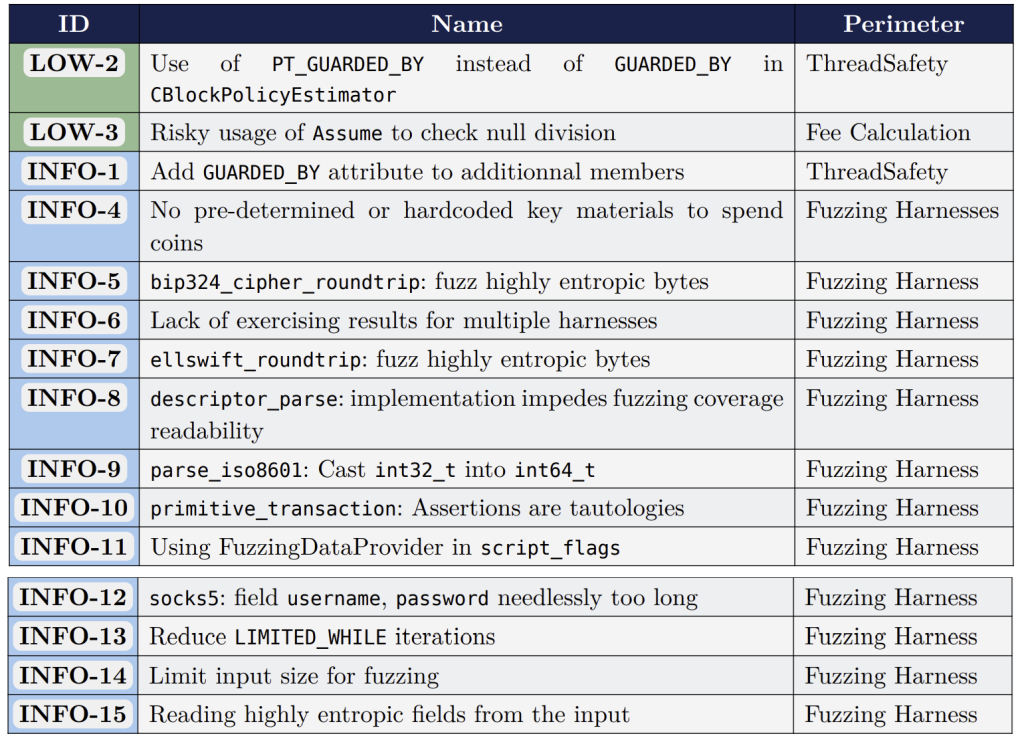
Bitcoin Core audit results

Schmidt was careful not to present the report as a declaration that the software is bug-free. He wrote that “that isn’t to say there aren’t still bugs lurking in the software. More improvements still need to be made. But this audit is a nice step along the way to help ensure Bitcoin doesn’t break and continues to serve the world as a secure, reliable monetary network.”

Brink also highlighted the collaborative structure of the effort. The organization noted that “the assessment was conducted by Quarkslab (@quarkslab) and was coordinated with the help of the Open Source Technology Improvement Fund (OSTIF @OSTIFofficial). Funding was provided by Brink with the support of our donors, with technical collaboration from Niklas Gögge and Antoine Poinsot.” It publicly thanked “Quarkslab, the OSTIF, Niklas, and Antoine for their work on this project,” and made the full report freely available.

In its summary of the initiative, Brink tied the audit back to Bitcoin’s broader reliability guarantees. “Funding independent reviews like this is just one way we help ensure Bitcoin doesn’t break and continues to serve the world as a secure, reliable monetary network,” the organization said, repeating that “independent review only strengthens that confidence.”

At press time, BTC traded at $91,764.
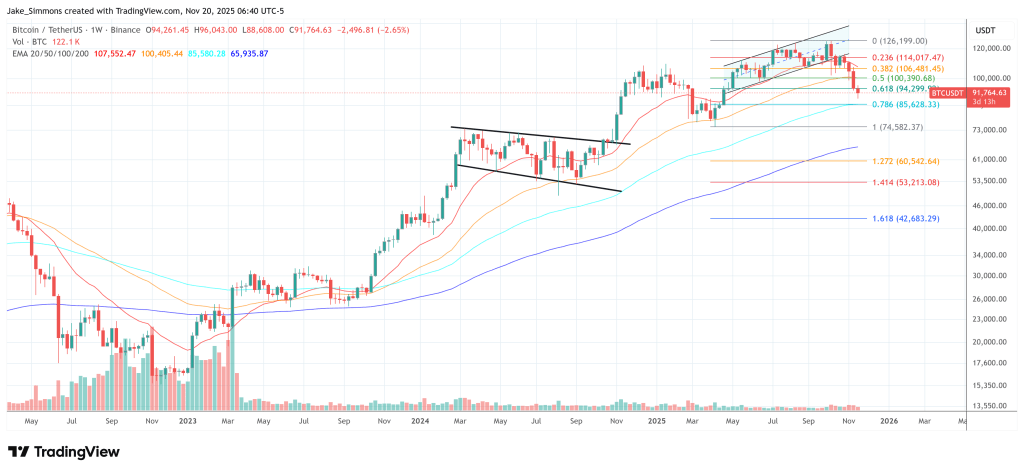
Bitcoin price
Market Opportunity
Core DAO Logo
Core DAO Price(CORE)
$0.1264
$0.1264$0.1264
+3.94%
USD
Core DAO (CORE) Live Price Chart
Disclaimer: The articles reposted on this site are sourced from public platforms and are provided for informational purposes only. They do not necessarily reflect the views of MEXC. All rights remain with the original authors. If you believe any content infringes on third-party rights, please contact service@support.mexc.com for removal. MEXC makes no guarantees regarding the accuracy, completeness, or timeliness of the content and is not responsible for any actions taken based on the information provided. The content does not constitute financial, legal, or other professional advice, nor should it be considered a recommendation or endorsement by MEXC.

You May Also Like

Strive Finalizes Semler Deal, Expands Its Corporate Bitcoin Treasury

Strive Finalizes Semler Deal, Expands Its Corporate Bitcoin Treasury

Strive had finalized its acquisition of Semler scientific after securing the approval of shareholders earlier in the week. The final deal brought both firms’ Bitcoin
Share
Tronweekly2026/01/17 12:30
Why 2026 Is The Year That Caribbean Mixology Will Finally Get Its Time In The Sun

Why 2026 Is The Year That Caribbean Mixology Will Finally Get Its Time In The Sun

The post Why 2026 Is The Year That Caribbean Mixology Will Finally Get Its Time In The Sun appeared on BitcoinEthereumNews.com. San Juan, Puerto Rico’s La Factoría
Share
BitcoinEthereumNews2026/01/17 12:24
EUR/CHF slides as Euro struggles post-inflation data

EUR/CHF slides as Euro struggles post-inflation data

The post EUR/CHF slides as Euro struggles post-inflation data appeared on BitcoinEthereumNews.com. EUR/CHF weakens for a second straight session as the euro struggles to recover post-Eurozone inflation data. Eurozone core inflation steady at 2.3%, headline CPI eases to 2.0% in August. SNB maintains a flexible policy outlook ahead of its September 25 decision, with no immediate need for easing. The Euro (EUR) trades under pressure against the Swiss Franc (CHF) on Wednesday, with EUR/CHF extending losses for the second straight session as the common currency struggles to gain traction following Eurozone inflation data. At the time of writing, the cross is trading around 0.9320 during the American session. The latest inflation data from Eurostat showed that Eurozone price growth remained broadly stable in August, reinforcing the European Central Bank’s (ECB) cautious stance on monetary policy. The Core Harmonized Index of Consumer Prices (HICP), which excludes volatile items such as food and energy, rose 2.3% YoY, in line with both forecasts and the previous month’s reading. On a monthly basis, core inflation increased by 0.3%, unchanged from July, highlighting persistent underlying price pressures in the bloc. Meanwhile, headline inflation eased to 2.0% YoY in August, down from 2.1% in July and slightly below expectations. On a monthly basis, prices rose just 0.1%, missing forecasts for a 0.2% increase and decelerating from July’s 0.2% rise. The inflation release follows last week’s ECB policy decision, where the central bank kept all three key interest rates unchanged and signaled that policy is likely at its terminal level. While officials acknowledged progress in bringing inflation down, they reiterated a cautious, data-dependent approach going forward, emphasizing the need to maintain restrictive conditions for an extended period to ensure price stability. On the Swiss side, disinflation appears to be deepening. The Producer and Import Price Index dropped 0.6% in August, marking a sharp 1.8% annual decline. Broader inflation remains…
Share
BitcoinEthereumNews2025/09/18 03:08



