Glassnode says XRP is slipping back into a cost-basis configuration last seen in February 2022, with newer buyers accumulating at levels that leave a prior cohortGlassnode says XRP is slipping back into a cost-basis configuration last seen in February 2022, with newer buyers accumulating at levels that leave a prior cohort

XRP Market Structure Resembles That Of February 2022, Glassnode Warns

2026/01/20 17:00

Glassnode says XRP is slipping back into a cost-basis configuration last seen in February 2022, with newer buyers accumulating at levels that leave a prior cohort “top” increasingly underwater, an on-chain setup that can shape sell pressure around key price zones.

In a note shared Monday via X, the analytics firm pointed to a rotation in realized prices by age band. “The current market structure for XRP closely resembles February 2022,” Glassnode wrote. It added that “psychological pressure on top buyers builds over time,” framing the current tape as one where patience is being tested rather than rewarded.

What This Means For XRP Price

The firm’s core observation is that wallets active in the short-term window, roughly the 1-week to 1-month cohort, are accumulating below the cost basis of holders in the 6-month to 12-month band. In practice, that means newer demand is stepping in at prices that are cheaper than what a meaningful slice of mid-term holders paid.

That relationship matters because cohorts tend to behave differently when price revisits their cost basis. When spot trades below a cohort’s realized price, that cohort is, on average, underwater. If the market rallies back toward that level, some of that supply can become eager to de-risk into breakeven, creating overhead liquidity that can cap upside until it is absorbed.

Glassnode’s “Realized Price by Age” chart (7-day moving average) visualizes this dynamic by plotting cohort realized prices against spot. The standout feature is the gap between shorter-term and 6–12 month cost bases during the most recent consolidation, echoing the firm’s February 2022 comparison.
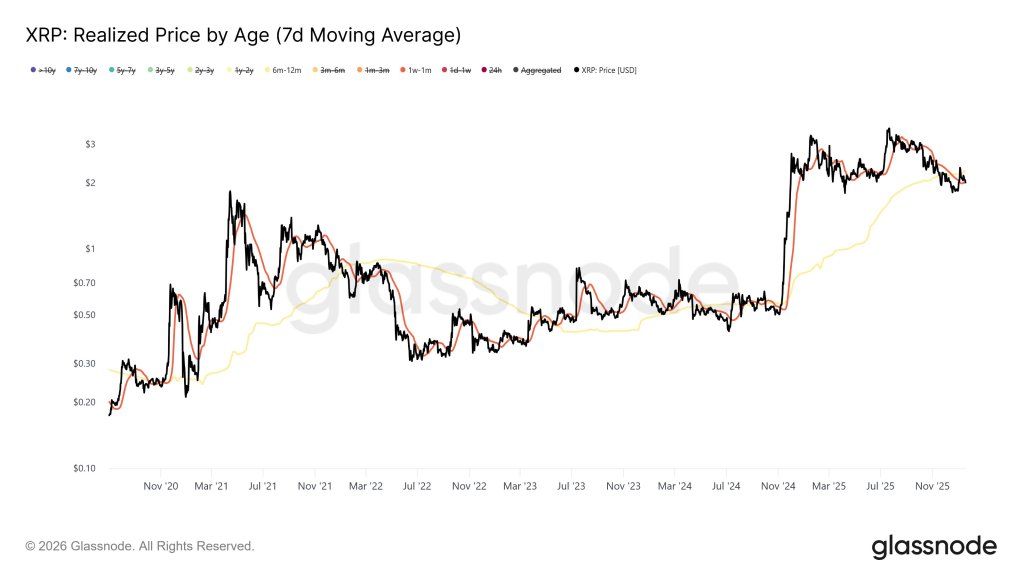
XRP Realized Price by Age (7-day MA)

With XRP price again trading slightly below the $2 mark, a post by Glassnode from Nov. 24 2025 also comes back into focus. Glassnode quoted this old X post in which it singled out $2 as the level where this cohort stress has been most visible in flows. “The $2.0 level remains a major psychological zone for Ripple holders,” the firm said. “Since early 2025, each retest of $2 saw $0.5B–$1.2B per week in losses,” a reminder that many holders have been exiting at a loss as price revisits that handle.

Those realized loss estimates are a key qualifier: they suggest that $2 is not just a chart level, but a behavior level, where spending decisions change and where capitulation (or forced de-risking) can cluster.

Notably, in February 2022, XRP put in a sharp round-trip: after slipping to about $0.6034 on Feb. 2, it ripped higher to the month’s peak near $0.8758 on Feb. 8, then rolled over into the back half of the month as macro risk accelerated. Then, XRP was back around $0.70 by Feb. 23–24 (roughly 20% off the Feb. 8 high), before bouncing into month-end near $0.7856 on Feb. 28.

The late-month downdraft coincided with the Russia–Ukraine escalation and the Feb. 24 invasion, which hit risk assets broadly and pushed major crypto lower intraday, consistent with the risk-off impulse seen across the entire crypto market.

At press time, XRP traded at $1.9294.
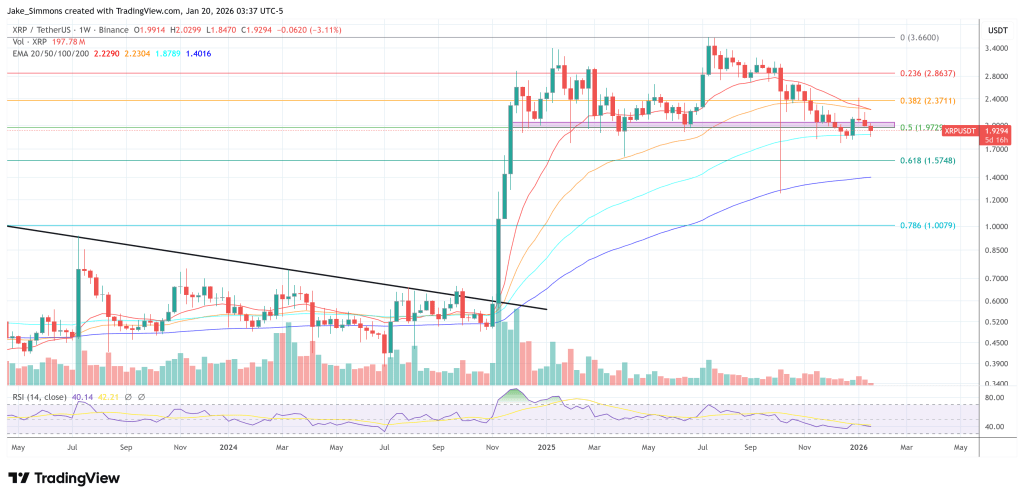
XRP price chart
Market Opportunity
XRP Logo
XRP Price(XRP)
$1.9219
$1.9219$1.9219
-3.00%
USD
XRP (XRP) Live Price Chart
Disclaimer: The articles reposted on this site are sourced from public platforms and are provided for informational purposes only. They do not necessarily reflect the views of MEXC. All rights remain with the original authors. If you believe any content infringes on third-party rights, please contact service@support.mexc.com for removal. MEXC makes no guarantees regarding the accuracy, completeness, or timeliness of the content and is not responsible for any actions taken based on the information provided. The content does not constitute financial, legal, or other professional advice, nor should it be considered a recommendation or endorsement by MEXC.

You May Also Like

Pump Fun Fund Launches $3M Hackathon: Market-Driven Startups

Pump Fun Fund Launches $3M Hackathon: Market-Driven Startups

The post Pump Fun Fund Launches $3M Hackathon: Market-Driven Startups appeared on BitcoinEthereumNews.com. In a bid to evolve beyond its roots as a memecoin launchpad
Share
BitcoinEthereumNews2026/01/20 20:06
WhatsApp Web to get group voice and video calls soon

WhatsApp Web to get group voice and video calls soon

The post WhatsApp Web to get group voice and video calls soon appeared on BitcoinEthereumNews.com. WhatsApp is developing voice and video calling features for group
Share
BitcoinEthereumNews2026/01/20 20:13
Aave DAO to Shut Down 50% of L2s While Doubling Down on GHO

Aave DAO to Shut Down 50% of L2s While Doubling Down on GHO

The post Aave DAO to Shut Down 50% of L2s While Doubling Down on GHO appeared on BitcoinEthereumNews.com. Aave DAO is gearing up for a significant overhaul by shutting down over 50% of underperforming L2 instances. It is also restructuring its governance framework and deploying over $100 million to boost GHO. This could be a pivotal moment that propels Aave back to the forefront of on-chain lending or sparks unprecedented controversy within the DeFi community. Sponsored Sponsored ACI Proposes Shutting Down 50% of L2s The “State of the Union” report by the Aave Chan Initiative (ACI) paints a candid picture. After a turbulent period in the DeFi market and internal challenges, Aave (AAVE) now leads in key metrics: TVL, revenue, market share, and borrowing volume. Aave’s annual revenue of $130 million surpasses the combined cash reserves of its competitors. Tokenomics improvements and the AAVE token buyback program have also contributed to the ecosystem’s growth. Aave global metrics. Source: Aave However, the ACI’s report also highlights several pain points. First, regarding the Layer-2 (L2) strategy. While Aave’s L2 strategy was once a key driver of success, it is no longer fit for purpose. Over half of Aave’s instances on L2s and alt-L1s are not economically viable. Based on year-to-date data, over 86.6% of Aave’s revenue comes from the mainnet, indicating that everything else is a side quest. On this basis, ACI proposes closing underperforming networks. The DAO should invest in key networks with significant differentiators. Second, ACI is pushing for a complete overhaul of the “friendly fork” framework, as most have been unimpressive regarding TVL and revenue. In some cases, attackers have exploited them to Aave’s detriment, as seen with Spark. Sponsored Sponsored “The friendly fork model had a good intention but bad execution where the DAO was too friendly towards these forks, allowing the DAO only little upside,” the report states. Third, the instance model, once a smart…
Share
BitcoinEthereumNews2025/09/18 02:28