NVIDIA Corporation ($NVDA) Stock: Robotics Push with Jetson AGX Thor
TLDR
- Nvidia stock traded at $181.48 (+1.96%) on August 25, 2025, ahead of Q2 earnings.
- Company launched Jetson AGX Thor, a $3,499 developer kit called a “robot brain.”
- Thor chips are 7.5x faster than the prior generation, with 128GB memory.
- Robotics revenue remains just 1% of total sales but grew 72% year over year.
- Partners include Amazon, Meta, Agility Robotics, and Boston Dynamics.
As of midday on August 25, 2025, shares of Nvidia Corporation (NASDAQ: NVDA) were trading at $181.48, up 1.96%, with investors closely watching the upcoming Q2 earnings call scheduled for August 27 at 5 PM EDT.
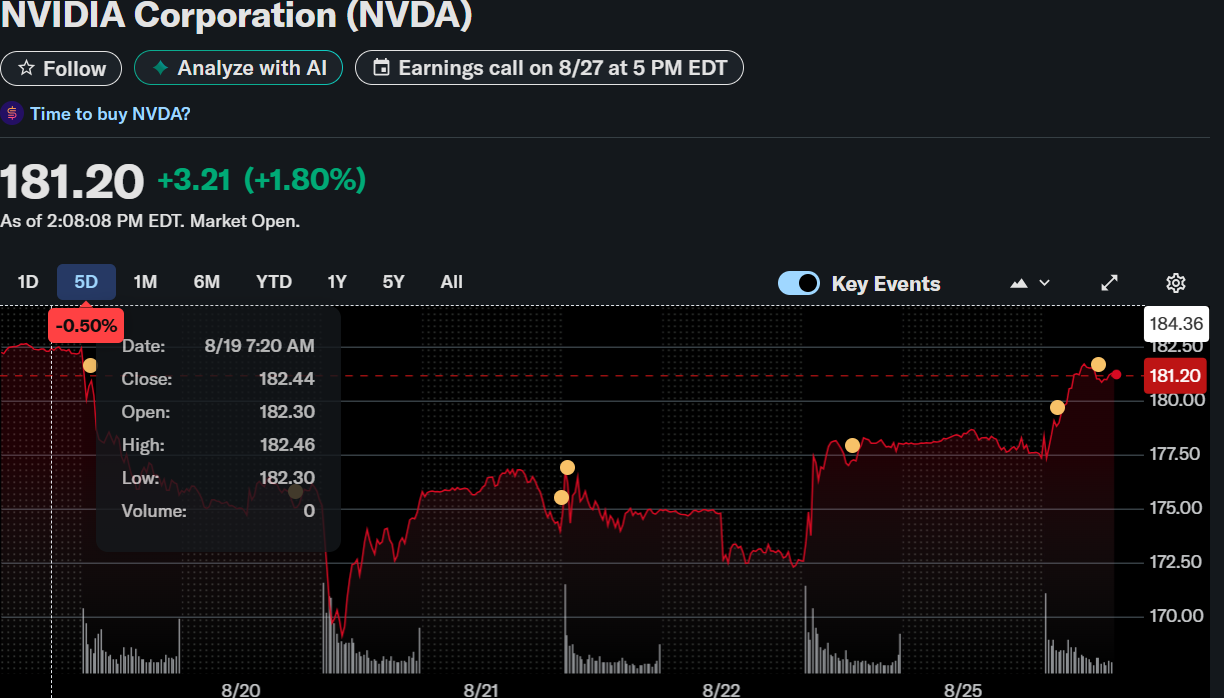
NVIDIA Corporation (NVDA)
The market spotlight, however, turned to Nvidia’s announcement of its latest robotics chip module, the Jetson AGX Thor, which is now available as a developer kit for $3,499. Nvidia describes the chip as a “robot brain,” with first shipments expected next month.
The Jetson AGX Thor
The Jetson AGX Thor represents Nvidia’s biggest bet on robotics to date. Once companies use the developer kit to prototype their robots, Nvidia will sell Thor T5000 modules for production-ready deployment at $2,999 per unit for orders exceeding 1,000 chips. Based on the Blackwell graphics processor architecture, which also powers Nvidia’s flagship AI chips and gaming GPUs, the Jetson Thor is designed to run large generative AI models and visual recognition tasks critical for humanoid robots and autonomous systems.
Nvidia noted the chip is 7.5 times faster than its predecessor and is equipped with 128GB of memory to handle advanced AI workloads.
Strategic Expansion into Robotics
CEO Jensen Huang has emphasized robotics as Nvidia’s most important growth avenue outside of artificial intelligence, which has already driven a tripling of company sales over the past two years. While robotics still contributes only about 1% of total revenue, momentum is accelerating. Nvidia’s automotive and robotics unit, recently consolidated, reported $567 million in sales in May, reflecting 72% growth on a yearly basis. Nvidia Vice President of Robotics and Edge AI Deepu Talla explained that the company’s role is to empower industries through computing platforms and software rather than building robots directly.
Adoption and Partnerships
Major firms including Amazon, Meta, Agility Robotics, and Boston Dynamics are already working with Nvidia’s Jetson chips, underscoring broad industry adoption. The Jetson AGX Thor is positioned not only for humanoid robots but also for autonomous vehicles. Nvidia confirmed that Chinese automakers are expected to integrate Thor chips into self-driving platforms. While its automotive offerings run on Drive OS under the Drive AGX brand, the underlying architecture is closely aligned with the robotics-focused Thor modules.
Performance Overview
Nvidia’s stock performance continues to eclipse benchmarks. Year-to-date returns stand at 35.27%, compared to 9.89% for the S&P 500. Over one year, shares have gained 40.43%, while the index rose 14.71%. The company’s long-term track record is even more striking, with a three-year return of 915.36% and a five-year return of 1,329.17%, far outpacing the S&P 500’s 53.93% and 87.70%, respectively. With AI and robotics at the core of its strategy, Nvidia’s expansion into new markets like robotics could further solidify its growth trajectory.
The post NVIDIA Corporation ($NVDA) Stock: Robotics Push with Jetson AGX Thor appeared first on CoinCentral.


You May Also Like

XRP Breakout Loading? Key $1.50 Level Could Ignite Powerful Rally

Trump’s Truth Social Withdraws Bitcoin ETF Filing With the SEC