While crypto markets were quite volatile in August and bitcoin lost 6.49% during the month, the stablecoin economy grew by more than $17 billion. Stablecoins Soar by $17B in August Despite Crypto Market Chaos As of Sept. 2, 2025, defillama.com data shows the fiat-pegged, U.S. dollar-driven crypto economy holds a value of $284.558 billion. On […]While crypto markets were quite volatile in August and bitcoin lost 6.49% during the month, the stablecoin economy grew by more than $17 billion. Stablecoins Soar by $17B in August Despite Crypto Market Chaos As of Sept. 2, 2025, defillama.com data shows the fiat-pegged, U.S. dollar-driven crypto economy holds a value of $284.558 billion. On […]

August Sees 92% Jump in Stablecoin Transaction Volume, Reaching $3 Trillion

For feedback or concerns regarding this content, please contact us at crypto.news@mexc.com

While crypto markets were quite volatile in August and bitcoin lost 6.49% during the month, the stablecoin economy grew by more than $17 billion.

Stablecoins Soar by $17B in August Despite Crypto Market Chaos

As of Sept. 2, 2025, defillama.com data shows the fiat-pegged, U.S. dollar-driven crypto economy holds a value of $284.558 billion. On Aug. 1, it measured $267.091 billion, reflecting growth of $17.467 billion since then. About $3.2 billion of that increase came from tether ( USDT), which carries a market cap near $167.97 billion, representing 59.03% of the stablecoin market’s total worth.
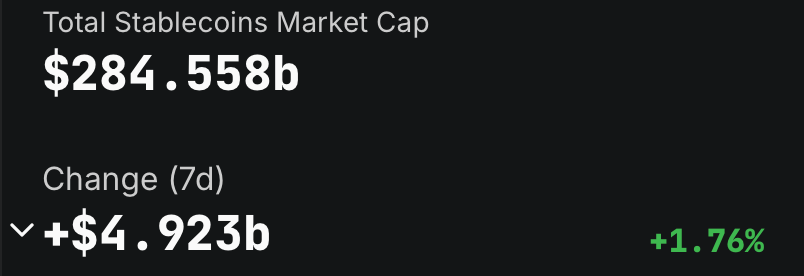
August Sees 92% Jump in Stablecoin Transaction Volume, Reaching $3 Trillion Stablecoin economy stats according to defillama.com on Sept. 2, 2025.

Around $7.98 billion of the increase came from Circle’s USDC, which now commands a market cap of roughly $71.85 billion. Ethena’s USDe gained notable momentum over the past month, with its supply climbing more than 41% to $12.403 billion. USDe recorded inflows of roughly $3.65 billion, according to defillama.com’s stablecoin metrics.

Interestingly, Sky’s DAI grew by $880 million in August, marking a rise of just over 20%. Sky’s USDS declined by roughly $300 million, leaving its market cap at $4.511 billion. Meanwhile, World Liberty Financial’s USD1 climbed by $349 million in August, a gain of 16%. Blackrock’s BUIDL dipped 0.6% in August, with $14 million in outflows pulling its market cap down to $2.384 billion.

Rounding out the top ten, Ethena’s USDtb rose by $72 million, Falcon Finance’s USDf added $146 million, and Paypal’s PYUSD climbed $162 million since the start of August. USDtb now holds a market cap of about $1.509 billion, USDf is valued at roughly $1.234 billion, and PYUSD sits at $1.175 billion.

Paypal’s stablecoin crossed the $1 billion mark in mid-August, and its overall market cap now stands at an all-time high. Over the last 30 days, Artemis Terminal stablecoin data shows adjusted transaction volume jumped over 92% to hit $3 trillion.
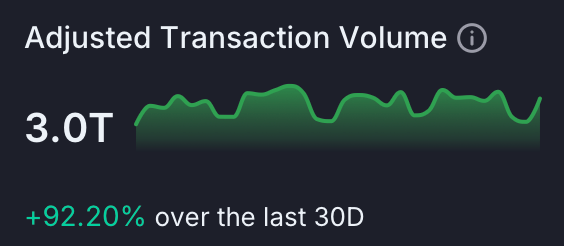
August Sees 92% Jump in Stablecoin Transaction Volume, Reaching $3 Trillion Stablecoin stats according to Artemis Terminal on Sept. 2, 2025.

The number of transactions also climbed 16.9% to 1.2 billion, showing that activity is heating up across multiple chains. Meanwhile, unique stablecoin addresses grew by almost a quarter, reaching 41.7 million. Longer-term data shows how Ethereum and Tron have cemented themselves as the backbone of stablecoin liquidity.

Since late 2023, supply has surged to all-time highs, with Ethereum leading by a wide margin and Tron holding steady as the second-largest base for stablecoins. Emerging players like Arbitrum, Base, Aptos, and TON are gradually carving out slices of the pie, but the market remains overwhelmingly concentrated on Ethereum and Tron, which together anchor a great deal of the $280 billion-plus ecosystem.


Disclaimer: The articles reposted on this site are sourced from public platforms and are provided for informational purposes only. They do not necessarily reflect the views of MEXC. All rights remain with the original authors. If you believe any content infringes on third-party rights, please contact crypto.news@mexc.com for removal. MEXC makes no guarantees regarding the accuracy, completeness, or timeliness of the content and is not responsible for any actions taken based on the information provided. The content does not constitute financial, legal, or other professional advice, nor should it be considered a recommendation or endorsement by MEXC.

You May Also Like

Neom terminates $1bn tunnel contract at heart of The Line

Neom terminates $1bn tunnel contract at heart of The Line

Saudi Arabia’s Neom has cancelled a roughly $1 billion tunnelling contract at the heart of its flagship “The Line” giga-project, according to public documents.
Share
Agbi2026/03/18 11:28
Gold continues to hit new highs. How to invest in gold in the crypto market?

Gold continues to hit new highs. How to invest in gold in the crypto market?

As Bitcoin encounters a "value winter", real-world gold is recasting the iron curtain of value on the blockchain.
Share
PANews2025/04/14 17:12
These Are The XRP Price Targets You Need To Know Now: Cubic Analytics Founder

These Are The XRP Price Targets You Need To Know Now: Cubic Analytics Founder

Cubic Analytics founder Caleb Franzen says XRP is entering a decisive phase after months of compression, with the price structure implying a path toward the $6–$11 zone so long as the market defends what he calls the key risk line at $2.68. XRP Price Targets In a wide-ranging discussion on the Thinking Crypto podcast with host Tony Edward, Franzen stressed that his conclusions are grounded in “price, structure, and statistical signals” rather than narrative. “It’s the chart itself. It’s the structure itself,” he said. “So long as we stay above $2.68, we’re going much higher.” Franzen’s XRP view comes out of the same template he applies across digital assets: identify trend integrity, map the impulse-consolidation rhythm, and translate it into a ladder of Fibonacci extension targets on a logarithmic scale. In XRP’s case, he argues the market traced higher highs and then “tightened up” into a controlled series of lower highs—what he calls a classic volatility coil that “allows price to reset… for the next leg higher.” Related Reading: Social Media Turns Bearish On XRP: Is This A Buy Signal? He then anchors objective targets to that structure: using the most recent consolidation leg, he cites the 161.8% extension near roughly $4.40 and the 261.8% extension around $6. From the larger Q1 swing—Q1 highs to Q1 lows—he adds a second band of objectives at approximately $5.40 and $11.55. The message, in his words: “Those are the price targets that you have to be aware of if you’re holding and investing in XRP… so long as we stay above $2.68.” Risk management is central to how Franzen frames the trade. Rather than a maximalist forecast, he sets a clear invalidation level and treats it as a mechanical decision point. “If we fall below $2.68, you can get stopped out. You can reduce some of your exposure. You can slow down your DCA,” he said. “It’s okay to be wrong. It’s just not okay to stay wrong.” The Macro Angle Although the podcast also covered Bitcoin, Ethereum and Solana, Franzen’s macro and cross-asset framework is meant to contextualize, not overshadow, the XRP setup. He repeatedly described himself as “time agnostic,” declining to pin outcomes to a specific month or quarter and insisting that the tape, not the calendar, dictates probability. “I’ve been sharing [cycle] targets since the middle of 2023,” he noted, adding that the prudent path is to keep raising targets within an uptrend while letting invalidation handle the rest. That stance is informed by what he characterizes as resilient, supportive macro conditions—good enough for risk assets to trend without demanding a weak US dollar as a crutch. He pointed to strong real activity data and improving earnings assumptions as evidence that risk appetite is not being forced; it’s developing naturally. Related Reading: XRP Ready For $9 Blast — ‘Break $3.10 And It’s Game Over,’ Says Analyst Among the specific markers he flagged: Q2 real GDP growth at 3.8% with expectations of roughly 3.9% for Q3; prime-age unemployment near historic lows at about 3.8%; labor force participation rising; and both real and nominal wage growth, with wages around 4.1% year over year. In credit, he underscored tight spreads and high-yield corporates printing multi-year highs—“and if we adjust them for the dividend yield, they’re trading at all-time highs”—a combination that, in his experience, does not occur when markets are bracing for imminent stress. “As we’re looking at the weight of the evidence here, everything is coming together,” he said. “Higher highs and higher lows, increasing risk appetite, decent macro conditions, the Fed is cutting interest rates… We have to continue to have an upward bias.” That macro lens matters for XRP, he argues, because it reinforces the primacy of structure over story. He criticized a common assumption that crypto rallies must coincide with a falling dollar, highlighting that the US Dollar Index (DXY) has been roughly flat since mid-April while Bitcoin—and, by extension, broader crypto beta—advanced materially. He also described a composite lens that prices Bitcoin against a basket of global currencies (effectively offsetting BTC/USD by DXY) and said that index is making fresh all-time highs too, reflecting “weak global fiat currencies, not necessarily just a weak dollar.” The implication for XRP: if the broader liquidity and risk backdrop continues to reward trend persistence, then the technical coil and extension ladder have a cleaner runway. At press time, XRP traded at $2.8593. Featured image created with DALL.E, chart from TradingView.com
Share
NewsBTC2025/10/08 21:30