Polkadot price forms a bullish flag ahead of tokenomics overhaul on March 12

Polkadot price will be in the spotlight this month as the layer-1 network makes one of its biggest changes since its inception.
- Polkadot price has formed a bullish flag pattern pointing to an eventual rebound this month
- The network will implement new changes to its tokenomics next week.
- It will also introduce a new approach to its staking approach.
Polkadot (DOT) token was trading at $1.5223 on Wednesday, up by 37% from its lowest point in February. Its market capitalization has jumped to $2.5 billion.
DOT price will be in focus next week as the developers implement the new tokenomics framework that will cap the number of tokens to 2.1 billion.
It will also reduce its emissions immediately by 53.6% and eliminate treasury burns, replacing it with a new Dynamic Allocation Pool. Instead of burning tokens, the network fee generated from transactions, slashes, and coretime sales will go to a new permanent on-chain pool available for governance allocation.
The governance will be free to allocate the DOT tokens to validator rewards, staking incentives, treasury budgets, and strategic reserves.
The other big change will be on staking, where validators will have to lock at least 10,000 DOT tokens as self-stake. On top of this, the minimum validator commission will move to 10%, while unbonding will be slashed from 28 days to between 24 and 48 hours.
Polkadot’s tokenomics changes come after the network completed the move to Polkadot 2.0, which involved three core parts: asynchronous backing, agile coretime, and elastic scaling.
Asynchronous backing reduced its block time from 12 seconds to 6 seconds, while agile coretime replaced parachain auctions with a more flexible model. Elastic scaling enabled vertical scalability by allowing parachains to access multiple cores in real time.
Still, a major challenge for Polkadot is that its ecosystem growth has been relatively limited, with developers opting for other popular chains like Solana and Ethereum.
Polkadot price prediction: Technical analysis
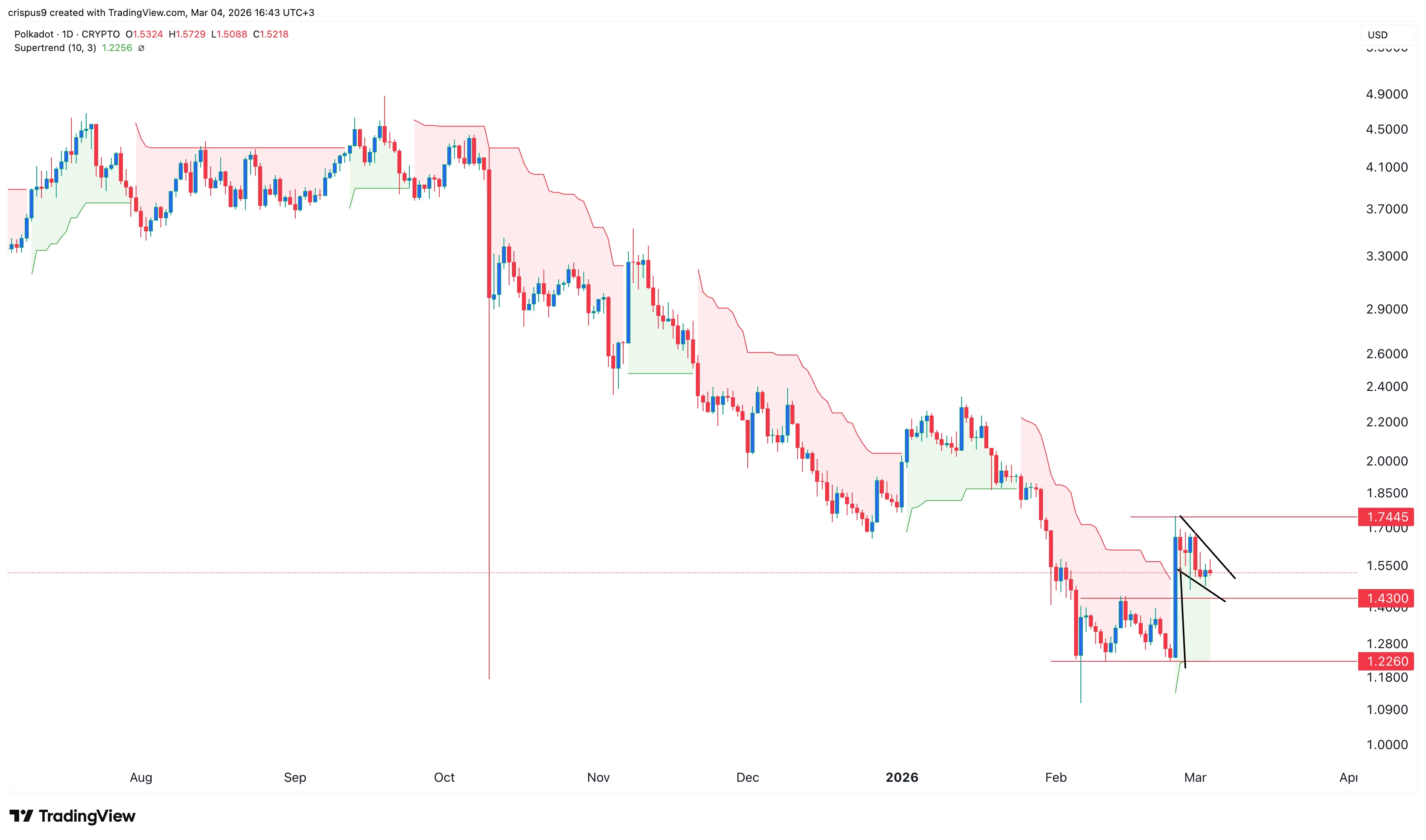
The daily timeframe chart shows that the DOT token price has rebounded in the past few days, moving from a low of $1.2260 to the current $1.550. This rebound happened after forming a double-bottom pattern at $1.2260 and a neckline at $1.4300.
Polkadot price then pulled back, forming a bullish flag pattern, which often leads to a bullish breakout. It has also flipped the Supertrend indicator from red to green.
Therefore, the most likely DOT price forecast is bullish, with the next initial target being last month’s high of $1.7445. A move above that level will point to more upside, potentially to $2.
However, there is also a risk that it will retreat after the tokenomics changes as investors sell the news.
You May Also Like

Why AVAX Traders Are Watching $11.50 and $8.00 Right Now

USDsui debuts as Treasury yield is routed to Sui DeFi