

Online Payment Statistics 2026: Explosive Growth

The world of online payments has evolved dramatically over the last decade, transforming how we exchange money, purchase goods, and manage financial transactions. Imagine walking into a store, paying with just a tap on your smartphone, or splitting a dinner bill with friends using an app in seconds. Online payment technologies have not only made these scenarios possible but also mainstream. Today, this trend is only accelerating, with more users embracing the convenience, speed, and security of digital payments.
Editor’s Choice
- Mobile payments already hold a 30% global point-of-sale share and are forecast to reach 45% by 2027, making them the leading everyday payment method.
- In 2025, 16% of consumers relied on mobile payments for everyday purchases, and this share is set to rise further through 2026 as cash usage declines.
- By 2026, digital wallet users are expected to reach 5.2 billion, or over 60% of the global population, with adoption exceeding 75% in several Asia-Pacific countries.
- In 2026, about 39% of U.S. merchants accept cryptocurrency payments at checkout, with 88% citing customer demand and 84% expecting crypto to become common within five years.
- In 2026, 98% of fraud and compliance leaders report integrating AI into daily workflows, with 95% confident that AI can detect and prevent payment fraud.
Recent Developments
- 39% of US merchants now accept cryptocurrency for online transactions.
- BNPL providers further expanded into B2B cross-border transactions.
- Voice-activated payments market valued at $9.87 billion.
- TikTok Shop US ecommerce sales are projected to reach $23.41 billion.
- Digital wallets reach 5 billion users worldwide.
- A2A consumer transactions hit $1.4 trillion.
- Subscription e-commerce digital wallets hold 48.52% market share.
- 1.4 billion new P2P A2A users globally.
- Green fintech advances with automated carbon tracking in payments.
Key Trends Shaping the Future of the Payments Industry
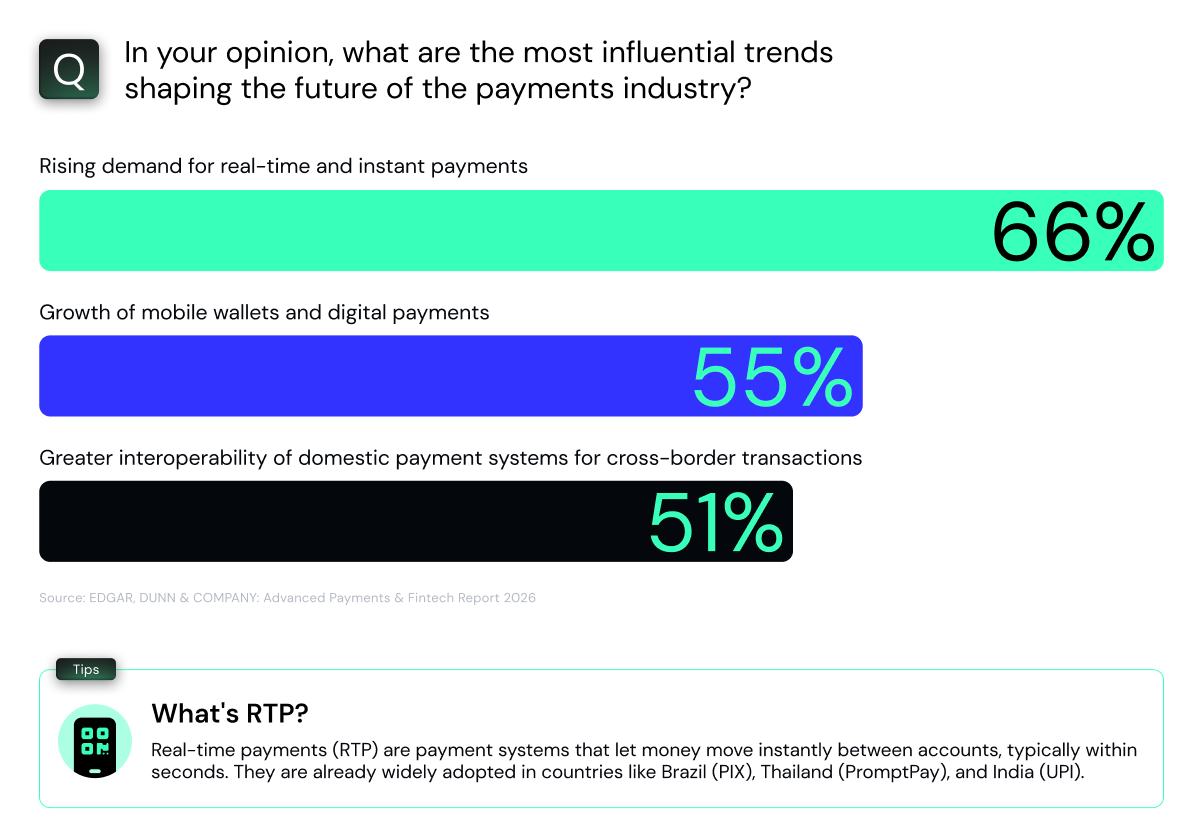
- 66% of industry experts say the growing demand for real-time and instant payments will shape the future of the payments industry.
- 55% of respondents highlight the rapid growth of mobile wallets and digital payments as a major trend in global payments.
- 51% of experts believe better interoperability between domestic payment systems will improve cross-border transactions in the coming years.
- The rising demand for real-time payments (RTP) shows that users expect instant money transfers within seconds instead of waiting hours or days.
- Countries such as Brazil (PIX), Thailand (PromptPay), and India (UPI) already use real-time payment systems widely, showing how fast this trend is expanding worldwide.
 (Reference: Omise)
Most Popular Payment Methods in the U.S.
- Credit cards account for 35% of all payments.
- Debit cards represent 30% of consumer payments.
- Cash comprises 14% of payment methods by number.
- ACH transfers average 6 payments per month.
- Mobile payments make up 23% of all monthly payments.
- Digital wallets are used in 39% of online transactions.
- Checks average 1 payment per month.
- Credit card transaction value exceeds $4 trillion.
Major Concerns and Challenges in Payment Systems
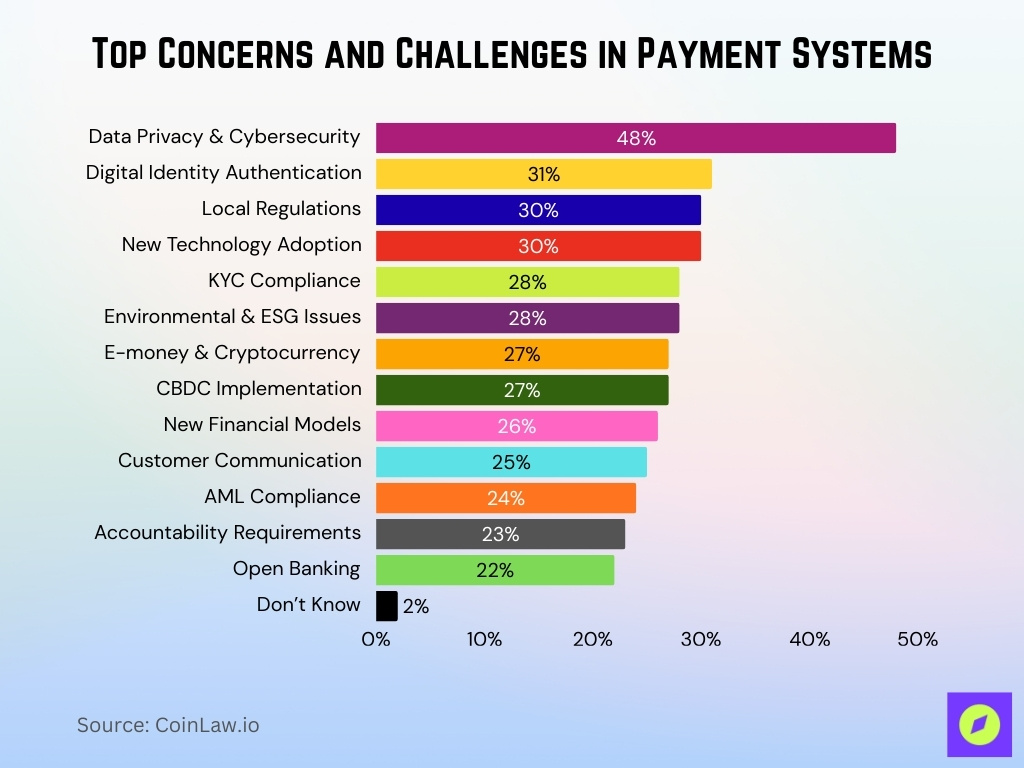
- 48% of respondents identify data privacy and cybersecurity as the biggest challenge in modern payment systems.
- 31% of experts highlight digital identity authentication as a key concern for secure transactions.
- 30% of respondents say local regulatory pressures create major challenges for payment providers.
- Another 30% point to the use of new technology as a challenge while adopting modern payment systems.
- 28% of experts consider KYC (Know Your Customer) compliance a major operational hurdle.
- 28% of respondents say environment and climate concerns (ESG) influence payment system development.
- 27% of experts believe e-money and cryptocurrency adoption introduce regulatory and operational challenges.
- Another 27% identify Central Bank Digital Currencies (CBDCs) as an emerging challenge for the payments ecosystem.
- 26% of respondents highlight new business models such as crowdfunding and peer-to-peer lending as a concern for traditional payment systems.
- 25% of experts say customer communication and transparency remain key operational challenges.
- 24% of respondents point to anti-money laundering (AML) requirements as a significant regulatory burden.
- 23% of experts highlight enhanced accountability and compliance standards as ongoing industry challenges.
- 22% of respondents believe open banking frameworks create implementation and security concerns.
- Only 2% of respondents say they do not know the major challenges facing payment systems.
 (Reference: PwC)
Digital Wallet Usage and Market Penetration
- Apple Pay leads the US with 49% mobile wallet market share.
- PayPal holds 28% US digital wallet market share.
- Google Pay has 15% US digital wallet market share.
- WeChat Pay and Alipay command 92% combined in China.
- PhonePe processes 48% of India’s UPI transactions.
- Digital payments in India reach a $10 trillion value.
- 84% of Chinese use mobile wallets.
- Digital wallets exceed 5.2 billion global users.
- Biometrics drive multi-factor authentication standard.
Key Factors Influencing Online Purchase Decisions
- 86% of consumers make influencer-inspired purchases annually.
- Discounts are preferred by 60% for “X% off everything” promotions.
- 88% encouraged to try new brands with offers.
- 57% wouldn’t purchase without coupon codes.
- Price, trust, and convenience are the strongest predictors.
- 30% threshold for an attractive discount.
- Promotions, refunds, and reputation key influencers.
- 76% cite speed and convenience for digital payments.
Buy Now, Pay Later (BNPL) Trends
- Global BNPL payments reach $509.2 billion.
- E-commerce BNPL grows to $12.84 billion.
- US BNPL users on track for 100 million by 2027.
- 36.8% of BNPL users are Gen Z.
- 63% UK millennials have used BNPL.
- Global transaction value grows 20% yearly.
- 38% Gen Z Australians prefer BNPL over credit cards.
- BNPL share in Asia e-commerce 4.1%.
How Consumers Fund Their Mobile/Digital Wallets
- 65% of consumers use debit cards.
- 53% fund with credit cards.
- 36% use app balance.
- 26% direct debit from bank accounts.
- 16% use prepaid cards.
Impact of Government Policies on Online Payments
- GENIUS Act establishes a federal framework for payment stablecoins.
- PSD3 mandates stronger SCA to reduce fraud risks.
- RBI-DPI rises to 516.76 in H1 FY26.
- China WeChat Pay cross-border fees average 0.1%.
- Brazil PIX nears 7.9 billion monthly transactions.
- UK Open Banking hits 15.16 million users.
- 93% Brazilian adults use PIX.
- 84% providers enhance security via GDPR.
Frequently Asked Questions (FAQs)
Digital wallets account for 53% of global online purchase transactions, making them the leading online payment method worldwide.
Real‑time payment transactions are expected to reach almost 428 billion annually by 2026, representing over 25% of all global electronic payments.
QR‑code payments are projected to account for roughly 48.6% of all digital wallet transactions by volume, reaching around 380 billion transactions globally.
Real‑time payments are expected to generate approximately $173 billion in additional economic output across 30 countries by 2026.
Conclusion
The rapid growth of online payments today reflects a fundamental shift in how we transact, shop, and manage finances. Consumers worldwide are increasingly turning to digital wallets, mobile payments, and contactless options for convenience, speed, and security. Innovations in payment security, cross-border solutions, and government policies continue to drive the industry’s evolution, addressing consumer demands for transparency and accessibility.
As payment methods diversify and adapt to regional preferences, the online payment landscape will remain dynamic, setting new standards for convenience and security across the globe. The future of online payments promises even more integration, innovation, and accessibility, shaping a truly global, connected economy.
The post Online Payment Statistics 2026: Explosive Growth appeared first on CoinLaw.
You May Also Like

VAT reductions seen viable with exemption crackdown

U.S. SEC chief Atkins said bond with sister agency CFTC to include joint meetings, exams
Copy linkX (Twitter)LinkedInFacebookEmail
