The post Redwood Materials Raises $350 Million To Boost Electric Grid Battery Business appeared on BitcoinEthereumNews.com. A modular battery microgrid powers Redwood Materials’ Nevada campus. Redwood Materials Redwood Materials, the leading U.S. recycler of lithium-ion batteries and a growing supplier of materials for new ones, just raised $350 million to expand its ability to supply grid-scale energy storage systems as electricity demand, especially for AI data centers, surges. The round, led by venture firm Eclipse with participation from Nvidia’s investment arm, boosted the Carson City, Nevada-based startup’s total funds raised to $2.2 billion. Redwood didn’t confirm its valuation as a result of the latest round, but people familiar with the matter said it’s over $6 billion. Redwood said in a statement that the funds will “accelerate the expansion of our energy storage deployments, refining and materials production capacity,” and be used to grow its engineering and operations teams. Tesla cofounder and board member JB Straubel, who Forbes estimates has a net worth of at least $2 billion, created Redwood in 2017 to help build up a U.S. supply base for critical materials needed to make lithium-ion batteries for electric vehicles and to reduce reliance on China. That started with recovering valuable elements, including cobalt, nickel, copper and lithium, from used batteries. All of these materials, which are mined globally but refined mainly in China, are then supplied to other companies as well as used to make cathode materials for new cells. In July, it partnered with General Motors to get lithium-iron phosphate (LFP) battery cells from the automaker for large-scale energy storage systems that are in high demand by utilities and AI data center operators. For the latest in cleantech and sustainability news, sign up here for our Current Climate newsletter. “The opportunity’s pretty immense across the board,” said Joe Fath, partner and head of growth for Palo Alto, California-based Eclipse. The long experience of Straubel… The post Redwood Materials Raises $350 Million To Boost Electric Grid Battery Business appeared on BitcoinEthereumNews.com. A modular battery microgrid powers Redwood Materials’ Nevada campus. Redwood Materials Redwood Materials, the leading U.S. recycler of lithium-ion batteries and a growing supplier of materials for new ones, just raised $350 million to expand its ability to supply grid-scale energy storage systems as electricity demand, especially for AI data centers, surges. The round, led by venture firm Eclipse with participation from Nvidia’s investment arm, boosted the Carson City, Nevada-based startup’s total funds raised to $2.2 billion. Redwood didn’t confirm its valuation as a result of the latest round, but people familiar with the matter said it’s over $6 billion. Redwood said in a statement that the funds will “accelerate the expansion of our energy storage deployments, refining and materials production capacity,” and be used to grow its engineering and operations teams. Tesla cofounder and board member JB Straubel, who Forbes estimates has a net worth of at least $2 billion, created Redwood in 2017 to help build up a U.S. supply base for critical materials needed to make lithium-ion batteries for electric vehicles and to reduce reliance on China. That started with recovering valuable elements, including cobalt, nickel, copper and lithium, from used batteries. All of these materials, which are mined globally but refined mainly in China, are then supplied to other companies as well as used to make cathode materials for new cells. In July, it partnered with General Motors to get lithium-iron phosphate (LFP) battery cells from the automaker for large-scale energy storage systems that are in high demand by utilities and AI data center operators. For the latest in cleantech and sustainability news, sign up here for our Current Climate newsletter. “The opportunity’s pretty immense across the board,” said Joe Fath, partner and head of growth for Palo Alto, California-based Eclipse. The long experience of Straubel…

Redwood Materials Raises $350 Million To Boost Electric Grid Battery Business

For feedback or concerns regarding this content, please contact us at crypto.news@mexc.com

A modular battery microgrid powers Redwood Materials’ Nevada campus.

Redwood Materials

Redwood Materials, the leading U.S. recycler of lithium-ion batteries and a growing supplier of materials for new ones, just raised $350 million to expand its ability to supply grid-scale energy storage systems as electricity demand, especially for AI data centers, surges.

The round, led by venture firm Eclipse with participation from Nvidia’s investment arm, boosted the Carson City, Nevada-based startup’s total funds raised to $2.2 billion. Redwood didn’t confirm its valuation as a result of the latest round, but people familiar with the matter said it’s over $6 billion.

Redwood said in a statement that the funds will “accelerate the expansion of our energy storage deployments, refining and materials production capacity,” and be used to grow its engineering and operations teams.

Tesla cofounder and board member JB Straubel, who Forbes estimates has a net worth of at least $2 billion, created Redwood in 2017 to help build up a U.S. supply base for critical materials needed to make lithium-ion batteries for electric vehicles and to reduce reliance on China. That started with recovering valuable elements, including cobalt, nickel, copper and lithium, from used batteries. All of these materials, which are mined globally but refined mainly in China, are then supplied to other companies as well as used to make cathode materials for new cells. In July, it partnered with General Motors to get lithium-iron phosphate (LFP) battery cells from the automaker for large-scale energy storage systems that are in high demand by utilities and AI data center operators.


For the latest in cleantech and sustainability news, sign up here for our Current Climate newsletter.


“The opportunity’s pretty immense across the board,” said Joe Fath, partner and head of growth for Palo Alto, California-based Eclipse. The long experience of Straubel and the team he’s put together at Redwood, including other Tesla veterans, in the battery business, is among the reasons the firm led the latest round.

“One of the things we focus on is manufacturing at scale and we help companies with that,” he said. “They have folks on the team that did this at Tesla, at Rivian, at other big-scale places. … That team is very capable and efficient. Most of the C-suite there came out of Tesla and they cut their teeth, not just in the EV business, but they were kind of the leaders in the energy storage business.”

Trump administration policies have been detrimental to the U.S. EV market. Last month, it phased out a federal tax credit for buying new and used electric models, and in February, it clawed back funds to build public charging stations, but grudgingly restarted the program in August after legal challenges from several U.S. states. Federal programs created by the Biden administration to boost clean energy production have also been gutted. But the Administration has been supportive of efforts to expand domestic production and refining of critical materials for batteries and electric motors, even taking equity stakes in a large new lithium mine and the only U.S. rare earth minerals mine, both of which are in Nevada.

And while federal programs created by the Biden administration to boost clean energy production have also been gutted, electricity prices have spiked, rising at more than double the rate of overall inflation. That means increasing demand for large batteries to store electricity generated from solar and wind farms, as well as natural gas turbines. Power-hungry AI data centers have been a major source of higher electricity demand, something that Nvidia, the top supplier of AI data center chips, is well aware of.

Closely held Redwood is far from the only company looking to grow its energy storage business. Tesla said on Wednesday its Megapack battery storage systems were a particular bright spot in the third quarter, rising 44% in value to $3.5 billion.

LFP cells, made mainly in China, are preferred for use in large energy storage batteries not only because they’re cheaper than more energy-dense lithium-ion cells traditionally used in electric cars — they’re also less likely to overheat and catch on fire.

“Redwood is creating a new generation of U.S.-made energy storage systems—scalable, low-cost, and designed to power data centers, industry, and the grid—reducing reliance on imported LFP batteries,” the company said, without providing prices and other details.

More From Forbes

ForbesGM Supplying Batteries For Data Center, Energy Grid PacksForbesBillionaire Trump Donor Paulson Scores Windfall Thanks To Government’s Investment In Trilogy MetalsForbesA $250 Million Plan To Pull Lithium For Batteries From The Great Salt Lake

Source: https://www.forbes.com/sites/alanohnsman/2025/10/23/redwood-materials-raises-350-million-to-boost-electric-grid-battery-business/

Disclaimer: The articles reposted on this site are sourced from public platforms and are provided for informational purposes only. They do not necessarily reflect the views of MEXC. All rights remain with the original authors. If you believe any content infringes on third-party rights, please contact crypto.news@mexc.com for removal. MEXC makes no guarantees regarding the accuracy, completeness, or timeliness of the content and is not responsible for any actions taken based on the information provided. The content does not constitute financial, legal, or other professional advice, nor should it be considered a recommendation or endorsement by MEXC.

You May Also Like

Tether Backs Ark Labs’ $5.2 Million Bet on Bitcoin’s Stablecoin Revival

Tether Backs Ark Labs’ $5.2 Million Bet on Bitcoin’s Stablecoin Revival

The post Tether Backs Ark Labs’ $5.2 Million Bet on Bitcoin’s Stablecoin Revival appeared on BitcoinEthereumNews.com. In brief Ark Labs secured backing from Tether
Share
BitcoinEthereumNews2026/03/12 21:44
MySQL Single Leader Replication with Node.js and Docker

MySQL Single Leader Replication with Node.js and Docker

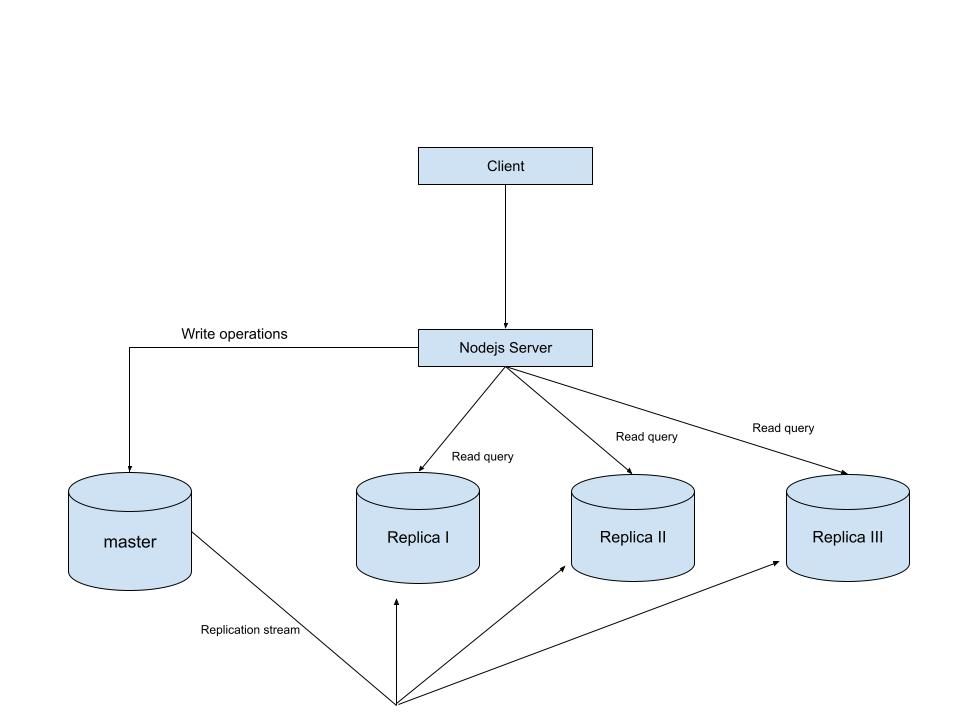
Modern applications demand high availability and the ability to scale reads without compromising performance. One of the most common strategies to achieve this is Replication. In this setup, we configured a single database to act as the leader (master) and handle all write operations, while three replicas handle read operations. In this article, we’ll walk through how to set up MySQL single-leader replication on your local machine using Docker. Once the replication is working, we’ll connect it to a Node.js application using Sequelize ORM, so that reads are routed to the replica and writes go to the master. By the end, you’ll have a working environment where you can see replication in real time Prerequisites knowledge of database replication Background knowledge of docker and docker compose Background knowledge of Nodejs and how to run a NodeJS server An Overview of what we are building Setup Setup our database servers on docker compose in the root of our project directory, create a file named docker-compose.yml with the following content to setup our mysql primary and replica databases. \ \ name: "learn-replica" volumes: mysqlMasterDatabase: mysqlSlaveDatabase: mysqlSlaveDatabaseII: mysqlSlaveDatabaseIII: networks: mysql-replication-network: services: mysql-master: image: mysql:latest container_name: mysql-master command: --server-id=1 --log-bin=ON environment: MYSQL_ROOT_PASSWORD: master MYSQL_DATABASE: replicaDb ports: - "3306:3306" volumes: - mysqlMasterDatabase:/var/lib/mysql networks: - mysql-replication-network mysql-slave: image: mysql:latest container_name: mysql-slave command: --server-id=2 --log-bin=ON environment: MYSQL_ROOT_PASSWORD: slave MYSQL_DATABASE: replicaDb MYSQL_ROOT_HOST: "%" ports: - "3307:3306" volumes: - mysqlSlaveDatabase:/var/lib/mysql depends_on: - mysql-master networks: - mysql-replication-network mysql-slaveII: image: mysql:latest container_name: mysql-slaveII command: --server-id=2 --log-bin=ON environment: MYSQL_ROOT_PASSWORD: slave MYSQL_DATABASE: replicaDb MYSQL_ROOT_HOST: "%" ports: - "3308:3306" volumes: - mysqlSlaveDatabaseII:/var/lib/mysql depends_on: - mysql-master networks: - mysql-replication-network mysql-slaveIII: image: mysql:latest container_name: mysql-slaveIII command: --server-id=3 --log-bin=ON environment: MYSQL_ROOT_PASSWORD: slave MYSQL_DATABASE: replicaDb MYSQL_ROOT_HOST: "%" ports: - "3309:3306" volumes: - mysqlSlaveDatabaseIII:/var/lib/mysql depends_on: - mysql-master networks: - mysql-replication-network In this setup, I’m creating a master database container called mysql-master and 3 replica containers called mysql-slave, mysql-slaveII and mysql-slaveIII. I won’t go too deep into the docker-compose.yml file since it’s just a basic setup, but I do want to walk you through the command line instructions used in all four services because that’s where things get interesting.
command: --server-id=1 --log-bin=ON The --server-id option gives each MySQL server in your replication setup its own name tag. Each one has to be unique and without it, replication won’t work at all. Another cool option not included here is binlog_format=ROW. This tells MySQL how to keep track of changes before passing them along to the replicas. By default, MySQL already uses row-based replication, but you can explicitly set it to ROW to be sure or switch it to STATEMENT if you’d rather log the actual SQL statements instead of row-by-row changes. \ Run our containers on docker Now, in the terminal, we can run the following command to spin up our database containers: docker-compose up -d \ Setting Up Our Master (Primary) Server To configure our master server, we would have to first access the running instance on docker using the following command docker exec -it mysql-master bash This command opens an interactive Bash shell inside the running Docker container named mysql-master, allowing us to run commands directly inside that container. \ Now that we’re inside the container, we can access the MySQL server and start running commands. type: mysql -uroot -p This will log you into MySQL as the root user. You’ll be prompted to enter the password you set in your docker-compose.yml file. \ Next, we need to create a special user that our replicas will use to connect to the master server and pull data. Inside the MySQL prompt, run the following commands: \ CREATE USER 'repl_user'@'%' IDENTIFIED BY 'replication_pass'; GRANT REPLICATION SLAVE ON . TO 'repl_user'@'%'; FLUSH PRIVILEGES; Here’s what’s happening: CREATE USER makes a new MySQL user called repl_user with the password replication_pass. GRANT REPLICATION SLAVE gives this user permission to act as a replication client. FLUSH PRIVILEGES tells MySQL to reload the user permissions so they take effect immediately. \ Time to Configure the Replica (Secondary) Servers a. First, let’s access the replica containers the same way we did with the master. Run this command in your terminal for each of the replica containers: \ docker exec -it <replica_container_name> bash mysql -uroot -p <replica_container_name> should be replace with the name of the replica container you are trying to setup b. Now it’s time to tell our replica where to get its data from. While inside the replica’s MySQL shell, run the following command to configure replication using the master’s details: CHANGE REPLICATION SOURCE TO SOURCE_HOST='mysql-master', SOURCE_USER='repl_user', SOURCE_PASSWORD='replication_pass', GET_SOURCE_PUBLIC_KEY=1; With the replication settings in place, let’s fire up the replica and get it syncing with the master. Still inside the MySQL shell on the replica, run: START REPLICA; This starts the replication process. To make sure everything is working, check the replica’s status with:
SHOW REPLICA STATUS\G; Look for Replica_IO_Running and Replica_SQL_Running — if both say Yes, congratulations! 🎉 Your replica is now successfully connected to the master and replicating data in real time.
Testing Our Replication Setup from the Node.js App Now that our replication is successfully set up, we can configure our Node.js server to observe the real-time effect of data being replicated from the master server to the replica server whenever we write to it. We start by installing the following dependencies:
npm i express mysql2 sequelize \ Now create a folder called src in the root directory and add the following files inside that folder connection.js, index.js and model.js. Our current directory should look like this We can now set up our connections to our master and replica server in the connection.js file as shown below
const Sequelize = require("sequelize"); const sequelize = new Sequelize({ dialect: "mysql", replication: { write: { host: "127.0.0.1", username: "root", password: "master", database: "replicaDb", }, read: [ { host: "127.0.0.1", username: "root", password: "slave", database: "replicaDb", port: 3307 }, { host: "127.0.0.1", username: "root", password: "slave", database: "replicaDb", port: 3308 }, { host: "127.0.0.1", username: "root", password: "slave", database: "replicaDb", port: 3309 }, ], }, }); async function connectdb() { try { await sequelize.authenticate(); } catch (error) { console.error("❌ unable to connect to the follower database", error); } } connectdb(); module.exports = { sequelize, }; \ We can now create a User table in the model.js file
const {DataTypes} = require("sequelize"); const { sequelize } = require("./connection"); const User = sequelize.define("User", { name: { type: DataTypes.STRING, allowNull: false, }, email: { type: DataTypes.STRING, unique: true, allowNull: false, }, }); module.exports = User \ and finally in our index.js file we can start our server and listen for connections on port 3000. from the code sample below, all inserts or updates will be routed by sequelize to the master server. while all read queries will be routed to the read replicas.
const express = require("express"); const { sequelize } = require("./connection"); const User = require("./model"); const app = express(); app.use(express.json()); async function main() { await sequelize.sync({ alter: true }); app.get("/", (req, res) => { res.status(200).json({ message: "first step to setting server up", }); }); app.post("/user", async (req, res) => { const { email, name } = req.body; let newUser = await User.build({ name, email, }); // This INSERT will go to the write (master) connection newUser = newUser.save({ returning: false }); res.status(201).json({ message: "User successfully created", }); }); app.get("/user", async (req, res) => { // This SELECT query will go to one of the read replicas const users = await User.findAll(); res.status(200).json(users); }); app.listen(3000, () => { console.log("server has connected"); }); } main(); When you make a POST request to the /users endpoint, take a moment to check both the master and replica servers to observe how data is replicated in real time. Right now, we are relying on Sequelize to automatically route requests, which works for development but isn’t robust enough for a production environment. In particular, if the master node goes down, Sequelize cannot automatically redirect requests to a newly elected leader. In the next part of this series, we’ll explore strategies to handle these challenges
Share
Hackernoon2025/09/18 14:44
Nvidia shares fall 3%

Nvidia shares fall 3%

The post Nvidia shares fall 3% appeared on BitcoinEthereumNews.com. Home » AI » Nvidia shares fall 3% Chipmaker extends decline as investors continue to take profits from recent highs. Photo: Budrul Chukrut/SOPA Images/LightRocket via Getty Images Key Takeaways Nvidia’s stock decreased by 3% today. The decline extends Nvidia’s recent losing streak. Nvidia shares fell 3% today, extending the chipmaker’s recent decline. The stock dropped further during trading as the artificial intelligence chip leader continued its pullback from recent highs. Disclaimer Source: https://cryptobriefing.com/nvidia-shares-fall-2-8/
Share
BitcoinEthereumNews2025/09/18 03:13