Samsung Electronics crossed the $1 trillion market capitalisation mark on Wednesday after its shares surged more than 15%…Samsung Electronics crossed the $1 trillion market capitalisation mark on Wednesday after its shares surged more than 15%…

Samsung crosses $1 trillion valuation as AI chip demands surge

2026/05/06 19:11
3 min read
For feedback or concerns regarding this content, please contact us at crypto.news@mexc.com

Samsung Electronics crossed the $1 trillion market capitalisation mark on Wednesday after its shares surged more than 15% in a single session. This is the largest single-day gain in the company’s history, as investors flocked to AI-linked stocks following record quarterly earnings.

The rally makes Samsung only the second Asian company to reach that valuation, after Taiwan Semiconductor Manufacturing Company (TSMC). The tech giant had first crossed the $1 trillion threshold in February. Still, Wednesday’s surge cemented it at that level with significant momentum behind it.

Samsung’s profits jumped significantly in the first quarter. The company’s operating profit increased more than eight times to 57.2 trillion Korean won as its revenue reached a record high of 133.9 trillion won. This strong performance exceeded the company’s total projected operating profit for all of 2025, which is 43.6 trillion won.
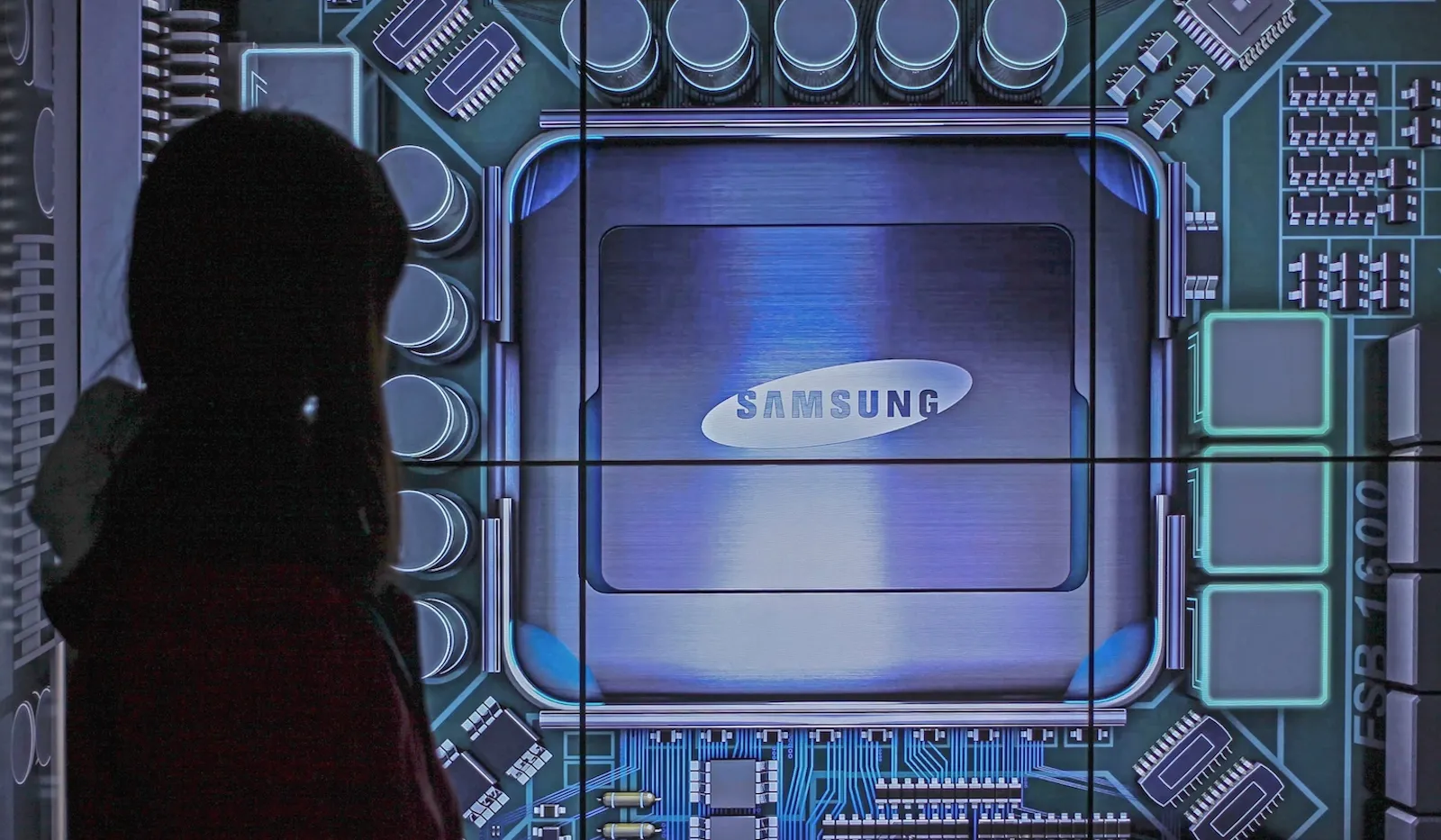
Samsung crosses $1 trillion valuation as AI chip demands surgeSamsung AI Chip

Apple’s recent discussions with Samsung and Intel about making chips in the United States have increased investor interest. This could help Apple rely less on TSMC for its chip production. For Samsung, even the chance of getting a large contract from Apple has boosted investor confidence.

The Korean stock market rose as well. Shares of SK Hynix, Samsung’s main competitor in chips, increased by over 10%. This helped the Kospi index rise above 7,000 for the first time in history.

What is driving Samsung’s growth, and where the competition stands

Samsung’s earnings are improving because of the rising demand for high-bandwidth memory chips, or HBM. These chips are important for running large AI models. They help AI processors quickly access and move large amounts of data. This speed is crucial for training and operating the extensive AI systems used by companies like Nvidia, Google, and Microsoft.

“There is a tremendous shortage in DRAM and NAND memory chips due to torrid AI demand, which is very memory hungry due to AI’s high bandwidth and storage needs,” said Yu Jing Jie, technology equity analyst at Morningstar.

AI startups in commanding lead as 70 startups became unicorns in the first four months of 2026

DRAM chips are fast storage chips that temporarily hold data while a processor is working. NAND chips are slower but keep data even when the device is turned off. Both types of chips are currently in short supply. Building new semiconductor production facilities usually takes two to three years, so the supply shortage is not likely to improve anytime soon.

Also read: Samsung debuts Galaxy S26, S26+ and S26 Ultra with proactive AI and next-gen performance

The company is trying to catch up with SK Hynix, which leads the high-bandwidth memory (HBM) market with about 55% of it, while it holds around 25%. In February, Samsung announced that it was the first company in the world to start mass production of HBM4 chips, the sixth and newest generation of high-bandwidth memory.

They have begun delivering these chips to unnamed customers. HBM4 chips are expected to play a key role in Nvidia’s upcoming Vera Rubin AI architecture, which will support next-generation AI data centres.

Samsung crosses $1 trillion valuation as AI chip demands surgeSamsung AI

Feedback from customers about Samsung’s HBM4 products has been mostly positive, according to analysts. Investors are less worried about the market share difference with SK Hynix because conventional DRAM profits have recently become very strong. This gives The company a solid earnings base, even outside the high-end HBM market.


Market Opportunity
USD.AI Logo
USD.AI Price(CHIP)
$0.05422
$0.05422$0.05422
-5.47%
USD
USD.AI (CHIP) Live Price Chart
Disclaimer: The articles reposted on this site are sourced from public platforms and are provided for informational purposes only. They do not necessarily reflect the views of MEXC. All rights remain with the original authors. If you believe any content infringes on third-party rights, please contact crypto.news@mexc.com for removal. MEXC makes no guarantees regarding the accuracy, completeness, or timeliness of the content and is not responsible for any actions taken based on the information provided. The content does not constitute financial, legal, or other professional advice, nor should it be considered a recommendation or endorsement by MEXC.

You May Also Like

Mutuum Finance (MUTM) Update: V1 Protocol Goes Live, Key Mechanisms Explained

Mutuum Finance (MUTM) Update: V1 Protocol Goes Live, Key Mechanisms Explained

The start of April 2026 marks a significant turning point for the decentralized world. While many older networks are struggling with slow growth and high fees,
Share
Techbullion2026/04/02 19:46
Unlocking Massive Value: Curve Finance Revenue Sharing Proposal for CRV Holders

Unlocking Massive Value: Curve Finance Revenue Sharing Proposal for CRV Holders

BitcoinWorld Unlocking Massive Value: Curve Finance Revenue Sharing Proposal for CRV Holders The dynamic world of decentralized finance (DeFi) is constantly evolving, bringing forth new opportunities and innovations. A significant development is currently unfolding at Curve Finance, a leading decentralized exchange (DEX). Its founder, Michael Egorov, has put forth an exciting proposal designed to offer a more direct path for token holders to earn revenue. This initiative, centered around a new Curve Finance revenue sharing model, aims to bolster the value for those actively participating in the protocol’s governance. What is the “Yield Basis” Proposal and How Does it Work? At the core of this forward-thinking initiative is a new protocol dubbed Yield Basis. Michael Egorov introduced this concept on the CurveDAO governance forum, outlining a mechanism to distribute sustainable profits directly to CRV holders. Specifically, it targets those who stake their CRV tokens to gain veCRV, which are essential for governance participation within the Curve ecosystem. Let’s break down the initial steps of this innovative proposal: crvUSD Issuance: Before the Yield Basis protocol goes live, $60 million in crvUSD will be issued. Strategic Fund Allocation: The funds generated from the sale of these crvUSD tokens will be strategically deployed into three distinct Bitcoin-based liquidity pools: WBTC, cbBTC, and tBTC. Pool Capping: To ensure balanced risk and diversified exposure, each of these pools will be capped at $10 million. This carefully designed structure aims to establish a robust and consistent income stream, forming the bedrock of a sustainable Curve Finance revenue sharing mechanism. Why is This Curve Finance Revenue Sharing Significant for CRV Holders? This proposal marks a pivotal moment for CRV holders, particularly those dedicated to the long-term health and governance of Curve Finance. Historically, generating revenue for token holders in the DeFi space can often be complex. The Yield Basis proposal simplifies this by offering a more direct and transparent pathway to earnings. By staking CRV for veCRV, holders are not merely engaging in governance; they are now directly positioned to benefit from the protocol’s overall success. The significance of this development is multifaceted: Direct Profit Distribution: veCRV holders are set to receive a substantial share of the profits generated by the Yield Basis protocol. Incentivized Governance: This direct financial incentive encourages more users to stake their CRV, which in turn strengthens the protocol’s decentralized governance structure. Enhanced Value Proposition: The promise of sustainable revenue sharing could significantly boost the inherent value of holding and staking CRV tokens. Ultimately, this move underscores Curve Finance’s dedication to rewarding its committed community and ensuring the long-term vitality of its ecosystem through effective Curve Finance revenue sharing. Understanding the Mechanics: Profit Distribution and Ecosystem Support The distribution model for Yield Basis has been thoughtfully crafted to strike a balance between rewarding veCRV holders and supporting the wider Curve ecosystem. Under the terms of the proposal, a substantial portion of the value generated by Yield Basis will flow back to those who contribute to the protocol’s governance. Returns for veCRV Holders: A significant share, specifically between 35% and 65% of the value generated by Yield Basis, will be distributed to veCRV holders. This flexible range allows for dynamic adjustments based on market conditions and the protocol’s performance. Ecosystem Reserve: Crucially, 25% of the Yield Basis tokens will be reserved exclusively for the Curve ecosystem. This allocation can be utilized for various strategic purposes, such as funding ongoing development, issuing grants, or further incentivizing liquidity providers. This ensures the continuous growth and innovation of the platform. The proposal is currently undergoing a democratic vote on the CurveDAO governance forum, giving the community a direct voice in shaping the future of Curve Finance revenue sharing. The voting period is scheduled to conclude on September 24th. What’s Next for Curve Finance and CRV Holders? The proposed Yield Basis protocol represents a pioneering approach to sustainable revenue generation and community incentivization within the DeFi landscape. If approved by the community, this Curve Finance revenue sharing model has the potential to establish a new benchmark for how decentralized exchanges reward their most dedicated participants. It aims to foster a more robust and engaged community by directly linking governance participation with tangible financial benefits. This strategic move by Michael Egorov and the Curve Finance team highlights a strong commitment to innovation and strengthening the decentralized nature of the protocol. For CRV holders, a thorough understanding of this proposal is crucial for making informed decisions regarding their staking strategies and overall engagement with one of DeFi’s foundational platforms. FAQs about Curve Finance Revenue Sharing Q1: What is the main goal of the Yield Basis proposal? A1: The primary goal is to establish a more direct and sustainable way for CRV token holders who stake their tokens (receiving veCRV) to earn revenue from the Curve Finance protocol. Q2: How will funds be generated for the Yield Basis protocol? A2: Initially, $60 million in crvUSD will be issued and sold. The funds from this sale will then be allocated to three Bitcoin-based pools (WBTC, cbBTC, and tBTC), with each pool capped at $10 million, to generate profits. Q3: Who benefits from the Yield Basis revenue sharing? A3: The proposal states that between 35% and 65% of the value generated by Yield Basis will be returned to veCRV holders, who are CRV stakers participating in governance. Q4: What is the purpose of the 25% reserve for the Curve ecosystem? A4: This 25% reserve of Yield Basis tokens is intended to support the broader Curve ecosystem, potentially funding development, grants, or other initiatives that contribute to the platform’s growth and sustainability. Q5: When is the vote on the Yield Basis proposal? A5: A vote on the proposal is currently underway on the CurveDAO governance forum and is scheduled to run until September 24th. If you found this article insightful and valuable, please consider sharing it with your friends, colleagues, and followers on social media! Your support helps us continue to deliver important DeFi insights and analysis to a wider audience. To learn more about the latest DeFi market trends, explore our article on key developments shaping decentralized finance institutional adoption. This post Unlocking Massive Value: Curve Finance Revenue Sharing Proposal for CRV Holders first appeared on BitcoinWorld.


Share
Coinstats2025/09/18 00:35
Oscar Health (OSCR) Stock Soars 11% on Record-Breaking Quarterly Earnings

Oscar Health (OSCR) Stock Soars 11% on Record-Breaking Quarterly Earnings

Oscar Health (OSCR) stock rallied 11% after delivering record $679M profit, $2.07 EPS (vs $1.06 estimate), and 57% membership growth year-over-year. The post Oscar
Share
Blockonomi2026/05/06 19:52

Starter Gold Rush: Win $2,500!

Starter Gold Rush: Win $2,500!Starter Gold Rush: Win $2,500!

Start your first trade & capture every Alpha move