The narrative surrounding Ethereum’s future has fundamentally shifted, and is rapidly solidifying its role as the global, compliant settlement layer for traditional finance (TradFi). This strategic transformation is inextricably linked to the dominance of Stablecoins and the explosive growth of Tokenized Real-World Assets (RWAs). Network Effects Of Stablecoins And RWA On Ethereum In a recent post on X, the Token Terminal highlighted a key insight focusing on why Stablecoins and RWAs matter for the Ethereum market cap. To date, Stablecoins and RWAs are crucial for ETH, as the market capitalization of tokenized assets on ETH acts as the floor for ETH’s market cap. Related Reading: Ethereum’s Next Milestone: November Fork Targets Scalability And Efficiency – Details The reasoning is that as more assets are tokenized on the ETH blockchain, including the massive market of stablecoins and the growing sector of RWAs, the total value locked and secured by the network increases, and the more Ethereum’s market cap benefits. A Host and Producer of The Edge_Pod, known as DeFi_Dad, has reflected on how rewarding it feels to finally see stablecoins cementing credibility for Ethereum and the decentralized finance (DeFi).  For years, explaining crypto in real life carried negative associations, which were often tied to price speculation or hype. Meanwhile, the narrative has shifted, and stablecoins have provided a clear, relatable entry point, with investors focused on investing in digital money applications using Stablecoins.  However, the expert pointed out that the stablecoins are now so mainstream in the media that even government officials and traditional media are taking them seriously. Unlike Bitcoin, which many people only associate with volatile price action, stablecoins provide practical utility and a way to earn 5–10% yields on-chain. According to DeFi_Dad, most of it is built on ETH and stablecoins, which are like Fundstrat and the ChatGPT moment for crypto, a breakthrough product that clicks instantly for the masses. From there, stablecoins would become the stepping stone into DeFi yield and broader digital asset exposure. A Stronger Foundation For Future Development Amid the Ethereum advancements, the new Go-Pulse v3.3.0 has officially been released, a major rebase that is going to make the ETH network even faster and more robust. Richard Heart mentioned that the update from the old Go-Ethereum (GETH) v1.13.13 has gone all the way up to the new v1.16.3, which would deliver substantial performance and efficiency improvements. Related Reading: Ethereum On-Chain Bloodbath: Rugs And Scams Erode Retail Confidence, What To Know Heart credited ETH’s role in the process, noting that the Ethereum mainnet serves as the ultimate testing ground. By proving stability on the ETH, PulseChain is the first to integrate and is the most reliable and optimized software enhancements into its own ecosystem. Featured image from Getty Images, chart from Tradingview.comThe narrative surrounding Ethereum’s future has fundamentally shifted, and is rapidly solidifying its role as the global, compliant settlement layer for traditional finance (TradFi). This strategic transformation is inextricably linked to the dominance of Stablecoins and the explosive growth of Tokenized Real-World Assets (RWAs). Network Effects Of Stablecoins And RWA On Ethereum In a recent post on X, the Token Terminal highlighted a key insight focusing on why Stablecoins and RWAs matter for the Ethereum market cap. To date, Stablecoins and RWAs are crucial for ETH, as the market capitalization of tokenized assets on ETH acts as the floor for ETH’s market cap. Related Reading: Ethereum’s Next Milestone: November Fork Targets Scalability And Efficiency – Details The reasoning is that as more assets are tokenized on the ETH blockchain, including the massive market of stablecoins and the growing sector of RWAs, the total value locked and secured by the network increases, and the more Ethereum’s market cap benefits. A Host and Producer of The Edge_Pod, known as DeFi_Dad, has reflected on how rewarding it feels to finally see stablecoins cementing credibility for Ethereum and the decentralized finance (DeFi).  For years, explaining crypto in real life carried negative associations, which were often tied to price speculation or hype. Meanwhile, the narrative has shifted, and stablecoins have provided a clear, relatable entry point, with investors focused on investing in digital money applications using Stablecoins.  However, the expert pointed out that the stablecoins are now so mainstream in the media that even government officials and traditional media are taking them seriously. Unlike Bitcoin, which many people only associate with volatile price action, stablecoins provide practical utility and a way to earn 5–10% yields on-chain. According to DeFi_Dad, most of it is built on ETH and stablecoins, which are like Fundstrat and the ChatGPT moment for crypto, a breakthrough product that clicks instantly for the masses. From there, stablecoins would become the stepping stone into DeFi yield and broader digital asset exposure. A Stronger Foundation For Future Development Amid the Ethereum advancements, the new Go-Pulse v3.3.0 has officially been released, a major rebase that is going to make the ETH network even faster and more robust. Richard Heart mentioned that the update from the old Go-Ethereum (GETH) v1.13.13 has gone all the way up to the new v1.16.3, which would deliver substantial performance and efficiency improvements. Related Reading: Ethereum On-Chain Bloodbath: Rugs And Scams Erode Retail Confidence, What To Know Heart credited ETH’s role in the process, noting that the Ethereum mainnet serves as the ultimate testing ground. By proving stability on the ETH, PulseChain is the first to integrate and is the most reliable and optimized software enhancements into its own ecosystem. Featured image from Getty Images, chart from Tradingview.com

Ethereum Future Runs On Stablecoins And Tokenized Assets — Here’s What To Know

2025/10/02 06:00

The narrative surrounding Ethereum’s future has fundamentally shifted, and is rapidly solidifying its role as the global, compliant settlement layer for traditional finance (TradFi). This strategic transformation is inextricably linked to the dominance of Stablecoins and the explosive growth of Tokenized Real-World Assets (RWAs).

Network Effects Of Stablecoins And RWA On Ethereum

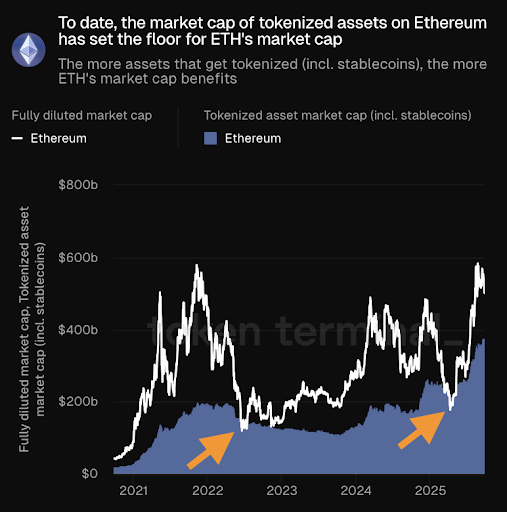
In a recent post on X, the Token Terminal highlighted a key insight focusing on why Stablecoins and RWAs matter for the Ethereum market cap. To date, Stablecoins and RWAs are crucial for ETH, as the market capitalization of tokenized assets on ETH acts as the floor for ETH’s market cap.

The reasoning is that as more assets are tokenized on the ETH blockchain, including the massive market of stablecoins and the growing sector of RWAs, the total value locked and secured by the network increases, and the more Ethereum’s market cap benefits.
Ethereum

A Host and Producer of The Edge_Pod, known as DeFi_Dad, has reflected on how rewarding it feels to finally see stablecoins cementing credibility for Ethereum and the decentralized finance (DeFi). 

For years, explaining crypto in real life carried negative associations, which were often tied to price speculation or hype. Meanwhile, the narrative has shifted, and stablecoins have provided a clear, relatable entry point, with investors focused on investing in digital money applications using Stablecoins. 

However, the expert pointed out that the stablecoins are now so mainstream in the media that even government officials and traditional media are taking them seriously. Unlike Bitcoin, which many people only associate with volatile price action, stablecoins provide practical utility and a way to earn 5–10% yields on-chain.

According to DeFi_Dad, most of it is built on ETH and stablecoins, which are like Fundstrat and the ChatGPT moment for crypto, a breakthrough product that clicks instantly for the masses. From there, stablecoins would become the stepping stone into DeFi yield and broader digital asset exposure.

A Stronger Foundation For Future Development

Amid the Ethereum advancements, the new Go-Pulse v3.3.0 has officially been released, a major rebase that is going to make the ETH network even faster and more robust. Richard Heart mentioned that the update from the old Go-Ethereum (GETH) v1.13.13 has gone all the way up to the new v1.16.3, which would deliver substantial performance and efficiency improvements.

Heart credited ETH’s role in the process, noting that the Ethereum mainnet serves as the ultimate testing ground. By proving stability on the ETH, PulseChain is the first to integrate and is the most reliable and optimized software enhancements into its own ecosystem.

Ethereum
Market Opportunity
FUTURECOIN Logo
FUTURECOIN Price(FUTURE)
$0.08415
$0.08415$0.08415
+0.13%
USD
FUTURECOIN (FUTURE) Live Price Chart
Disclaimer: The articles reposted on this site are sourced from public platforms and are provided for informational purposes only. They do not necessarily reflect the views of MEXC. All rights remain with the original authors. If you believe any content infringes on third-party rights, please contact service@support.mexc.com for removal. MEXC makes no guarantees regarding the accuracy, completeness, or timeliness of the content and is not responsible for any actions taken based on the information provided. The content does not constitute financial, legal, or other professional advice, nor should it be considered a recommendation or endorsement by MEXC.

You May Also Like

House Judiciary Rejects Vote To Subpoena Banks CEOs For Epstein Case

House Judiciary Rejects Vote To Subpoena Banks CEOs For Epstein Case

The post House Judiciary Rejects Vote To Subpoena Banks CEOs For Epstein Case appeared on BitcoinEthereumNews.com. Topline House Judiciary Committee Republicans blocked a Democrat effort Wednesday to subpoena a group of major banks as part of a renewed investigation into late sex offender Jeffrey Epstein’s financial ties. Congressman Jim Jordan, R-OH, is the chairman of the committee. (Photo by Nathan Posner/Anadolu via Getty Images) Anadolu via Getty Images Key Facts A near party-line vote squashed the effort to vote on a subpoena, with Rep. Thomas Massie, R-Ky., who is leading a separate effort to force the Justice Department to release more Epstein case materials, voting alongside Democrats. The vote, if successful, would have resulted in the issuing of subpoenas to JPMorgan Chase CEO Jamie Dimon, Bank of America CEO Brian Moynihan, Deutsche Bank CEO Christian Sewing and Bank of New York Mellon CEO Robin Vince. The subpoenas would have specifically looked into multiple reports that claimed the four banks flagged $1.5 billion in suspicious transactions linked to Epstein. The failed effort from Democrats followed an FBI oversight hearing in which agency director Kash Patel misleadingly claimed the FBI cannot release many of the files it has on Epstein. Get Forbes Breaking News Text Alerts: We’re launching text message alerts so you’ll always know the biggest stories shaping the day’s headlines. Text “Alerts” to (201) 335-0739 or sign up here. Crucial Quote Dimon, who attended a lunch with Senate Republicans before the vote, according to Politico, told reporters, “We regret any association with that man at all. And, of course, if it’s a legal requirement, we would conform to it. We have no issue with that.” Chief Critic “Republicans had the chance to subpoena the CEOs of JPMorgan, Bank of America, Deutsche Bank, and Bank of New York Mellon to expose Epstein’s money trail,” the House Judiciary Democrats said in a tweet. “Instead, they tried to bury…
Share
BitcoinEthereumNews2025/09/18 08:02
Polygon Tops RWA Rankings With $1.1B in Tokenized Assets

Polygon Tops RWA Rankings With $1.1B in Tokenized Assets

The post Polygon Tops RWA Rankings With $1.1B in Tokenized Assets appeared on BitcoinEthereumNews.com. Key Notes A new report from Dune and RWA.xyz highlights Polygon’s role in the growing RWA sector. Polygon PoS currently holds $1.13 billion in RWA Total Value Locked (TVL) across 269 assets. The network holds a 62% market share of tokenized global bonds, driven by European money market funds. The Polygon POL $0.25 24h volatility: 1.4% Market cap: $2.64 B Vol. 24h: $106.17 M network is securing a significant position in the rapidly growing tokenization space, now holding over $1.13 billion in total value locked (TVL) from Real World Assets (RWAs). This development comes as the network continues to evolve, recently deploying its major “Rio” upgrade on the Amoy testnet to enhance future scaling capabilities. This information comes from a new joint report on the state of the RWA market published on Sept. 17 by blockchain analytics firm Dune and data platform RWA.xyz. The focus on RWAs is intensifying across the industry, coinciding with events like the ongoing Real-World Asset Summit in New York. Sandeep Nailwal, CEO of the Polygon Foundation, highlighted the findings via a post on X, noting that the TVL is spread across 269 assets and 2,900 holders on the Polygon PoS chain. The Dune and https://t.co/W6WSFlHoQF report on RWA is out and it shows that RWA is happening on Polygon. Here are a few highlights: – Leading in Global Bonds: Polygon holds 62% share of tokenized global bonds (driven by Spiko’s euro MMF and Cashlink euro issues) – Spiko U.S.… — Sandeep | CEO, Polygon Foundation (※,※) (@sandeepnailwal) September 17, 2025 Key Trends From the 2025 RWA Report The joint publication, titled “RWA REPORT 2025,” offers a comprehensive look into the tokenized asset landscape, which it states has grown 224% since the start of 2024. The report identifies several key trends driving this expansion. According to…
Share
BitcoinEthereumNews2025/09/18 00:40
transcosmos helping Chinese lingerie brand LING LINGERIE’s full-fledged entry into Japan

transcosmos helping Chinese lingerie brand LING LINGERIE’s full-fledged entry into Japan

Executing strategies to help LING LINGERIE, a Chinese brand meeting Gen Z needs, boost awareness TOKYO, Jan. 23, 2026 /PRNewswire/ — transcosmos today announced
Share
AI Journal2026/01/23 19:30