On-chain data shows the short-term holder Bitcoin whales have recently increased their Realized Cap share to the highest level ever. Bitcoin Is Currently Being Dominated By New Capital In a new post on X, CryptoQuant community analyst Maartunn has talked about the latest trend in the share of the Bitcoin whale Realized Cap held by the short-term holders. The Realized Cap here is an on-chain indicator that measures, in short, the total amount of capital that the BTC investors as a whole have put into the cryptocurrency. Changes in this metric reflect the incoming or outgoing of capital. Related Reading: Bitcoin Retests STH Cost Basis Again: Is This Where Support Flips? In the context of the current topic, the Realized Cap of only a portion of holders is of interest: the whales. These are the entities carrying more than 1,000 BTC (about $111.4 million) in their balance. Whales can be further broken down into cohorts on the basis of holding time. Whale-sized holders who bought their coins within the past 155 days are known as the short-term holder (STH) or new whales. Similarly, those who have a holding time higher than this cutoff are called the long-term holder (LTH) or old whales. Now, here is the chart shared by Maartunn that shows how the Bitcoin Realized Cap dominance of these two groups has changed over the past decade: As displayed in the above graph, new whales have rapidly gained ground in the Bitcoin Realized Cap recently and hit a dominance of 44%. The STH whales represent the big-money capital that has come into the coin over the last 155 days. Thus, it would appear that 44% of the capital stored on the BTC network is currently “fresh.” This is the largest share of the whale Realized Cap that the STHs alone have occupied in the cryptocurrency’s history. To put things into perspective, the 2021 bull run topped out at a value of 31%. The STH whales gain Realized Cap dominance through two means: a transfer of coins between members of the cohort at a higher price and selling from the LTH whales. LTH whales are the resolute hands of the market who hold out through volatile periods in wait for profitable exit opportunities. These smart-money investors usually ramp up their selling during bull runs and transfer their coins to new money coming into Bitcoin. As long as demand is high enough to absorb this distribution, the rally continues, but once capital inflows drop off, the asset hits a top. Related Reading: Bitcoin Crash Unlike LUNA & FTX Collapses, Says Glassnode: Here’s Why So far, the growth in the STH whale Realized Cap share has maintained, but it only remains to be seen how much room is still left. BTC Price Bitcoin has been struggling to recover since Friday’s crash as its price is still trading around $111,400. Featured image from Dall-E, CryptoQuant.com, chart from TradingView.comOn-chain data shows the short-term holder Bitcoin whales have recently increased their Realized Cap share to the highest level ever. Bitcoin Is Currently Being Dominated By New Capital In a new post on X, CryptoQuant community analyst Maartunn has talked about the latest trend in the share of the Bitcoin whale Realized Cap held by the short-term holders. The Realized Cap here is an on-chain indicator that measures, in short, the total amount of capital that the BTC investors as a whole have put into the cryptocurrency. Changes in this metric reflect the incoming or outgoing of capital. Related Reading: Bitcoin Retests STH Cost Basis Again: Is This Where Support Flips? In the context of the current topic, the Realized Cap of only a portion of holders is of interest: the whales. These are the entities carrying more than 1,000 BTC (about $111.4 million) in their balance. Whales can be further broken down into cohorts on the basis of holding time. Whale-sized holders who bought their coins within the past 155 days are known as the short-term holder (STH) or new whales. Similarly, those who have a holding time higher than this cutoff are called the long-term holder (LTH) or old whales. Now, here is the chart shared by Maartunn that shows how the Bitcoin Realized Cap dominance of these two groups has changed over the past decade: As displayed in the above graph, new whales have rapidly gained ground in the Bitcoin Realized Cap recently and hit a dominance of 44%. The STH whales represent the big-money capital that has come into the coin over the last 155 days. Thus, it would appear that 44% of the capital stored on the BTC network is currently “fresh.” This is the largest share of the whale Realized Cap that the STHs alone have occupied in the cryptocurrency’s history. To put things into perspective, the 2021 bull run topped out at a value of 31%. The STH whales gain Realized Cap dominance through two means: a transfer of coins between members of the cohort at a higher price and selling from the LTH whales. LTH whales are the resolute hands of the market who hold out through volatile periods in wait for profitable exit opportunities. These smart-money investors usually ramp up their selling during bull runs and transfer their coins to new money coming into Bitcoin. As long as demand is high enough to absorb this distribution, the rally continues, but once capital inflows drop off, the asset hits a top. Related Reading: Bitcoin Crash Unlike LUNA & FTX Collapses, Says Glassnode: Here’s Why So far, the growth in the STH whale Realized Cap share has maintained, but it only remains to be seen how much room is still left. BTC Price Bitcoin has been struggling to recover since Friday’s crash as its price is still trading around $111,400. Featured image from Dall-E, CryptoQuant.com, chart from TradingView.com

Newbie Bitcoin Whales Now Control 44% Of Realized Cap, Highest Ever

2025/10/16 16:00
3 min read
For feedback or concerns regarding this content, please contact us at crypto.news@mexc.com

On-chain data shows the short-term holder Bitcoin whales have recently increased their Realized Cap share to the highest level ever.

Bitcoin Is Currently Being Dominated By New Capital

In a new post on X, CryptoQuant community analyst Maartunn has talked about the latest trend in the share of the Bitcoin whale Realized Cap held by the short-term holders.

The Realized Cap here is an on-chain indicator that measures, in short, the total amount of capital that the BTC investors as a whole have put into the cryptocurrency. Changes in this metric reflect the incoming or outgoing of capital.

In the context of the current topic, the Realized Cap of only a portion of holders is of interest: the whales. These are the entities carrying more than 1,000 BTC (about $111.4 million) in their balance.

Whales can be further broken down into cohorts on the basis of holding time. Whale-sized holders who bought their coins within the past 155 days are known as the short-term holder (STH) or new whales. Similarly, those who have a holding time higher than this cutoff are called the long-term holder (LTH) or old whales.

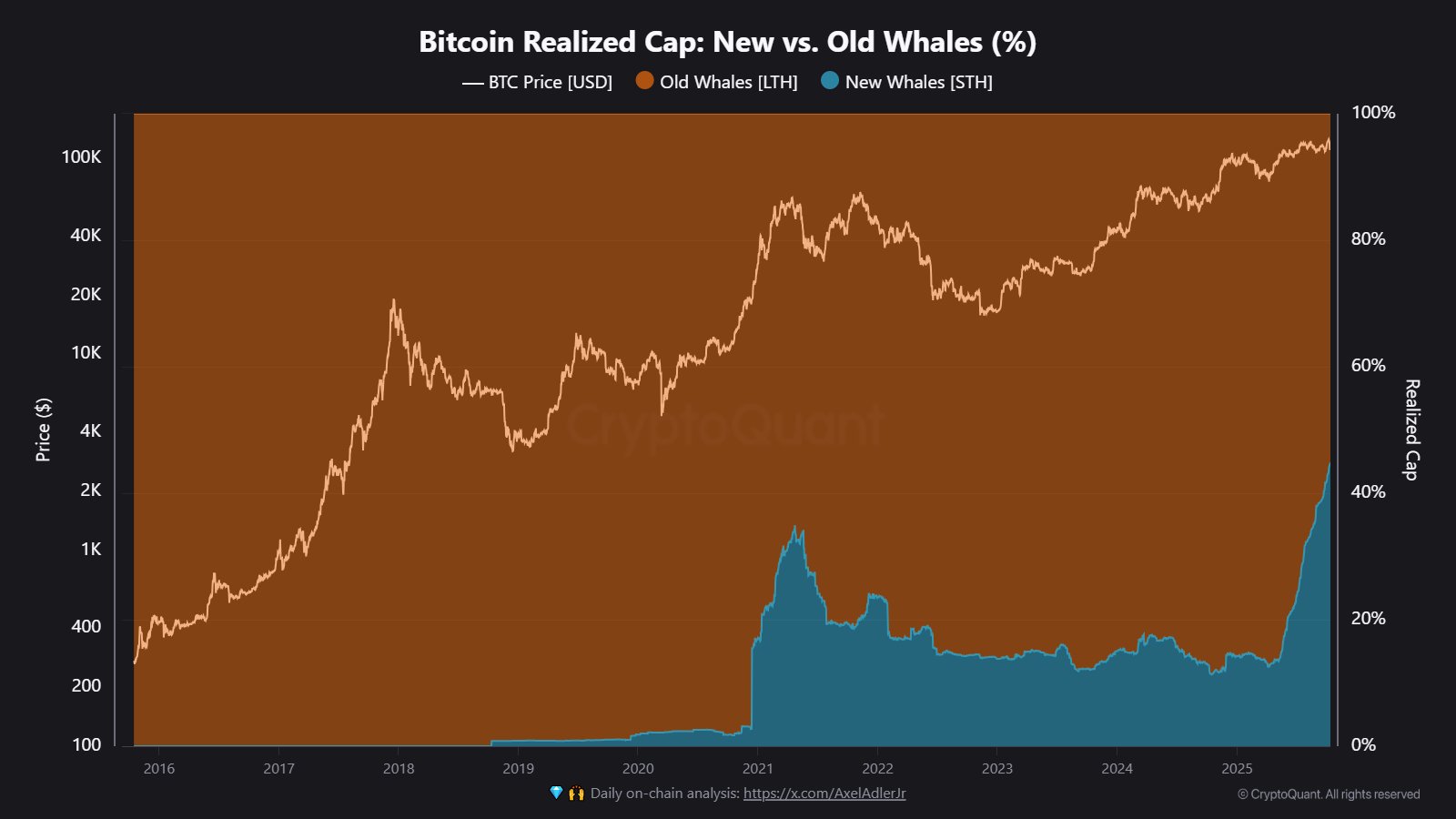
Now, here is the chart shared by Maartunn that shows how the Bitcoin Realized Cap dominance of these two groups has changed over the past decade:
Bitcoin Whale Realized Cap

As displayed in the above graph, new whales have rapidly gained ground in the Bitcoin Realized Cap recently and hit a dominance of 44%. The STH whales represent the big-money capital that has come into the coin over the last 155 days. Thus, it would appear that 44% of the capital stored on the BTC network is currently “fresh.”

This is the largest share of the whale Realized Cap that the STHs alone have occupied in the cryptocurrency’s history. To put things into perspective, the 2021 bull run topped out at a value of 31%.

The STH whales gain Realized Cap dominance through two means: a transfer of coins between members of the cohort at a higher price and selling from the LTH whales.

LTH whales are the resolute hands of the market who hold out through volatile periods in wait for profitable exit opportunities. These smart-money investors usually ramp up their selling during bull runs and transfer their coins to new money coming into Bitcoin. As long as demand is high enough to absorb this distribution, the rally continues, but once capital inflows drop off, the asset hits a top.

So far, the growth in the STH whale Realized Cap share has maintained, but it only remains to be seen how much room is still left.

BTC Price

Bitcoin has been struggling to recover since Friday’s crash as its price is still trading around $111,400.

Bitcoin Price Chart
Market Opportunity
Capverse Logo
Capverse Price(CAP)
$0.09907
$0.09907$0.09907
-0.22%
USD
Capverse (CAP) Live Price Chart
Disclaimer: The articles reposted on this site are sourced from public platforms and are provided for informational purposes only. They do not necessarily reflect the views of MEXC. All rights remain with the original authors. If you believe any content infringes on third-party rights, please contact crypto.news@mexc.com for removal. MEXC makes no guarantees regarding the accuracy, completeness, or timeliness of the content and is not responsible for any actions taken based on the information provided. The content does not constitute financial, legal, or other professional advice, nor should it be considered a recommendation or endorsement by MEXC.

You May Also Like

CEO Sandeep Nailwal Shared Highlights About RWA on Polygon

CEO Sandeep Nailwal Shared Highlights About RWA on Polygon

The post CEO Sandeep Nailwal Shared Highlights About RWA on Polygon appeared on BitcoinEthereumNews.com. Polygon CEO Sandeep Nailwal highlighted Polygon’s lead in global bonds, Spiko US T-Bill, and Spiko Euro T-Bill. Polygon published an X post to share that its roadmap to GigaGas was still scaling. Sentiments around POL price were last seen to be bearish. Polygon CEO Sandeep Nailwal shared key pointers from the Dune and RWA.xyz report. These pertain to highlights about RWA on Polygon. Simultaneously, Polygon underlined its roadmap towards GigaGas. Sentiments around POL price were last seen fumbling under bearish emotions. Polygon CEO Sandeep Nailwal on Polygon RWA CEO Sandeep Nailwal highlighted three key points from the Dune and RWA.xyz report. The Chief Executive of Polygon maintained that Polygon PoS was hosting RWA TVL worth $1.13 billion across 269 assets plus 2,900 holders. Nailwal confirmed from the report that RWA was happening on Polygon. The Dune and https://t.co/W6WSFlHoQF report on RWA is out and it shows that RWA is happening on Polygon. Here are a few highlights: – Leading in Global Bonds: Polygon holds 62% share of tokenized global bonds (driven by Spiko’s euro MMF and Cashlink euro issues) – Spiko U.S.… — Sandeep | CEO, Polygon Foundation (※,※) (@sandeepnailwal) September 17, 2025 The X post published by Polygon CEO Sandeep Nailwal underlined that the ecosystem was leading in global bonds by holding a 62% share of tokenized global bonds. He further highlighted that Polygon was leading with Spiko US T-Bill at approximately 29% share of TVL along with Ethereum, adding that the ecosystem had more than 50% share in the number of holders. Finally, Sandeep highlighted from the report that there was a strong adoption for Spiko Euro T-Bill with 38% share of TVL. He added that 68% of returns were on Polygon across all the chains. Polygon Roadmap to GigaGas In a different update from Polygon, the community…
Share
BitcoinEthereumNews2025/09/18 01:10
👨🏿‍🚀TechCabal Daily – Folded by a paper cut

👨🏿‍🚀TechCabal Daily – Folded by a paper cut

In today's edition: Mpact’s paper mill is shutting down || An e-commerce play for SA’s Post Office || Kenya’s traffic cop
Share
Techcabal2026/03/10 14:05
MTN Plans Starlink Launch in Zambia

MTN Plans Starlink Launch in Zambia

MTN’s Starlink launch plan in Zambia signals a new phase for satellite internet expansion, aiming to accelerate rural connectivity and support the country’s digital
Share
Furtherafrica2026/03/10 14:00