Bitcoin has broken below the $105,000 level, deepening market fears as selling pressure accelerates across the crypto landscape. The sharp move lower comes at a time when confidence is wavering, volatility is rising, and traders are bracing for possible further downside. Yet beneath the surface, a key on-chain indicator suggests that a critical liquidity shift […]Bitcoin has broken below the $105,000 level, deepening market fears as selling pressure accelerates across the crypto landscape. The sharp move lower comes at a time when confidence is wavering, volatility is rising, and traders are bracing for possible further downside. Yet beneath the surface, a key on-chain indicator suggests that a critical liquidity shift […]

Bitcoin Loses $105K Level As SSR Signals Fresh Capital Ready To Deploy – Details

2025/11/05 10:00
4 min read
For feedback or concerns regarding this content, please contact us at crypto.news@mexc.com

Bitcoin has broken below the $105,000 level, deepening market fears as selling pressure accelerates across the crypto landscape. The sharp move lower comes at a time when confidence is wavering, volatility is rising, and traders are bracing for possible further downside. Yet beneath the surface, a key on-chain indicator suggests that a critical liquidity shift may be approaching — one that has historically preceded major rebounds.

According to data from CryptoQuant, the Stablecoin Supply Ratio (SSR) has now fallen back into the same low zone seen just before Bitcoin’s earlier recovery this year, hovering around the 13–14 range. This indicator measures the ratio between Bitcoin’s market capitalization and the total market cap of stablecoins, offering insight into the amount of “dry powder” available on the sidelines.

When SSR declines, it typically signals that stablecoin liquidity — potential buying power — is increasing relative to Bitcoin’s valuation. Historically, this zone has often acted as a turning point, where capital quietly builds before re-entering risk assets.

SSR Signals Hidden Liquidity — But With a Cycle-End Twist

According to CryptoQuant analyst Woominkyu, the behavior of the Stablecoin Supply Ratio (SSR) offers critical insight into Bitcoin’s current position in the market cycle. When SSR drops, stablecoin liquidity — effectively the dormant “buying power” sitting on the sidelines — rises. This dynamic often precedes market recovery phases, as capital quietly prepares to rotate into Bitcoin.

Conversely, when SSR climbs, it typically reflects liquidity being deployed already, aligning with overheated markets and distribution periods.

Bitcoin Stablecoin Supply Ratio | Source: CryptoQuant

Right now, SSR is retesting its yearly lows while Bitcoin trades near $104,000 and attempts to consolidate. This alignment has historically marked powerful turning points, suggesting that fresh capital could be preparing to re-enter. In previous cycles, similar setups preceded relief rallies and, in some cases, explosive upside continuation. That makes the current environment particularly intriguing, even as bearish sentiment dominates and fear spreads across the market.

However, Woominkyu highlights a key nuance that traders cannot ignore: each SSR rebound zone in recent cycles has shown diminishing strength. In other words, while liquidity is accumulating, the magnitude of these signals appears to be weakening. This could mean that crypto’s liquidity engine — once driven heavily by rapid stablecoin expansion and speculative inflows — is slowing.

If this interpretation holds, Bitcoin may still see a recovery rally from current levels, potentially even one final push toward euphoric highs. But it also suggests the possibility that the market is gradually transitioning into a new phase — one defined less by aggressive liquidity cycles and more by maturing capital flows, institutional participation, and slower reflexive momentum.

Bitcoin Slides Toward Key Support as Momentum Weakens

Bitcoin’s price action continues to deteriorate as market volatility rises, with BTC now trading around $104,000 after breaking below the $105,000 level. On the 8-hour chart, the structure remains fragile, and the series of lower highs and lower lows highlights persistent bearish momentum. Attempts to reclaim the $110,000 region earlier in the week were rejected near the cluster of moving averages, reinforcing that sellers currently control the market.
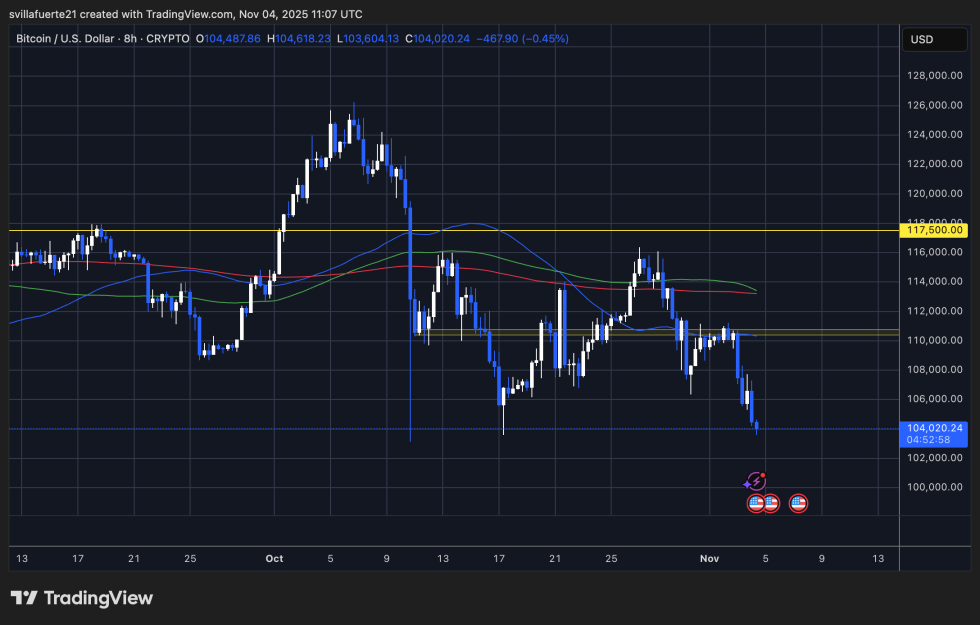
BTC testing local demand | Source: BTCUSDT chart on TradingView

The highlighted consolidation zones around $109,000–$111,000 and $106,000–$108,000 have flipped into resistance, providing a visual map of where supply continues to overwhelm demand. Now, price is approaching a critical demand zone near $102,000–$103,000. This area has historically attracted dip buyers, but if it fails, Bitcoin may be exposed to a deeper retrace toward psychological support closer to $100,000.

Volume has noticeably increased on recent red candles, suggesting panic-driven selling and forced liquidations rather than calm distribution. Meanwhile, moving averages are starting to roll over, and the 50-EMA has turned sharply lower, signaling momentum loss.

Bulls need to defend this current support region to avoid further downside acceleration. Until Bitcoin reclaims at least the $108,000–$110,000 zone, the market bias leans bearish, and traders should expect volatility and caution as price compresses near these key levels.

Featured image from ChatGPT, chart from TradingView.com

Disclaimer: The articles reposted on this site are sourced from public platforms and are provided for informational purposes only. They do not necessarily reflect the views of MEXC. All rights remain with the original authors. If you believe any content infringes on third-party rights, please contact crypto.news@mexc.com for removal. MEXC makes no guarantees regarding the accuracy, completeness, or timeliness of the content and is not responsible for any actions taken based on the information provided. The content does not constitute financial, legal, or other professional advice, nor should it be considered a recommendation or endorsement by MEXC.

You May Also Like

DBS Tests Repo With Ripple RLUSD and Franklin sgBENJI

DBS Tests Repo With Ripple RLUSD and Franklin sgBENJI

The post DBS Tests Repo With Ripple RLUSD and Franklin sgBENJI appeared on BitcoinEthereumNews.com. Ripple, DBS, and Franklin Templeton launch tokenized repo pilot on DBS Exchange. Repo trades use Ripple’s RLUSD stablecoin and Franklin Templeton’s sgBENJI token. sgBENJI issued on XRP Ledger enables fast collateralized lending and settlements. DBS, Ripple, and Franklin Templeton have signed a memorandum of understanding to bring repo transactions into tokenized finance. The framework pairs Ripple’s RLUSD stablecoin with Franklin Templeton’s sgBENJI tokenized money market fund, listed on DBS Digital Exchange. The setup gives accredited clients a path to rebalance cash into a regulated, yield-bearing vehicle while transacting with stablecoins that settle within minutes. For institutions used to overnight repo desks, this is a first look at how traditional liquidity tools can migrate onto public blockchains. Related: Franklin Templeton Launches its DeFi Solution Benji on Ethereum Demand From Institutions Shapes the Design The three firms cited rising demand for digital asset allocations, with surveys showing nearly nine in ten institutional investors plan to increase exposure in 2025. The repo model was chosen because it mirrors an existing backbone of global funding markets: collateralized lending against short-term securities. By allowing RLUSD to trade directly against sgBENJI on DBS Digital Exchange, desks can manage intraday liquidity, park stablecoin reserves into a fund earning regulated yield, and unwind positions quickly when cash is needed. DBS to Expand Collateralized Lending The next phase extends sgBENJI beyond a trading instrument into repo collateral. DBS plans to let investors pledge sgBENJI against credit lines arranged through the bank or third-party lenders. That opens deeper liquidity pools with the assurance that collateral sits inside a regulated balance sheet. For trading desks, that means onchain repo could eventually function like its traditional counterpart, rolling positions overnight, secured by tokenized assets that settle in near real-time. XRP Ledger as the Settlement Rail Franklin Templeton will issue sgBENJI tokens on…
Share
BitcoinEthereumNews2025/09/18 20:25
The Four Service Models That Actually Generate Revenue

The Four Service Models That Actually Generate Revenue

A practical guide to four repeatable AI service models—Speed-to-Lead, Workflow Automation, Specialized AI Training, and Productized Automation—with pricing, workflows
Share
Crypto Breaking News2026/03/16 20:08
2 Cryptocurrencies Under $0.50 That Could Reach $2.50 This Cycle

2 Cryptocurrencies Under $0.50 That Could Reach $2.50 This Cycle

In a market where most sub-$1 coins are speculation-driven, there are certain projects which are beginning to break through by offering real-world utility and long-term value for growth. Dogecoin (DOGE) and Mutuum Finance (MUTM) currently trading in the sub-$0.50 zone, have recently gained attention for their potential to hit as high as $2.50 in the […]
Share
Cryptopolitan2025/09/18 17:30




