

👨🏿🚀TechCabal Daily – A bigger slice of the Safari
TGIF. 
Thank you for sticking with us through another week of bad puns. Here’s to a weekend of rest and gearing up for another week of even worse ones. 

Speaking of things I’m unreasonably excited about, I’m counting down the days to James Cameron’s Fire and Ash, dropping in two weeks. Can’t wait to see what the box office king has cooked up this time.
I’ll leave you with a quote from Cameron’s MasterClass course: “Every great filmmaker [builder] started as a fan… I cannot emphasise the importance of curiosity.” Stay curious.
As you were.
—Emmanuel
- Quick Fire
 with Lotachi Anidi
 - Vodafone Kenya acquires 15% Safaricom stake
- Stitch, Capitec partner to enable recurring payments
- Who secured the bag?

- World Wide Web 3
- Job Openings
Features
Quick Fire with Lotachi Anidi
 Lotachi Anidi, design lead at Onboard
Lotachi Anidi is a Nigerian design entrepreneur who has spent more than six years building fintech products. From an early designer at Binance to a founding designer at Nestcoin, a Coinbase-backed company.
Her products serve millions across frontier markets, solving financial access problems that traditional banking systems consistently overlook. At Nestcoin, she leads design for Onboard, a global banking app that evolved from a crypto wallet into a comprehensive financial infrastructure.
- Explain what you do to a 5-year-old.
I make it really easy for grown-ups to give money to anybody, even if they live far away.
When grown-ups send money to family in other countries using old ways, it’s like mailing a dollar bill by the time it gets there, someone took 50 cents. I make an app where you send that dollar, and your family gets almost all of it, instantly.
- Beyond AI, in what ways has design evolved, and what did you do to get ahead?
Design has moved from making things work and look pretty to becoming a core strategic tool. The best designers today aren’t order-takers. They understand business, they have a POV, and they’re willing to push back. I’ve made it my mission to champion that shift, both at Onboard and in public.
I started a talk show, Behind the Ship, to show that design thinking and storytelling matter. I push designers and myself to make their work visible, to read beyond design, to understand the business problem we’re actually solving. And I’m vocal about it. If I’m not convinced about adirection, I say so. I don’t accept the status quo just because it’s comfortable.
- What’s your career’s biggest ‘GOAT moment’? Tell us in a short story.
My GOAT moment was getting rejected at the final stages by Spotify and Revolut. I didn’t think I’d even get their attention, but I went through the entire interview process with both of them. Getting that far was already a win. It proved I could compete at that level.
But here’s the thing: when I didn’t get the offer, I realised I was actually relieved. Because what I really wanted wasn’t to join a massive company and execute someone else’s vision. What I wanted was what I’m doing now at Onboard, exercising my muscles as a design leader, building from zero to one. Building something from nothing. Shaping culture and product from the ground up.
- What’s your hot take on how design will continue to matter to Africa’s tech ecosystem (or not)? And how should newbies position themselves?
Design from Africa has been largely invisible, but that’s changing. And the newbies positioning themselves right now will own their market. Here’s what I’d tell them: don’t wait to be hired by a big company. Build something. Solve a problem you actually care about. And tell your story. Document your process, your failures, your thinking. Do it in public.
Powering businesses across Africa to pay and get paid in local currencies.
With Fincra, businesses, startups, global enterprises and platforms can easily send and receive payments in multiple African currencies, empowering trade, and growth across the continent. Create your account in 3 minutes.
telecoms
Vodafone Kenya buys 15% additional Safaricom stake, securing major shareholding
 Image Source: Vodafone
Kenya’s government decided to sell part of its Safaricom stake because it needed more money in its coffers. Two weeks ago, Vodacom Group, South Africa’s biggest telecom operator, said it was “open” to buying part of the Kenyan government’s shareholding in Safaricom.
Now, on December 3, Vodafone Kenya bought a 15% stake from the Kenyan government for KES 204.3 billion ($1.57 billion), lifting its combined direct and indirect holding to 55%. And just like that, majority control has been achieved, as the 50% regulatory threshold for effective control was crossed. Someone should have seen that coming. Oh wait… WE did. The Kenyan government chose to negotiate privately and sell to Vodafone rather than open up to a public sale, due to a “fiscal urgency.” So, they went to a buyer who could pay.
Here’s how it’s playing out: Vodacom Group, which owns 87.5% of Vodafone Kenya, will restructure internally to acquire the remaining shares of Vodafone Kenya by buying out the remaining shareholders, adding an indirect 4.99% in Safaricom. Alongside the stake purchase, Vodafone Kenya is paying the government KES 40.2 billion ($309 million) to collect future dividends that would have gone to the state. The government will retain a 20% stake after the sale, and public investors will continue to hold 25%.
Why it matters: Safaricom is Kenya’s most valuable listed company and its biggest corporate taxpayer. It also dominates mobile money through M-PESA with a 91% market share. This deal is a win-win as the Kenyan government gets the money from the shares (and then some), and Vodacom gets the additional stake it was open to buying.
Yet, regulatory approvals from the Capital Markets Authority (CMA), the Competition Authority (CAK), the Central Bank of Kenya (CBK), and regional competition bodies are still required for this to move forward. Importantly, Vodafone Kenya does not intend to trigger a full takeover offer for the remaining Safaricom shares.
Enjoy smooth payments while you’re home this Detty December

Coming home for Detty December? Enjoy smooth payments every day with your Paga US account. Send money to any bank instantly. Don’t miss out, get started now.
companies
Stitch, Capitec Bank partner to introduce variable recurring payments
 Image source: Tenor
Stitch, one of South Africa’s largest fintech startups, has announced a partnership with Capitec Bank, the country’s largest retail bank by customer base, to roll out Variable Recurring Payments (VRP), a next-generation way to automate subscriptions and bills, like Netflix, deliveries, or utilities, straight from your bank account.
How it will work: Once a customer sets up Capitec Pay VRP, they can authorise a merchant and define a maximum spending limit. After that, payments happen automatically in the background, giving customers more control and peace of mind.
What’s so special about that? Other banks, like First National Bank (FNB), Absa, and Standard Bank, already rely on DebiCheck for recurring payments. Yet while DebiCheck works, Capitec’s VRP uses a smarter, API-driven system, and Capitec is the first to deploy this new technology. It also fits neatly into South Africa’s evolving open banking framework, meaning customers and fintechs can connect accounts securely without relying on third-party apps.
Why does this matter? VRP is a step toward smarter and more efficient payments. This means that customers no longer have to approve every subscription or delivery manually, and they get full visibility and control over how much they spend and with whom. As more banks explore API-driven solutions, VRP could become the new standard for recurring payments, a groundwork proudly laid by Stitch and Capitec Bank.
Stay up to date with Paystack news!

Subscribe to Paystack for a curated dose of product updates, insights, event invites and more. Subscribe here →.
insights
Funding Tarcker
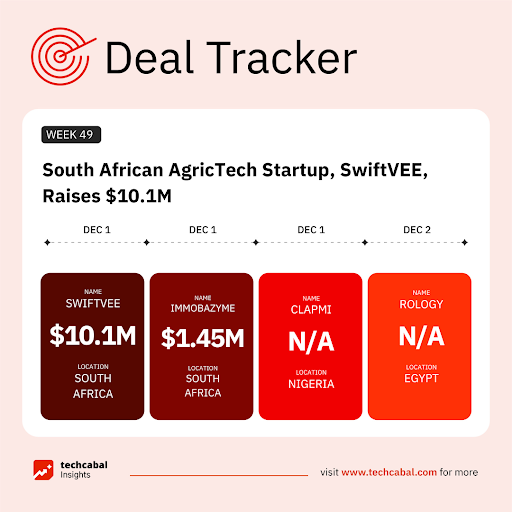 Image Source: TechCabal Inisights
SwiftVEE, a South African Agrictech startup, raised $10.1 million in a series A funding round. African venture capital firm HAVAÍC led the round with participation from Exeo Capital, Mike Kirsten and Carlo Dickson, and Zire Africa. (Dec 1)
Here are the other deals for the week:
- Immobazyme, a South African biotech startup, raised $1.45 million in growth capital in a round led by the University Technology Fund (UTF II), with participation from existing backer University of Stellenbosch Enterprises (USE) and Fireball Capital. (Dec 1)
- Gigmile, a Nigerian fintech startup, closed an undisclosed seed round led by ENZA Capital with participation from Seedstars International Ventures and Norrsken Africa Fund. (Dec 1)
- Rology, an Egyptian healthtech startup, raised an undisclosed growth funding. The round had participation from healthcare industry leaders, the Philips Foundation, Johnson & Johnson Impact Ventures, Sanofi Global Health Unit’s Impact Fund, and MIT Solve Innovation Future. (Dec 2)
Follow us on Twitter, Instagram, and LinkedIn for more funding announcements. Before you go,what is the future of digital health in Nigeria? Find out here.
AI in a Nutshell gives you weekly AI knowledge and insights

Want to stay close to AI but hate long reads? AI in a Nutshell gives you weekly AI knowledge, news, tools, and insights – short, smart, and fun. Perfect for curious (but lazy) readers who still want to stay ahead. Subscribe here.
CRYPTO TRACKER
The World Wide Web3
Source:

|
Coin Name |
Current Value |
Day |
Month |
|---|---|---|---|
| Bitcoin | $91,996 |
– 1.15% |
– 9.72% |
| Ether | $3,157 |
– 0.85% |
– 5.41% |
| XRP | $2.08 |
– 4.60% |
– 7.58% |
| BNB | $899 |
– 1.03% |
– 5.06% |
* Data as of 06.41 AM WAT, December 5, 2025.
JOB OPENINGS
- Piggyvest —Product Marketing & Communications Lead — Lagos, Nigeria
- Busha — Business Development Manager, Reconciliation and Settlement Analyst (Fiat & Crypto) — Hybrid (Lagos, Nigeria)
- Trust Wallet — Android Engineer, Frontend Engineer, Growth and Performance Marketing Analyst, Talent Acquisition Specialist — Remote
- Paystack —Senior Full Stack Engineer — Cape Town, South Africa
- Paystack — Business Development Partner — Lagos, Nigeria
- Flutterwave — Treasurer, Africa — Lagos, Nigeria
- Big Cabal Media —Senior Financial Analyst, Junior Sales Analyst — Hybrid (Lagos, Nigeria)
There are more jobs on TechCabal’s job board. If you have job opportunities to share, please submit them at bit.ly/tcxjobs.
- Delve into AI: 64% of African workers used AI last year, outpacing global average
- Simple tricks to make your MTN, Airtel, Glo and 9mobile data last longer
- Arrested by Phone: A Graphic Novel
Written by: Opeyemi Kareem and Emmanuel Nwosu
Edited by: Emmanuel Nwosu & Ganiu Oloruntade
Want more of TechCabal?
Sign up for our insightful newsletters on the business and economy of tech in Africa.
- The Next Wave: futuristic analysis of the business of tech in Africa.
- TC Scoops: breaking news from TechCabal
- Francophone Weekly by TechCabal: insider insights and analysis of Francophone’s tech ecosystem
P:S If you’re often missing TC Daily in your inbox, check your Promotions folder and move any edition of TC Daily from “Promotions” to your “Main” or “Primary” folder and TC Daily will always come to you.

You May Also Like

Trump Pauses Iran Strikes for 5 Days – Bitcoin Jumps Above $71,400

Trump Trigger Sparks Crypto Market Rally: Bitcoin Hits $71K, XRP & ETH Spikes

